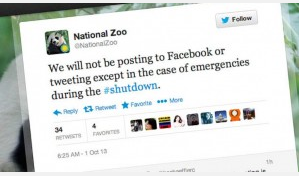
The government shutdown has affected everyone and everything from families to companies but one outcome that no one saw coming, a Twitter blackout. The U.S. Capital, FAA Safety Alerts, NASA Voyager, LBJ Library, even the National Zoo all took part in this no social media communications. With the government being shut down this is not only putting a halt to working in the office, but to those who handle these governmental social media sites as well. This means no posts, no explanations, and no responding to comments and questions. These agencies have closed off their doors of communication to the public, via social media, completely.
Social media has not been around for that long. While the U.S has experienced a government shut down in the past, it has been 18 years since something of this magnitude has struck our nation. Social media was unheard of 18 years ago, thus causing this to not even be an issue. Today, social media has become one of the leading sources of information and a powerhouse in keeping the public connected. The government shutting down this outlet of communication has resulted in a form of crisis communication. The purpose of agencies having social media outlets are to protect and defend individuals, companies and organizations when in the midst of a public challenge. In retaliation to these “Twitter blackouts,” American citizens have turned to social media to voice their disgust. According to an article in Forbes, opinions have turned into hash tag campaigns including one of the more popular, #DearCongress. Citizens are communicating their disappointment and shock with some serious feedback. Most of these opinions focus around lawmakers and officials continuing to draw salaries during this shutdown while employees of these agencies go unpaid.
Many people also agree that the government is participating in a disservice by shutting down their social media as well, seeing this decision as a sign of weakness. Being human, we all want answers. Everyone wants to know what it going on and why. If American’s can’t get their information from trusted government sources, they will surely go elsewhere to find answers. Following the crisis management theory would provide government officials and those responsible for running social media sites like Twitter, with a proactive plan to follow in order to maintain a positive reputation. However, rather than taking advantage of this opportunity to stimulate debate and discussion around these critical issues, the government is taking the easy way out by hanging a figurative “do not disturb” sign on their Twitter accounts.
-Parker Farfour, Kaitlin Batson, Caitlin Ford, Alex Corrigan
With a week full of fails, I imagine that readers will display a facepalm or two. Ad fails are fairly common and many are laughed off and explained through the phrase, “Everyone makes mistakes.” While ad fails often hit us in our funny bones, some offend readers far more than expected. This past year, AT&T and Esquire Magazine produced some facepalm-worthy ads that hit our country in one of its most sensitive spots: 9/11.
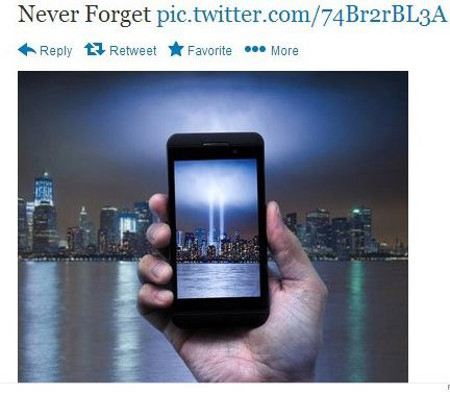
What was supposed to be an anniversary tribute to those who died in the Twin Towers turned into an outrageous ad for AT&T. The company tweeted the below photo as a 13th anniversary mark of respect to 9/11. The tweet immediately went viral, leading to hundreds of angry comments within minutes that claimed the ad was “tacky” and “tasteless”. The image was pulled from Twitter within an hour, followed by a tweet from the carrier saying, “We apologize to anyone who felt our post was in poor taste. The image was solely meant to pay respect to those affected by the 9/11 tragedy.”
It seems that in this situation, AT&T just can’t do anything right. Users of Twitter still were not happy with the apology, admitting that it’s insincerity somehow made the situation worse. Some consumers were so outraged that they threatened to change phone carriers, all because of this ad. In today’s market, finding new customers costs six to seven times more money than it would cost to maintain them. Finding new customers can’t be easy, especially after the bad media attention that AT&T received once the photo was released. If the Twitter comments live up to their words, AT&T could be out a lot of cash by the end of this year.
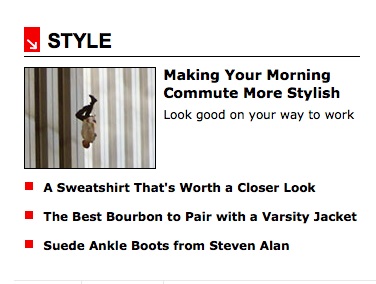
AT&T was not the only company to bring the facepalms this past 9/11. Esquire Magazine’s online server accidentally posted an iconic photo next to a headline for another article. Instead of describing it, here’s an example of “a picture is worth a thousand words” :
Following the post, Esquire tweeted a half-hearted apology saying, “Relax, everybody. There was a stupid technical glitch on our “Falling Man” story and it was fixed asap. We’re sorry for the confusion.” I imagine that Esquire did not consider their Return on Investments (ROI) when posting this tweet. While such outrage over a glitch may seem silly, taking the time to post a genuine apology would secure their consumers and perhaps draw in more. Because the Huffington Post reported on the incident, consumers from all over the world could unsubscribe from the magazine, causing a bad ROI for Esquire. It seems that a genuine “I’m sorry” tweet from the magazine would be far worth the investment it takes to produce the post. Instead, they received a negative return in response to their unenthusiastic efforts.
It has been exactly one year since Hurricane Sandy first hit the coastline of the United States. Much of the news media last October covered Hurricane Sandy and the damage that it caused. With all the focus on such a serious event it was important that brands and companies remained sensitive to the issue at hand. However this is exactly what several brands, including American Apparel, did not do. American Apparel was criticized for their promotion of their “Sandy Sale” during the storm. The ad stated, “In case you’re bored during the storm just Enter SANDYSALE at Checkout.” The sale was only available in the states that were most impacted by the storm, which included Connecticut, Delaware, Massachusetts, North Carolina, New Jersey, New York, Pennsylvania, Virginia, and Maryland.
During this disaster consumers were most likely expecting to see messages that were heartfelt and encouraging, not promotional social media ads for clothing companies. This violation of expectancies caused by American Apparel created negative backlash from not only their consumers, but also the public. The Expectancy Violation Theory states that the outcome of negative communication may result in uncertainty in people’s behavior. A consumer replied to American Apparel’s ad by tweeting that she will forever boycott their stores. This consumer, along with many others, probably became uncertain if they wanted to purchase from this brand in the future.
Another aspect of the Expectancy Violations Theory explains that reward from the violation can be either negative or positive. In American Apparel’s case, the ‘reward’ was negative. In most cases, a negative reward is met by socially acceptable behavior in attempt to correct any violation, but the CEO of American Apparel did the exact opposite. In response to the unfavorable backlash, he stated that, “I don’t think our marketing guys made a mistake. Part of what you want to do in these events is keep the wheels of commerce going,” he told Business Week. “People shopped on it. We generated tens of thousands of dollars from the sale, but we’ll probably lose a million dollars from this (storm) event at a minimum. We’re here to sell clothing. I’m sleeping well at night knowing this was not a serious matter.”
Over the years, “Made in the U.S.A.” has become American Apparel’s trademark marketing approach, but in this particular situation, nothing could be less depicting of American ideals and morals than this failed attempt to generate income. This and other failed public relations ventures should be seen as an example of what not to do during a national crisis. The way we see it, during crises, PR specialists and media relations professionals should proceed in one of two ways. Either stray away from social media, or only produce messages that do not promote one’s brand. In the long run, this situation did not make a lasting impact on American Apparel, but if you were the CEO, how would you have responded to this negative feedback? When have other brands violated your expectancies in a positive or negative way?
-Aaron Love, Kara Zimmerman, Rachel Clay, Rebecca Hobbs
Presentations are everything in life, and in a sense, we are always marketing ourselves to the public with our voices and actions. These components work together to create a brand image for each person as an individual. James Twitchell claims that a brand “is the application of a story to a product or service,” so it is important to realize what stories your life is telling and what images you are portraying. Many people tend to forget that online communication can be extremely harmful to a personal brand, and often diminish their brand images with common mistakes. The top 5 personal brand fails to avoid have been listed to help strengthen and build who you are as a brand.
# 1 – Oversharing
Although the tailgating and partying of your undergraduate days may be over for the most part, many forget that the pictures and posts that documented all those nights have not. Not only do people look at all of the bits of information people say and share, but posts remain in cyber space long after they are forgotten, and are easily and readily available for anyone and everyone to see.
Susan Adams wrote an article on managing online reputation, one of her key points was this: “Keep private things private, while assuming nothing is truly private.”
Everything about you on the Internet comes together to form a picture of your personality, even if you feel this picture may not be true to who you are. Think treating the Internet as a diary doesn’t matter? Oversharing has been linked to: self-incrimination, break-ins, loss of employment, and failed relationships.
Having trouble entering the workforce? You may need to examine what’s on your social media sites. Employers routinely search applicants to see what type of information, pictures, and statuses pop up. Besides not being able to land you a job, oversharing can also get you fired from one. Monster.com shared how an employee took the day off from work, telling his boss he had a funeral, however, later that day the employee posted pictures of himself at a party. His boss found out, and naturally he got fired.
Every time you go to post something whether it be as a status, tweet, wall post, share, picture, whatever- think to yourself, “Is this TMI? Would I want my employer to see this? Would I be proud of this years from now?”
# 2 – Underestimating Technology
We’ve all heard of Snapchat , the application that allows you and your friends to take ridiculous photos that once viewed, are immediately deleted… until recently. Not only can people screenshot your snap, but a counter-application called Snaphack has brought into question whether or not the photos you are sending are truly being deleted. Snaphack allows users to save screenshots of snapchats. Once saved, these photos can be uploaded to social media outlets such as Facebook or Twitter. One of Snapchat’s original uses was for sending racy photos, and Snaphack could easily lead to some very personal pictures being published for all to see.
Snapchat is just one of the many applications that at face value seems harmless and fun, but could easily affect employment opportunities. Being aware and responsible for everything you send via any technology medium is essential to keeping your personal image a good one. So next time you think it might be funny to send a Snapchat of you and your friends doing something questionable, make sure you would be okay with seeing it on the Internet the next day. What you might think is funny during the time, won’t be funny if it is found on your employer’s desk the next morning.
# 3 – Not Staying Up-to-Date With the Latest Social Media Sites and Apps
Facebook, Twitter, Pinterest, Vine, Instagram, LinkedIn, -the list is constantly growing and evolving when it comes to social media sites and apps available for public use. One of the biggest PR fails that people tend to overlook is not taking advantage of these social media techniques as a way to catch employer’s eyes, and to network.
Understanding and taking advantage of social media sites is essential in a world that is each day growing more reliant on technology. Where in the past employers only had a resume and a portfolio to judge a candidate for a job position, now the possibilities for judgment are endless. So why not take advantage of it? Take for example LinkedIn, a social media site that caters specifically to people to network professionally and allows users to connect with one another and build and maintain a broader network of professionals you can trust. It is a smart way of getting your personal name and brand out there for employers to see.
The website is helping people get jobs, so make a great move for yourself and join if you haven’t already!
# 4 -Talking Badly About Your Boss… Or Anyone For That Matter
In order for anyone to be happy with his or her job there must be a positive work environment. Most of us have had that one job we hated because of co-workers, company standards, the work itself, or the boss. In these sort of situations, trash talking seem to come with the business. So, for future and recent graduates we want to warn you, one of the biggest fails you can make in your career is talking trash about your boss, company, or coworkers online.
Recently, this video, featuring Marina Shifrin quitting her job, went viral on YouTube. You have probably seen it, but please feel free to watch it again and laugh.
Funny right? Except for the fact that her past boss knows how she really feels about him and her future employers will undoubtedly see her as unprofessional. So, as a rule of thumb, always save your rantings and trash talkings for your parents and close friends because if you share your personal (and most likely unprofessional) opinions and the wrong person sees it , you can kiss recommendations good-bye, as well as turn your personal brand image into that of a spiteful person.
(Also, take a look at her ex-boss’s response.)
# 5 – Poor Grammar
Poor grammar can affect your brand and your career. Anna Underhill, a consultant for a HR firm, said poor spelling and grammar has become a serious issue for employers. Writing is the main way communication takes place via employers and employees and clients. Having poor correspondence in writing undermines the professionalism of yourself as well as your company.
Communication skills are consistently rated in the top 10 things employers look for. Knowing the difference between affect/effect, their/there, its/it’s, should be common sense not consistent mistakes. While shorthand and abbreviations are the norm in social media, that type of writing should never be integrated into business composition.
Erik Deckers asks for you to think of it this way: If you receive a cover letter from a perspective employee filled with errors, would you hire that person? What sort of message are you sending to potential business partners when your initial email is riddled with mistakes?
Make your personal brand an effective one that highlights all of your best qualities. Don’t be afraid to jump into the cyber world to “sound [your] barbaric yawp,” but be cognizant of the do’s and don’t when it comes to establishing and maintaining a great image.
With the beginning of October also comes the beginning of Breast Cancer Awareness Month, so the color pink starts popping up everywhere. Even the cardboard sleeves around Starbucks coffee cups have turned pink. But what you won’t see on your tall Pumpkin Spice Latte is a pink ribbon, or any mention of breast cancer for that matter. If you examine the sleeve, you will see that it sports the phrase “We warmly welcome La Boulange delicious pastries, now served warm at your neighborhood Starbucks.” La Boulange is Starbucks’ new pastry line – also being débuted this October. How convenient that its pink hue appears as if the company is supporting breast cancer.
Technically, Starbucks has done nothing wrong. After all, they are not lying about donating proceeds to cancer research. They are merely playing off the association of pink in October. No one really “owns” the color pink so Starbucks isn’t violating any ethical guidelines, but where is the line drawn?
Starbucks is taking advantage of what is called “pink-washing”, a form of cause marketing. Pink-washing is when an organization spends more money and resources on promoting their support of a cause than is actually donated to the cause. Even though Starbucks isn’t intentionally promoting breast cancer research, their customers are interpreting their pink theme that way. We believe as communication scholars that the message is determined by the receiver, not the sender. Therefore, Starbucks is guilty of pink-washing.
The NFL is another organization that has been a prominent offender of pink-washing. Their entire organization has exploded in pink gloves, pink cleats, pink sweatbands, and even their logo has a pink ribbon on it this month. They call their campaign “A Crucial Catch”. It is a partnership with the American Cancer Society to raise awareness for breast cancer research and the importance of annual screenings for women. All of the pink items being worn by players and coaches will be auctioned off at the end of the season.
But what we need to evaluate is just how effective this campaign is. Nearly everyone knows about the dangers of breast cancer and how to prevent it as best we can. It seems to me, that the NFL turned pink as more of a charitable statement than to promote the cause. Business Insider did the numbers and figured out that for every $100 in sales of pink gear, only $3.54 is going towards research while the NFL is keeping approximately $45.
What do you think? Do you think that advertising for a cause is a good thing, no matter the reasoning behind it?
What comes to mind when you think about breast cancer awareness? Is it a friend or family member that you know who has overcome the illness? The month of October? The color Pink? For me, the words breast cancer awareness immediately prompts my brain to the Susan G. Komen foundation. The Susan G. Komen foundation was founded in 1982. With the goal of saving lives and ending breast cancer forever, the foundation to date has invested more than $2.2 billion in research and life-saving community programs. According to their website, Komen grants have been made up to $300 billion allowing for major breakthroughs in breast cancer research over the past 30 years. The foundation prides itself on the implementation of community events as well as their signature event: The Susan G. Komen Race for the Cure. This event alone has raised more than $1.5 billion while also working to inform the public, honor those lost in the fight with breast cancer, and fund breast cancer research and treatment facilities.
With all of this success I cannot help but wonder why? What is so special about this foundation? How have they been able to emerge and sustain themselves as one of the most successful breast cancer awareness foundations?
The answer is that this unique foundation serves as a means of community for women suffering and overcoming similar hardships. Rather than just serving as a fundraising initiative, The Susan G. Komen foundation is often portrayed as an outlet for women with breast cancer to connect and gather to discuss commonalities. This illustrates women’s immense drive to seek connection within society. This can be related to communication specialist Deborah Tannen’s theory of genderlect. This particular theory of communication explains the differences between how men and women engage in conversation. Genderlect indicates that the way men and women differentiate in the methods of how they converse are neither right nor wrong, or superior or inferior. They are simply different. Women have a deep drive to seek connection in communication where as men have a deep drive to seek status. This connection-seeking behavior is drastically evident within the foundation. The Susan G. Komen website is this foundations primary way of connecting women. Upon visiting the website, you will notice that there are support groups for women, no matter their stage in life. Tabs labeled “I’ve been diagnosed with breast cancer” and “Someone I know was diagnosed” make for easy navigation when on this website. This type of setup is ideal for women. Going through a tragedy such as this can put quite the strain on a women’s life. Understanding how women operate and what it takes to meet their needs through the genderlect theory, allows women to receive the adequate support they need in a way that best suits them.
The foundation began when Nancy G Brinker promised her dying sister Susan that she would do everything she could to end breast cancer. The promise between the sisters sparked such an impact that many were willing to help the cause. Now, on top of their signature event and community partnerships the Susan G Komen foundation has become so successful that there are programs in more than fifty countries.
The success of the foundation has continued to build over a period of time starting with the passionate story of Susan G Komen. As more and more people have jumped on the bandwagon, the foundation has recognized the importance of spreading the word about breast cancer, encouraging early detection and treatment, and influencing involvement from many people, all in ways that cater to the communication needs of women. In turn, they have been able to inspire hope, fund research, and benefit cancer survivors globally.
Click on the link below to visit the Susan G. Komen website for further information regarding this organization.
When we think breast cancer, many of us think pink ribbons and a sorority of survivors and supporters. Unfortunately, an important percentage is often forgotten. One in ten men are diagnosed with breast cancer, and although this number is significantly less than women, a diagnosis for breast cancer in men brings along an entirely different set of challenges. One cultural conception of disease is a disease being a cultural stigma. Many men do not know that having breast cancer is even a possibility and think of it as a “woman’s disease.” Men diagnosed with breast cancer often go into a state of shock, confusion and embarrassment along with the other concerns a cancer diagnosis includes.
Many women know when the harmful BRCA 1 and BRCA 2 inherited gene runs in their family, and these women are more likely to get frequently tested. Many men, however, are unaware that they are also susceptible to inheriting these genes. Often, a male diagnosis can be more fatal, because they do not know they should be looking for warning signs. These symptoms become more dangerous the longer they are left untreated.
The Health Belief Model explains that if people are more aware of potential risk and harm they face, they are more likely to take preventative action. There needs to be more health campaigns to raise attention to the cause. There are some organizations, such as The BLUE WAVE and H.I.S Breast Cancer Foundation, who are making efforts to spread awareness for male breast cancer by holding events for men and women diagnosed with breast cancer to support each other and raise awareness. Most importantly, their mission is to ensure these men they are not alone. Even though some groups have begun to spread the word, a large challenge still remains to beat the stigma of men with breast cancer.
– Rachel Edwards, Dylan Fowler, Ashley Creps, Chad Darrah, Ryan Nagy





 IMC Hawks Blog