Blog

  • Paul McCartney’s NEW Publicity Stunt

    The digital world of iTunes and social media has given the music industry both high and low notes. While the Internet offers accessibility, it also caters to specificity. Most predominantly, the Internet offers an array of platforms for artists to upload, share, and send their music.  However, while music junkies may be constantly searching for new digs, most people eventually acquire a particular taste for what they choose to send through their ear buds.  Internet music services such as Pandora, Spotify, and iHeartRadio allow users to handpick and listen to an endless variety of artists and genres. This narrowcasting of music leaves artists waging campaigns to try to reach listeners. As a result, clutter prevails.

    Like in advertising, clutter has become a big problem in music promotion. As Douglas Rushkoff pointed out in The Persuaders, “The more messages they create, the more they have to create to reach us.”

    The more opportunity social media platforms – YouTube, MySpace Music, and most recently Vine – offer artist to share their music, the more competitive and important promotion of music and musician become.

    So how does a music artist break through all the online music clutter without breaking budget? The answer is: great music, a little luck, and a publicity stunt.

    Not new to the music arena are surprise gigs on rooftops or buses in the middle of big cities, events known in the public relations world as a publicity stunts. This past October, music legend Sir Paul McCartney promoted his recently released album, NEW, by doing just such a thing – performing a surprise concert in the middle of Times Square.
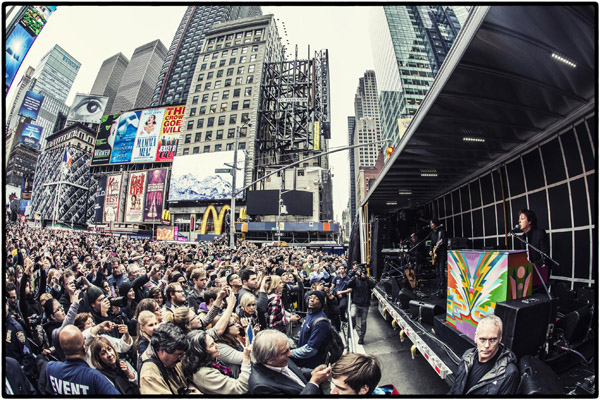
    Paul McCartney at performs at the Times SquareTelling fans only hours before – via Twitter – he played a 15-minute long show featuring the single “New”, as well as music from the (not at the time released) album. McCartney was not only able to give NYC fans a concert, but fans from around the world could tune in through Times Square live webcast and watch the performance.
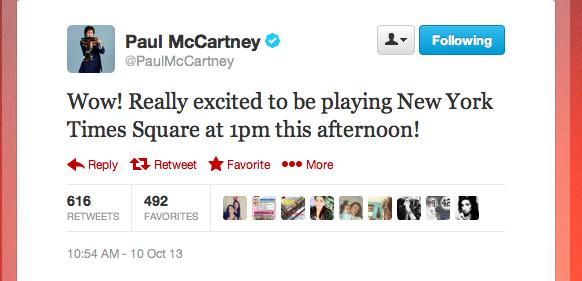
    pm tweet nyThe surprise gig resulted in social media buzz and major news coverage, all promoting the NEW album for free. The stunt was so successful; exactly a week later he performed another surprise concert in London.

    pm tweet loSir Paul McCartney proved how to conquer the masses. Not only did he succeed in making his fans happy, but also he succeeded in executing a publicity stunt that generated both word of mouth and media coverage that ended up promoting his music at no cost to him.

    Caroline Robinson, Savannah Valade 

  • Anna Rexia Makes Another Appearance

    Zombies. Ghosts. Serial killers. These are some popular symbols of Halloween that are frequently seen in movies, haunted houses and decorations. However, what I find more frightening are some of the costumes that I see while trying to find my own “original” costume idea each Halloween. This year, I came across the most frightening costume of them all, not because of a scary mask or fake blood, but because it is poking fun at a serious mental illness that affects millions of people around the world. The “Anna Rexia” costume first caused some serious uproar back in 2011, when retailers like HalloweenStore.com and Ricky’s NYC began carrying the costume, manufactured by Dreamgirls International, but they stopped after a great deal of media backlash and thousands signed a petition on Change.org.

    Now, two years later, this controversial and insensitive costume is apparently back up for sale on the website HalloweenParty13.com, which I discovered from a Facebook posting of a more recent Change.org petition. At first, all I could think about was how disgusting a costume like that is, and how I would judge anyone wearing it, but I want to turn this into a learning opportunity by relating this controversy to public relations. My question is: Did the companies handle the outrage and negative publicity surrounding this costume appropriately?

    As I did my research, I found articles on news sites such as The Huffington Post and other blogs, about the resurrection of “Anna Rexia.”  I saw on Buzzfeed that the retailer HalloweenStore.com posted a status to their Facebook page about one week ago, explaining that people should do research before signing a petition because the retailer hasn’t sold that costume since 2011.  This status was calling out people who angrily emailed the store about their distaste, when they weren’t actually the retailers currently selling the costume.   The wording was harsh, with certain words fully capitalized and many exclamation points, which detracts potential customers and pushes current customers away.  The post has since been deleted.

    enhanced-buzz-32177-1382713416-25
    via BuzzFeed

    During the original controversy in 2011, Dreamgirls International said the costume was a form of “dark humor,” and that people wearing it is a “matter of taste.”  However, the company is now saying that the costume was discontinued in 2007 and the matter is now out of their hands.  At first, Dreamgirls International was using the communication theory of framing, which highlights specific aspects of an issue and “frames” people’s perspective on it.  The company was trying to downgrade the offensive costume as being humorous and describing themselves as a “company run by women for women”; that just wanted to create an “eccentric” way for a woman to express herself on Halloween.  Now, they are denying all responsibility for any current sales of the costume.  This denial is not only inconsistent, but it is the opposite of what any student in an introductory PR class would learn—don’t deny ownership of a problem.

    I believe that neither of these companies handled the “Anna Rexia” backlash well.  If you, the reader, were the spokesperson of either company, how would you handle this situation?

    -Maggie Dowicyan

  • Taking the Fun Out of Trick or Treat

    BEWARE to all trick-or-treaters occupying the streets of Fargo, North Dakota tonight. Children are in for a rude awakening when visiting the residence of a woman who has clearly forgot the true meaning/purpose of Halloween. A letter written to a local radio station, by a woman identified only as “Cheryl,” is sparking a great deal of interest on outlets of social media.


    Cheryl ignited controversy when revealing her plan to trick obese children this Halloween by filling their goodie bags with warning letters instead of quintessential treats and candy. These letters voice her opinion of how “the moderately obese kids should not be consuming sweets and treats to the extent of other children this Halloween season.” Although, it is evident that Cheryl’s intention is to send a message to parents of kids that are noticeably overweight it seems that this is the wrong way of going about addressing the issue. Unfortunately, Cheryl is not taking into account the great deal of harm that this little prank could create. Rather than solving the problem of childhood obesity, this could create a feeling of demoralization and ultimately cause children to form negative self-images.


    By choosing this “solution” in an attempt to solve the problem of childhood obesity one must be left wondering if Cheryl considered the expectations of the children and the people that she might violate during the process. This brings us to the concept of the expectancy violations theory, an idea by Judee Burgoon. This theory is commonly studied in psychology or communication studies classrooms. It claims that communication is the exchange of information which can be used to violate the expectations of others; this violation can then be perceived as negative or positive depending on the relational status between the two engaged.


    In this specific situation, we assume that Cheryl does not know each and every one of the trick-or-treaters and parents that plan to come to her house and therefore it would be difficult for her to assume their perception of her “treat”, It is assumed that children dressed up in costumes, knocking door-to-door, with buckets in hand, are in search of mass amounts of candy. It is almost guaranteed that those children who receive a mean note rather than a yummy piece of candy are bound to be upset and react in a negative way. Unfortunately, it does not seem like Cheryl took into consideration the fact that she will not know each of the trick-or-treaters on a personal basis and therefore could really offend them with her unpleasant note. Although it seems as though she wants to solve a problem, this does not seem like the best way to go about it.

    -Parker Farfour, Caitlin Ford, Kaitlin Batson, Alex Corrigan


    http://blogs.ajc.com/news-to-me/2013/10/30/kids-getting-youre-fat-letters-this-halloween/


    http://www.cbsnews.com/8301-204_162-57610010/n.d-woman-to-hand-out-fat-letters-to-obese-kids-during-halloween/

  • Sexy Drunk Candy Day

    A blog featured by our IMC predecessors two years ago touched on the roots of Halloween, evidently for informational purposes. But if we look at the origin of the holiday, and compare it to the simple consumer monster it is today, what does it say about our culture? How did it transform from a festival rooted in serious meaning to whatever it’s supposed to be today?

    Halloween started with the Celts many moons ago, over time it was adapted and changed by the Romans, and became what we know it as today in the 1900s. None of that is really important. What is important is how we cannibalized the traditions and passed them along, while turning the holiday into nothing more than a consumption animal party.

    The phenomenon that explains this is Social Construction of Reality, but how did it get to this? It seems that most traditions were forged in some pretty substantial fires, but American culture has a way of reducing the importance of history to make some money. The idea behind the tradition is not communicated to growing generations, and the meaning gets lost behind the ways we celebrate. Then the Americans who grow up and pay money to be a part of the “tradition” end up satisfied with their part in the whole ordeal while walking away a little poorer, and just as ignorant.

    A Google Search of “Halloween Sales 2013” turns up a link to coupons from retailers pushing to sell costumes, candy, and other Halloween-related things. A short list of the companies offering these discounts are Aeropostale, The Popcorn Factory, Party City, Amazon, Toys R Us, the Disney store, Babies R Us, Walgreens, Land’s End, Pier 1 Imports, Petco, Hot Topic, The Home Depot, Urban Outfitters, Williams-Sonoma, Cotton On, Sears, Roaman’s, and Target. Apparently Tide is also in on the Halloween action (from my colleagues’ Monday post).

    None of the companies’ ads say anything about the Celts or the Romans.

    One Halloween participant properly respecting the Celts.
    One Halloween participant properly respecting the Celts.

    Nobody ever told me what Halloween was about. I just learned to associate it with costumes and candy from my mom. It’s kind of like St. Patrick’s Day, which (you would think) is not too relevant to Americans that lack origins in Ireland, but is extensively used to increase sales and get people drunk. The fact is, today, that all Halloween really is about are costumes, candy, and partying. Most holidays end up being just another reason to party in America, but Halloween is the most notorious for partying being its sole purpose.

    Ask around, especially on campus, and people will have a whole slew of methods for celebrating the holiday. If a person has kids, they will dress their kids up and walk around to get candy on Halloween. Some folks may stay inside and hand out candy to other people’s kids if they feel up to it. Those who don’t have kids will probably dress up and get drunk.

    That’s about it.

    I could talk about the implications of the most prevalent American Halloween costumes featured in our local costume shops (which are perfectly in tune with the holiday’s roots), but everyone knows that it all pretty much ranges from “sexy nurse,” to “sexy M&M”  or “sexy pirate” for women, and “pirate,” to “caveman” for men. Most Halloween emphasis is placed on the costume. The rest is on the party or the candy.

    It doesn’t have anything to do with any of the reasons it was created. Sure, there’re Jack-O-Lanterns that have survived in homage to ol’ Stingy Jack, but does anybody reading this know about him (assuming that any one of the extremely cool tales about him is the one responsible for the tradition)?

    I say, since Halloween seems to just be an arbitrary holiday nowadays, that we change the name completely, maybe to “Sexy Drunk Candy Day.” Let’s reconstruct the reality of Halloween. Why not?

    – Chad Darrah

  • Artichoke Buttercups, Anyone?

    October 31st is the one day of the year that kids get the chance to dress up in their favorite costumes, carve pumpkins, trick-or-treat, and most importantly eat excessive amounts of sugar. This Halloween season, Crest and Oral-B have teamed up to make a commercial that portrays a child’s greatest nightmare- a Halloween without candy. This innovative and hilarious commercial titled, “Halloween Treats Gone Wrong,” is an unofficial experiment that captures how kids act when they find out healthy treats are replacing candy. This playful scare-tactic is one that parents are sure to appreciate as they attempt to find ways to motivate kids to brush and floss this Halloween.

    Companies consider many different appeals when creating advertisements to grab the attention of current and future consumers. Appeals are often used to influence consumers to purchase a product as well as speaking to their interests.  One appeal that is used often, and in this particular advertisement, is humor. If applied correctly, humor can be extremely successful in marketing a brand. Humor is used in this commercial through the use of children and their innocence and tendency to be blunt regarding their own opinions. The appeal to humor is effective at gaining and retaining the attention of audiences because humor results in better recall. Crest and Oral-B do a good job of effectively keeping their audiences engaged in their commercial while marketing their brands at a time of the year when you would least expect it.  By turning this campaign into a positive and laughable viewing experience, Oral-B and Crest have kept themselves relevant during Halloween and have shown that they too can relate to what parents everywhere are thinking.

    By establishing humor in their commercial, Crest and Oral-B have possibly widened their potential customer bases by creating a memorable narrative to leave with audiences. This emotional link that Crest and Oral-B created with their audiences increases the intent for consumers to purchase their products for themselves and their children. Some appeals to humor are not as successful as the Crest and Oral-B campaign have been.  While this commercial is being shared not only on television but also on social networking sites, other marketing attempts have not been as lucrative. If the humor is not received well by the audience the ad can backfire and create a negative image surrounding the brand.

    Image

    Have you seen any other examples of brands using the holiday season to promote their products? Do you think the use of humor in this ad was successful? What are some examples of humor used in ads that have resulted in you purchasing their product(s)?

    -Aaron Love, Kara Zimmerman, Rachel Clay, Rebecca Hobbs


  • A Ghost In Their Own Campaign

    When you think of Halloween, you probably aren’t thinking of laundry detergent. Tide is innovatively trying to change this perception by incorporating the spooky tradition into their brand. On their website, Tide has provided a list of common Halloween candy stains and directions on how to get them out of clothing. Tide even suggests several Halloween costumes that can be put together last minute. Furthermore, Tide has included a special tip list for making Halloween fun and stress-free. By the end of reading all of these posts, what you wouldn’t have originally paired together (Tide and Halloween) makes total sense.

    Hoping to capitalize on Halloween even further, in mid-October, Tide posted a video to their Vine page to begin their “Scared Stainless” campaign.

    Vine, created in late January 2013, is an app that allows users to create short, looping videos.  In line with other social media frameworks, users can “like” others’ posts and can follow other users. Sporting a 400% growth rate between the first and third quarters of 2013, Vine is the fastest growing social media outlet in the world.

    Tide jumped on the Vine bandwagon this year, posting their first video in August. Focusing in on Discovery Channel’s Shark Week, their Vine featured an animated drawing of a shark jumping out of water, biting a piece out of the Tide logo and showing the copy “we get out blood, too”. This fun video caused a buzz in social media news, and left many wondering if Tide would be a future leader in the Vine world.

    Until the end of Halloween, Tide will be posting scary movie themed Halloween videos, all featuring the Tide bottle. So far, only four Vines have appeared showing the Tide bottle in the scene of the movie Carrie, the mother in psycho, and a replication of the popular scene of the Poltergeist.

    Click here to watch a Scared Stainless Vine by Tide

    However, since their first post the company has neglected to keep the creative and fun videos coming. As of October 27th, the Tide Vine only has 2430 followers and only five total posts.

    Laundry detergent is predominately targeted at women because they are estimated to control around 80% of household decisions.  Tide strives to have middle-class women between the ages of 18-54 act as the purchasers and users of their variety of washing powder products. By expanding campaigning practices to Vine for six quick seconds, is Tide really reaching the target market that they would like to impact? It is no surprise that the higher in age, the lower the chance of a woman using Vine throughout her day to discover these snippets Tide has placed online for the season. This short-lived effort may very well be a wasted attempt at reaching the targeted consumers of their products.

    An underwhelming response from the company leaves us asking: Is it effective for companies to have a social media account just to say they have one even if they fail to utilize it? With Halloween only four days away and barely any notoriety, was the campaign even worth it?

    Meghan Carey, Morgan Jones, Jade Lester, Caroline Robinson, Savannah Valade

  • A Revved Up Recovery

    With every public relations or advertising fail comes an organization’s quick efforts to recover from their mistakes. As the mistakes are revealed, an organization must begin to determine the most efficient way to recover from what they have done wrong to save and maintain their image as well as their reputation. Although damage control can be stressful, and at times difficult to manage, it is crucial for the long-term success of an organization. Columnists from Inc. compiled a list of what they feel are the three most important steps in a quick and efficient recovery from a PR fail.

    1. “Be Frank and Fast”

    Admitting your mistake is the first step in resolving the issue and recovering an organization’s brand image. Be frank with the audience and admit to your mistake; if an organization tries to deny an obvious wrongdoing the organization runs the risk of having their mistake come back to haunt them. In addition, address the problem as soon as attention is brought to the mistake. Whether it be a rogue tweet from a company’s Twitter or an offensive advertisement acknowledging the mistake as quickly as possible will help to boost an organizations morale and gain back their credibility from the audience.

    2. “Admit Mistakes, Move On and Learn”

    Shying away from obvious wrongdoings is not going to help an organization recover from the mistake they made. A person or organization doesn’t intentionally make a mistake, especially when it relates with their brand image, but learn from the mistake and move on. There is something to be learned with every mistake; an organization should work to understand what went wrong and be cautious not to repeat themselves. As Rebekah Epstein stated in the Huffington Post, “People don’t remember the mistakes you make; instead, they remember how you react to them.” Be wary of how you handle the situation. If an organization handles a advertisement fail with poise, it would most likely result in people thinking more highly of them for the way that the situation was handled.

    3. “Correct Quickly”

    The longer an organization takes to correct their mistake, the more opportunities they create for a larger audience to see what they did wrong. Correct the mistake quickly. Not only is it important to regain a brand’s image, but the longer a mistake is available for the public to view, the larger a window to offend an audience is open. In addition, the faster an organization corrects a mishap, the quicker they can get back to their normal routines within the company.

    A company doesn’t intentionally produce an advertisement with the objective of offending their audience—it is the last thing they plan to do. However, a company can never predict exactly how their audience will react to their new marketing strategy or advertisements. Through Coordinated Management of Meaning, an organization’s audience creates their own opinions and views—the majority of which are based off of what other people think and say about it on the advertisements they produce. It is through the development of these opinions that an organization is able to determine if their new strategy was successful, or if the organization needs to begin the recovery process from a new advertising mishap. In the case of Mountain Dew, they felt that they were on the right track to a new and successful advertisement, they didn’t anticipate the overwhelming negative feedback they received in response to their advertisement. When the disapproval of the audience began to roll in, Mountain Dew officials worked to do what needed to be done in order to create a happy audience again.

    -Tilson Hackley