Blog

  • On a Lost, Senior Seahawk.

    Many years ago, in the midst of my five-year career as an infantryman in the United States Army, I had a grand vision. My best friend at the time, Ryan Wood (pictured below on the left, with me in 2006), and I, were going to get a house together in Oklahoma City. I was going to go to college for creative writing, and he was going to go for art and political science. Our goal was to create a graphic novel showcasing the reality of American imperialism and its brutal effects on the globe. We assumed that eventually we would be rich enough to open a punk rock venue/bar together and go from there. The plan was solid. Nothing could of went wrong, until Ryan Wood was killed in Baghdad in 2007. That event threw everything off track.

    MeNWood

    So I got lost. I developed many problems, and worst of all (for me), my future was shot, my friend and focal point of my plan was gone. I left the Army with my plan dissolved, but eventually I moved away from my family in Arizona and enrolled at Cape Fear Community College in Wilmington, NC. I had no definable goal in mind, and I was only going to school to make money off of the government’s generous compensation for my service (Service members get a GI Bill when they get out, which pays them monthly to go to college.) I chose Communication Studies because it had the easiest math requirements, and seemed somewhat related to a career in some sort of writing, which was good enough for me at that time.

    I made it to UNCW at 28 years old. I never felt like I fit into the college culture. I lived off campus my whole career and never got involved in extracurricular activities. I also found I could never connect on any lasting level with my classmates because I constantly compared them to the friendships I had forged in the inferno of 25 months of war. I noticed, a few months after completing all the prerequisite courses and earning an AA, that I was losing the knowledge I gained in those courses. There is no screening process to divide potentially dedicated, outstanding students from the ones who just attend to attend, and those listed second forget everything. So I slipped in through the cracks and ended up jaded by the ordeal. I approached college in a less-than-ideal way: I just did enough to get through it.

    But the resources were, and are, there for those who are interested. There is a career center to build a resume, volunteering, applied learning, and internship opportunities to add valuable experience to your education. There are professors who, if you come to them with concerns, will go out of their way to help you reach the place you’re aiming for. But nobody is going to drop any of that in your lap. You have to seek it out and pursue it yourself. I didn’t reach out. I skirted by with the minimum, and am left with a mostly hollow experience of what could have been another milestone in my life.

    What I have learned about myself in my four years of college is that my lack of a plan has morphed into a lack of passion, which has reinforced a lack of precise direction. I sit here on the cusp of graduation, with a hazy track of uncertainty unfolding before me. I see my classmates rattling off their big goals to their buddies, detailing the rungs they will need to climb to make those plans work, and I see their youth, which I am quickly losing. It leaves me wondering what I have been doing the past four years, and causes even more concern about the next four. I have the wisdom to know I did not do the best that I could in school, but the wisdom came too late to be of any use at UNCW.

    It could be argued that I was never a go-getter, and was doomed from the start due to a personality defect, but at least I am here sharing my wisdom instead of shivering in a gutter somewhere. I did have a plan at one point, but have failed to create one since it was lost. So don’t write me off as just a bad example of a good college student. Look at me as a wise, bad example of a good college student, since I have recognized and shared my shortcomings. You could learn something from me. I could tell you how wonderful the opportunity was and how clear it made my life, or I could give you the truth of it. I went to UNCW without really knowing why, and now I am leaving without knowing exactly why I was there. College seems like a logical “next step” for many, but you have to engage with it far more than that for your education to be a life-changing experience. You have got to know yourself and know what you want out of life, or college is going to be just another grind for you.

    To be fair, I did take an internship opportunity that may have sharpened me up a bit, and every one of my teachers were excellent, passionate, and dedicated to their craft. Not one person entrusted to my education failed me in the slightest. I remember being asked “What is your career goal?” during advising, and instead of sticking with “I don’t know,” I would come up with fuzzy answers to push the meeting along. But the tools were there. I just passed them up. UNCW was a great place that has enriched and guided many lives, and will continue to do so after I pass through. The tools will be there for you, and you ought to use them.

    I learned many things in college, but the most important thing I learned wasn’t in the brochure, at orientation, on the website, or in the course catalog: have a plan and a backup plan as quickly as possible, and get motivated and involved enough to turn the plan into reality. Seek out and grab every opportunity that moves you towards that reality and never let up. Otherwise you may find yourself at 30 years old, sitting with backed up classwork clawing at your heels and a foggy future two weeks before graduation, wondering how so many others seem to have it all figured out while you float on through to no apparent destination.

    -Chad Darrah

    I must say, the situation is not as dire as I have presented it. All I know is that a lot of people think I am a good writer, enough to make me believe it. But I do not know how that translates into a career to tell an advisor. So I’ll trudge through the muck until it all clicks, or I will die before it ever clicks. Either way I am following a path that is good enough for me. I’m just not so sure where college fits on that path.

    I also have to use my soapbox one last time to express a hearty thank you to Dr. Jeanne Persuit for giving me the most monumental, colossally meaningful display of encouragement I have ever received on this murky trek. I thank you with the highest degree that a blog post can convey, and can honestly say that that moment was the undisputed highlight of my college career.

    I have to ask that you please raise a glass for Sergeant Ryan Mitchell Wood next time you get a chance. Google his name and title to get a feel for him, as he is the driving force of my motivation. Pay your respects. I give his memory and family extraordinary credit for helping me hold onto something sacred, which is a necessity to keep me moving.
  • Student Surveys

    A large part of our Integrated Marketing Communication II class is to work with a client in the community. In creating an IMC Plan for our clients a large part of the plan is to gather information from students and the community. Two of our groups in class have created surveys specifically geared towards students. Below are the links to two students surveys, if you all could take a few minutes to complete the surveys it would be greatly appreciated!

    Volunteer Survey: http://appserv01.uncw.edu/SelectSurveyNET//TakeSurvey.aspx?SurveyID=723L6o9K

    ETeal Survey: http://appserv01.uncw.edu/SelectSurveyNET//TakeSurvey.aspx?SurveyID=983K9m7M

    We appreciate your participation!

  • The Hunger Games are…Real?

    The Hunger Games: Catching Fire, opened on November 22, 2013 as a sequel to the Hunger Games. What started as a series of books by Suzanne Collins has been turned into a hit soon-to-be trilogy. Catching Fire made an estimated $158,074,286.00 on its opening night in the United States alone, according to IMDB. The blockbuster film partnered with many companies, including Subway and Feeding America. This trio has combined forces to also include Twitter in an effort to end hunger.

    As a result of Subway and Catching Fire being partners, Subway is currently using the tributes of the Games to encourage people to eat in the restaurant. This type of celebrity endorsement brings in people who might not normally eat there. “Oh, if Peeta eats Subway, I should too!” Granted, this behavior might come more from children but they, in turn, will ask their parents to take them to Subway. I’ve seen this time and time again with my younger siblings. This also works for the older crowd, however, because a partnership of this nature often includes promotional items or sales/deals that someone may anticipate being offered. Subway has transformed their marketing strategies and dining areas, with concepts like “Where Victors Eat” and “Win your own Victory Tour,” with the latter being a sweepstakes in conjunction with their collectible Catching Fire drink cups.r_kat1

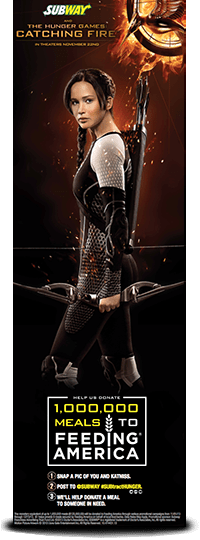
    In the third and final facet of this trio of partners, Feeding America has jumped in and put their cause directly in the middle. Subway has placed cardboard cutouts of tributes Katniss, Peeta, and Finnick in the dining areas of Subways. A patron, after eating “What Victors Eat,” can take a photo with the cutouts and post it to the Subway Twitter, with the hashtag of #SUBtractHunger. Each time a hashtag is used, it is counted towards the 1,000,000 meals that Subway will buy for Feeding America. In the fine print, it says that Subway will donate up to $125,000, as each dollar makes about nine meals. However, this linkage will only exist until 11:59pm on December 15, 2013. The meals will be provided from Feeding America through local food banks in areas in need.

    This celebrity endorsement effectively ties in cause marketing in order to create an environment in which Subway patrons are encouraged to aid Feeding America. Though there is no mention of patrons being able to donate money directly to Feeding America via Subway and Catching Fire, the Feeding America website has a donation area, as well as a hyperlink to a Hunger Games site, where a large “Ignite the Fight Against Hunger” plea is proudly displayed under a Mockingjay and above a photo of the tributes stoically ready to win the real-world Hunger Games. The number of families that go hungry over the holidays is continuously growing. With Feeding America, Subway, and the Hunger Games movie series teaming up to feed families, alongside many other organizations attempting to end hunger, do you think the odds are in are their favor?

    -Hilary Hall

  • Towels For Troops: Supporting Our Heroes

    I cannot speak for others, but one of the most quickly used products in my household is paper towels. Often times, it seems that they have to be bought on a weekly basis. Thankfully, Brawny, the paper towel company, recognized the necessity that paper towels have become and leveraged their product to help out a worthy cause.

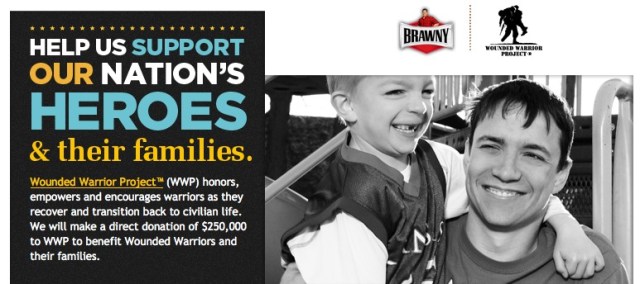
    Last year, Brawny partnered with the Wounded Warriors Project to launch an “Inner Strength” campaign. For two years, Brawny has prided itself on standing strong alongside the Wounded Warrior Project (WWP) as a means of honoring injured service members. In 2012 alone, Brawny raised more than $500,000 for the WWP.

    hahahahaha

    For those of you who are unaware of the Wounded Warriors Project, it is a form of charitable support for members of the armed forces who were injured in the line of duty. Donations made to WWP help thousands of wounded warriors and their families as they return home from current conflicts.

    With great success, Brawny decided to continue this cause marketing initiative committing to raise $600,000 this year. As a means of accomplishing this goal, Brawny has promised to make a direct donation of $250,000 to benefit the WWP. They have also announced their pledge to donate an additional $1, up to $350,000 for every individual who: shares a “Thank You” note on the Brawny Facebook page, “likes” Brawny paper towels on Facebook, or texts THANKS to 272969.

    Large goals like this are often hard to achieve, but worth it when it comes to a good cause. In the study of rhetorical theory, Greek philosopher, Aristotle teaches the three modes of persuasion: ethos, pathos, and logos. In this example, Brawny is able to use cause marketing to appeal to pathos or the emotion of the audience, but this tactic is commonly used in cause marketing. Pathos is the strongest mode of persuasion; making it a more frequently used appeal.

    Personally, when I hear the word “persuasion” I immediately make the connection to an interchangeable and more frequently used term…Influences. Persuasion is a process directed towards changing or influencing people’s beliefs, attitudes, and intentions. Individuals are persuaded each and every day. Persuasion is a critical and underlying goal of all marketing and advertising efforts.

    The “Inner Strength” campaign is an effective form of cause marketing conducted by Brawny and the WWP. This particular campaign does an efficient job of persuading customers purchasing decisions by appealing to the audiences’ emotions. Customers are much more inclined to buy a product if they know that it is for a good cause.  It is that simple.

    In this case, customers are buying Brawny products because it is to their understanding that a percentage of the proceeds go to the WWP. This is because these consumers feel a sense of sympathy for wounded soldiers. This is a form of persuasion at its finest. Ultimately, cause marketing has proven to pay off in this scenario seeing how Brawny sales are through the roof and donations made to the WWP are at an all-time high

    Happy Thanksgiving!

    -Caitlin Ford, Parker Farfour, Alex Corrigan, Kaitlyn Batson

  • Do the (RED) Thing

    One of the most successful examples of cause marketing is the Product Red campaign that was launched in 2006. This was when the Red foundation paired up with recognizable brands such as Starbucks, Gap, Coke and Apple to raise money for HIV/AIDS. Since its launch, the organization has raised $215 million. This money goes straight to The Global Fund, who invests 100% of the earnings to HIV/AIDS programs in Africa. This marketing seems to be benefiting both parties because while the nonprofit is raising money and visibility, the for-profit is gaining customers who support the cause. BRSL_Lockup_October2013

    The reason cause marketing is so popular is because it gives consumers an extrinsic and intrinsic reward  for their purchases. The extrinsic motivation to buy the product is the product itself. While the intrinsic motivation is to walk away knowing that you just donated money to a good cause. In the book Cognitive Surplus, Clay Shirky describes how times are changing and people are now doing things just because they want to, not because they are getting rewarded. I agree with him and believe that people are still going to buy products that they already wanted or needed before they found out it was connected to an organization. If someone wants Starbucks, they are going to get it whether or not it is on the day that the company is donating to the Red foundation.

    What do you think? Have you ever gone out of your way to buy a certain product, because you knew a percentage of your purchase was going to go to a good cause? Would you buy a Red iPod, even though you wanted the green one? Take a minute and think about if you are more driven by intrinsic or extrinsic motives.

    -Ashley Creps

  • Marketing for a Cause: One Pair of Shoes at a Time

    Whether or not you know what cause marketing is, there is a good chance that you have participated in it in one way or another.  Since cause marketing is the collaboration of a company with a specific organization or cause, which is something that many brands participate in, we have decided to focus on one particular well known company that uses this tactic. The specific brand that many people, maybe even you, have supported through cause marketing is TOMS.  TOMS is a shoe company that provides a pair of shoes to a child in need around the world every time that a pair is purchased.

    TOMS

    The idea of TOMS shoes came about when founder, Blake Mycoskie, visited Argentina and discovered children within the village were walking around barefoot. Determined to help, Mycoskie created the campaign “One for One,” that would “match every pair of shoes purchased with a pair of new shoes given to a child in need.” The company has had outstanding success, becoming nationally appraised and known for their good deeds. According to their website, TOMS has given 10 million pairs of shoes spanning over 60 countries. A motivating factor behind the TOMS brand is their demonstration of corporate responsibility through their desire to help others in need.

    The Theory of Reasoned Action makes a good connection with TOMS and cause marketing because it states that attitude drives intention which overall drives the desired behavior. The Theory of Reasoned Action also states that, “If the outcome seems beneficial to the individual, he or she may then intend to or actually participate in a particular behavior.” TOMS’ mission drives consumers to have a positive attitude towards the brand and an inclination to purchase their products because the outcome is helping children in need.  Peer groups, friends, family, role models, and celebrities also play an active role in influencing consumers to participate in a desired behavior. Consumers who have a positive attitude about a celebrity that advocates TOMS may in turn have a positive attitude about TOMS, which will increase their intention and actual behavior of purchasing their products.
    What are some other instances where you have seen companies and brands use cause marketing to sell their products?  Do you think people’s motivation to purchase TOMS shoes is more for the fashion statement and to look like a good person or to genuinely donate?

    -Aaron Love, Kara Zimmerman, Rachel Clay, Rebecca Hobbs

  • A Soda With A Cause

    Are you shopping for a cause this holiday season?

    They don’t call it the giving season for nothing. Around the holidays you see and hear it everywhere “Would you like to donate a dollar to ______ to help sick children today? It only takes a $5 donation to _______! Or, shop here! We’re a good organization! We support ________. ” That _____ has a name: cause marketing.

    According to The Nonprofit Times, cause marketing, in a broad sense, is when  “a nonprofit and for profit corporation partner together with the purpose of advancing the mission-related work of the nonprofit, and the marketing goals of the corporation.” We regularly see this through traditional cause-related marketing on a day-to-day basis (donation-with-purchase of a product/service), but it seems as though cause marketing during the holidays is especially pertinent.

    Do you feel as though companies that don’t partake in cause marketing are more rare than those who do? This holiday season, Coca-cola is doing the opposite of advertising, while still partaking in cause-marketing. Confusing right? Well check this out.

    Starting November 18th, Coca-Cola decided to cut all advertisement funds and donate the money that would be used for relief efforts in the Philippines from Typhoon Haiyan. The company still plans to partake in holiday ads soon, but the pathos link that the company is creating by helping out those devastated by the disaster is sure to boost sales. The company has raised $2.5 million for the relief already. Way to go, Coke.

    So how about you? Does the pathos-oriented approach presented by cause-marketing make you more vulnerable to purchasing a product, or is it just expected now-a-days?

    Morgan Jones, Jade Lester