Blog

  • Out With The Old, In With The New: Technology Decides It All

    Everyday you as a consumer are exposed to hundreds of thousands of brands. Over the decades the shopping industry has exploded with most brands disappearing at the same rate new ones appear, yet some brands have stood the cluttered test of time – one of those is Macy’s.

    Created in 1858 by Rowland Hussy Macy the Macy’s store was originally a dry goods store. Macy’s started to gain notable recognition in the 1900s with its holiday window displays and the hiring of Santa Claus for the stores. In 1924 the store moved to its current NYC location, on the corner of Broadway and 34th Street. This year was also the first Macy’s Day Parade, which was organized to celebrate immigrant employees new American Heritage.

    macys6n-2-web

    In 1944, Macy’s became apart of the Federated Department Stores, Inc., renamed Macy’s Inc. creating the world’s largest department store. Today, Macy’s has 800 stores in the United States and sells merchandise online.

    Macy’s isn’t the only iconic retailer – Sears Roebuck ring a bell? Starting in 1886, the mail order company prospered as it was able to provide low cost alternative to farmers. As mail order plants transitioned into stores, Sears found their place in city life and the retailer soon became a retailer giant. Today the store owns 863 mall-based operations and 1200 other locations including hardware, outlet, tire, and battery stores.

    sears catalogue

    Nowadays Macy’s and Sears are direct competitors, but it seems Sears, the company who invented mail order, can’t quite figure out online order.

    Holiday sales account for a large indicator of profit margins and often depict the health of a company. Sears seems to be in critical condition – US stores suffered a 9.2 percent drop. In decline for some time now, and with little to no improvement, some speculate the store could be gone by 2017.

    The history of an iconic brand is something that should be cultivated in your identity – it induces credibility, shows longevity, and prompts nostalgia. Yet being historic isn’t merely enough to remain vibrant. Iconic companies remain iconic because they are able to cultivate lasting relationships with consumers – at all time periods – and that means evolving.

    Looking at each retailers attempt to reach customers during the holiday seasons could explain Sears 9.2 percent drop in sales. Both have social media accounts, yet social media presence is widely disproportionate. Macy’s Instagram account has 150,00 followers while Sears has two Instagram accounts – “Sears” and “Sears Style” – yet both of the followers combined don’t even reach 8,000. A huge missed opportunity for Sears – Instagram is leading the way in social media, growing faster than Facebook, Twitter, and Pinterest combined.

    According to Gary Vaynerchuk’s article “The Road to Black Friday: Macy’s vs. Sears”, the use of social media by Sears is lazy. Choosing to ignore the social media culture they have posted irrelevant and uninteresting content such as a link to one of their commercials and an original YouTube video. While Macy’s post content that is culturally relevant, trendy, and formed around pop culture.

    Our culture today has switched, as James Twitchell describes it, “In the last generation we have almost completely reversed the poles of shame so that where we were once ashamed of consuming too much (religious shame), we are now often ashamed of consuming the wrong brands (shoppers’ shame)”. In this day in age a brand establishes and remains relevance by relationship cultivation, reinforcement, and engagement forged through technology – the Internet and social media. It seems Sear’s inability to adapt to technology has prevented them being able to participate in the younger crowds culture leading in profit and brand influence. As an American brand we hope Sears can get back into the groove but as they stand now they are the weakest link.

    In what other ways do old brands stay new? Can you think of any others that have had a hard time capturing new generations of shoppers? Or others that have done well?
    Caroline Robinson, Savannah Valade, Elizabeth Harrington

  • A Brand’s Dream World

    The ways of marketing have changed drastically over the last 50 years. Brands are now more easily accessible to consumers through social media, they have created interactive campaigns, and more brands seem to be indulging in TV commercials that grab attention. But one thing has remained: nothing says advertising like handing out free things with your logo on it.

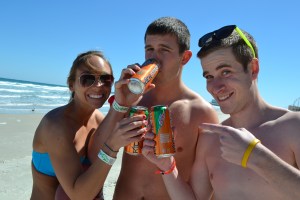
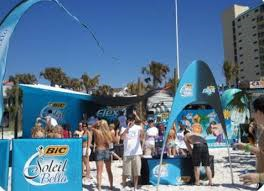
    Spring break is not an exception to this rule. It has become a hub for expensive and outrageous advertising campaigns. All through March, companies like Unilever and Gillette are infiltrating Daytona Beach and Panama City Beach in Florida with sponsored events, beachfront oxygen bars and ads on everything from the simplest of koozies to even pillow cases and shower curtains. Booths and buses line the street to attract consumers to a free gift bag that undoubtedly exposes them to their logo and their brand thousands of times that week.

    Companies are starting to get more creative, however. One New York Times article stated that “Crest has created a tooth-brushing station on wheels that will appear outside nightclubs. Even the Army National Guard has a spring break presence: it is hoping to attract new recruits in South Padre with an obstacle course on the beach and recruitment officers passing out information.”

    With all of this constant exposure to sunlight and advertising, one would wonder if it makes a difference in the sales of the products that are featured. The demographic of 18-24 year olds are fascinated with getting free things, and getting them immediately. We are not the group you choose to sit down and take a survey and receive something in the mail two weeks later.
    bic

    One company that has made it its mission to attract spring breakers is Axe, the brand that makes body sprays and shower gels, but is more famous for its provocative commercials and advertising techniques. They have been attending spring break since ’06, in which they first created the “Axe Boot Camp: Spring Break Readiness” campaign to attract young men to buy their products.

    That year, Axe also was featured in hotels with room keys stamped with Axe logos and posters in lobbies and elevators. The ads they featured before the week of spring break could’ve made mothers cringe at the thought, but young adult men fantasize about their spring break adventures. One ad offered “rules of engagement” on co-ed showering. Another gave tips on how to successfully proposition a woman in an elevator. Hotel guests were even given customized do-not-disturb signs that read “Mission in Progress.” One thing is for sure, Axe did not leave anything to the imagination for its consumers.
    axe

    As IMC students, we have a learned disposition to notice all and every advertisement and marketing technique we see, because we know that everything is advertising. The kids on spring break, however, see it as a free bottle of water in 80 degree weather. The companies behind these brands are obviously generating revenue or some sort of positive reinforcement from their time at spring break, but perhaps their real intention is to attract that demographic in hopes of sustaining a long term consumer to brand relationship. Nothing says vacation like a hot budding romance, and who says it can’t be with a brand?

    -Crystan Weaver

  • Students Help Students Travel

    Ready to experience the world with exclusive travel discounts and rewards without breaking your college fund? Well we found just the website to make this process and your travels go much smoother. StudentUniverse is a technology company that offers these incentives and many more through their website. The best part? Membership is free! StudentUniverse is the leading student travel agency with almost one-third of all U.S. college students visiting the site every year. The website and blog offered by this company are operated by college students themselves. This team of students creates and spreads the latest trends so you know the destinations chosen are the “hottest” vacation spots this year.

    This travel agency also coordinates campaigns to engage students with brands and destinations, gaining their attention and swaying purchase decisions. StudentUniverse sells exclusive airfares from over 60 airline partners as well as sale rates on hotels and tours all throughout the world. The company also writes a blog, likewise conducted by students, which discuss the latest and greatest deals. They offer apps that you can download that release discounts on hotels, tours and more. The blog posts also offer information and tips about the youth travel market and how this industry is growing. Airline deals are also displayed in the blog along with the benefits for international students. StudetUniverse also gives away free round trip flights to a maximum number of students and scholarships to study abroad.

    wales

    StudentUniverse recently introduced WeHostels, which is a new application for any smart phone that allows users to book hotels or hostels last-minute all over the world. It also features over 200,000 properties listed within the app. The target audience of this app is for students and young budget-conscious travelers between the ages of 18 and 28. WeHostels is currently  one of the most downloaded apps across the globe. It has been called one of the “100 Brilliant Companies of the Year” by Entrepreneur Magazine.

    One of the main components of WeHostel’s said brilliance is the emotional appeal of its campaign. Their campaign focuses on the destinations that people would like to travel to before death. This idea heavily utilizes pathos and pulls as the heart-strings of the target audience. WeHostels encourages people to deeply think about where they would love to travel most to before they die by using the hashtag “beforeidie” on Twitter. In turn of promoting the app via hashtag usage, WeHostels has made the promise to send a few lucky travelers on their dream bucket list journey. This is a prize that is sure to be coveted by inspired young travelers.

    In addition to promoting #beforeidie on Twitter, WeHostel has also created a video to display their mission of empowering young travelers. The video shows different individuals on the street saying where exactly in the world they would like to go before they die. Once again, pathos is strategically incorporated into this advertisement by providing young dreamers with a sense of empowerment.  In the end of the short video, WeHostels encourages audience members to go to their website to take the next step in making their dreams come true.

    The promotions and ideas that StudentUniverse provide are endless and the information is very beneficial for the average college student. StudentUniverse’s mission states, “It’s about getting the most out of your time in school. We believe in the positive effects that travel experiences can have on a person’s character and that having those experiences early on in life is critical in personal development”. They are a dedicated company who value the experience to travel and attempt to make the process a little easier. The company even offers a 24/7 customer support line for any comments, questions, or concerns at your convenience! Do you think that their use of pathos was effective in the overall advertisement of the app?

    -Briana McWhirter, Hannah Turner, Emily Foulke

  • PepsiCo Kickstart’s Spring Break 2014

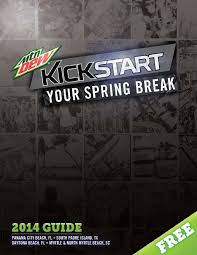
    At the start of every year, the Collegiate Marketing Group publishes a Spring Break Guide for college students across the nation. The guide was first published in 1992 providing travel tips, destination news and information on everything about Spring Break.

    kickstart

    The Collegiate Marketing Group specializes in the youth market and basically owns all territory related to Spring Break marketing. Their Spring Break Guide reaches an estimated one million students including the print and web publication as well as the students on social media.

    This year, Pepsi’s new Mountain Dew energy drink, Kickstart, is the featured annual sponsor, replacing Coca-Cola. The shift in sponsor seems to be due to PepsiCo’s efforts in supporting the Mountain Dew brand.

    kickstart2

    Kickstart was introduced in February 2013, and sales surged to more than 100 million in the first 6 months. PepsiCo is planning on supporting Kickstart even more in year two. Kickstart was given a 35% media spending boost compared to its first year on the market.


    This 35% can already be seen through the increased spring break advertising PepsiCo has been sponsoring. There are a number of things that PepsiCo reveals about themselves by choosing to spend their marketing budget on college spring break guides.  The first is that it identifies PepsiCo’s target audience for this campaign. A second thing is they are trying to associate this drink and its brand with the spring break scene (party, lights, sun, fun, etc).

    kcikstart3

    While these 2 things stand out, there are many other things to examine in this campaign.  While you are on spring break, will you notice Kickstart and give it a try? We’ll see how PepsiCo and Kickstart do with their promotional campaign.

    – Rachel Gracy & Greg Rothman

  • The Highlight of The Year: Spring Break

    Spring Break is one of the most anticipated times of the year for some college goers, where weeks prior to vacation students fantasize of their care free getaways, or basically anything far away from libraries and classrooms. Students spend thousands of dollars planning cruises, flights to foreign countries, or even traveling to famous college spots such as Panama City, Florida or Las Vegas, Nevada. However, we wonder how students figure out the most cost friendly and safe way to travel, especially when excessive booze is (more than likely) involved. Some students decide to take the independent route and rally with friends to make their ideal itinerary, whereas others might look towards travel services for guidance. While watching a rerun of The Real World: Cancun (It’s a guilty pleasure, promise) I had my IMC skills to notice a marketing strategy that integrated a service placement with the popular reality program. The Real World, which focuses on diverse strangers living in a house together over a few months, is a popular television segment amongst the 18-25 year old male/female demographic. This seems an appropriate age range for more spring breakers, so it wasn’t a bad idea for the show’s producers to throw in an advertisement for a spring break organization, conveniently located in one of the most sought after spring break destinations for United States travelers.  “StudentCity”, an organization that focuses on high school and college students, is a service that provides all access guidance to flights, hotels, parties, booze, the works. Their website even capitalizes on how spring break is a “rite of passage” and that their all access package is all you need for spring break!

    14a283aa7270a7

    The phrase “All publicity is good publicity” is a well-known, arguable phrase that can be regarded as true in awareness, however demeaning in quality or credibility. Throughout the season’s run of The Real World: Cancun, the cast were summoned to work at “StudentCity” each day, where job duties included: helping incoming travelers find their hotels, escorting students to parties or other locations, and organizing special events that (more than likely) off-camera revolved around The Real World: Cancun itself. Problems aroused when some cast mates got too intoxicated, cast mates neglected to show up for work, or disputes broke up in front of spring breakers. These conflicts were broadcast on the show regardless, and the organization clearly didn’t fight to bring down the negative actions of cast mates who worked for their company.

    This would be a problem for most paying companies, where they want their service to be shined in a positive light on a popular program. However, since the target audience for this organization seems to be 18-25 (and some room on the outside for untraditional spring break goers), did “StudentCity” appreciate the intoxication, fighting, and drama of the show that surrounded its company? In most situations, this Lindsay Lohan behavior would clearly be “bad publicity;” it leaves us wondering if this was the organization’s intention overall.

    Jami Rogers


  • “Dumb Ways to Die” Campaign—Dumb Enough to Work?

    What do you think of when you hear “Australia”? Accents? Kangaroos? The Great Barrier Reef? Wouldn’t it be nice to be there in lieu of the recent frigid weather? I bet two things no one would ever put together is Australia and train safety, but you probably will after seeing the two awareness commercials Australia has recently released for the Melbourne Metro.

    In 2012 “Dumb Ways to Die” was launched as a train safety PSA. The three-minute animated spot features personified blobs making outrageously stupid decisions –  setting your hair on fire, eating out of date medicine, using the clothes dryer as a hiding place, selling both kidneys on the Internet. With these demonstrations, comes a catchy song that illustrates each scene as it unfolds. At the 2:24 mark, the audience is introduced to train safety in which the dumbest ways to die are: standing on the edge of a train station platform, driving around the barrier at a railroad crossing, and running across the tracks.

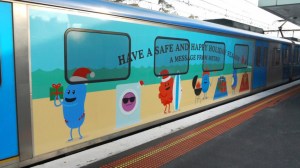
    This year, another PSA spot appeared just in time for Valentine’s Day. Titled “Dumb Ways”, the second video – this only ones 30 seconds – features the blob from the original spot who died from selling both his kidneys on the Internet and replicates the format of the first spot with the simplistic design elements, characters, and tune. Even though the new spot has absolutely no correlation with train safety, the advertisement’s copy reads “Be safe around Valentine’s Day*” and in smaller font, “*and trains”.

    With the release of the newest Valentine spot, it is obvious that McCann Melbourne realized the success first 3 minute spot reached with over 71 million YouTube views. However, the Valentine Day advertisement is relying on the presumption that the viewer has already seen previous campaign efforts, which include radio, print and outdoor advertising. The campaign even has some interactive media such as a fully functioning website and a mobile phone game app that offers short mini games where you can save the characters from their “dumb” deaths.

    There is no denying that the whole campaign is undeniably cute and captures attention, but the question is, is this direction effective?

    When asked about the creation and initial vision of the campaign, John Mescall, McCann’s executive director, said this, “The idea for a song started from a very simple premise: What if we disguised a worthy safety message inside something that didn’t feel at all like a safety message? So we thought about what the complete opposite of a serious safety message would be and came to the conclusion it was an insanely happy and cute song.”

    metrotrain_2

    What Mescall is describing is the use of logical fallacy or in our case irrelevant points. Usually the use of fallacies in an argument or message weakens it, but Mescall used it to his advantage, strengthening the impact.

    One logical fallacy, argumentum ad baculum, is an argument that uses threats or forces to cause the acceptance of the conclusion. Example: “Do this! Or ____ will happen!” “If you don’t this, ____ will happen!” The Dumb Ways campaign uses this fallacy’s appeal to fear in the explicit form of death – if you do these activities in the ad you will die – to remind people of the need for train safety.

    In addition, another logical fallacy is also used – red herring. In this type, a fallacy of diversion is created where irrelevant arguments or information is introduced into a discussion in order to divert people’s attention away from the issue under discussion and towards a different conclusion. No one needs to know all the dumb ways to die; almost all of the scenarios are things that are common sense. Except for the last 30 seconds, none of the scenarios are relevant to educating people on train safety.

    Over a year after the original launch of the “Dumb Ways to Die” commercial, the campaign has grabbed the attention of the world, educating all of us on train safety. What do you think of this PSA? Do you think the campaign could have been stronger if the agency had gone in a different direction?

    Savannah Valade, Elizabeth Harrington, Caroline Robinson

  • Hilfiger says No Filter Needed

    Every year, New York Fashion Week is anticipated by people around the world.  High-end designers, fashion photographers, bloggers, and models wait for all year for this week.  But this year, there was another audience counting down the days: Instagrammers.

    Tommy Hilfiger hired two popular Instagrammers Brian Difeo and Anthony Danielle to organize an InstaMeet, which is a get together for Instagrammers to take artsy pictures and share photography advice.  It might sound lame to us, but Hilfiger doesn’t think so.  He gave these two (as well as a select group of Instagrammers chosen by Difeo and Danielle) backstage access, seats to the Tommy Hilfiger Women’s Fall 2014 show, and an opportunity to meet the designer.

    lucky-instameet-fashion-week.jpg

    InstaMeets are becoming more and more common as a way to advertise events and brands.  Kat Irlin (pictured above), an Instagrammer in charge of organizing Lucky Magazine’s InstaMeet for Fashion Week, looks forward to InstaMeets.  “It’s such a cool way of bringing like-minded people together. People at InstaMeets are super nice and passionate about photography, and I’ve made so many good friends at InstaMeets,” said Irlin.

    Organizing an InstaMeet was Hilfiger’s way to cut through the cluttered world of social media.  Using technology like Google Hangout, Instagram, and the incorporation of iPhones into the runway walk is a sign of the times.  Jessica Sfera, digital and social media coordinator at Diesel, says that coming up with the next best thing is the only way to keep up. “It just gets increasingly hard to get through the clutter,” she says.

    Some are questioning Hilfiger’s decision to hire inexperienced photographers rather than experts.  After all, Difeo and Danielles have more than 100,000 followers and fashion photographers Chiara Ferragni and Aimee Song have more than 1 million followers.  By choosing someone with a tenth of the followers as other designers, Hilifiger may have missed out on some publicity.

    Did Hilfiger make the right call?

    – Christine Schulze