Blog

  • Censorship or Protection?

    Freedom of speech is covered under our Constitution and is a right in America. This freedom comes with responsibilities that are overseen by the Federal government. Law.com defines censorship as, “the act of altering, adjusting, editing, or banning of any or all media resulting from the presumption that its content is perceived to be objectionable, incendiary, illicit, or immoral by the Federal Government of the United States”. Social media is censored by law enforcement agencies for any type of activity that is deemed violent, threatening, illegal, or damaging with the intent of causing harm to someone.

    According to uslegal.com, the entertainment industry is the most obvious place to see censorship. Freedom of speech can be jeopardized by attempts to regulate movies, interfering with playwrights, screenwriters, filmmakers, performers, and distributors. The Motion Picture Association of America (MPAA) rates all movies based on age. These ratings have become more stringent over the years. Hometheather.com states Steven Spielberg was responsible for creating the PG-13 rating. His 1984 films, Gremlins, Indiana Jones and the Temple of Doom received complaints from parents who were concerned with some of the scenes. The laws do not prevent the industry from putting violence, sex, and/or profane language in films but they require ratings to advise when they are. The regulations have made it more difficult for children under the age of seventeen to buy movies and games without their parents’ consent. Many parents are pleased with this law because some people believe watching violent movies can bring out aggression in kids.

    So how does this affect advertising? Does a change in movie regulation mean a change in its viewers? If so, advertisers will be challenged to adjust to a changing market.

    What are your views on censorship? Can it go so far that we will lose our right to freedom of speech?

    – Susan Willetts

  • FDA Takes on Tobacco

    After the discovery of the harmful health effects tobacco products can have on the body, the method of selling and promoting tobacco has sparked many debates. Those in opposition to the advertising of tobacco question how companies can legally advertise their products that have been proven to cause damage to the body. In addition, children, who may not understand the grave danger these products can cause, could potentially view these advertisements and be persuaded to use tobacco products. In order to regulate the advertising of tobacco, Congress began censoring the advertising of cigarettes by banning promotions on television and radio in 1969. The censoring of advertisements continued in 1989 when Congress prohibited advertising directly to children. However, Congress did not stop there. New regulations have been released that further force the censorship of marketing tobacco products.

    While some agree to the censorship laws imposed on tobacco advertising, others posit that these regulations encroach on the company’s freedom of speech. Their main argument states that although it is commercial speech, it is still the company’s freedom of speech. Two large tobacco companies have already filed suit against the new laws on grounds of the First Amendment. Those in opposition see this as limiting the company’s freedom of expression by controlling what content they can release, and where. They also see it as the government not trusting individuals to make smart, informed decisions on their own.

    The U.S. Food and Drug Administration (FDA) issued  a broad set of censorship rules that affected the advertising and promotion of tobacco as well a set of new requirements relating to sales distribution of the product.  On June 22, 2010, the chosen rules were implemented into the law.

    cigs

    There are three primary requirements relating to the selling and advertising of tobacco. First, the rule banned tobacco brand names from sponsoring any athletic, musical, social or cultural event. The brand is also restricted from sponsoring a specific athlete or team at such events. Second, any audio advertisements were also required to use only words with no music or sound effects playing in the background. Lastly, the rule prohibits the selling of any items such as hats and tee shirts sporting tobacco brands or logos.

    Since the initial rule was issued by the FDA, another requirement was passed. Outdoor advertising on platforms such as billboards is also prohibited. Rules are continuously being presented to the court, attempting to create even more restrictions for tobacco advertising. Most recently, a rule was presented that would limit tobacco advertisements to using only black text with no graphics at all. This rule was denied.

    Tobacco sales have decreased significantly within the past 3 years. Do you think this is a result of the censorship laws the FDA imposed on the advertising of tobacco?

    – Hannah Turner, Emily Foulke, Briana McWhirter

  • How Fraudulent Web Traffic is Changing the Digital Advertising Industry

    Digital advertising is expected to grow by 17% and become a $50 billion dollar industry by the end of 2014. But, as billions of dollars continue to flow into the industry, an equally staggering statistic has emerged that has companies and advertisers seriously rethinking their online advertising budgets.

    A report released by the Interactive Advertising Bureau states that 36% of all web traffic is fraudulent, and not actually viewed or clicked by a real person. Online “bots” are created to visit fake websites and click advertisements repeatedly, while advertisers pay for these views believing they are reaching a real audience. The industry is struggling to find an answer for the overwhelming amount of fake traffic, and it could cause a major change to the industry.

    “When you bundle bots, clicks fraud, view-ability and the lack of transparency [in automated ad buying], the total digital-media value equation is being questioned and totally challenged,” said the chief executive of the Association of National Advertiser, Bob Liodice.

    However, even with 1/3 of web traffic officially labelled as fake, marketing executives are calling digital advertising “too important” to stay away from. In fact, digital advertising is still expected to rise to more than 28% of total U.S. advertising expenditures across all platforms and mediums. Advertisers are now demanding concrete viewership statistics as well as full reimbursements for significant fraudulent viewers.


    Two vital statistics in advertising are the “reach“, or the number of individuals exposed at least once to an ad, and the “frequency“, which is the number of times that a single person is exposed to an ad in a specific period of time. These statistics are the basis for all marketing and advertising strategies, and any strategic decisions over the effectiveness of that ad are calculated using these basic numbers. Because of the recent exposure of rampant fraudulent web traffic, many companies  are finding themselves questioning their involvement with digital advertising.

    How will the future of digital advertising be affected by these developments? Will fraudulent web traffic continue to increase, and ruin the credibility of digital advertising?

    – Greg Rothman

  • SOPA to end online advertising

    The internet today is an extremely powerful tool with almost limitless applications and opportunities for innovation. In the world of capitalism it can be argued that the internet has become the single most powerful tool used to market towards consumers. Online ad campaigns can drastically cut costs while potentially reaching a massive audience, especially if it happens to go viral. The analysis and interpretation of Big Data has enabled companies to quantify extremely specific trends amongst the everyday consumer. As the internet continues to evolve, so does the way in which Advertisers utilize it to market their products.

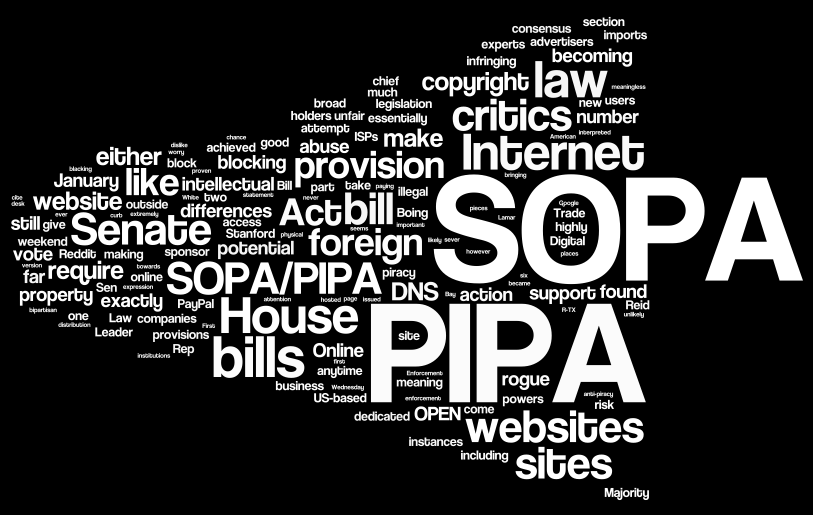
    Recently congress has yet again brought up the infamous SOPA bill challenging the liberty the internet provides and forcing all information online to be copyrighted and accounted for. SOPA is an acronym that stands for the Stop Online Piracy Act. This bill’s purpose is to crack down on online copyright infringement, by limiting access to sites popular for the trading of pirated content. You have most likely heard the saying that pirating is not a victimless crime, and we all know that is the truth. The question is, is this the way to go about solving the problem?

    Picture-33

    Now in theory this may seem like a good idea, but once we delve further into this topic it becomes apparent that there are much deeper ramifications. Now this does not merely affect owners/creators of internet websites, but also the online advertisers that cater to these websites as well. Rex Harris with Techli.com points out a potential threat to advertisers:

    “ For those that are unfamiliar, this is what happens when a publisher is unable to deliver in full on a contract (for instance, a guaranteed number of online impressions). When this happens, the publisher must “make it good” for the advertiser with either a cash credit, or by offering even more ad inventory that was initially contracted. Can you imagine what will happen when sites are temporarily being shut down on a regular basis or when sites are blocked from running their clients’ advertisements? Impression guarantees will be nearly impossible to keep, and SOPA will turn online advertising into an unstable, grossly inefficient business for everyone involved.”

    The overabundance of censorship will hinder online advertisers from doing their jobs, thus producing lower revenue for online advertising.

    Austin Johnson, Jade Johnson-Grant, Jami Rogers, Ty Thomas

  • FCC Reviews Rules and Regulations

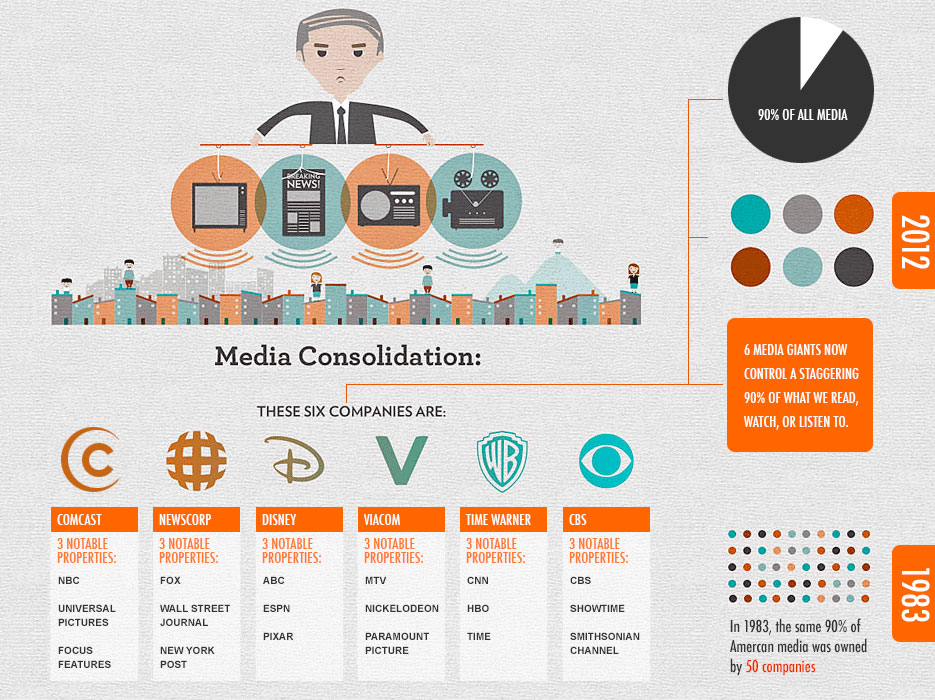
    As the final four teams prepare to battle it out in March Madness, it’s a sure bet that sports fan are waiting to see what else the tournament has in store this season. With coverage, updates, and analysis, it’s also a pretty sure bet that these fans are tuning into ESPN – the station that has become the sports authority. But did you know that the testosterone filled station is owned by a company that producers princesses fairytales – Disney? Did you know Disney also owns ABC, Marvel, Pixar, and Touchstone. Part of what’s known as the “Big Six” – Comcast, News-Corp, Disney, Viacom, Time Warner, and CBS – account for 90% of media ownership across the ­states.

    media_consolidation

    The process of consolidation through mergers and acquisitions, has led to media conglomerates – few companies owning all of the media outlets.

    Many argue that media consolidation hurts competition by blocking out new media companies. According to Senator Wellstone, media give people access to a wide variety of opinions, analyses, and perspectives and it holds concentrated power accountable to people. With only a few companies controlling all the media the two functions of media (listed above) are compromised. Specifically related to advertising, a combination of media also leads to monopoly over audience and advertisers.

    Today, the Federal Communication Commission (FCC), an independent US government agency responsible for controlling media regulation, will vote to make TV station’s joint sales agreements (JSAs) subject to current ownership rules. The commission will also vote on a rule that prohibits two or more of the top four TV stations in a market from jointly negotiating agreements with pay TV providers.

    Tom Wheeler, FCC Chairman, cited that the considered changes were motivated by evidence that suggested the rules that protect competition diversity and localism have been circumvented.

    JSAs are an arrangement many see as a loop hole around the limits on owning no more than two TV stations in a market. With endorsement from the Department of Justice, the FCC is now moving ahead with the rule “that if the owner of one station in a marketing sells 15 percent or more of the advertising time for another, then it will be deemed to have ownership interest in the station.”

    Broadcasters are fighting back. Gordon Smith, president and CEO of the National Association of Broadcasters, says, “The real loser will be local TV viewers. This proposal will kill jobs, chill investment in broadcasting, and reduce meaningful minority programming and ownership opportunities.”

    Stations that do have JSAs will have two years to dismember deals. However, stations can apply for a waiver in which JSAs will be examined on a case by case basis to determine if public interest is served by keeping the agreement.

    Additionally, as part of the 2014 review, the FCC will propose to keep the ban on owning more than two TV stations, but question whether the cross-ownership ban between TV, radio, broadcast, and newspapers should be lifted.

    However, while the five commissioners of the FCC will all vote on the issue, the ultimate decision may be left in the hands of just one, Democratic commissioner Mignon Clyburn. The issue has split the five down party lines with the GOP commissioners, Ajit Pai and Mike O’Rielly speaking out against the proposal. In order to advance the ruling, Wheeler will need the favor of both democratic commissioners.

    While the commissioners are deciding, we are left wondering to what degree will these rules affect our media markets? Will Clyburn’s decision trend toward more or less regulation?

    Tell us what you think. Should the FCC approve the JSA rule? Are media conglomerates affecting the free flow of information to society? Or has the Internet made possible enough independent outlets?

    Savannah Valade, Caroline Robinson

  • An Icey Spring

    With the coming of spring, consumers and brands alike are ready to celebrate. Rita’s Italian Ice turned it into an actual celebration. For no other reason than it’s finally springtime, Rita’s was giving away free Italian ice on the first day of spring last week.

    This year was the 22nd Annual Free Ice Giveaway. No purchase necessary – all you had to do was head to your nearest Rita’s between 12 pm (when the store opens) and 9pm. You had any of the 65 flavors to choose from and after that, only the third part of their motto – Ice, Custard, Happiness – was left to fulfill.

    Rita’s Free Italian Ice

    Of course, there was a social media component too. Rita’s guests were encouraged to post pictures of their free 12-oz cup using the hashtag #RitasFirstDayofSpring in hopes of winning some “cool” prizes. No word on what the prizes were, but Rita’s now has some cheery group photos of customers with their “Rita’s fix” on their website.

    It all started in 1992, when only a few Rita’s stores were open this early in the season. Since then, the company has grown to 600 locations in 20 different states that participate in the icy giveaway. Rita’s is also in the process of opening stores internationally in China, India, and Canada.

    Rita’s financial advisers were probably cringing with how many cups of free ice they were just letting people take for free. Over the years, more than 10 million cups of free ice have been given away. But there is obviously a method to the madness; how else could they continue the tradition for over two decades? The interesting thing is that Rita’s hardly promoted their event at all. Other than a few social media posts, there were no ads on TV or Youtube videos. It isn’t unusual for the company – they’re used to relying on word of mouth for their advertising. Even this guy helped boost their image by writing a song about their delicious treats:

    Do you think their hands-off approach is working? Or better question: did you get your Rita’s?

    – Christine Schulze

  • A Very Perry Spring

    We are now in the transitional time of year when all the bitterness of the cold winter is transferring into the sunny, light-hearted feel that spring brings. One particular brand that has always been known for its spring-like characteristics is easily that of Perry Ellis and they are bringing forth their positively electric style to match the approaching season. For the upcoming spring/summer 2014 campaign, Perry Ellis is delivering a new, creative way to show men that style can be a fun experience. The campaign was released back in the month of January which was titled, “A Very Perry Spring: We’ll Put a Spring in your Step”. The foundational idea for this campaign is to assist men on the breakdown of fashion (patterns, prints, how to dress in suits and even undress) and to extend the message that men’s fashion does not have to be too serious and that style can be unpretentious and fun.

    Perry Ellis launched his first line back in the year 1976 with the philosophy of levity being his legacy. The company is a distributor of a broad line of high quality men’s and women’s apparel, accessories, and children’s apparel. He believed that clothing should not be taken too seriously and should be fun. Perry Ellis redefined the fashion industry. Perry Ellis has coined the term that one could be labeled as, “very Perry Ellis”. This means customers of this brand are innovating their own unique style, instead of going with the fashion flow, and still looking chic.

    For the Very Perry Spring 2014 campaign, Perry Ellis reunited with photographer Daniel Jackson and the label top models, Jason Cameron and Albert Reed. The advertisements incorporated the foundation of levity in the brand by fashioning vibrantly colored imagery showing the models in various confident and playful poses. Showing that style can be a fun experience, the images seem to leap out of the frame. Whether it is a hand or a hat, the meaning of this photographic placement is meant to contrast with the brand’s iconic “time to defy convention” attitude.

    perry-ellis-spring-summer-2014-campaign-photos-0001

    perry-ellis-spring-summer-2014-campaign-photos-0003

    perry-ellis-spring-summer-2014-campaign-photos-0004

    Not only has the campaign mastered the traditional advertisements representing the brand’s legacy, but has also incorporated a new media strategy to reach consumers in the digital world. Matt Cronin, Vice President of marketing at Perry Ellis discusses the new media tactics will include “a series of engaging and witty videos which will bring the Very Perry attitude to life”. These videos consist of style tutorials for men and how to dress modernly. The style tutorials are entertaining, easy-going, and show men that dressing up is a lesson in laid-back attitude and breaking the rules.

    Perry Ellis utilizes these media channels to promote its brand and for users to stay connected:

    Facebook

    Perry Ellis’ spring campaign is also holding a “March to a Million Facebook Fans” with incentives for contenders to win prizes by helping the company reach 1,000,000 fans.

    Instagram

    Pinterest

    Twitter

    And the brands new style blog

    Brand tagline: “Very Perry”

    The Very Perry Spring 2014 platform delivers a fundamental point of view from which the brand operates and incorporates everything the company is built off of into this new direction of marketing.The campaign will include digital campaigns featuring both still and video assets advertising the versatility of outlets the line is offering.

    -Briana McWhirter