Category: Social Media

  • Have You Experienced the Rainbow?

    If you haven’t been to the Skittles website in a while (or perhaps, ever) now would be a good time to take a peek.  What you might expect to be a typical site, designed to provide advertisement and purchase opportunities, has undergone quite a facelift.  Unlike most sites, the website for Skittles has been reborn as a social media machine disguised as a blog.  Near the top of the page is the familiar Skittles slogan, “Taste the Rainbow.”  Scroll down a bit, and you’ll find an entirely irrelevant tweet from the Skittles Twitter account. @Skittles says, “It’s all fun and games until the chinchillas show up with the karaoke machine.” Next come a few phrases like “lace the train slow,” “trace the vein bro,” and “encase the faint glow,” all with coordinating pictures and all rhyming with the original slogan of “taste the rainbow.” Add a few quirky videos, more interesting tweets from fans, and many opportunities to share things via social media, and  you’ve pretty much summed up Skittles’ entire online marketing tactic.

    The Skittles commercials take on a similar level of oddity as their website.  Whether it’s a teenager catching “Skittles pox” from a “highly infected” friend with the message to “contract the rainbow,” or a guidance counselor eating Skittles out of a student’s unibrow with the message to “pluck the rainbow,” these commercials seem to be getting stranger and more extreme year to year.  So, do these weird messages work to promote their product?  Their 23 million Facebook fans, 47,000 followers on Twitter, and nearly 10 million views on YouTube would suggest that they do.

    As a product that has been a favorite with candy-lovers since their appearance in 1979, Skittles has little need for getting their brand noticed so much as keeping their brand relevant.  That’s exactly the idea behind their weird marketing.  By showcasing their social media followers on their website, and giving fans something different to talk about, Skittles is making people rethink what they already know about Skittles and driving them back to their brand.  The genius behind this tactic is that the product hasn’t changed.  What they are changing is stated right at the top of their site.  “Experience the rainbow.”  Skittles is changing the whole experience associated with their little chewy candies in a colorful shell to be more exciting and hilarious than before.

    What seems to appeal to consumers these days, especially to Skittles’ target market of pre-teens and adolescents, is the eccentric and the humorous.  Skittles has mastered both of these arts.  Not only are they staying relevant, they’re staying interesting.  As advertising trends continue to shift, Skittles will doubtless continue to meet the needs of their consumers and remain a favorite fruity snack to all.  The only question now, is what comes next.

    Ally Walton, Hannah Eure, Gene Lee, Lauren Habig, Erin Kiffmeyer

  • The End is Near…

    That’s right folks… election day is just around the corner! After a long year of campaigns taking over commercials, social media, and highway grass, it is high time the winners are decided. The question is: do you know who you will be voting for? If you find yourself in need of some unbiased information on the election, check out this non-partisan voter resource created by UNCW’s Media and Politics class! UNCW Know Your Vote is intended to help voter’s like you get the facts without the spin. Information is available on both the presidential and North Carolina’s candidates for governor. Along with links to fact checkers, mainstream media sources, and political blogs! Be sure to check it out and let us know what you think!

    -Alexandra Huss

  • “Saaaay Instagram!”

    Instagram is a mobile social media network. Pictures are the only content users can upload. There are no clickable links. Nor are there special types of profiles for businesses or celebrities. By doing this, Instagram has in a sense leveled the playing field. Brands, as of now, cannot pay to have their content promoted or purchase any sort of advertisements on Instagram.

    So why would a brand be interested in this? There doesn’t seem to be an advantage from a business perspective. How could a brand get the word out about their Instagram without being able to promote within the network? This is where the share ability on Instagram comes into play. Instagram users have the ability to share their Instagram posts on Twitter, Facebook, Tumblr, Flickr, and Foursqaure. Additionally, brands can use relevant hashtags on their pictures to draw Instagram users who may be interested in what they are Instagramming to their business account.

    Now that it is clear how a brand could draw traffic to their Instagram, it is interesting to look at the content brands post on Instagram and how these posts contribute to their brand identity. The content of the posts will vary on the type of brand and each brand’s individual needs. For example, Taylor Swift utilizes Instagram as a way to communicate her thanks to her fans and visually share parts of her life with them. Many celebrities use Instagram in this manner. It is effective in helping fans see celebrities as relatable people, and makes them seem less out of touch with the everyday reality.

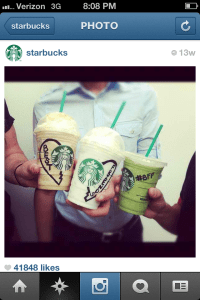
    Larger brands can also use Instagram in a variety of ways. Two of the largest brand accounts on Instagram offer an interesting comparison. Starbucks uses pictures taken of their products by customers that hashtag pictures with “#starbucks.” MTV takes pictures of celebrity visitors, backstage/onstage at awards shows, newly released videos or singles… anything that is happening at MTV is pretty much free game. Is one better than the other? The answer lies in brand identity. Starbucks strives to make a heartfelt connection with their customer base, while MTV relies on sparking their customers interest with the celebrity factor. For Starbucks, trying to make a heartfelt connection works. While they are an international chain, as a brand Starbucks wants to keep that feeling of the neighborhood coffee shop alive yet still provide consistent products globally. By highlighting the existing Starbucks customer base, the brand still appears personal.  MTV takes another route by using Instagram to revive their brand identity of music television. The majority of their Instagram is focused on new songs, videos, and musician sightings. This is a major change from their actual televised programming which ranges from scripted shows such as, Awkward. to reality shows such as the infamous Jersey Shore. By using their Instagram to focus on their musical brand identity, MTV is returning to their roots. Instagram is a way to appease the viewers who prefer the old MTV without all of the television shows.

    Whether it be your average individual using a filter to feel artsy or avid Starbucks drinkers expressing their love for a drink, this social networking site is creating a sense of community through a few simple taps on your smartphone. Brands can use this sense of community to make their customers feel more in touch with their products. Try scrolling down Starbucks’ Instagram feed without having your mouth water! Now where’s my Pumpkin Spice Latte?!

    – Alexandra Huss, Caroline Merrill, Alyssa Morrello, Lauren Van Trigt, Dann Williams

  • HubSpot: The Transformation From Outbound Marketing to Inbound Marketing

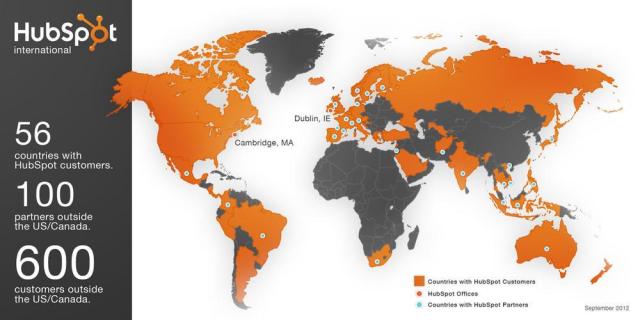
    Among the large variety of social media in today’s society, HubSpot, although not very well-known, has been a major pioneer within its field and has generated great success. HubSpot was created by Brian Halligan and Dharmesh Shah at the Massachusetts Institute of Technology (MIT) in June of 2006 and has been rapidly growing ever since. It is new strategic marketing software that is actively helping over 7,500 companies within 46 countries by generating personal research including blogging, social media, email marketing, etc. Hubspot’s marketing techniques have been used for online companies such as Twitter, LinkdIn, among many others.

    Brian Halligan, one of the co-founders of HubSpot, stated the following in one of his blog posts on the site: “Rather than doing outbound marketing to the masses of people who are trying to block you out, I advocate doing “inbound marketing” where you help yourself “get found” by people already learning about and shopping in your industry. In order to do this, you need to set your website up like a “hub” for your industry that attracts visitors naturally through search engines, the blogosphere, and social media. I believe most marketers today spend 90% of their efforts on outbound marketing and 10% on inbound marketing, and I advocate that those ratios flip.” This is the driving force behind the company today.

    With the competition that is present in today’s business world, it is crucial to have a tactical plan to further market one’s brand. HubSpot achieves this by taking the best inbound marketing techniques and combining them into one spot, which is exactly what HubSpot accomplishes. This innovative tool is not free, but there is a free trial run that one can sign up for prior to buying a full subscription. In a country where the use of social media has increased a whopping 356% in six years, it is no secret that social media is now a competitive market. A company generally needs to be utilizing social media better than their competitors to be successful. HubSpot helps with this because it compares a company to their competitors on a social level and teaches a company how to develop and grow faster than its competitors. It also educates companies on how to create exciting, new content for the public and how to use cross-channel campaigns. These services that HubSpot offers allow businesses to stand out in today’s very crowded business market.

    The proof that HubSpot is effective is in the statistics. Studies show that on average, after three months of use, HubSpot users experience 32% more leads per month and 24.6 times more leads after twelve months of use. In 2011, HubSpot grossed over thirty million dollars in revenue. Internationally, HubSpot is growing at a rate of 200% a year and even has scheduled to open a new headquarters in Dublin in 2013. The opening of this new headquarters is expected to provide 150 jobs for the citizens of Ireland and already employs 300 people in the United States.

    Since the creation of HubSpot in 2006, the company has been quickly evolving. Not only are more companies using it, but the company has provided many jobs in a time where new jobs are a worldwide necessity. With the increase of social media influence in society today, companies such as HubSpot are essential in aiding a company convey its message to a large pool of consumers.

    Sasha De Vecchi, Lindsay Gallagher, Jay Reilly, Cary Welborn

  • Celebrity Branding Through Social Media

    Nowadays, there is a wide variety of ways to advertise and promote one’s image as well as many products through personal branding. Celebrities are among the first to take advantage of the new social media phenomenon to further promote themselves and products they have endorsed.  Social media outlets such as Facebook, Twitter, YouTube, Instagram, Tumblr, Pinterest, etc. have been in a state of constant growth, as they cater to both the average consumer as well as celebrities. Interconnectivity has played a crucial role in keeping celebrities globally connected to a wider public in order to further promote themselves and gain a higher level of exposure.

    When it comes to many things such as self-branding and the use of social media, one must elaborate a thought-out, cohesive strategy in order to achieve optimum results. First of all, it is important to keep in mind that not all celebrities wish to accomplish the same thing through their social media outlets.  There are many reasons for a celebrity to join a social media site, from simply connecting with fans to promoting a product or event.  Also, each social media medium serves a different purpose and targets a more specific audience. In a recent trend, celebrities have been representing themselves by “opening up” and increasing their level of self-disclosure through many forms of social media. This could be due to the fact that it is believed that social media can be used to build trust with fans as well as build and develop a more personal connection with them by allowing them to see the “real” superstar.  For example, it is difficult to feel a personal connection to President Obama.  By following Obama on Twitter or Facebook, one might feel that this personal relationship has greatly improved.  Not only is this beneficial for the average American, but it could indirectly help Obama.  For example, someone that does not currently have a stance on politics could follow Obama on Twitter, like what they see, and vote for him in the next election.  This is just one example that portrays that social media outlets are a powerful, mass communication tool.  That being said, it is important for one to remain very conscience about what they say.  It does not take much for a tweet by a celebrity or political figure to create a huge controversy, whether or not they intended it to.  We sometimes forget that celebrities are human beings that make mistakes, and one of these mistakes could be by putting too much personal information on the internet.  Voicing an opinion can easily offend many other people.  The celebrity could in theory remove the tweet, but that does not mean it will be deleted from the Internet.  With the millions of followers many celebrities have and the fact that celebrities tend to keep social media outlets as public as possible, almost anyone could snap a screenshot of the tweet immediately and continue to circulate it through the web.

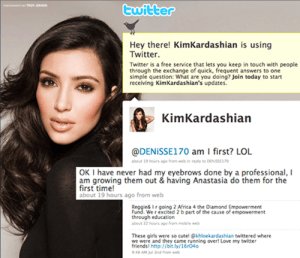
    While there are disadvantages for celebrities putting their lives on the World Wide Web, outlets such as social media can also be used as a free type of advertising or promotion.  Almost all main-stream celebrities have utilized multiple forms of social media from blogs to Twitter.  Britney Spears, Kim Kardashian and Justin Bieber are all examples of celebrities that have endorsed various products and used social media (more specifically, Twitter) to promote them. This has shown to be an effective marketing technique at little or no cost to them.

    Not every celebrity endorses a certain product, but they do essentially brand themselves when they decide post on social media sites.  Whether they mean to or not, the content they post reflects their personality and in turn, allows followers to characterize them.  Mastering how to effectively brand one’s self on these sites has in essence became a modern day art.  In today’s day and age, a social media suicide could destruct the celebrity’s image as a whole.

    Sasha De Vecchi, Lindsay Gallagher, Jay Reilly, Cary Welborn

  • Remember When… Social Media Was Not Overrun With Ads?

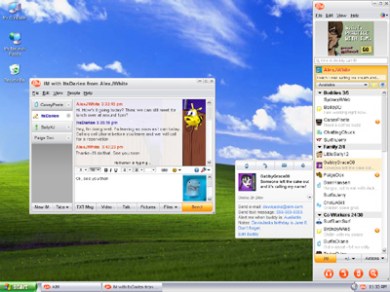
    Do you know how to transfer your buddy list? What is your Myspace song today? Why did you lower me in your Top 8? Where did you get your buddy icon? Remember when these were your biggest worries on social networking? Nowadays, a social networker must be fully aware of everything they post, every picture they are in, and even everything they click on.                            Image

    When social media first began, it is doubtful that anyone could have predicted where it is today. Employers search Facebook, Twitter, and LinkedIn before hiring new staff. School systems are implementing cyber bullying policies across the nation. Even our parents are sending us friend requests. It is hard to come by someone who doesn’t have a Facebook or Twitter. Due to the popularity of social media, it is no surprise advertisers want to tap into this huge online market.

    Image

    What began with AOL Instant Messenger, evolved into the Myspace fad, and now Facebook, Twitter, FourSquare, Pinterest, LinkedIn, and Instagram have joined the scene. After Myspace died out, there was much debate about how long Facebook would last. With the help of advertisers, it seemed like it could potentially last forever. Unfortunately, with the rise of other social networking sites, Facebook has seen a less than desirable decline in popularity. Now Mark Zuckerberg, the CEO of Facebook, is having to persuade advertisers to continue investing. In an interview covered by ABC News, he “[promised] better results as Facebook’s mobile app is made friendlier to advertisers.”

    What does this mean for users?  More advertising headed your way! If you’ve seen Facebook’s login page lately, you might notice that it has officially been sold. It is hard not to notice as it takes up more than three-fourths of the screen. When Myspace sold their front page, it was the first sign they were not cutting it anymore. Does this mean Facebook’s “in” time is ending soon too? Not if Zuckerberg can help it.

    You might notice the sidebar ads following more closely to your internet searches. As Facebook tries to evolve to keep up with the market, Zuckerberg stated that he would like to make Facebook a search engine that could compete with Google. It is no coincidence that the items you were looking for on Amazon a couple of days ago are popping up in the ads you see on Facebook.  Long gone are the innocent days of simply “lol”ing with your buddies on AIM.  It seems now more than ever before the public will become a constant target for advertisers.

    Will this increase in advertising on Facebook lead to a shift in which social network is the most popular? Will Instagram and Twitter combined be able to wipe out Facebook? Would it even matter because Facebook owns Instagram? Or will the dark horse network, Google +, take the internet by storm?

    G2G. Mom needs the comp. TTYL 🙂 ❤

    Alexandra Huss, Caroline Merrill, Alyssa Morrello, Lauren Van Trigt, Daniel Williams

  • #Eastwooding

    Clint Eastwood is a man of many roles: he’s a movie star, American badass, producer, director, and even politician.  Most recently, he can also add empty chair talker to the list.  Eastwood attended the Republican National Convention this past Thursday, August 30th. He was attending the convention to give an endorsement speech prior to Republican candidate Mitt Romney taking the microphone, and things got a little wacky.  Eastwood began talking and asking rhetorical questions directed towards Barack Obama to an empty chair on stage.   Almost immediately after the speech aired on television, Clint’s stint at the convention became a huge buzz on social media networks, such as Twitter, where #invisibleobama was trending.  Not only were people talking about Eastwood’s strange chair conversation, but people also began posting pictures of themselves reprimanding empty seats as well, giving rise to the internet’s newest sensation, #Eastwooding.

    Romney may not have known what the outcome of bringing Eastwood to the convention would be, but it was certainly a strategic move on his part. It is safe to say that even if no one was expecting such a social media buzz about the speech, Romney was definitely looking to add star power to his campaign. Barack Obama and his wife, Michelle, have become celebrities in their own right over the last four years. Obama has even taken to trying to downplay his celebrity in this election. This article from the Washington Times discusses Obama’s relationship with George Clooney. Obama is quoted as saying, “Clooney keeps his distance so that [the President] won’t be criticized for hanging out with Hollywood celebrities.” So it makes sense for Romney to try to bring in some celebrity credit, since after all, he is competing with the President who hangs out with George Clooney and was nominated by Oprah Winfrey. Who could be better to compete with those two celebrities than Clint Eastwood? Both candidates are trying to walk the fine line of celebrity endorsement. Obama has a little too much, and Romney has a bit too little. Why does celebrity endorsement even matter though? Celebrities are able to make campaign’s multidimensional and bring in more funds.

    Mitt Romney knew what he was doing when he brought in Clint Eastwood. He knew that Eastwood is a celebrated and respected actor that everyone can easily recognize. What the Romney campaign did not realize was the unintentional social media phenomenon that #Eastwooding would become. This trending topic got people from all over the country posting pictures of themselves speaking to empty chairs. Not only did it spark a riot via social media outlets, it also turned a national holiday, Labor Day, into National Empty Chair Day where people were encouraged to continue to post more pictures of empty chairs. Coincidence? We will let you decide that one. As for the Republican Party, their intentions of bringing in Mr. ‘Dirty Harry’ himself were well thought out and calculated in hopes that he would be able to rally the voters who are currently undecided to choose their candidate. Instead, the Republican National Convention of 2012 will forever be known for Clint Eastwood yelling at an empty chair as opposed to what issues the party stands for in this election. These unintentional acts can make or break a campaign. Will #Eastwooding have a lasting impact on the campaign? Will the President soon become #invisibleobama? Only time will tell.

    Alexandra HussCaroline MerrillAlyssa MorrelloLauren Van Trigt, Daniel Williams