Category: Non-Profit

  • Non-Profits of North Carolina

    Hello everyone! Today let’s recognize just a few companies who exist not for profit, but rather to help out those within their communities here in North Carolina.

    The Hope Center of Wilmington is a non-profit that helps the less fortunate, unsheltered individuals in the community to find homes and shows them how to do important life tasks that they may never have the chance to learn otherwise. They share food with local individuals who experience homelessness on every Monday, Wednesday, and Friday. Opportunities to donate or volunteer time are offered online.

    paws4people is quite a unique organization with many locations throughout North Carolina that helps to provide assistance dogs to those with various physical, neurological, and even psychological and emotional disabilities. These dogs are highly trained by volunteers for various purposes to help those in many communities. paws4people believes that all children with disabilities should receive treatment as good as any other individual and should be treated as clients. In their mission statement they believe that these clients should be like family.

    Unlocking Silent Histories while headquartered in Austin, TX has chapters located in both Guatemala and Pembroke, NC. They strive to provide indigenous youth of their communities with learning opportunities and encourages them to provide the world with the histories of their community and their heritage. The youth in these communities are taught leadership skills at a young age so that they can lead in expressing themselves. They are taught creative skills and digital skills so that they can create documentaries that tell their stories, and they can then share those stories with peers and with others around the world.

    We should all do our part to volunteer at organizations to support our communities and help make the world even just a little bit better.

    Tell us about some of your non-profit experiences down below!

    Andrew Moody ’17

  • A Symbol of Hope or Shopping?

    1
    http://www.sportivostlucia.com/?attachment_id=780

    Whether it be the NFL, Yoplait’s pink lids, or local breast cancer benefit events, like UNCW Communication Studies Society’s Rock for a Cure this Friday night, the color pink is plastered all over the nation during the month of October. As it stands, the pink ribbon is a universal symbol representing the fight against breast cancer. Over the past few years some critics have emerged saying this beacon of hope has merely become an annual marketing campaign. Nancy Stordahl, a blogger for the Huffington Post, criticizes the campaign and in 2012 she composed a list of the ten things she felt were wrong with the pink ribbon.

    You can find the full article here, but there are two points in particular she relates back to marketing that raise an interesting discussion. The first is that the pink ribbon is being used to sell stuff and has lost its original purpose, a purpose to unite this country and show our commitment to finding a cure. Today, marketers are using the pink ribbon to tie the cause to the products they are trying to sell. Stordalh even calls breast cancer the “shopping disease.” Customers are no longer buying just the product but they are now buying into the pink ribbon and what it has traditionally stood for. The typeology approach to IMC acknowledges that companies have products that look like another company’s products and services. However, it also points out that the market depends on common interests between themselves and the people who can help their company thrive. While the number of pink ribbon branded products on the market may be alarming, maybe marketers are giving consumers what they want – a deeper connection to a brand that allows them to make a contribution to something that has seemingly impacted them both.

    The second point Stardahl makes is that marketers are selling the idea of “selling good will.” If the consumer purchases a product that will lead to a company’s contribution, the consumer views this purchase as their contribution to the cause. This tactic allows corporations and organizations to sell more products and increase profits while enhancing their corporate social responsibility at the same time. In turn, consumers are able to buy into the commodity culture that surrounds the pink ribbon. They become part of the fight and part of the cure all while donning their pink ribbon branded merchandise.

    3
    http://www.shescribes.com/2010/10/free-60-day-membership-to-bjs-wholesale-club-for-everyone.html

    Next time you have the opportunity to join the fight, think local and try to avoid the marketing tactic of “selling good will” and supporting the “shopping disease.” If what critics say is true, and the pink ribbon has lost its symbolism for hope, strength and a unified commitment to a cure, is it ethical for marketers to continue using this symbol on their products? Let us know what you think about the national attention that is brought to the pink ribbon. Do you think it has become a marketing tactic or does it still representation of the fight to find cure?

    http://www.huffingtonpost.com/nancy-stordahl/breast-cancer-pink-ribbons_b_1951319.html

  • There’s a New Animal in the Jungle of Advertising

    How do you break through the clutter? That’s the question marketers and advertisers have to figure out with every campaign they produce.

    So how do they do that? By doing something unusual, unexpected, and memorable – guerrilla marketing. First coined by Jay Conrad Levison, guerrilla marketing relies on unique or unorthodox methods of advertising or promotion to gain consumers’ attention. Below is a video by Mango Moose Media displaying a couple of guerrilla marketing techniques.

    Guerrilla marketing is in your face, but there are a couple of core concepts (besides ultimate creativity) that make guerrilla marketing significantly effective. According to Elena English, “the idea is to play on human responses and emotions rather than present a sale, product release, or pitch”. The difference is the highlight on customer interaction with the goal of grabbing their attention, not selling them the product. English also explains guerilla marketing involves “extensive use of humor, lots of visuals, plays on “humanisms” and pop culture references”. So in honor of this, we found two completely different guerilla-marketing stunts that represent these core concepts.

    The “Storm Drains are the MOUTH of the River” campaign was done by the City of Reno to battle the city’s river pollution problem. In 2013, local artist were commissioned to paint storm drains as the mouths of frogs, fish, and octopus. To learn about the campaign and how its effectiveness was measured watch the case study, Art Vs. Pollution, below.

    As the video describes, the campaign worked to “humanize” the storm drains with a pop art style. The utilization of pop art to grab attention is not unknown to the marketing world. James Twitchell says in his book Lead Us Into Temptation that pop art on commercial packaging has been and is still grabbing the attention of consumers. It especially worked well in this campaign in which the cartoon aquatic species brought to life the message.

    All guerrilla marketing doesn’t have to be inanimate objects. Chobani used it to continue marketing efforts for the “How Matters” campaign, which works to position its yogurt as real and natural. Relying on the audience’s knowledge of its Superbowl commercial, Chobani broke through the clutter with a 1400-pound human bear costume.

    This realistic and naturally misplaced bear has gained over 4 million views in less than a month. The stunts effectiveness is due to the memorable bear’s search for food that is natural, which reinforces the brand message.

    Guerrilla marketing is limitless; it can be used for many purposes, such as reinforcing brands or gaining exposure for issues, and in many inanimate or animate ways. Yet, they all have one goal and this is to capture people’s attention. What do you think of these guerrilla marketing strategies? Do you think these companies used them effectively?

    Caroline Robinson, Elizabeth Harrington, Savannah Valade

  • Towels For Troops: Supporting Our Heroes

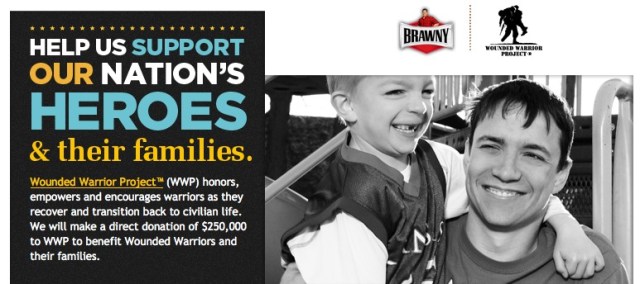
    I cannot speak for others, but one of the most quickly used products in my household is paper towels. Often times, it seems that they have to be bought on a weekly basis. Thankfully, Brawny, the paper towel company, recognized the necessity that paper towels have become and leveraged their product to help out a worthy cause.

    Last year, Brawny partnered with the Wounded Warriors Project to launch an “Inner Strength” campaign. For two years, Brawny has prided itself on standing strong alongside the Wounded Warrior Project (WWP) as a means of honoring injured service members. In 2012 alone, Brawny raised more than $500,000 for the WWP.

    hahahahaha

    For those of you who are unaware of the Wounded Warriors Project, it is a form of charitable support for members of the armed forces who were injured in the line of duty. Donations made to WWP help thousands of wounded warriors and their families as they return home from current conflicts.

    With great success, Brawny decided to continue this cause marketing initiative committing to raise $600,000 this year. As a means of accomplishing this goal, Brawny has promised to make a direct donation of $250,000 to benefit the WWP. They have also announced their pledge to donate an additional $1, up to $350,000 for every individual who: shares a “Thank You” note on the Brawny Facebook page, “likes” Brawny paper towels on Facebook, or texts THANKS to 272969.

    Large goals like this are often hard to achieve, but worth it when it comes to a good cause. In the study of rhetorical theory, Greek philosopher, Aristotle teaches the three modes of persuasion: ethos, pathos, and logos. In this example, Brawny is able to use cause marketing to appeal to pathos or the emotion of the audience, but this tactic is commonly used in cause marketing. Pathos is the strongest mode of persuasion; making it a more frequently used appeal.

    Personally, when I hear the word “persuasion” I immediately make the connection to an interchangeable and more frequently used term…Influences. Persuasion is a process directed towards changing or influencing people’s beliefs, attitudes, and intentions. Individuals are persuaded each and every day. Persuasion is a critical and underlying goal of all marketing and advertising efforts.

    The “Inner Strength” campaign is an effective form of cause marketing conducted by Brawny and the WWP. This particular campaign does an efficient job of persuading customers purchasing decisions by appealing to the audiences’ emotions. Customers are much more inclined to buy a product if they know that it is for a good cause.  It is that simple.

    In this case, customers are buying Brawny products because it is to their understanding that a percentage of the proceeds go to the WWP. This is because these consumers feel a sense of sympathy for wounded soldiers. This is a form of persuasion at its finest. Ultimately, cause marketing has proven to pay off in this scenario seeing how Brawny sales are through the roof and donations made to the WWP are at an all-time high

    Happy Thanksgiving!

    -Caitlin Ford, Parker Farfour, Alex Corrigan, Kaitlyn Batson

  • Dogfish Disaster Averted

    As we have gravitated towards becoming a society submerged in technology, in recent years, outlets of social media have become essential marketing tools for many companies and organizations.Facebook, Twitter, Instagram and Vine are few forms of social media utilized by most. While social media can strongly influence consumer behaviors and increase consumer awareness it can also be detrimental to a company’s image. In some cases social media can be the cause of a PR crisis. Crisis management is the process by which an organization deals with this major event that threatens to harm the organization.

    The American Red Cross is a prime example of an organization who exemplifies strong crisis management skills. This honorable humanitarian organization managed to dodge-a-bullet back in 2011 when an intern fired off a personal tweet on the company’s twitter account. The tweet read “Ryan found two more 4 bottle packs of Dogfish Head’s Midas Touch beer…when we drink we do it right #gettingslizzerd”.

    red cross

    This uniquely unorthodox and unprofessional tweet received a lot of negative attention from the general public. In this particular circumstance social media proved to be the cause of the crisis. When responding to the tweet the Red Cross avoided disaster by acknowledging that the tweet went out, deleting it, and explaining with humor that is was a mistake. This is an example of crisis management where the Red Cross turned a potentially harmful tweet in to an opportunity for engagement.

    Thankfully, the Red Cross realized the potential of social media and understood the power that it has to bring down a major organization. Now, other companies can look at this experience and utilize it to learn for themselves. After understanding the Red Cross’s response it is easy to break down their post-crisis steps and keep them in mind for other emergency situations. First, they were able to assess the situation. They realized the crisis was a major problem but they came to the conclusion that they could handle it which brought them to their second step, adapting their message. They considered their stakeholders and created a strong message to appeal to them. Lastly, they were able to analyze and learn from the situation post-crisis. Although this could have led to a horrific downfall for one of the greatest humanitarian organizations, everyone was able to benefit, understand, and learn from this experience.

    red cross 2

    -Parker Farfour, Caitlin Ford, Alex Corrigan, Kaitlin Batson

  • Government Shutdown affects Nonprofits

    On Tuesday October 1st, the United States government shutdown for the first time in 17 years. Who is out of work? With exceptions, most agencies without any funding from outside the federal government are forced to send “non essential” workers home, and “essential ” workers will have delayed pay checks. So what does this mean for the numerous nonprofit organizations who receive government funding? It looks like many nonprofit organizations are just going to have to wait it out. The interesting thing is, a time of a government shutdown leads to high demand for nonprofit organizations to help the community; but how the nonprofit organization is affected as a whole will depend on how long this period lasts.image

    In the Huffington Post, Tim Delaney, president and CEO of the National Council of Nonprofits response to the public states, “While business as usual in Washington focuses on partisan posturing and personal positioning, the business of serving communities doesn’t stop. Indeed, the needs of the people have escalated due to the all-too-steady stream of actual and threatened government slowdowns, shutdowns, and meltdowns. That’s why charitable nonprofits do all they can to keep their doors open to serve local communities across America”.

    Feeding America  addresses that depending on how long the shutdown lasts, programs like Supplemental Nutrition Assistance Program (SNAP- formally known as food stamps) and Women, Infants and Children (WIC) could be in danger as they currently only have enough funding to make it through October. If this persists, people who currently get assistance from these programs will seek alternative non profit solutions. Areawide Aging Agency , in Oklahoma, is one nonprofit organization receiving federal funding that could be affected soon. In an article on NewsOK, Marnie Taylor, executive director of the Oklahoma Center for Nonprofits states, “While in Washington they’re fighting to close doors, here we’re fighting to keep them open”.

    image
    Other organizations don’t have until the end of October. Meals on Wheels is getting hit by the government shutdown hard. In an article on mlive, Meals on Wheels executive director Alison Foreman states, “We get about $250k from the federal government so it’s more than half of our budget. If they don’t reach an agreement by Friday we won’t be getting any money on Monday to pay for the food.”

    Each of these organizations are now faced with handling this situation in a way that they’re reputation will not be a stake. The Situational Crisis Communication Theory by W. Timothy Coombs states that when an organization is threatened they need to react with a communication media strategy. How they are framed in the media will persuade the views of the organization to their publics. Not communicating possible threats is the worst thing they can do. After all, this is all that nonprofit organizations can do in a crisis like this while they wait for a government decision.

    -Kelsey Raskob

  • Less Cancer, More Birthdays

    “Imagine a world with more birthdays.” Everyone loves a birthday. Birthdays mean parties, presents, cake, maybe a few libations followed by the possible dancing, and just overall merriment. Birthdays celebrate life and represent another year in the world. It is pretty agreeable that birthdays insinuate a good thing and have an overall positive connotation. The American Cancer Society, which hosts Relay for Life-a walking event that is held across the nation and raises millions a year for cancer research and resources, has taken this phrase and integrated it into their marketing campaign to make people rally behind their cause. Now the phrase, “Imagine a world with more birthdays” has an even greater, even tear-jerking message. Imagine a world with less loved ones passing away from cancer and more people being able to be merry and on earth for another year.

    As the designated “Official Sponsor of Birthdays” the American Cancer Society takes hold of the emotional appeal of connecting their cause to everyday life.  The American Cancer Society uses slogans such as “Happy Birthday is a victory song,”  “A world with less cancer is a world with more birthdays” and many others to very effectively draw people into raising funds for the events.  Connecting something scary, like the often terminal illness of cancer, to the happy annual event of celebrating a birthday, something that everyone has, is a very innovative way to put the American Cancer Society’s cause at a relatable level for all.  Everyone may not have cancer, but everyone has a birthday.

    The fact that the American Cancer Society markets their events as a general celebration of life in general makes it appealing to those with cancer or those who have survived cancer because they are fighting and have fought to live and have more birthdays.  It also makes it appealing to those who haven’t had cancer because they get a chance to really celebrate, be grateful for their health, and the fact that they have been able to celebrate their birthdays without fear of them being shorthanded by cancer.  Finally, the message really digs emotionally when it comes to a person who has had a loved one pass away from cancer.  How amazing would it be to be able to celebrate one more birthday with that special person?


    As a society, we understand that messages are being thrown every which way to try to get us to do something.  While the American Cancer Society could use a percentage or amount of money to help get people to support the cause of cancer prevention and awareness, instead they opt to display their organization as one that can bring an immense amount of hope to all audiences.  It’s safe to say the proof is in the pudding.  The American Cancer Society’s Relay for Life had an astonishing 4 million participants and raises about 400 million dollars a year.  With a marketed identity of one that sponsors overall joy, the American Cancer Society has struck a chord causing a strong continued success that many charitable organizations long for.  Happy Birthday must be victory song after all.

    – Alexandra HussCaroline MerrillAlyssa MorrelloLauren Van TrigtDann Williams