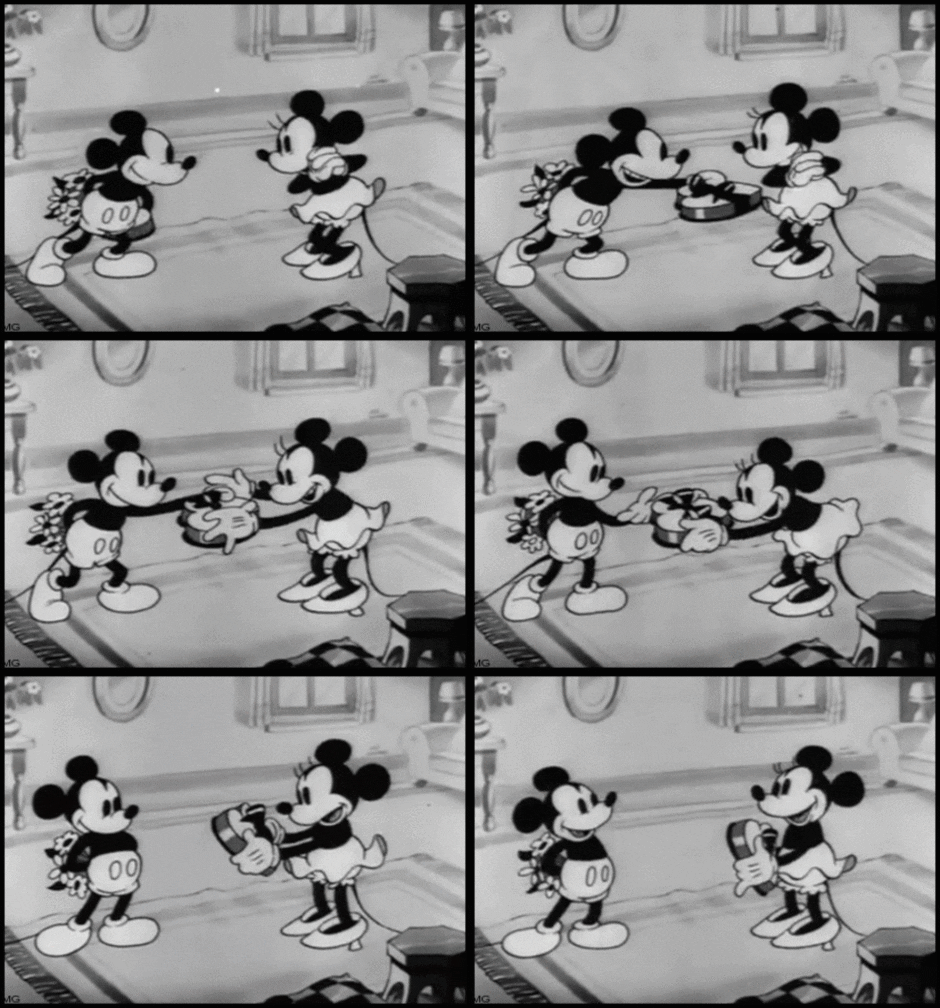
Today is the one day of the year where LOVE IS IN THE AIR, and it’s totally socially acceptable:
But before half of you start thinking already, “it’s just a Tuesday, the institution is a sham, love is dumb, I don’t care about Valentine’s Day”, this isn’t about the history of Valentine’s Day.
It isn’t about what you should get your significant other,
Our culture deems roses as the unofficial-official flower of February 14th. If any of you have talked to a florist or self-proclaimed flower expert, you know that there appears to be a cultural agreement that a color code system exists for what kind of roses you should get depending on the person or purpose they are for. I have put in some research, and this is the general internet consensus for which color roses mean what:
Red roses: Love and romance, the perfect way to say “I love you”
White roses: New beginnings or purity
Yellow roses: Friendship
Pink roses: Admiration and appreciation, the red roses distant cousin
Orange roses: Enthusiasm and passion
If you’re reading this hoping to figure out what rose you should give your significant other because you waited until last minute, congratulations, I just did half the work for you. If you’re like me however, and wonder why flowers have meanings to begin with, keep reading.
Flowers have been used to communicate human emotion and meaning for ages. There are stories dating back to ancient China, Egypt, Greece, and Rome that show flowers to be an integral part of social culture, such as gifting. Our society today identifies gift giving as a way to communicate and express something from gift giver to receiver. Even at less festive occasions like funerals, flowers are given as a way to communicate to the grieving family that you are sorry for their loss.
Hate it or love it, but I personally think that the fact that we as a culture communicate with each other through flowers, like colored roses, is fascinating. Sure it might all be a sham, it might just be a way to boost rose sales.. but it is also important to think about the implications rose giving says about our culture. We communicate in more ways than verbally speaking, even if it is just giving a flower.
So here is a toast to all of you, may the loves of your life get you red roses as an expression of their eternal love for you, and not yellow as a way to say “we need to be just friends”.
Donald Trump as a citizen and as a presidential candidate was known to get himself into sticky situations on social media, more specifically Twitter.
@realDonaldTrump engaged heavily in Twitter communication during the course of the election cycle. His ‘twitter-happy’ personality often came across aggressive and disrespectful. However, this was the brand that Donald Trump created for himself, as he knew what I was getting himself into.
Donald Trump, just minutes before the inaugural ceremony, took the time to tweet for the first time with his newly adopted Twitter handle @POTUS.
A little less than a month ago, on January 20th, Donald J. Trump was sworn into the Office. Also on that day, the now 45th President adopted the Twitter handle @POTUS. With this transition comes a bigger responsibility of how the President chooses to communicate using social media. President Trump must now reinvent his social media communication strategy, and re-brand himself as the President of the United States.
Former President Barack Obama was the first president to utilize Twitter to communicate with the nation; However, the 44th President was not nearly as dependent on this form of communication as is President Trump.
Ever since President Trump entered office, he has been utilizing Twitter and Facebook heavily. I have personally seen several events streaming live via Facebook. As many of us know, it can take up valuable time to generate a powerful message with only 140 characters. As students who are studying communication, we understand that a key skill to have in the process of “managing mutual responding” is to be able to generate effective and efficient messages to convey understanding to listening parties. It is not easy, especially with a limit of 140 characters. President Trump, however, seems to have no problems generating messages throughout the day among his Presidential duties. I can almost see the book on the shelf now…The Art of the Tweet by Donald Trump.
Regardless of anyone’s opinions of President Trump’s policies, decisions, and beliefs, he is still breaking through barriers by trying to cut out the middleman in bringing you important information. If he is able to maintain ‘presidential etiquette’, do you think it is appropriate for President Trump to continue his frequent tweeting? Can this help prevent news sources from misinterpreting his attitude towards something, or an event that occurred? Just a couple points to think about.
Life near the beach means seeing surf shops by the dozen. And what do you think lies inside these surf shops? Brands like Roxy, of course.
In 1990, Quicksilver began a venture to create Roxy, a swimwear brand that encompassed the female surfer, the first of its kind in a sport dominated by men. The brand grew and was well received by the surf-ette, and Roxy even created the first women’s board short.
So what can we learn from Roxy’s brand identity?
1. Their products are for women.
2. They target these products to women.
The logo, two Quicksilver logos reflected against each other to create a go to feminine symbol, a heart, encompasses the brand’s feminine spirit.
Roxy took a plunge into a market dominated by menswear, and came out drenched in success. But Roxy faces a definite challenge-
How do you advertise an all women’s surf-wear brand, especially swimsuits, without receiving backlash for objectifying women’s bodies?
The answer? I don’t think Roxy has been able to do it yet.
Critics were quick to comment on this ad for the Roxy Pro Biarritz competition from 2013 featuring surf pro Stephanie Gilmore.
This is the teaser video that doesn’t reveal Gilmore’s face, but the focus on her body was enough to send consumers into a critique frenzy
Advertisements seek to sell the product to the consumer, and noise, like a consumer not paying attention, can affect the ads effectiveness. The problem is that women’s bodies, even men’s, are often objectified as a tactic to break the noise that can distract consumers. Sex appeal holds attention, it gets consumers talking.
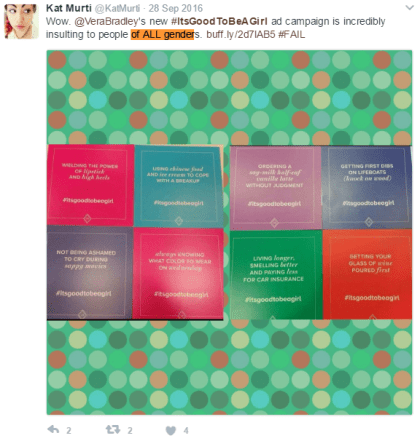
What are some alternatives when advertising a ‘women’s’ brand? Vera Bradley tried last year in 2016 with their #itsgoodtobeagirl campaign that was supposed to celebrate the everyday woman, and sell the luggage and handbag company’s products of course.
@KatMurti
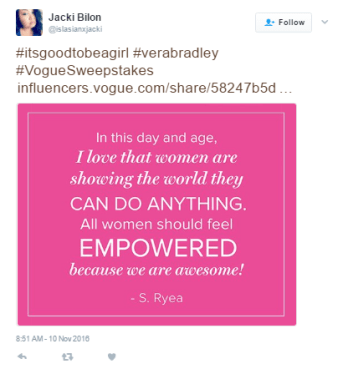
Consumers were OUTRAGED, calling the campaign sexist and offensive not only to women, but men as well (ouch). The campaign eventually released less abrasive content, and called on a more girl-power type approach by quoting inspiring women.
The hashtag #itsgoodtobeagirl is still trendy on Twitter today #PRsave.
@islasianxjacki
Gender objectification in advertising is obviously a hot topic to critique, but as everyone knows, sex sells. And when you’re trying to sell a product, you need to sell.
There has GOT to be a way in advertising that can celebrate and use the human body without objectifying it.
Since the Roxy Pro Biarritz scandal, Roxy has laid pretty low in terms of video advertisements.
The question is this, if you were Roxy, how would you continue to advertise your all women’s apparel and surf wear? Keep in mind surfing isn’t done in hoodies and sweatpants; it is done in swimwear, boardshorts, and wetsuits. So…would you use sex appeal, or pull a Vera Bradley and try something risky and innovative (even if it could possibly fail at first)?
Applying for jobs has many young adults worried. There are ways, however, to boost your chances of landing that job. Creating a Linkedin Profile is one way to show your professionalism and is a good way to network with countless other people, but you are probably thinking that many people have these profiles. How can you make yours stand out? We have some tips that you can use when crafting your profile.
Join as Many Groups as You Can
Linkedin allows it users to connect with others and start groups. It is important to be in groups because the more groups you are in the more likely you will be found when searched by an employer. Be sure to only join groups that are relevant to the jobs you want to get. The more groups you are a part of the more times your name your will appear in front of someone looking to hire. You can really make yourself standout by leading a group too.
Be Very Descriptive in Your Summary
The more descriptive you are in your summary the better your chances will be in attracting attention to your profile. This space allows you to tell what separates you from your peers. It is a good resource to share your story. Also, be sure to include many keywords in the “speciality” section so that when searched, your profile will show up sooner.
3. Keep it Professional
Your Linkedin profile should be completely different than your Facebook profile. Linkedin is not a place to chat with your friends or create a profile to see how many shares or likes it can get. It is about networking and giving companies an online representation of who you are. Your profile needs to be organized. If your profile is a mess then whoever is looking at your page will assume that you are a mess too.
Show off Your Work
Linkedin gives its users the opportunity to attach files or link websites in the profile. It is important to utilize this so that employers have a direct link to see the work you have done. Do not be afraid to show off your work and be proud of what you have done. Remember confidence is key. Make your profile a confident one.
Keep it as Updated as Possible
Your Linkedin profile should not be outdated. A profile is not created and then left to be alone. It should be in motion and kept up to date. Your profile needs to constantly be updated so that employers see all your experience. If you leave important information out then they will have no way of knowing of it. They can only see what you put out there. Adding that extra information could mean the difference between getting hired or getting overlooked. If you have experience then be sure to let them know. Do not limit yourself.
Let us know what you think of our tips and be sure to comment below if you have any of your own that you would like to share!
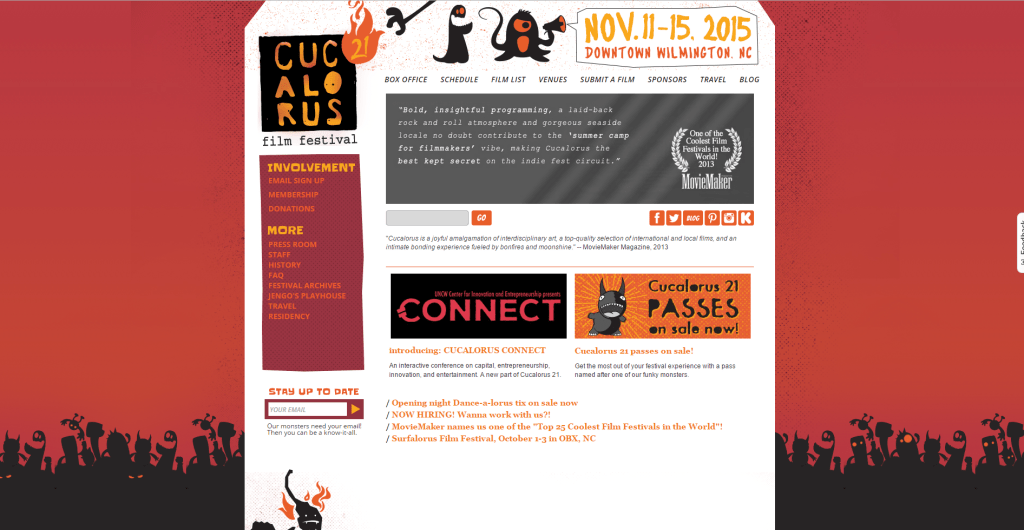
Cucalorus is Wilmywood’s premiere quirky film festival, showcasing independent films from local, national and international artists. Film connoisseurs sporting chunky glasses, artsy students in their thrift-store best and less interesting folk like you and I file into Thalian Hall (or one of the many other venues), settle down and wait for the lights to dim. This November will be the 21st year this little slice of art and culture draws people to downtown Wilmington.
I could barely convince people to keep coming after my twelfth birthday party, so how does Cucalorus garner a big crowd each consecutive year? A cohesive brand narrative, that’s how. And Cucalorus’ brand narrative is nothing short of weird—but in the good way. Let’s explore what makes Cucalorus cool.
It’s in the copy
While none of these factors are ranked in any specific order of importance, I am a word person and always like to read and evaluate the voice of an organization. Many organizations forget about this, not capitalizing its subtle importance. Bad organizations.
Cucalorus, on the other hand, has got its copy down pat. The copy, whether it’s online, in print or broadcasted on the radio, is how an organization communicates not only its news or events, but its personality, its voice and its image. Here’s a snippet of copy from Cucalorus’ donation page on their website:
“Hey Cucalorians!!! Do you need to get rid of unwanted cash? Make a donation and we’ll send you a tax deduction letter to send your fuzzy little friends at the IRS (they don’t need your money and clearly don’t know what to do with it!!). We do know what to do with it – we’re already plotting and scheming for the 21st annual Cucalorus Film Festival – taking place November 11-15, 2015!!! Help us fund the dreams and visions of artists all over the world by making a donation today.
Dreaming of eggnog omelettes!
Cucalorius.
The Cucalorus Film Foundation is a 501c3 non-profit and your donation is tax deductible to the fullest extent of the law.”
On first glance this might sound unprofessional and not the voice an organization would want to convey. The context, though, is important. Cucalorus’ audience is mostly the aforementioned artists, hipsters and independent film connoisseurs and Cucalorians. These types of people generally like funny, creative and quirky things (like Cucalorus). These types of people also tend to be skeptical of the IRS—not to mention the state cutting NC’s film incentive last year. So yes, it might be OK for Cucalorus to be a bit irreverent, and it’s their creative risk.
Digital presence, dude
If your business doesn’t have some sort of online presence (an email address counts), I would like you to write to me immediately by carrier pigeon and explain how you’re still surviving. An online presence is increasingly important each year, and now just having a website and Facebook isn’t cutting it. Brand cohesion across appropriate social media networks and inter-connectivity between them is vital.
Cucalorus not only has a website, Facebook, Twitter, Pinterest, and Instagram but their own blog and—drum roll—they are all updated. Bravo, Cucalorus. Content creation and audience engagement are essential to a successful IMC strategy.
Creepily consistent image
This one is tandem with the digital presence. IMC consists of advertising, public relations, marketing and every other single communication an organization can perform with its publics. Consistency in corporate communication allows the organization and its audiences to construct a narrative and image of the brand. This is what people can relate to. This is how we can see the quirkiness, irreverence and artsy personality of Cucalorus as if it were that weird kid in your English class who would always have some snappy reference to an obscure book even your professor hadn’t read. But less annoying.
The color scheme and design is consistent. The font-faces, graphics and little cartoon dudes are consistent. There’s well-organized navigation and that copy I was talking about earlier. The social media pages follow suit. There’s an article on this if you’re into academic papers. Basically, the author, Simon Torp from Odense University in Denmark, says that as an organization your communication through all channels must be consistent, accessible and in line with your self-image, public image and meta-image for people to take you seriously.
Zany staff workers
When I said all channels of communication, I meant all of them. Even the staff workers and volunteers need to be carefully selected and even briefed on an organization’s code of conduct. One time I went to a screening of a Cucalorus film at Thalian Hall and, not to get into too much detail, I, with the rest of the audience, was sternly asked by staff to partake in a ritual involving whipped cream, button pins and our tongues. Was I offended? No, but I could have been if I had been misguided by thinking Cucalorus was actually a convention for neo-Puritans. Because their self-branding and self-image don’t suggest that, I could expect something out of the ordinary. It’s the risk that Cucalorus takes to maintain its image and appeal to its target audience.
High-quality product
When it comes down to it, a business or organization is only as good as its product. Silly brand narrative and image aside, Cucalorus does a good job at what it does. It recruits and selects excellent film talent from around the world and showcases it in quality and entertaining venues. This is where word-of-mouth comes into play. Word-of-mouth marketing or WOM is an organic and invaluable means of public relations, advertising and marketing. Have you ever read a positive news story about an organization you love? Or has a good friend of yours recommended a product or service they favor? These are examples of WOM that can make or break an organization depending on whether they are in favor or against it. Maintaining the balance between brand narrative, professionalism and good business sense is how an organization thrives. While Cucalorus does an outstanding job of its own branding and controlled media, its reputation for quality and intrigue reign in filmmakers and spectators every year.
I am no way affiliated with the Cucalorus film festival professionally, nor do I represent it. I recognize good IMC in organizations and talk about it here. But, if you are tired of what the local theaters are playing, check out a showing of something interesting between November 11 and 15 downtown at Cucalorus.
With the rapid growth of new products, brand extensions and the blurring of traditional and new age advertising, marketing and advertising to target audiences has reached a new level of competitiveness. Brands now must adapt to this changing environment and contest with competitors to stay at the top of their market and target to audiences in creative, attention-grabbing tactics.
The most iconic brand in the soda market, and throughout the world, is undoubtedly that of Coca-Cola. In the summer of 2011, Coke created an original marketing strategy to run a campaign that would inspire people to connect with the brand both online and offline in order to acclimate to the changing marketing environment. The campaign’s prime objective was to increase consumption of Coke over the summer season and to get people to fall in love with the iconic brand again. Particularly, in Australia, at the time nearly 50% of teens and young adults had never tasted a Coke and this drove the brand to reconnect with the country.
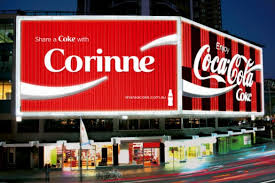
Established in Australia, the ‘Share a Coke’ campaign immediately received positive media attention and consumer responsiveness. The idea of the ‘Share a Coke’ campaign was to place Australia’s 150 most popular names on the front of millions of Coca-Cola bottles, simple right? This was the first time in 125 years that Coke had made such a paramount transformation to it packaging, and it was revolutionary.
“We used publicly available data to review the most popular names in Australia and ethnic representation in Australia to ensure the diversity of our multi-cultural nation was represented appropriately.”
– Coca-Cola Spokesperson.
The Coca-Cola brand wanted to initiate conversations by putting Australians front and center and inspire them to connect with people and ‘Share a Coke’. The central theme that gave ‘Share a Coke’ its power was the way a brand so universal could replace its logo with individual names by reaching out to consumers and personalizing its brand to individuals.
“We are using the power of the first name in a playful and social way to remind people of those in their lives they may have lost touch with, or have yet to connect with”
-Lucie Austin, Marketing Director for Coca-Cola South Pacific.
The ‘Share a Coke’ campaign strategically exhibited that when personalization in advertising is done the right way, it can be highly appealing and extremely effective. While Coke got personal, media was buzzing with talk over what the brand was implementing behind the personalization. Coke remained silent until Australia’s highest rated media weekend. The campaign was revealed to the public and aired across the biggest weekend in Australian sport, during the AFL (Australian Football League) and NRL (National Rugby League) grand finals which reached over 30% of the population.
Succeeding the campaign launch, requests for more names were coming in the thousands. Coke was prepared for this boom of requests by setting up kiosks that toured 18 Westfield shopping centers attracting consumers to personalize any name on a Coca-Cola bottle.
Coke wanted to especially reach out to the 50% of young adults that had never tasted a Coke in Australia, and there was no better way to reach this target market than online. Participation and mass allocation was achieved through Facebook by providing consumers with the resources to connect and ‘Share a Coke’ by creating a personalized virtual Coke bottle to share with a Facebook friend. Consumers were tagging friends in pictures with personalized Coke bottles and sharing stories on social media platforms like Twitter, Facebook and YouTube. Coke consumers also could create their own commercials! With the abundance of requests still pouring in, Coke told consumers to put in a vote of “who do you want to share a Coke with the most?” via Facebook. After 65,000 people voted, Coke bottles with 50 new names were released. “Consumers were invited to SMS a friend’s name, which was projected live onto the iconic ‘Coca-Cola’ sign at Sydney’s King’s Cross. They then received an MMS enabling them to share their friend’s name up in lights, via Facebook and email.”
The multi-platform communications strategy was implemented to ‘Share a Coke’ with someone you know, or want to know and ultimately gave people the resources to find, connect and share. After 3 short months of running the campaign, young adult Coca-Cola consumption increased significantly in Australia by up to 7%, making 2011 Coke’s most fruitful summer season in history. The ‘Share a Coke’ campaign resulted in 76,000 virtual coke cans shared, 378,000 extra coke cans printed at kiosks, and 5% more people were drinking coke. Coca-Cola had successfully won over Australia and became a part of popular culture again.
With just a couple weeks until another one of the biggest card holidays, Mother’s Day, card companies are gearing up their promotions. Last week, American Greetings released their new ad, “The World’s Toughest Job” and with over 14 million views in just one week, it’s safe to say the video has gone viral. This call to action is sure to have you considering whether or not to switch from Hallmark to American Greetings this year.
Prior to this advertisement, American Greetings ads consisted of mainly cute animals – much like the ones you can find on their actual greeting cards. What these ads were missing were what this recent ad captured – emotion evoking concepts – something competitors such as Hallmark have been relying on and capturing for years. See Hallmark’s “Proud Mom” ad below:
Yet, it seems that even Hallmark couldn’t capture the raw emotions that the Mullen Agency was able to evoke from the interviewees – simply starting with a job posting and 24 interview candidates. The finished piece was a compilation of honest reactions that left viewer’s hearts melting.
The American Greetings’ spot isn’t the only ad that has played on the love and appreciation of our mothers this year. Proctor and Gamble’s “Thank You, Mom” series showed the mother as much a part of the Olympics as the athletes themselves. Several other companies including British Airways and General Electric have recently produced ads centered on mothers.
So what do these “tribute to mom” ads tell us and why do our hearts warm when we watch them? Understanding how advertising works tells us the answer. Ads tell us what is virtuous and what is our ideal world. These “shout out to moms” tell us what we virtue – the compassion mothers have and the love families have for their mother. In the ideal world, that appreciation would be shown by a card everyday, but since this isn’t the ideal world we hope to make it up on Mother’s Day.
So what do you think about all these ads centered on Mothers? Is it ethical to exploit this relationship that our society holds so valuable? Will you turn to buying an American Greetings card this holiday or stick with Hallmark?















 IMC Hawks Blog