Category: Media Ethics/Censorship

  • The Shallows: What the Internet is Doing to Our Brains

    Have you ever wondered as technology continues to advance and we continue to use this technology, what effects this might have on us?

    It is not something that most people think about every day as most of us only see the benefits that new technology brings. Sure the challenge to stay in the “real” world is evident, as social media has become more and more prevalent, but what about more long-term effects that all of this technology can have.

    The Shallows by Nicholas Carr, a 2011 Pulitzer Prize finalist, answers this question as it relates to possibly one of the most impactful advancement in information technology, the internet.

    The infographic below illustrates Carr’s two central ideas about how the internet is changing the way we think.


    Whether it was books, clocks, or maps, these forms of information technology have always influenced the way humans thought, and the internet is simply the newest tool at our disposal.

    Carr’s First Point 

    Carr’s first point is that the human brain is always developing.

    He refers to experts in neuroscience to prove that the brain continues to change in response to its environment. Depending on the stimulus, the neural pathways in our brains are rerouted in response.

    Once Carr establishes that our brains are susceptible to change, he explains how the internet is forcing us to think in a non-linear fashion, as opposed to the traditional linear way of thinking that books made us think in.

    The Effects of the Internet

    This non-linear way of thinking means that we are now more accustomed to scanning for pertinent information as well as receiving information with minimal effort. So even when we are done using the internet, the effects of the internet do not leave use. Our brains still want to process information in this non-linear way.

    The benefits of using the internet and thinking non-linearly are that we can process more information faster and more efficiently than ever.

    The question now becomes, as we continue to use the internet, will these benefits continue to outweigh the potential downsides.

    Check out The Shallows to find out if the internet is changing the way we think for better or worse!

  • How Social Networks Can Make Us Smarter: Social Physics

    Anthropology, sociology, and psychology are all branches of science that have previously explained human behavior. But the Digital Age has introduced the need for a new way to look at how the new social networks are affecting human behavior and the rate and flow of ideas: social physics.

    new-piktochart_21509652_1ef5bfb0b34122c710c4f669bbdab5cd053d5698

    Alex Pentland’s, ‘Social Physics’ is a series of research the MIT scientist has collected through the experiments of both his own and of others’, about how the digital breadcrumbs we are leaving are explaining vast new areas of human behaviors.  Social physics starts with understanding that the way we look at human behavior now; as groups in markets or classes, is OUTDATED. And too broad. Pentland proposes that we create more than enough data to study within our own networks of individual interactions.

    Here is a breakdown of the book in 4 parts:

    Part I: Social Physics- The basic breakdown of Pentland’s idea. The two building blocks of social physics are idea flow and social learning. Idea flow is essentially exploration, the process of finding new ideas, and engagement, creating a behavioral norm from the idea. Social learning is creating human behavior from idea flow.

    • One of Pentland’s most interesting studies called The FunFit study is in this part, and basically, supports the idea that social network incentives can create organizations guided by change (it starts on pg. 67)

    Part II: Idea Machines- Breaks down how social physics is composed of patterns of interactions, and those patterns create intelligence. When a pattern of interaction is created, things like creativity and productivity are affected and increase.

    Part III: Data-Rich Cities- This part is the base of part IV in Pentland’s book, and explains the local effect of social physics. One interesting point in this part is that we essentially create 3 basic patterns that ‘set the rhythm’ of your neighborhood, city, etc. The patterns;

    what you do on your typical school/workday

    what you do on your days or evenings off from pattern #1,

    and lastly, what you do every once in a blue moon, the wild card days

    are exposed by our digital breadcrumbs, and can be seen from something as small as your mobile data usage. These bread crumbs can be used to directly measure human behavior. The population is defined by tribes, all of which have their own 3 patterns where rhythms are predictable every day of the week.  Even disease spread in your neighborhood is affected by social physics.

    Part IV: Data-Rich Societies- Wraps up the whole idea of the book and applies it to society as a whole. Because of the ease of access to all of the data we are leaving, exchanging, and creating, there needs to be a new way to look at privacy. Pentland’s New Deal on Data proposes 3 things:

    you have the right to have data that is about you.

    you have the right to fully control the use of data that is about you.

    you have the right to spread or destroy data that is about you.

    In Greek mythology, Prometheus gave life to his clay figures with fire.

    Social physics is that fire. So what does it all mean? Are we truly progressing? Will we regret it all?

    You are already living social physics-

    you might as well read it , and understand it (

    and understand it.

    (and you might as well buy it for as low as $3.98 on Amazon)


    Kayla Millie ’17


  • FCC Reviews Rules and Regulations

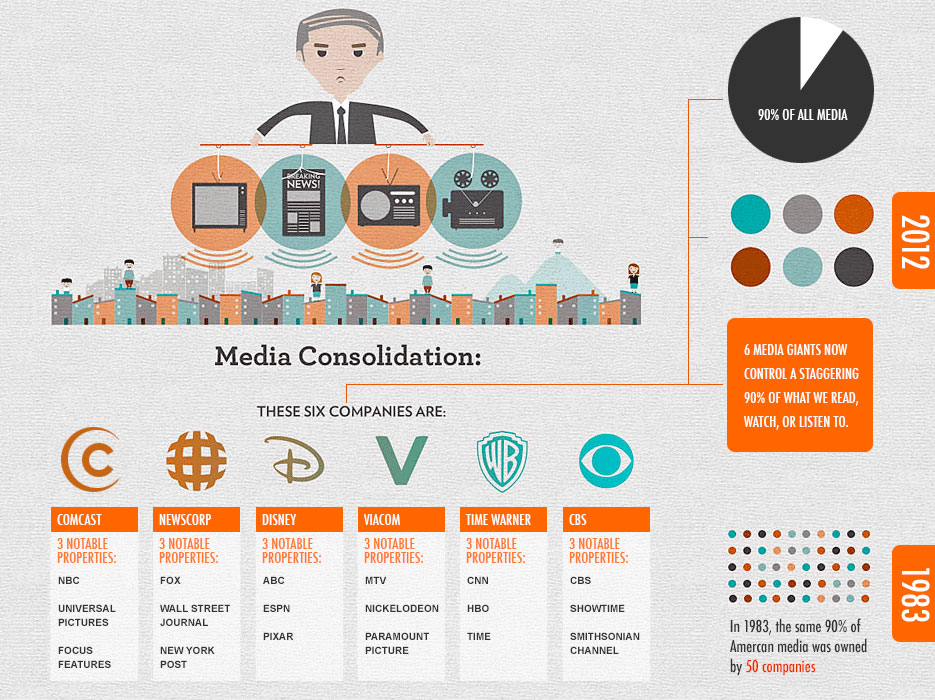
    As the final four teams prepare to battle it out in March Madness, it’s a sure bet that sports fan are waiting to see what else the tournament has in store this season. With coverage, updates, and analysis, it’s also a pretty sure bet that these fans are tuning into ESPN – the station that has become the sports authority. But did you know that the testosterone filled station is owned by a company that producers princesses fairytales – Disney? Did you know Disney also owns ABC, Marvel, Pixar, and Touchstone. Part of what’s known as the “Big Six” – Comcast, News-Corp, Disney, Viacom, Time Warner, and CBS – account for 90% of media ownership across the ­states.

    media_consolidation

    The process of consolidation through mergers and acquisitions, has led to media conglomerates – few companies owning all of the media outlets.

    Many argue that media consolidation hurts competition by blocking out new media companies. According to Senator Wellstone, media give people access to a wide variety of opinions, analyses, and perspectives and it holds concentrated power accountable to people. With only a few companies controlling all the media the two functions of media (listed above) are compromised. Specifically related to advertising, a combination of media also leads to monopoly over audience and advertisers.

    Today, the Federal Communication Commission (FCC), an independent US government agency responsible for controlling media regulation, will vote to make TV station’s joint sales agreements (JSAs) subject to current ownership rules. The commission will also vote on a rule that prohibits two or more of the top four TV stations in a market from jointly negotiating agreements with pay TV providers.

    Tom Wheeler, FCC Chairman, cited that the considered changes were motivated by evidence that suggested the rules that protect competition diversity and localism have been circumvented.

    JSAs are an arrangement many see as a loop hole around the limits on owning no more than two TV stations in a market. With endorsement from the Department of Justice, the FCC is now moving ahead with the rule “that if the owner of one station in a marketing sells 15 percent or more of the advertising time for another, then it will be deemed to have ownership interest in the station.”

    Broadcasters are fighting back. Gordon Smith, president and CEO of the National Association of Broadcasters, says, “The real loser will be local TV viewers. This proposal will kill jobs, chill investment in broadcasting, and reduce meaningful minority programming and ownership opportunities.”

    Stations that do have JSAs will have two years to dismember deals. However, stations can apply for a waiver in which JSAs will be examined on a case by case basis to determine if public interest is served by keeping the agreement.

    Additionally, as part of the 2014 review, the FCC will propose to keep the ban on owning more than two TV stations, but question whether the cross-ownership ban between TV, radio, broadcast, and newspapers should be lifted.

    However, while the five commissioners of the FCC will all vote on the issue, the ultimate decision may be left in the hands of just one, Democratic commissioner Mignon Clyburn. The issue has split the five down party lines with the GOP commissioners, Ajit Pai and Mike O’Rielly speaking out against the proposal. In order to advance the ruling, Wheeler will need the favor of both democratic commissioners.

    While the commissioners are deciding, we are left wondering to what degree will these rules affect our media markets? Will Clyburn’s decision trend toward more or less regulation?

    Tell us what you think. Should the FCC approve the JSA rule? Are media conglomerates affecting the free flow of information to society? Or has the Internet made possible enough independent outlets?

    Savannah Valade, Caroline Robinson

  • Personal Preferences vs. Employer Requirements

    Six weeks until graduation here at UNCW. Ask any senior what’s on their mind and I can almost guarantee it has something to do with employment – resumes, cover letters, interviews, portfolios.

    It is our goal to make a good impression on our potential employers in every form – in person, on paper, and increasingly important, online. Searching someone’s name can yield a lot of information – sometimes too much information.

    In the COM Department, many students will enter fields where managing an online presence is part of their job responsibility. Here is where we enter the public versus private debate. We have been told that our social network sites should be kept public so that prospective employers, especially those in the marketing field, can see what we post about, how often we post, and if we’re keeping up with the latest trends. But what if companies aren’t making the public or private view a personal preference? What if they are demanding access to your accounts? Other than directly asking for your log in information, employers are also asking applicants to friend a human resources manager, or log in to a company computer during an interview.

    American Civil Liberties Union (ACLU) attorney, Catherine Crump said: “It’s an invasion of privacy for private employers to insist on looking at people’s private Facebook pages as a condition of employment or consideration in an application process.  People are entitled to their private lives. You’d be appalled if your employer insisted on opening up your postal mail to see if there was anything of interest inside. It’s equally out of bounds for an employer to go on a fishing expedition through a person’s private social media account.”

    Facebook’s privacy officer, Erin Egan, also weighed in on the issue: “In recent months, we’ve seen a distressing increase in reports of employers or others seeking to gain inappropriate access to people’s Facebook profiles or private information. This practice undermines the privacy expectations and the security of both the user and the user’s friends. It also potentially exposes the employer who seeks this access to anticipated legal liability.”

    Much of what these employers are doing could be illegal. When interviewing, every human resource staff member knows that some topics are strictly off limits. Asking one of these off limits questions could put your company at serious risk for being sued for discrimination. Yet by using to social media investigation or review, this kind of off limits information can be collected about a potential employee even before their interview.

    Here are some examples of questions employers cannot ask:

    –   Are you married?
    –   How old are you?
    –   Do you have children? If so how many and how old are they?
    –   What church do you attend?
    –   Do you belong to any social or political groups?
    –   Do you suffer from an illness or disability?
    –   Are you taking any prescribed drugs?

    And for women specifically:

    –  Do you plan to get married?
    –  Do you intend to start a family?
    –  Are you likely to take time off under the Family and Medical Leave Act?

    McNees Wallace & Nurick LLC describe the issue as “Tempting Fruit from a Poisonous Tree”. They give the following example:
    Applicant – Alex Jackson – catches your eye. Excellent resume, degree from a New York Ivy League school, published in trade magazine, active in community, and has excellent references. You decide to pull their Facebook page to get a better feel for the applicant. You find Alex is a 42 year old female, active in the Catholic Church, recently married, and has one year old son. A recent posts says “Please pray for my mother as she recovers from her most recent bout with cancer.”

    Just like Alex’s, your profile probably reveals a lot of the same information. In just a matter of a few clicks, race, age, religion, gender, and medical history have all been revealed – and are all illegal questions for an employer to ask. In a worst case scenario, an employer could even get sued under a variety of Acts if one felt such factors contributed to swaying a hiring decision.

    Social media continues to blur the lines of public and private. Be prepared for your interview – know what questions are likely to be asked, but also know what questions you don’t have to answer. How do you feel about employers requiring to see your accounts? Acceptable or infringing? Where should the line be drawn? Is there a compromise that can be made?

    – Savannah Valade

    Make sure to keep up with the blog this week as the team explores more employment trends in preparation for COM Studies Day this Friday. Students and alumni are encouraged to attend the informational panels, fashion, and networking events that will take place throughout the day. This is a great opportunity to learn, ask questions, and get advice . For those who cannot attend the events, follow the IMC Hawks here on Twitter as we will be live tweeting, as well as live blogging, throughout the day’s events.


  • Ambush Marketing, Rule 40, and the Sochi Controversy You Aren’t Hearing About

    Have Olympic advertising partnerships gotten too big? Have rules and restrictions protecting these “official sponsors” gone too far?

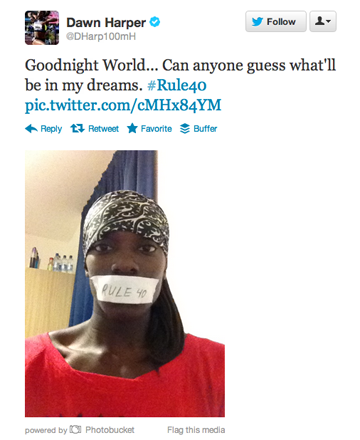
    Dawn Harper Tweets her Opinion of Olympic Rule 40
    Dawn Harper Tweets her Opinion of Olympic Rule 40

    Two-time track and field medalist Dawn Harper thinks so.  That’s why she posted this tweet with #Rule40 in protest of the IOC’s infamous Rule 40 during the 2012 Olympics in London.

    If you aren’t yet familiar with Rule40, it is a total ban on an athlete’s promotion of personal sponsors and their ability to acknowledge those who helped them get where they are today. It is especially focused on social media, where it has become a commonplace for athletes to thank sponsors with pictures and personal statements.

    Harper isn’t the only athlete to voice her displeasure with the effective “gag order” on competitors, but with companies spending upwards of $100,000,000.00 to associate their brands with the Olympics Games, is it really that hard to see why #Rule40 is in effect?

    Some have even gone as far to refer to the situation as a “battle”. Yet, despite the activism surrounding #rule40, without a doubt the biggest threat to the official Olympic sponsors is the ever-pervasive ambush marketers, silently stalking and waiting for their chance to steal some the Olympic brand name.

    These controversial ambush marketing campaigns attempt to capitalize on high-visibility events and locations through brand association without having to pay for the high-cost of officially sponsoring an event. My favorite example of ambush marketing involved the Minnesota Timberwolves selling this advertisement on the side of their stadium, where it happens to only be viewable from inside the nearby Minnesota Twins baseball stadium (where the official sponsor is Target).

    View of Timberwolves basketball stadium from inside the Twins baseball stadium
    View of Timberwolves basketball stadium from inside the Twins baseball stadium

    Ambush marketing may have been around in the advertising world for years, but the Olympics are seen as “the flagship event for ambush marketing”. Creative campaigns by infamous ambush advertisers like Nike often times attract more online buzz and conversation than the actual official sponsors.

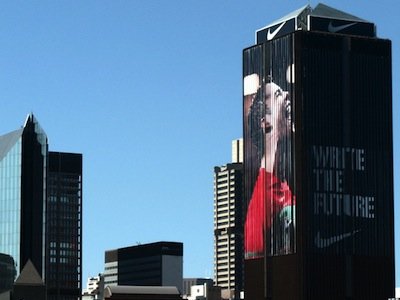
    During the 2010 World Cup in South Africa officially sponsored by Reebok, advertising juggernaut and infamous ambush marketer Nike, placed an eye-catching ad on the fourth tallest building in the entire city of Johannesburg. When paired with a lengthy viral video, many agreed that Nike had effectively hijacked the sponsorship from Reebok and gained closer brand association with the World Cup event.

    Nike ad in Johannesburg during World Cup 2010
    Nike ad in Johannesburg during World Cup 2010

    Another ambush marketing giant, Subway, has already launched its attempt to steal some association from the upcoming Sochi games.  Summer Olympian Michael Phelps and retired speed-skating icon Apollo Ohno both appear in TV commercials for Subway’s “$5 foot long campaign” due to some legal loopholes discovered by Subway.

    So is it reasonable for the IOC to implement Rule 40 to help protect sponsors? Freeskiier David Wise recently commented that, “[he] understand[s] the Olympics are a moneymaking game, but it’s sad for [him] to have all these sponsors who have really taken care of [him]…[he’s] on the biggest stage [he] can possibly be on and [he] can’t give them the representation they deserve.”

    Another athlete and social media enthusiast, Nick Goepper, has stated that he will be completely off of social media for the entirety of the Olympics. “I think it might be safer not to tweet anything,” said Nick, the 19-year-old favorite to win Ski Slopestyle gold. “All I know, it’s pretty much zero tolerance for branding.”

    The Sochi games are only 3 days away, but the media blackout protecting the games’ sponsors has been in effect since January 26. When the final medal is awarded and the closing ceremonies complete, which brands will you associate with the games? Which advertisements and commercials will be the most talked about and discussed? Is $100,000,000 too much to pay for a loose association with the Olympic rings?

    Will the “ambushers” steal the spotlight once again?

    – Greg Rothman

  • Igniting Your Inner Marlboro Man

    Image

    On January 10, Eric Lawson, an actor who played the “Marlboro Man” in print and outdoor advertising for the cigarette brand from 1978 to 1981, died from chronic obstructive pulmonary disease, commonly known as COPD—a disease frequently caused by smoking. Lawson was 72.

    Lawson isn’t the first Marlboro Man to die from a smoking-related disease. At least three other men who acted in the iconic campaign died due to causes linked to smoking cigarettes. David Millar died from emphysema in 1987, Wayne McLaren from lung cancer in 1992, and David McLean from lung cancer in 1995. McLean’s widow sued Philip Morris in 1996, claiming McLean had to smoke up to five packs of cigarettes per TV commercial filming. TV commercials for cigarettes were banned in 1971.

    The rugged, masculine Marlboro Man campaign was introduced in 1955 to market Marlboro to men, because at the time, filter cigarettes were regarded as feminine. The campaign ended in 1999, when the use of humans and cartoons (see Joe Camel) were banned as a result of the 1998 Master Settlement between tobacco companies and the state attorneys general. Today, cigarette advertising is primarily in magazines and retailers.

    Now, the very product the Marlboro Man advertised is ultimately taking away the actors’ lives. After he hung up his hat for Marlboro, Eric Lawson was an anti-smoking advocate, appearing in a public service announcement and a segment on Entertainment Tonight about the negative effects of smoking.

    Image

    Looking back at the cigarette ads of yesteryear, they definitely weren’t ethical, but they sold a lot of cigarettes. The Lucky Strike ad from 1930 claims a pack of Luckies protects against obesity. Today, we are more educated and know the real harm cigarettes cause. The percentage of adult smokers in the U.S. has dropped from 43 percent in 1964 to 18 percent today. (http://www.pbs.org/newshour/bb/health/jan-june14/lushniak_01-12.html)

    With the rising popularity of e-cigarettes, brands such as Blu are taking a “tough and masculine” approach. Does this ad remind you of something?

    Image

    Advertising for e-cigarettes does not fall under the same regulations as tobacco advertising because the product does not contain tobacco. However, e-cigs have not been proven safer than traditional cigarettes. Did Blu make an ethical choice by channeling Marlboro’s now-infamous campaign that made Marlboro the most popular cigarette brand in the country? Blu is a young brand that is advertising in a fashion similar to Marlboro did when it was new. If e-cigs are found to be not at all safer than tobacco cigarettes, should they be subject to the same regulations? What will it take to regulate e-cigarette advertising? These are questions to ask about the ethical implications of cigarette advertising today.

    -Nathan Evers

  • You can’t have your Coke and drink it too

    It’s one of the pillars of successful marketing, target your audience. Individualizing ads to particulars groups or regions of consumers ensure that messages have the most impact. But what happens when a company features a controversial scene in a spot, then removes it for some audiences and not others? Good marketing move or failure to take a stance?

    In its newest global campaign, “Reasons to Believe” Coca-Cola set out to inspire consumers that no matter what happens in life, it’s those small happy moments that make life worth living.

    Check out the commercial below.

    In most European countries the ad contains a scene of two gay men holding hands in front of their wedding party. However, in the Irish version (the video below) the scene has been replaced to feature a bride and groom.

    The Irish LGBT publication, EILE Magazine, brought attention to the issue, calling the removal an “inexplicable move”. In response to the criticism, Coca-Cola said that the advertisement had been tailored to individual markets so that the ad resonates with the people in each country where it is shown. The company defends the decisions saying that grooms were excluded from the Irish version because gay marriage is not legal in the country. EILE Magazine claims the Coca-Cola reasoning moot. The footage of the two grooms is known to be a video clip from a same-sex union ceremony in Australia – equivalent to a civil partnership in Ireland. Yet gay marriage is also illegal in Australia, but shown there. EILE claims the spot should have been suitable for Ireland as well.

    Coca-Cola has unequivocally made public their supporting stance on same sex marriage. Since 2006, the Human Rights Campaign continues to award Coca-Cola with a 100 percent ranking of their company polices and practices regarding LGBT. The Coca-Cola Company notes on their website, “To achieve a perfect score, companies must have fully inclusive equal employment opportunity policies, provide equal employment benefits, demonstrate their commitment to equality publicly and exercise responsible citizenship”

    Many are saying that Coca-Cola’s recent actions were hypocritical. Coca-Cola claims to support gay marriage, but their choice to remove a gay marriage scene from a commercial in Ireland, in which law does not prohibit such imagery, is misleading of the company’s values. Similarly, another beverage icon, Starbucks, has also gained attention for their hypocritical actions.

    Bryant Simon discusses the company Starbucks in his book Everything But the Coffee. Through his research he comes to discover that Starbucks isn’t delivering what they are promising in their brand – good coffee with little environmental impact. Claiming to buy fair-trade coffee from Rwanda and Nicaragua farmers, Starbucks was actually buying from bigger farmers and only buying 5-6 percent of fair-trade out of all the total coffee purchases.

    Much like Starbucks claiming to be environmentally friendly yet not taking the necessary steps in order to be green, Coca-Cola’s actions were just as misleading; claiming to support gay marriage yet removing a scene from one version of a commercial for the sole purpose of trying to please everyone.

    As future and current brand ambassadors we have to remember that every decision we make, including company policy decisions, become an integral part of brand, and when decisions are made that contradicts that it hurts the brand.

    On the other side of things, as consumers (and as Simon states in his book) we have to remember pursuing “solutions to highly complex social problems through buying and buying alone” doesn’t fix the problem or change the ideology. We have to stop relying and believing that buying certain brands is going to change a social issue.

    So, does Coke’s decision to take out the gay marriage scene hurt its brand identity? Should companies take stances on social issues? What practices do you follow to make sure this brand conflict doesn’t occur in your company or with your clients?

    Savannah Valade, Caroline Robinson, Elizabeth Harrington