Category: Entertainment

  • Tackling Consumers

    A round of applause for the Seattle Seahawks as the champions of the Super Bowl XLVIII. Even if you were not a fan of either the Broncos or the Seahawks, it almost a sure bet you tuned into the game. Every year over 100 million people observe what is arguably the sporting event of the year.

    The Super Bowl, however, is known for more than a fierce round of football – it’s known for the commercials. Here is time where advertisers pull out all the stops. Audiences expect commercials of both artistic and humorous grandeur. Prices for spots annually rise, this year topping at $4 million for a 30 second spot.

    Yet companies don’t spend millions for spots merely to entertain viewers. Unlike in decades past, advertisers are no longer in the business of explaining, but in the business of convincing and reinforcing. This is often the purpose of commercials we see every day. So, other than the guaranteed viewership, what is the worth of a Super Bowl spot?

    Credibility, claims Joe Glennon, assistant professor of advertising at Temple’s School of Media and Mass Communication. In an article for the Philadelphia Business Journal, Glennon explains that many advertisers walk away from the exorbitant price tag due to the simple financial standpoint that $4 million for 30 seconds is a largely impossible return on investment. He explains that of those who do justify the expense there are two primary advertisers – large, well known, companies who use the spots to reinforce brand propensities among current users, and smaller companies who use the spot as a means to launch into the market by gaining notoriety.

    So, in the myriad of last night’s entertainment, we have selected four commercials that beautifully represent the two credibility building categories Glennon noted; some attempting cut into, or further into the market, others reinforcing brand attitudes.

    Squarespace

    Squarespace created a spot that was a humorous, but accurate depiction of what the Internet is like – cluttered. Personifying memes, obnoxious advertisements, and the “duck face”, Squarespace offered to consumers that when using their services for website building and maintenance, the company could alleviate such distraction. So, why did Squarespace make it onto the list today? Simple, the Squarespace commercial introduced the company values and brand in a creative, weird, funny, and somewhat true way. Justifying the $4 million dollar expenditure seems to working so far – we are talking about – there’s probably a good chance other people are too.

    WeatherTech

    Although the ad was neither humorous nor heart-warming, WeatherTech’s commercial built on a sacred theme in the Super Bowl: American pride. Their slogan, “American Factories, American Raw Materials, and American Workers”, was enough to draw people’s interest and introduce their company as a defying the odds, sticking with their gut, and overcoming obstacles many American companies have faced. During a time when many gripe about US jobs becoming outsourced, it’s hard to say that WeatherTech didn’t prove their credibility with their national pride.

    Cheerios

    Yes, the adorable little girl is back and this time she is getting a brother. This 30-second ad wraps up what all of us remember of Cheerios and what the Cheerios brand wants us to remember about them; families coming together over love. Here Cheerios is showing how they are continuing to be a hearty and healthy part of growing families.

    Bank of America/(RED)/U2

    What does this commercial not do? It introduces U2’s new song “Invisible” (there is still time to get your free download if you haven’t done it), it highlights and raises money for the charity (RED), increases knowledge of AIDS/HIV, and shows Bank of America’s humanitarian efforts. Reinforcing their slogan, “Life is better when your connected”, Bank of America is giving a chance for its customers and the world to connect by helping to end an epidemic.

    What is your opinion? Do you think these commercials deserve a spot in these categories? What other commercials did you see that introduce the brand or reinforce existing brand propensities?
    Caroline Robinson, Savannah Valade

  • New Season, New Drama

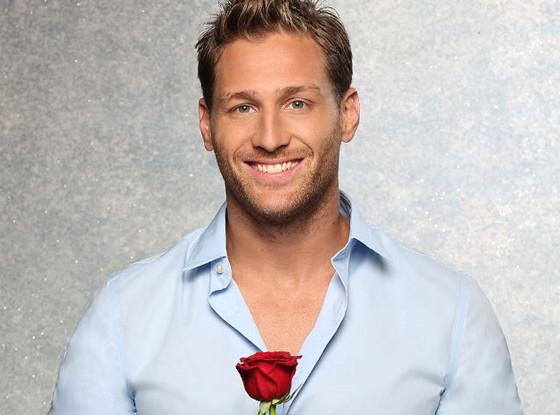
    For 7.8 million people, winter wasn’t too cold and lonely.  Their break was filled with anticipation and whispers about Juan Pablo Galavis, the new bachelor on ABC’s hit show The Bachelor.  As the first Latino to be featured on the show, his good looks and Spanish accent had women across the country swooning.  Now, almost three weeks later, Juan Pablo is still causing a stir – but for very different reasons.

    In an interview this past week, Juan Pablo gave a very controversial answer to whether he thought The Bachelor should make a gay or bisexual version of the show.

    “I respect [gay people], but I don’t think it is a good example for kids to watch that,” he said.  “There’s this thing about gay people — it seems to be, I don’t know if I’m mistaken or not — I have a lot of friends like that, but they’re more pervert in a sense.”

    Bachelor Nation recoiled at Galavis’ less-than-sexy response.  Some Juan Pablo fans rushed to his defense, but members of the gay community were more outspoken.  One Facebook user accused Galavis of knowing exactly what he was saying, as “pervertido” is the Spanish word for pervert.

    Even Bachelor producers felt the need to do some public relations acrobatics.  Producers tried to shift any blame away from the show and entirely onto Galavis, saying “Juan Pablo’s comments were careless, thoughtless and insensitive, and in no way reflect the views of the network, the show’s producers or studio.”

    juan pablo

    Juan Pablo later apologized through Facebook. He insisted that throughout the interview, he had nothing but respect for gay people and their families.  He did not mean to use the word pervert, but misspoke because of his limited English vocabulary.  He claimed to have only meant that gay people are more affectionate and intense, which might not be viewed positively by some of the TV audience.

    Juan Pablo probably meant to use apologia, a rhetoric in communication that is used in defense for one’s actions or opinions.  However, to many members of the gay community, it was perceived as a non-apology apology – something quite the opposite.  A term that first appeared in the ’70s, a non-apology is when you apologize – but only if you have to.  Many celebrities or companies involved in a scandal will attempt to enact crisis communication by “apologizing” for offending anyone, rather than for their actions.   To the public eye, Juan Pablo’s apology had non-apologetic written all over it.  Pulling the “I-don’t-speak-English-so-good” card as one CNN reporter so delicately put it, is one such red flag.

    Was Juan Pablo sincere in his apology? Or was he just trying to cover up some ill-used “palabras”?

    – Christine Schulze

  • The Hunger Games are…Real?

    The Hunger Games: Catching Fire, opened on November 22, 2013 as a sequel to the Hunger Games. What started as a series of books by Suzanne Collins has been turned into a hit soon-to-be trilogy. Catching Fire made an estimated $158,074,286.00 on its opening night in the United States alone, according to IMDB. The blockbuster film partnered with many companies, including Subway and Feeding America. This trio has combined forces to also include Twitter in an effort to end hunger.

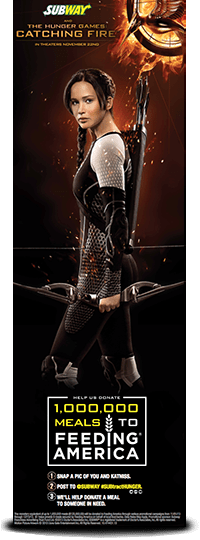
    As a result of Subway and Catching Fire being partners, Subway is currently using the tributes of the Games to encourage people to eat in the restaurant. This type of celebrity endorsement brings in people who might not normally eat there. “Oh, if Peeta eats Subway, I should too!” Granted, this behavior might come more from children but they, in turn, will ask their parents to take them to Subway. I’ve seen this time and time again with my younger siblings. This also works for the older crowd, however, because a partnership of this nature often includes promotional items or sales/deals that someone may anticipate being offered. Subway has transformed their marketing strategies and dining areas, with concepts like “Where Victors Eat” and “Win your own Victory Tour,” with the latter being a sweepstakes in conjunction with their collectible Catching Fire drink cups.r_kat1

    In the third and final facet of this trio of partners, Feeding America has jumped in and put their cause directly in the middle. Subway has placed cardboard cutouts of tributes Katniss, Peeta, and Finnick in the dining areas of Subways. A patron, after eating “What Victors Eat,” can take a photo with the cutouts and post it to the Subway Twitter, with the hashtag of #SUBtractHunger. Each time a hashtag is used, it is counted towards the 1,000,000 meals that Subway will buy for Feeding America. In the fine print, it says that Subway will donate up to $125,000, as each dollar makes about nine meals. However, this linkage will only exist until 11:59pm on December 15, 2013. The meals will be provided from Feeding America through local food banks in areas in need.

    This celebrity endorsement effectively ties in cause marketing in order to create an environment in which Subway patrons are encouraged to aid Feeding America. Though there is no mention of patrons being able to donate money directly to Feeding America via Subway and Catching Fire, the Feeding America website has a donation area, as well as a hyperlink to a Hunger Games site, where a large “Ignite the Fight Against Hunger” plea is proudly displayed under a Mockingjay and above a photo of the tributes stoically ready to win the real-world Hunger Games. The number of families that go hungry over the holidays is continuously growing. With Feeding America, Subway, and the Hunger Games movie series teaming up to feed families, alongside many other organizations attempting to end hunger, do you think the odds are in are their favor?

    -Hilary Hall

  • Dogfish Disaster Averted

    As we have gravitated towards becoming a society submerged in technology, in recent years, outlets of social media have become essential marketing tools for many companies and organizations.Facebook, Twitter, Instagram and Vine are few forms of social media utilized by most. While social media can strongly influence consumer behaviors and increase consumer awareness it can also be detrimental to a company’s image. In some cases social media can be the cause of a PR crisis. Crisis management is the process by which an organization deals with this major event that threatens to harm the organization.

    The American Red Cross is a prime example of an organization who exemplifies strong crisis management skills. This honorable humanitarian organization managed to dodge-a-bullet back in 2011 when an intern fired off a personal tweet on the company’s twitter account. The tweet read “Ryan found two more 4 bottle packs of Dogfish Head’s Midas Touch beer…when we drink we do it right #gettingslizzerd”.

    red cross

    This uniquely unorthodox and unprofessional tweet received a lot of negative attention from the general public. In this particular circumstance social media proved to be the cause of the crisis. When responding to the tweet the Red Cross avoided disaster by acknowledging that the tweet went out, deleting it, and explaining with humor that is was a mistake. This is an example of crisis management where the Red Cross turned a potentially harmful tweet in to an opportunity for engagement.

    Thankfully, the Red Cross realized the potential of social media and understood the power that it has to bring down a major organization. Now, other companies can look at this experience and utilize it to learn for themselves. After understanding the Red Cross’s response it is easy to break down their post-crisis steps and keep them in mind for other emergency situations. First, they were able to assess the situation. They realized the crisis was a major problem but they came to the conclusion that they could handle it which brought them to their second step, adapting their message. They considered their stakeholders and created a strong message to appeal to them. Lastly, they were able to analyze and learn from the situation post-crisis. Although this could have led to a horrific downfall for one of the greatest humanitarian organizations, everyone was able to benefit, understand, and learn from this experience.

    red cross 2

    -Parker Farfour, Caitlin Ford, Alex Corrigan, Kaitlin Batson

  • #YTMA… What’s that?

    This past Sunday, November 3rd, YouTube decided to take a leap and reinvent the fundamentals of music video awards as we know them; YouTube held their inaugural YouTube Music Awards (YTMA). The live-streamed event, sponsored by Kia, took place in New York City. Directed by Spike Jonze, YTMA was an interesting and unconventional mix of miscellaneous acts, unscripted hosts (Jason Schwartzman and Reggie Watts), and awkward moments. Although they received criticism of their “home made” feel they did one-up their MTV awards competitors in one aspect, along with live performances by popular artist such as Eminem, Lady Gaga, and Arcade Brothers they also incorporated “live music videos”.

    According to Ad Age, YouTube averages more than 1 billion viewers each month and is owned by Google, the most powerful of all internet companies. With this is mind we can only assume that the YTMA was a huge success. Wrong! The viewership was astonishing low, it was only viewed by 220,000 people at its peak; to put this into perspective the MTV VMA’s viewership was at 10.1 million this year.

    So where did they go wrong? Although both Kia and Youtube advertised on their websites’ homepages for some time prior to the event. YouTube neglected to realize the importance of advertising on their mobile app.  This was a huge miss to their prime public because mobile apps are 40% of where their user base are present.

    Also, unlike watching music video awards on TV, YouTube had a social media disadvantage.  Like many live TV events YMTA did have a hashtag, #YTMA, for viewers to tweet while watching the event. The hashtag reached a decent number of about 30,000 tweets, but there was potential to have had much more. Once again they forgot to keep in mind that many of their viewers watch from mobile devices, making it difficult to watch and tweet at the same time. This resulted with a large decrease of tweets about YTMA when the event went live, which possibly hindered other tweeters to start viewing.

    These two factors alone go against the Audience Theory by Chaïm Perelman and Lucie Olbrechts-Tyteca which states “approaches will achieve the greatest adherence according to an ideal audience.”  YouTube’s target audience is the social media and mobile users, and because YouTube did not take into account these minor but impacting factors, it may have cost them viewers.  Nicholas Carr the author of The Shallows says, “most TV shows and movies are also trying to become more Web-like”. I think YouTube may be going in the wrong direction. They have excelled as an online video website, for their sake they should keep it that way and stop trying to be more TV-like.

    -Kelsey Raskob

  • Paul McCartney’s NEW Publicity Stunt

    The digital world of iTunes and social media has given the music industry both high and low notes. While the Internet offers accessibility, it also caters to specificity. Most predominantly, the Internet offers an array of platforms for artists to upload, share, and send their music.  However, while music junkies may be constantly searching for new digs, most people eventually acquire a particular taste for what they choose to send through their ear buds.  Internet music services such as Pandora, Spotify, and iHeartRadio allow users to handpick and listen to an endless variety of artists and genres. This narrowcasting of music leaves artists waging campaigns to try to reach listeners. As a result, clutter prevails.

    Like in advertising, clutter has become a big problem in music promotion. As Douglas Rushkoff pointed out in The Persuaders, “The more messages they create, the more they have to create to reach us.”

    The more opportunity social media platforms – YouTube, MySpace Music, and most recently Vine – offer artist to share their music, the more competitive and important promotion of music and musician become.

    So how does a music artist break through all the online music clutter without breaking budget? The answer is: great music, a little luck, and a publicity stunt.

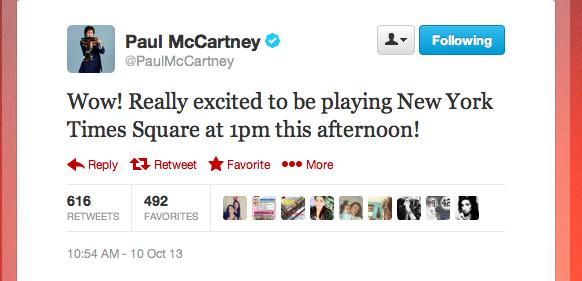
    Not new to the music arena are surprise gigs on rooftops or buses in the middle of big cities, events known in the public relations world as a publicity stunts. This past October, music legend Sir Paul McCartney promoted his recently released album, NEW, by doing just such a thing – performing a surprise concert in the middle of Times Square.

    Paul McCartney at performs at the Times SquareTelling fans only hours before – via Twitter – he played a 15-minute long show featuring the single “New”, as well as music from the (not at the time released) album. McCartney was not only able to give NYC fans a concert, but fans from around the world could tune in through Times Square live webcast and watch the performance.

    pm tweet nyThe surprise gig resulted in social media buzz and major news coverage, all promoting the NEW album for free. The stunt was so successful; exactly a week later he performed another surprise concert in London.

    pm tweet loSir Paul McCartney proved how to conquer the masses. Not only did he succeed in making his fans happy, but also he succeeded in executing a publicity stunt that generated both word of mouth and media coverage that ended up promoting his music at no cost to him.

    Caroline Robinson, Savannah Valade 

  • “Together We Make Football” and Community

    When I think about the NFL, or football in general, my mind immediately goes to large men with helmets running into each other; granted, I am not a big sports fan.  Most people’s minds wouldn’t imagine a little girl as the face of a major NFL ad campaign.  However, tiny Samantha Gordon, a ten-year-old pee-wee football player from Utah, is featured on the first commercial of the NFL’s “Together We Make Football” campaign.

    0ap2000000247227

    “Together We Make Football” is a contest where football fans of all ages, shapes and sizes are encouraged to share their stories of how football impacts their lives and what it means to them.  The contest narrows down to ten finalists, with five invited to take part in Super Bowl XLVIII festivities.  These stories can be in video, picture or story form and are posted to the “Together We Make Football” website.  The winners are chosen by a panel of judges, and the site’s visitors are invited to “like” the different posts; although these likes don’t have any affect on the contest winners.

    So how can I, someone so inexperienced in all things NFL, take an interest in “Together We Make Football?”  By applying it to what I know.  This campaign is a perfect example of how subcultures form and become such tight-knit communities.  The Social Identity Theory of communication states that people have many different versions of themselves depending on the groups, or subcultures, they belong to.  Different social situations are what drive these separate “selves” to behave in certain ways.  The title alone explains why “Together We Make Football” exemplifies this theory.  Defining fans of football as a “we” takes thousands of people and brings them together into a single unit.

    nfl-rivals-has-arrived-bring-your-rivalries-into-the-game-now_niesg_0

    Social Identity Theory goes further, saying that people belonging to one group tend to favor others within the group at the expense of others on the outside.  This holds true in the NFL regarding team rivalries in which fans become passionately involved.  Rivalries are like a double-edged sword, bringing together fans of the same team while creating tension with the fans of the opposing team.

    “Together We Make Football” reminds us that all fans are the same.  Ultimately, the goal is for their favorite team to win.  The campaign reminds us that all fans have the same goal, though it might be for different teams.  It allows people to share why they love the game so much, which can bridge the gap between rivals.  The different fan groups can become a single football-loving “we” because of the “Together We Make Football” campaign.

    – Maggie Dowicyan