Category: Celebrities

  • Which Form of Social Media Content Works Best for Increasing Brand Attitude?

    By Shelby Watson

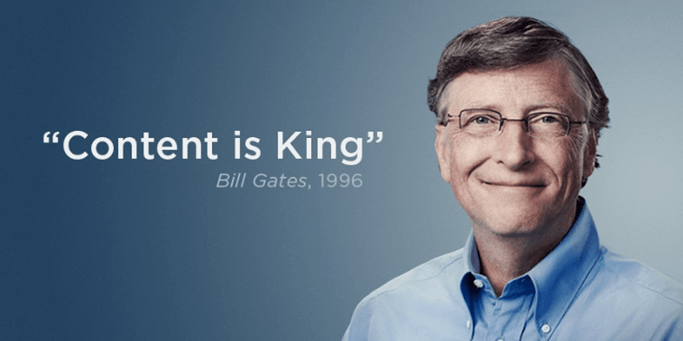
    (Photo from Dreamwealth Films, http://dreamwealthfilms.com/content-is-king-what-bill-gates-said-about-internet-in-1996/)

    Creating content-driven media to share across social channels is one of the most effective ways for a brand to reach their target audience today. However, there are so many different ways to create advertising content. How do you know which one is the most effective? Especially for brands that are looking to increase positive attitudes towards their product or service, understanding the techniques available and being able to decide which one will work the best for your purposes is incredibly important.

    What are the major techniques used by companies on social media?

    First, it will help to understand what techniques are available to you. Content marketing is a more traditional tool used by a brand, where hired social media coordinators will create original content for a brand, share that content, and try to increase brand reputation or sales. Typically, this form of content is heavily curated by the company producing it and is easy to control, which can allow a brand to create a cohesive image of itself.

    Sponsored content is content that a company pays someone to post in order to promote the brand’s image or encourage sales of its products. Often, sponsored content is posted by influencers within a certain niche market or a well-known or respected celebrity. Sponsored content is almost always disclosed as such, so an audience is aware that the content they are seeing is marketing.

    User-generated content is content that an individual posts on their own social media channels promoting a brand or product. Often, user-generated content does not disclose whether or not the poster was paid or otherwise compensated for promoting something. This kind of marketing can be riskier because a brand cannot always predict how an individual will talk about their products or services.

    Which techniques are most effective at increasing positive brand attitude?

    According to a study completed in 2019, there are significant differences in how audiences receive certain types of content. Sponsored content is generally received less favorably, likely because the disclosure that something is a paid #ad comes off as insincere to a targeted audience. For example, in November of 2021, Amazon teamed up with actor Terry Crews in hopes of improving attitudes towards the working conditions within the company’s fulfillment centers. In a TikTok posted to his channel, Crews visits an Amazon warehouse and acts like a kid in a candy store, excited about the work and employee benefits offered by Amazon (which the video says include paid college tuition and flexible working hours). The internet was quick to point out the insincerity within the video, noting that it does not accurately represent what working at a fulfillment center is like. Crews was also criticized for being willing to promote such an unrealistic video for money. In the end, Amazon’s brand attitude, as well as Crews’, took a hit because of the sponsored content.

    (Photo from Business Insider, https://www.businessinsider.com/terry-crews-amazon-ad-video-2021-11)

    On the other hand, content marketing and user-generated content are both better received by audiences because these forms of content are generally trusted more. It makes sense that user-generated content is more likely to read as sincere – if someone who doesn’t work for or with a company promotes a product or service, we are likely to believe they do actually enjoy it. For example, shopping has become a popular niche within TikTok and Instagram. #Amazonfinds on Instagram is filled with all kinds of items people are promoting from the website, and “Amazon Must Haves” videos like this one are incredibly popular across TikTok. Popular ways for brands to encourage positive user-generated content include challenges or giveaways that require users to post something in order to participate.

    It is a little more surprising, however, that content marketing and user-generated content show little difference in how they influence audience brand attitudes. Audiences likely trust content marketing more than sponsored content because the connection between author and message is clearly established. We know that a brand is going to market goods or services to us, so we expect to see ads when we follow a brand on social media. However, when we follow a celebrity or influencer, we expect to see content about them and their lives, not necessarily ads. So, this form of marketing reads as trustworthy.

    To continue with the example of Amazon, the company uses its Instagram (@amazon) as a way to reinforce its brand image and messaging. The company features humorous reviews of items from its website and uses symbols such as Amazon delivery trucks, the trademark Amazon smile, and the brand’s orange, black, and white color palette in order to support the brand image it has already built. Because we expect to see Amazon promoting itself and the items it sells on its own Instagram page, we are more likely to trust the content they are posting and in turn, may be more likely to purchase something through their platform.

    How can this help me market my own brand on social media?

    Understanding how your audience perceives different forms of content on social media can allow you to make informed decisions about how to improve brand attitudes. Depending on what your brand is looking to accomplish, you might determine that sponsored content is not the way to go or that you would prefer the control of content marketing over user-generated content. It’s always important to remember that these are general rules and that specific scenarios may call for specific kinds of content. However, using scientific research and recent case studies can help you make better decisions about your brand marketing in the future.

    Source

    Christandla, F., & Müller, J. (July 2019). Content is king – But who is the king of kings? The effect of content marketing, sponsored content & user-generated content on brand responses. Computers in Human Behavior, 96, 46-55. https://doi.org/10.1016/j.chb.2019.02.006

  • Spring Cleaning, Kondo Style

    After Wilmington suffered a rainy fall and a chilly winter, we have finally reached spring. The first official day of spring was March 20th, 2019 and we “sprung forward” on March 10th, which means more daytime! Even though we technically lost an hour of sleep, we have more daylight to do much more than we could during the end of Daylight Savings Time. Since we have more opportunities to tackle responsibilities during the daytime, one chore that may seem daunting to some, but rewarding to others is spring cleaning.

    blog4

    Spring cleaning is the act of decluttering places that you use the most often; whether it be your house, car, office, or any other areas that need some tidying up. Tidying up doesn’t mean just cleaning your dirty bathroom or your smelly car. It could also be the act of putting away those heavy coats and other winter clothes and replacing those clothes with your spring wear! People who usually start spring cleaning, give up because there are too many areas to tackle or realize that there is always next year. However, one woman has made an impact on several lives that not only have organizational issues but can share with the world that tidying up may not be so daunting after all, Marie Kondo.

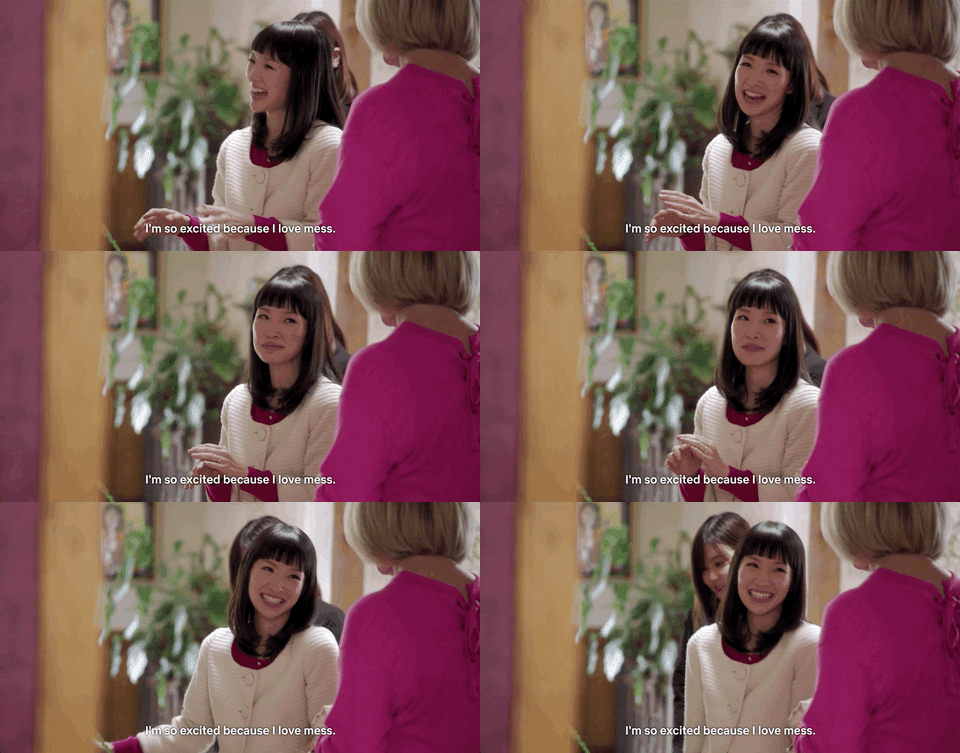
    If you binged watch any Netflix series, then you’ve possibly come across the popular Netflix series, “Tidying Up with Marie Kondo.” In the hit series, Kondo is invited to step into the lives of people who suffer from organizational issues or have a difficult letting items go that give them “joy” even though the items may be a doorstop. Kondo explains her method to her clients and reassures to them that it’s more than just throwing out the things you no longer need; it’s about choosing joy.

    blog1.gif

    So how exactly is the method broken down? The KonMari Method™ encourages that people should tidy by category, not location. Starting with clothes, then moving to books, papers, komono (known as miscellaneous items), and, lastly, sentimental items. To complete the KonMari Method™, Kondo explains her six basic rules of tidying:

    Rule #1: Commit yourself to tidying up.

    Rule #2: Image your ideal lifestyle.

    Rule #3: Finish discarding first.

    Rule #4: Tidy by category, not by location.

    Rule #5: Follow the right order.

    Rule #6: Ask yourself if it sparks joy.

    If the item doesn’t “spark joy,” to the client, Kondo asks them to thank them for the joy that they did give them, and then let it go the item that they wish to discard.

    Although the KonMari Method can’t organize certain aspects of your life, it can undoubtedly tackle those areas of your home that you’ve been procrastinating for the past year or so. Get started on your spring cleaning, Kondo style.

    -Kristian Worthy

  • And the Oscar Goes To…Advertising!

    And the Oscar Goes To…Advertising!

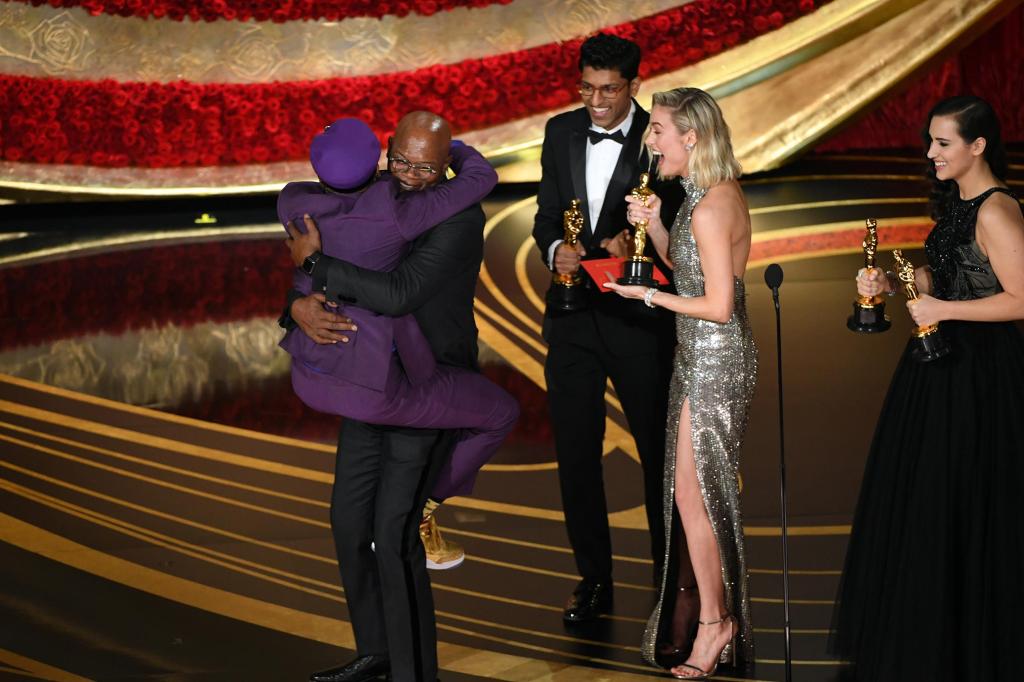
    The Academy Awards were last Sunday, and I think it’s safe to say there were plenty of surprises throughout the night. From the program having no host, to Green Book unexpectedly winning Best Picture, there was plenty to talk over the course of the next few days. Although director Spike Lee supposedly storming out after the Best Picture reveal, and Lady Gaga and Bradley Cooper’s steamy duet made headlines, things that didn’t get as much recognition were the various advertisement campaigns geared specifically towards the Academy Awards audience.

    It’s no secret that we are living in an age of recorded television and streaming services, and people have become impatient in general when it comes to sitting through commercials. Much like the Super Bowl, an awards show such as the Oscars are another example of a live televised event people tune in to in real time, and thus present the perfect opportunity to capitalize on viewers’ attention. While the adverts for the program didn’t cost nearly as much as those for the Super Bowl (according to Variety, 30 second advertisement spots for the Oscars cost between $2-3 million), it was very clear through the commercials’ content that they were advertising directly to the Academy Award audience, especially females.

    One example of this was with Walmart’s ad campaign. It’s known that fashion and style contribute to some of the Oscar’s biggest moments—both on the red carpet and in the award categories. Walmart, one of the night’s sponsors, seized this night of culture and fashion as an opportunity to advertise their clothing lines, while simultaneously highlighting film crew members and stylists who work endlessly behind the camera to make “movie magic” happen. The various commercials reinforced the idea that if ordinary people such as Julia Roberts’, Rami Malek’s, and Chadwick Boseman’s stylists can be glamorous and creative while wearing Walmart, then you can too!

    Another advertisement specifically aimed at women between the awards was a Budweiser commercial featuring Charlize Theron. In the commercial, Theron challenges female stereotypes while drinking her beer in a bar by challenging men to various games (billiards, darts, arm wrestling, etc.). An A-List celebrity, and a beautiful woman at that, was sure to capture and keep the attention of a time-shift-conditioned audience.

    Another Academy-specific ad campaign came from Google. The company utilized clips from various iconic movies, such as 2001: A Space Odyssey, Lady Bird, The Hangover Scream, Jerry Maguire, Deadpool etc., and depicted how the scenarios could have played out differently had Google been present in each scene. The commercials assume that viewers of the Oscars are movie buffs, and know enough about the films to understand the references within the commercials.


    What do you think? Do you believe the advertising efforts between the awards successfully kept audiences engaged? Did celebrities or those closely associated with celebrities influence your opinion about a product or brand featured? Comment below with your thoughts!

    -Audra Bullard

  • My RA Doesn’t Know What the BAFTAs Are… Do You?

    A couple nights ago, my RA was doing her door-to-door checkups when she came across my roommate and I discussing the BAFTAs (aka the British Academy of Film and Television Awards). We were talking about the typical stuff such as who was there and who we think had won when my RA interrupted and asked puzzledly, “The BA-who?”

    IMC Blog

    For her, she hadn’t heard of the BAFTAs and didn’t know what they were. Even when I explained what the acronym stood for, she still didn’t understand. Eventually, I referred to them as the ‘British’ Oscars.

    Although this explanation gave my RA a better grasp on what the ceremony was, it led me to wonder just how popular the BAFTAs were in the U.S. To be honest, the only reason why I knew about the ceremony was because some of my favorite celebrities, Prince William and Kate Middleton, advertised it on Twitter. Does social media always attract the BAFTAs’ viewers?

    To find my answer, I first had to watch their most recent show which were the British Academy Film Awards.

    The British Academy Film Awards were held on February 10, 2019 at the Royal Albert Hall, London, UK. The show featured notable (and nominated) actors like A Star Is Born’s Bradley Cooper, Black Panther’s Letitia Wright, The Queen of Scots and Suicide Squad’s Margot Robbie, and many more. Some of the film industry’s biggest winners were movies such as The Favourite and Roma which together won 10 BAFTAs.

    The awards were televised on the British network BBC One, but for North Americans, it was on the American network, BBC America. Although having them broadcasted on BBC America was a great tactic to bring in an American audience, not that many people have access to that channel. This led the BAFTAs in recent years to heavily rely on social media platforms to advertise their show.

    According to BAFTAs’ 2017 annual report, they create awareness by paying and partnering with Snapchat, Facebook, and Twitter to increase social engagement. This includes streaming live footage from the event along with hashtagging #BAFTAs or #EEBAFTAs. I have to say this strategy is smart since according to Edison Research, about 80 percent of North Americans had an online presence by 2017.

    Thanks to BAFTAs’ tactics and others, their 2017 online engagement totaled in 104,509,190 people. These engagements also include visits to BAFTAs’ website, organic visits on Facebook, and organic impressions on Twitter. This was an increase of 96 million from 2016.

    Another strategy the BAFTAs use is posting videos from their shows on to YouTube. Currently, their most popular video from the British Academy Film Awards is Dev Patel’s Supporting Actor acceptance speech for 2016’s Lion. It has about 820,000 views.

    The BAFTAs are killing their social media marketing and I hope by then end of 2019, they gain an even a bigger audience.

    Have you watched the BAFTAs this year? What do you think of their marketing strategies?

    Let me know in the comments!

    ⎼ Aliyah Harris

    Sources: Bafta.org

  • Do Celebrity Endorsements Change the Way People Vote?

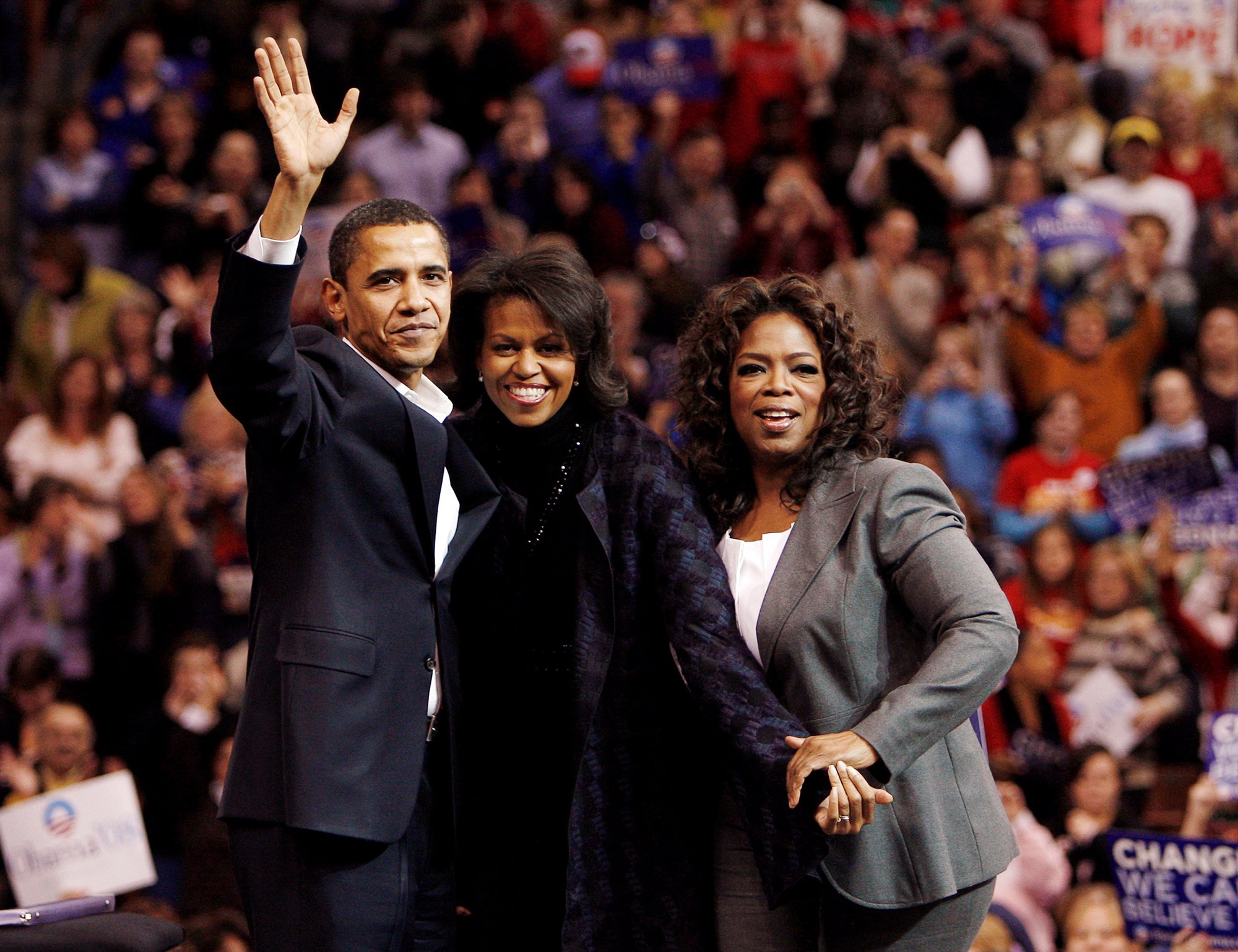
    180108-oprah-winfrey-michelle-obama-ac-532p_0fbd7ab0e3ab6c8a230fb18bc50e8ab0.fit-2000wThere is no denying how impactful celebrity endorsements can be on the public, especially in today’s political landscape. As the 2018 midterm election approaches, more and more celebrities are attempting to mobilize people to get to the polls and vote! But are these endorsements actually affecting candidates’ numbers?
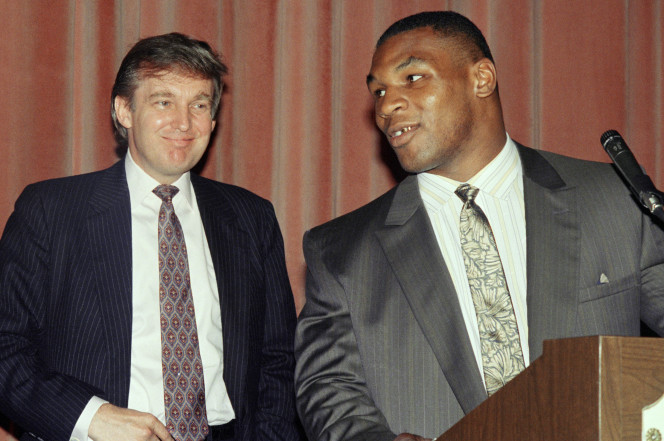
    Many celebrities have been seen personally endorsing candidates from their home states. Recently, Taylor Swift posted on Instagram that she will be voting for Tennessee candidates Jim Cooper and Phil Bredesen. Will Ferrell was spotted knocking on doors in Georgia endorsing Stacey Abrams for governor. Jack Black and Meryl Streep made large donations to Senator Claire McCaskill’s reelection fund. Even the Houston native, Travis Scott, voiced his support for Beto O’Rourke.

    ifxeonmt9clbgaoywl0b.png

    It is obvious celebrities have an effect on the way people think. People are more likely to use a product if they see a celebrity using that product or endorsing it.  Also, the more credible celebrities have a much higher impact on people’s opinions and decisions.  However, this does not seem to apply to the political scene.

    According to Gallup, Pew, and CBS News, celebrity-endorsed campaigns do not matter to the overwhelming majority of voters. CBS News polls revealed that 78% of people expected celebrity endorsements to have little to no effect on the election. Some experts say poll numbers may not accurately reflect the true impact that big-name celebrities have on campaigns.

    dt1.jpg

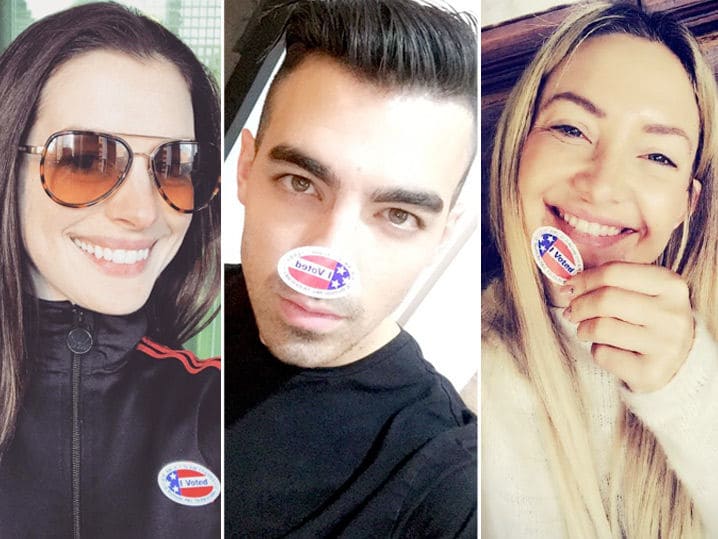
    So maybe, celebrities that endorse politicians aren’t doing the trick. One study found that an increase in young voter participation could be attributed to celebs that influence fans to “get out and vote”. Many celebrities are posting pictures of their “I Voted” stickers and tweeting to their fans the importance of having your voice heard by voting.

    1108-rocking-the-vote-primary-3-1200x630

    Overall, a voter who typically votes for one party is not going to turn around and become a supporter of another party because a celebrity told them to. But people who were undecided or weren’t planning on voting in the first place could be persuaded to get out to the polls. The link between celebrity power and politics has a long history and most studies claim it does not affect the way people vote. Perhaps the question we should ask is, “Do celebrity endorsements make you pay more attention?”

    – Lizzy Regnery


    References:

    http://theconversation.com/us-election-what-impact-do-celebrity-endorsements-really-have-66204

    https://www.marieclaire.com/politics/g24442884/celebrity-endorsements-politics-2018/

    http://www.electionanalysis2016.us/us-election-analysis-2016/section-2-campaign/us-election-what-impact-do-celebrity-endorsements-really-have/

    https://www.today.com/news/oprah-effect-can-celebs-sway-voters-wbna27227264

  • Humans of COM Studies: Lauren Arsena

    IMG_1652

    Photo courtesy of Lauren Arsena.

    Lauren Arsena entered UNCW in the Fall of 2014. At the time, she knew she was interested in marketing, but was unsure which major would be the best fit for her. She quickly discovered COM and the potential the department had to teach her, not only marketing, but advertising, public relations, and more.

    In terms of campus involvement, Lauren is the President of the Association for Campus Entertainment. ACE is the student-programming board at UNCW; they are responsible for a wide variety of events across campus, including the Jesse McCartney concert in Kenan Auditorium last Friday, September 22. Lauren was an integral part of the team that brought Jesse to campus, resulting in the fastest selling show in ACE’s history. The show sold out in less than 90 minutes.

    21765374_10155057972047684_4336483635715026473_o

    September 22, 2017: Jesse McCartney at the concert on campus. Photo courtesy of Hayley Kane (ACE Photographer).

    Lauren first decided to join ACE because she wanted to have a say in planning events for campus, while still having fun. Before becoming the president, Lauren was the Special Events Chair, now known as the Activities chair. She worked on a few of ACE’s traditional events like Last Seahawk Standing and Speed Dating. She created a few new events of her own as well, including Swing Dancing and Salsa Dancing lessons–both free for students. Last fall, she brought an improv group to campus for a Murder Mystery Dinner. Guests interacted with the characters to learn who the killer was.

    22041885_10155067467667684_6313689188606875575_o

    Lauren (right) and the Spirit Committee Chair Maddie (left) outside of Lumina Theater before one of ACE’s films. Photo courtesy of Hayley Kane (ACE Photographer).

    She has gotten the opportunity to apply a lot of the knowledge from her courses to her position in ACE and vice versa. Lauren states, “I’m on the PR/IMC track, so I’ve learned a lot about how to effectively market on social media. ACE also helps me in my classes because I have experience in event planning, leadership, teamwork, and public speaking.”

    Along with ACE, Lauren works as a Calendar Assistant for Campus Life. She uses Adobe Photoshop and Illustrator to create the calendars in the bathrooms of the Fisher Student Center and Union. Her experience with the Adobe Creative Cloud inspired her to add a Digital Arts minor.

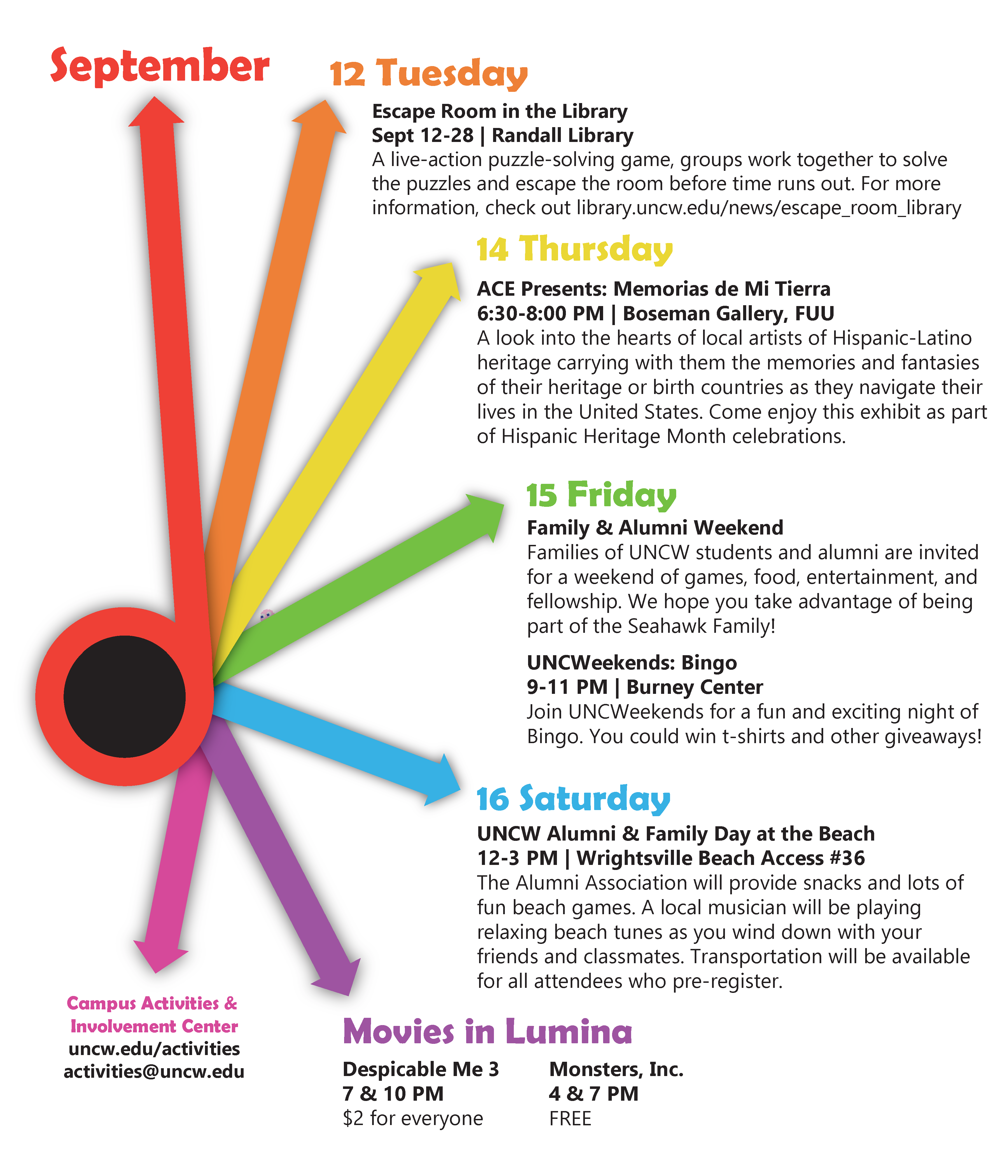
    Sep 11-16Sep 4-8

    Two of Lauren’s recent calendars. Lately, she has been hiding a Pac-man ghost somewhere in the design. See if you can spot him! Photos courtesy of Lauren Arsena.

    After graduation, Lauren would like to work in event planning for a few years. In the long term, she would like to return to school to work on a masters degree in Student Affairs. Her goal is to work with a student-programming board like ACE.

    22048076_10100869036421222_2365785808690913106_o

    September 26, 2017: Lauren (far right) photographed here with Brandon Stanton (center), the creator of Humans of New York. Brandon’s work is the inspiration behind this post. Photo courtesy of Stefani Norris (right of Brandon).

    “Interpersonal COM, public speaking, and PR have taught me how to market myself better to others so I feel more confident and ready to enter the workforce after I graduate.”

    By: Katie Solinski

  • #VersaceLovesGaga

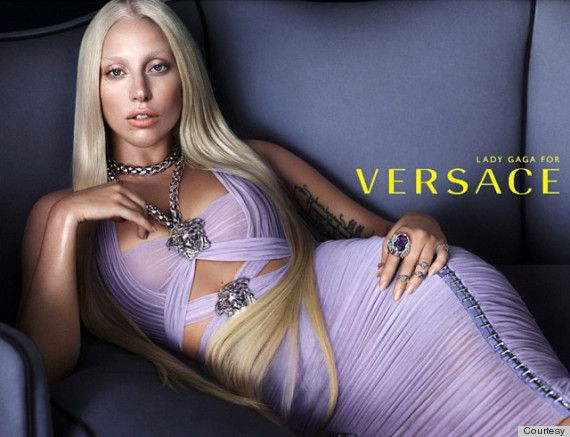
    Ever wonder what could happen if two fashion superstars like Donatella Versace and Lady Gaga got together?  They would open up a whole new world of consumers to both of their brands.  Versace is a well-known luxury clothing brand that been around since 1978.  The head lady in charge now is none other than Donatella Versace herself.  Although Donatella is distinguished as a talented designer, it’s her vibrant persona that makes her even more famous.  In recent years Versace usually went with non-famous models in their ad to focus more on the clothing instead of a celebrity name on it.  This spring fashion season Versace is trying a new campaign with Lady Gaga as the focus.

    This change up in the ad routine of Versace is very positive considering the social power these women have.   In leading up to this announcement, the two have been seen together everywhere.  This new well established friendship is great for the Versace brand.  Lady Gaga is a very influential woman not only in music, but in fashion.  When someone thinks of Gaga, their first thought is “I wonder what she’s wearing this time?”  She has a major advantage because of her power to expose this brand as much as possible.   Versace is thought of more as a mature brand, but with Lady G’s influence over a younger generation this can reel in a completely different group of purchasers then before.

    Lady Gaga is quite possibly a twenty-four hour ad campaign for the Versace clothing brand.  She is constantly being photographed in this brand that is then exposed all over the internet and in magazines.  She truly has embraced the product, she is being paid to promote to exact detail including her new Donatella look.

    Not only do these ladies have reach on tabloids, but their social media sites are a huge way to endorse the company as well.  The combined followers on twitter for Versace and Gaga is over forty-two million people.  The two are always promoting one another on various media sites, creating this whole new revolution for Versace. Including a personalized hash-tag for the Versace endorser herself, #VersaceLovesGaga.  This has been trending all over twitter, just proving how much influence she has also in the cyber world. This seems to be an extremely beneficial partnership for both brands and we’ll continue to see growth in Versace and Lady Gaga this fashion season.

    Melissa Shampoe