Category: cause marketing

  • Why Your Business Should Adapt a Green Thumb

    We’ve all heard the saying “Going Green”. Almost everyone nowadays is changing their daily habits to be more environmentally friendly. But what does this mean for businesses? Eco Brands are gaining popularity, which means adding some green to your business could be your next marketing move.

    With the rising concern about climate change, it’s no wonder people are beginning to be more cautious when shopping. Whether you believe in the crisis or not, there is some sort of draw to making an environmentally friendly decision. Consumers are becoming more and more likely to spend extra on a product if it is considered “green”.

    In a 2017 joint study done by, The Hong Kong Polytechnic University and Rajamangala University of Technology Phra Nakhon, researchers found that there is a strong relationship between brand green image and eco branding; specifically, within textile brands. A majority of the people surveyed agreed that eco-branding helps a brand’s reputation and credibility, and that it increases their likelihood of purchasing from a business.

    Eco-Branding is the emphasis on environmentally friendly practices within a company. This could mean that products are made with recycled materials, the production leaves a smaller carbon footprint, or that the company uses revenue to invest in protecting the environment. Some major corporations will highlight specific “green” projects they do while some companies are built upon the principle of being eco-friendly. Regardless, this is a rising trend for businesses as the world becomes increasingly worried about the state of the environment.

    Brand Green Image is described in the study as the consumer’s value in the eco-friendliness of a brand. Target consumers are predicted to be more willing to pay more for eco-friendly goods and services. Not all consumers hold environmentally cautious production as a high factor in decision making, but some however do. It is important to reflect the green image to that target market. The goal is to tap into the target’s values and create a more personal connection between the brand and consumer.

    Credibility is a huge factor in brand loyalty. Consumers favor brands that are consistent and reliable. Data shows a positive relationship between eco-brand and credibility. Eco-Branding shows that the brand is concerned in preserving the environment, a value in which some consumers hold highly. However, it is important when implementing eco-branding to be transparent with the audience. Claiming to be “green” when sustainable practices are not being made can cause major damage to a brand’s credibility.

    The study also showed that consumers are more likely to prefer a brand with an established green image. If eco-friendly tactics are integrated into the company’s brand image, participants of the survey stated that they were more likely to do business with them. This means that sustainability within a company is a key factor to market to the public.

    If you are considering enhancing your company’s brand image in the future, perhaps implement an eco-branding strategy.

    1. Introduce green products or services into your company. An example of a green product would be something that was made from recycled materials or was made in a process that used low energy. These types of products are becoming increasingly popular, especially within the fashion industry. Textiles require a lot of energy and water to create, so many brands are looking for alternate production methods for their products. Retail franchise H&M has a service that promotes recycling used clothes in exchange for a discount- which promotes an eco-friendly brand image.

    2. In addition to adding green products or services, promote green behavior in branding materials. Include reasons why it is important to shop sustainably or use green products. Being transparent on why the brand is eco-friendly helps to build credibility and trust amongst consumers.

    3. Highlight the effect on the environment your company has made by switching to be greener and articulate that data to shareholders. This creates more value in the company and can attract potential investors. Being transparent with shareholders is another way to strengthen relations and brand reputation.

    Not only does eco-branding have the potential to attract more customers, it can boost your company’s reputation. As the results of the study show, there is a positive relationship between eco-brand and green brand image. There is potential for increased value, profit, and brand loyalty. So perhaps going green might be your next business move?

    Post written by Lyndsey Newton

    Kan, Chi Wai, Ting Chow Cheby Yuen, Chamlong Sarikanon, and Rattanaphol Mongkholrattanasit. 2017. “A Study of Brand Green Image in Relation to Eco-Branding of Fashion Products.” Applied Mechanics and Materials 866: 448-451. doi:http://dx.doi.org.liblink.uncw.edu/10.4028/www.scientific.net/AMM.866.448. https://search-proquest-com.liblink.uncw.edu/docview/1910408508?accountid=14606.
  • Tips for Your Linkedin Profile

    Applying for jobs has many young adults worried. There are ways, however, to boost your chances of landing that job. Creating a Linkedin Profile is one way to show your professionalism and is a good way to network with countless other people, but you are probably thinking that many people have these profiles. How can you make yours stand out? We have some tips that you can use when crafting your profile.1217linkedin

    1. Join as Many Groups as You Can

    Linkedin allows it users to connect with others and start groups. It is important to be in groups because the more groups you are in the more likely you will be found when searched by an employer. Be sure to only join groups that are relevant to the jobs you want to get. The more groups you are a part of the more times your name your will appear in front of someone looking to hire. You can really make yourself standout by leading a group too.

    1. Be Very Descriptive in Your Summary

    The more descriptive you are in your summary the better your chances will be in attracting attention to your profile. This space allows you to tell what separates you from your peers. It is a good resource to share your story. Also, be sure to include many keywords in the “speciality” section so that when searched, your profile will show up sooner.  blog-cover-1024x587

    3. Keep it Professional

    Your Linkedin profile should be completely different than your Facebook profile. Linkedin is not a place to chat with your friends or create a profile to see how many shares or likes it can get. It is about networking and giving companies an online representation of who you are. Your profile needs to be organized. If your profile is a mess then whoever is looking at your page will assume that you are a mess too.

    1. Show off Your Worklinkedin2

    Linkedin gives its users the opportunity to attach files or link websites in the profile. It is important to utilize this so that employers have a direct link to see the work you have done. Do not be afraid to show off your work and be proud of what you have done. Remember confidence is key. Make your profile a confident one.  

    1. Keep it as Updated as Possible

    Your Linkedin profile should not be outdated. A profile is not created and then left to be alone. It should be in motion and kept up to date. Your profile needs to constantly be updated so that employers see all your experience. If you leave important information out then they will have no way of knowing of it. They can only see what you put out there. Adding that extra information could mean the difference between getting hired or getting overlooked. If you have experience then be sure to let them know. Do not limit yourself.

    Let us know what you think of our tips and be sure to comment below if you have any of your own that you would like to share!

    -Austin, Jonathan, & Kaela

    Photo Sources

     http://exclusive.multibriefs.com/images/exclusive/1217linkedin.jpg

  • A Symbol of Hope or Shopping?

    1
    http://www.sportivostlucia.com/?attachment_id=780

    Whether it be the NFL, Yoplait’s pink lids, or local breast cancer benefit events, like UNCW Communication Studies Society’s Rock for a Cure this Friday night, the color pink is plastered all over the nation during the month of October. As it stands, the pink ribbon is a universal symbol representing the fight against breast cancer. Over the past few years some critics have emerged saying this beacon of hope has merely become an annual marketing campaign. Nancy Stordahl, a blogger for the Huffington Post, criticizes the campaign and in 2012 she composed a list of the ten things she felt were wrong with the pink ribbon.

    You can find the full article here, but there are two points in particular she relates back to marketing that raise an interesting discussion. The first is that the pink ribbon is being used to sell stuff and has lost its original purpose, a purpose to unite this country and show our commitment to finding a cure. Today, marketers are using the pink ribbon to tie the cause to the products they are trying to sell. Stordalh even calls breast cancer the “shopping disease.” Customers are no longer buying just the product but they are now buying into the pink ribbon and what it has traditionally stood for. The typeology approach to IMC acknowledges that companies have products that look like another company’s products and services. However, it also points out that the market depends on common interests between themselves and the people who can help their company thrive. While the number of pink ribbon branded products on the market may be alarming, maybe marketers are giving consumers what they want – a deeper connection to a brand that allows them to make a contribution to something that has seemingly impacted them both.

    The second point Stardahl makes is that marketers are selling the idea of “selling good will.” If the consumer purchases a product that will lead to a company’s contribution, the consumer views this purchase as their contribution to the cause. This tactic allows corporations and organizations to sell more products and increase profits while enhancing their corporate social responsibility at the same time. In turn, consumers are able to buy into the commodity culture that surrounds the pink ribbon. They become part of the fight and part of the cure all while donning their pink ribbon branded merchandise.

    3
    http://www.shescribes.com/2010/10/free-60-day-membership-to-bjs-wholesale-club-for-everyone.html

    Next time you have the opportunity to join the fight, think local and try to avoid the marketing tactic of “selling good will” and supporting the “shopping disease.” If what critics say is true, and the pink ribbon has lost its symbolism for hope, strength and a unified commitment to a cure, is it ethical for marketers to continue using this symbol on their products? Let us know what you think about the national attention that is brought to the pink ribbon. Do you think it has become a marketing tactic or does it still representation of the fight to find cure?

    http://www.huffingtonpost.com/nancy-stordahl/breast-cancer-pink-ribbons_b_1951319.html

  • P&G Sochi Countdown Ends Today!

    Grab your patriotic gear and set your TV recordings—the 2014 Winter Olympics begin today! While the official opening ceremony will not be held until tomorrow, the first five events of the Olympics are being held today. As the world has anxiously been awaiting the kickoff to the winter games, official sponsors have been preparing promotional material for months in order to promote their brand in conjunction with the Olympics.

    One of the Olympics’ worldwide partners, Procter & Gamble, created an entire “Thank You Mom” advertising campaign for the 2012 London Olympics, thanking moms for their hard work and dedication in assisting their children to become Olympic athletes. Whether it was waking their children up for early practices, or simply driving them to training sessions, the campaign highlighted the mother’s supportive role of the athlete’s journey to worldwide success.

    This year, P&G won over the hearts of many with an emotional second chapter to the campaign, titled “Pick Them Back Up”, specially crafted to promote this years Winter Olympics. Check out the video below.

    Tear-jerking, right? Since its premiere during the Golden Globes, the video has gone viral and has been viewed over 13 million times on YouTube. With the slogan, “For teaching us that falling only makes us stronger,” the commercial effectively hits America’s soft spot by thanking mothers for encouraging their children to pick themselves up after they fall and keep working towards their dreams.

    In addition to the heart-warming tribute to moms, P&G also created feature videos on specific 2014 Winter Olympic athletes and their mothers. Each video gives the world insight on the athlete’s unique journey to the Olympics, and the backbone behind their success—their mom.

    P&G strategically incorporated pathos into their campaign in order to entice and persuade viewers using an emotional appeal. By inviting the world into the Olympian’s lives and sharing their stories, P&G gives viewers the chance to connect and relate to the athletes on an emotional level before the games begin. We watch as the future Olympians stumble, fall, get back up and push forward on their journey to become professional athletes.

    untitled

     The commercial gives the audience an opportunity to join and follow this year’s Olympians on their path to success by utilizing elements of pathos. The story has all of the warm and fuzzy emotions people typically like to see: smiling babies, determined children, great triumphs and most importantly, supportive mothers. After viewing the video and witnessing the athlete’s triumph over hardships, we feel the emotional obligation to follow the stories of the current Olympic athletes.

    “A mom’s love of a young child who is an athlete is a universal emotion,” Vice President of P&G said about the advertisement, “These commercials create positive feelings. When consumers think about the brand, the feelings will transfer over.”

    With the special “thank you” being directed at moms everywhere, the idea is that parents and children will want to immediately run to one another and share a misty-eyed hug. P&G  wants to associate themselves with the inspiration that accompanies the supportive relationship between a mother and child, as well as provide an opportunity for the viewer to join in on this feeling.

    P&G has done an incredible job  branding themselves as a family-valuing company. Through the newly released commercial for the “Thank you, Mom” campaign, that began back in October 2013, P&G has reinforced consumers that they believe in family and are devoted to all of the hard working mothers in the world. In the first video in the campaign P&G stated, “The hardest job in the world, is the best job in the world. Thank you, Mom.” This campaign has become one of the largest multi-brand activations in the company’s history. P&G is delivering their brand message for the Sochi Olympics through a variety of media channels globally.

    Marc Pritchard,P&G CMO, states that the focus of their marketing tactics have shifted predominantly to the internet. “I really think about it as digital first. We think of search and social and video and display as the first focus. That’s where our consumers are spending their time” stated Pritchard. The campaign has already been a huge success through its emotional components accompanying the Olympics to market its products’ relationships with consumers, especially to the mothers of the world.

    By incorporating pathos and reinforcing their family brand image using mothers as a focal point, P&G aims to increase brand propensity within their target audience. They hope that connecting to the audience on an emotional level, and in conjunction with the Olympics, will persuade consumers to chose their brand over their competitors. Do you think this ad worked? Does this campaign make you want to watch the Olympics?

    -Briana McWhirter, Emily Foulke, Hannah Turner

  • The Hunger Games are…Real?

    The Hunger Games: Catching Fire, opened on November 22, 2013 as a sequel to the Hunger Games. What started as a series of books by Suzanne Collins has been turned into a hit soon-to-be trilogy. Catching Fire made an estimated $158,074,286.00 on its opening night in the United States alone, according to IMDB. The blockbuster film partnered with many companies, including Subway and Feeding America. This trio has combined forces to also include Twitter in an effort to end hunger.

    As a result of Subway and Catching Fire being partners, Subway is currently using the tributes of the Games to encourage people to eat in the restaurant. This type of celebrity endorsement brings in people who might not normally eat there. “Oh, if Peeta eats Subway, I should too!” Granted, this behavior might come more from children but they, in turn, will ask their parents to take them to Subway. I’ve seen this time and time again with my younger siblings. This also works for the older crowd, however, because a partnership of this nature often includes promotional items or sales/deals that someone may anticipate being offered. Subway has transformed their marketing strategies and dining areas, with concepts like “Where Victors Eat” and “Win your own Victory Tour,” with the latter being a sweepstakes in conjunction with their collectible Catching Fire drink cups.r_kat1

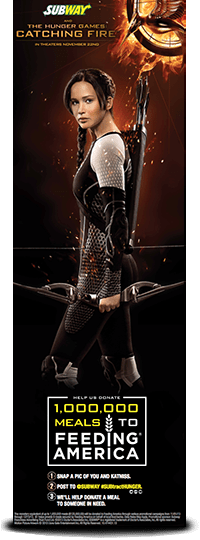
    In the third and final facet of this trio of partners, Feeding America has jumped in and put their cause directly in the middle. Subway has placed cardboard cutouts of tributes Katniss, Peeta, and Finnick in the dining areas of Subways. A patron, after eating “What Victors Eat,” can take a photo with the cutouts and post it to the Subway Twitter, with the hashtag of #SUBtractHunger. Each time a hashtag is used, it is counted towards the 1,000,000 meals that Subway will buy for Feeding America. In the fine print, it says that Subway will donate up to $125,000, as each dollar makes about nine meals. However, this linkage will only exist until 11:59pm on December 15, 2013. The meals will be provided from Feeding America through local food banks in areas in need.

    This celebrity endorsement effectively ties in cause marketing in order to create an environment in which Subway patrons are encouraged to aid Feeding America. Though there is no mention of patrons being able to donate money directly to Feeding America via Subway and Catching Fire, the Feeding America website has a donation area, as well as a hyperlink to a Hunger Games site, where a large “Ignite the Fight Against Hunger” plea is proudly displayed under a Mockingjay and above a photo of the tributes stoically ready to win the real-world Hunger Games. The number of families that go hungry over the holidays is continuously growing. With Feeding America, Subway, and the Hunger Games movie series teaming up to feed families, alongside many other organizations attempting to end hunger, do you think the odds are in are their favor?

    -Hilary Hall

  • Towels For Troops: Supporting Our Heroes

    I cannot speak for others, but one of the most quickly used products in my household is paper towels. Often times, it seems that they have to be bought on a weekly basis. Thankfully, Brawny, the paper towel company, recognized the necessity that paper towels have become and leveraged their product to help out a worthy cause.

    Last year, Brawny partnered with the Wounded Warriors Project to launch an “Inner Strength” campaign. For two years, Brawny has prided itself on standing strong alongside the Wounded Warrior Project (WWP) as a means of honoring injured service members. In 2012 alone, Brawny raised more than $500,000 for the WWP.

    hahahahaha

    For those of you who are unaware of the Wounded Warriors Project, it is a form of charitable support for members of the armed forces who were injured in the line of duty. Donations made to WWP help thousands of wounded warriors and their families as they return home from current conflicts.

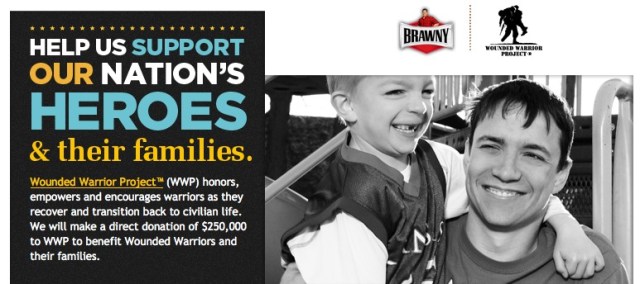
    With great success, Brawny decided to continue this cause marketing initiative committing to raise $600,000 this year. As a means of accomplishing this goal, Brawny has promised to make a direct donation of $250,000 to benefit the WWP. They have also announced their pledge to donate an additional $1, up to $350,000 for every individual who: shares a “Thank You” note on the Brawny Facebook page, “likes” Brawny paper towels on Facebook, or texts THANKS to 272969.

    Large goals like this are often hard to achieve, but worth it when it comes to a good cause. In the study of rhetorical theory, Greek philosopher, Aristotle teaches the three modes of persuasion: ethos, pathos, and logos. In this example, Brawny is able to use cause marketing to appeal to pathos or the emotion of the audience, but this tactic is commonly used in cause marketing. Pathos is the strongest mode of persuasion; making it a more frequently used appeal.

    Personally, when I hear the word “persuasion” I immediately make the connection to an interchangeable and more frequently used term…Influences. Persuasion is a process directed towards changing or influencing people’s beliefs, attitudes, and intentions. Individuals are persuaded each and every day. Persuasion is a critical and underlying goal of all marketing and advertising efforts.

    The “Inner Strength” campaign is an effective form of cause marketing conducted by Brawny and the WWP. This particular campaign does an efficient job of persuading customers purchasing decisions by appealing to the audiences’ emotions. Customers are much more inclined to buy a product if they know that it is for a good cause.  It is that simple.

    In this case, customers are buying Brawny products because it is to their understanding that a percentage of the proceeds go to the WWP. This is because these consumers feel a sense of sympathy for wounded soldiers. This is a form of persuasion at its finest. Ultimately, cause marketing has proven to pay off in this scenario seeing how Brawny sales are through the roof and donations made to the WWP are at an all-time high

    Happy Thanksgiving!

    -Caitlin Ford, Parker Farfour, Alex Corrigan, Kaitlyn Batson