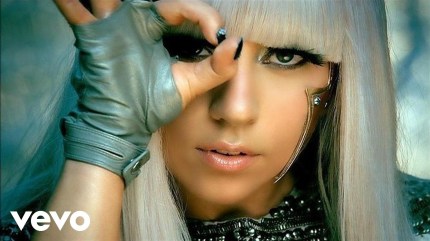
This year’s Super Bowl showdown between the Atlanta Falcons and New England Patriots is just days away. More than 100 million people tune in to the football game annually, but many of these people only care about the iconic halftime show performance. Over the last few decades, some of the world’s biggest stars have hit the stage, drawing in viewers from all walks of life. This year’s Super Bowl halftime performer is the one and only Lady Gaga.
When Lady Gaga came onto the pop music scene in 2008 with her hit single “Just Dance”, the world did know that a pop culture icon was being born. Over the next few years, she would go on to release single after single that topped the charts. Her fame grew exponentially and she gained a loyal fan following that would praise her every move. Lady Gaga began to refer to herself as “Mother Monster.” Gaga sent a message to the world that she embraces the weird in people rather than criticizing them, and encourages her fans to not be afraid of being a little different.
Aside from her music, one of the most iconic aspects of her brand image would have to be her out-of-this-world fashion choices. Fashion critics and fans alike would anxiously await for Gaga to arrive at red carpet because there was no telling what she would wear next. Lady Gaga’s raw meat dress from the 2010 VMA’s was arguably (but really there is no argument) one of the most memorable fashion statements ever made.
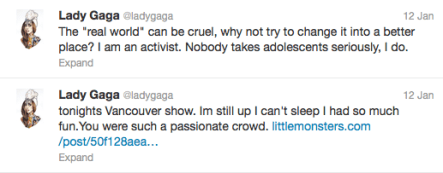
While Gaga’s fashion choices seem to be a little less extreme in recent years, her advocacy for LGBT rights, women’s rights, and against sexual violence have certainly not slowed down. Lady Gaga has used her voice and massive following to fight for the rights of so many people. She has cemented her brand image as someone who advocates tirelessly for equality.
With that being said, there is no doubt that Lady Gaga’s half time performance this Sunday will be anything short of iconic. What will she do with this massive platform? I think it is safe to say that a statement will be made. Do you think Lady Gaga will send a social message? Bring back the (now very very aged) meat dress? Or will she just captivate the world with her amazing vocals?
Leave a comment down below telling us your 2017 Super Bowl half time performance predictions.
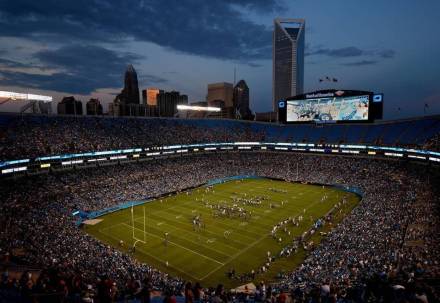
Living in the US, the NFL is easily one of the most recognizable brands we come into contact with on a daily basis. More specifically, living in North Carolina, we are fully immersed in the mania and hype of “Panther Nation.”
(Courtesy of @IGpanthernation via Twitter)
The Carolina Panthers, like other franchises, maintain a prominent and consistent brand image among their target demographics. There are numerous ways that an organization of this magnitude must communicate with its audience in order to stand out among the many notable NFL “power franchises.” The typology, or types of messages that an organization delivers, must be tailored to the situation, the environment, and the audience that they are trying to reach.
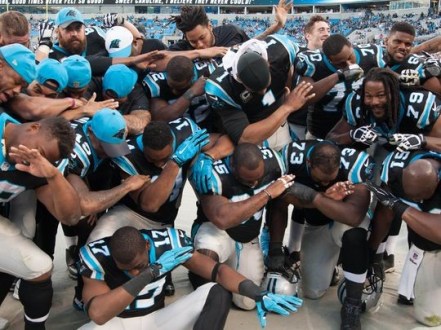
The 2015 NFL season is one that Panthers fans will not soon forget. The team’s star quarterback, Cam Newton, and his fellow teammates rose in popularity as they went on a 15 game winning streak. The team was frequently seen unapologetically posing for mid-game photo-ops, while “dabbing” on their competition.
(Photo: Jeremy Brevard, USA TODAY Sports)
Cam Newton was awarded the coveted title of league MVP and the team even made an appearance in the Super Bowl. I think it’s safe to say that a season like that makes the marketing team’s job quite easy. First of all, the media delivers a great deal of positive, unplanned press for a consistently victorious team. There was even hype created about “the perfect season” before it even happened!
(Joseph Person, The Charlotte Observer)
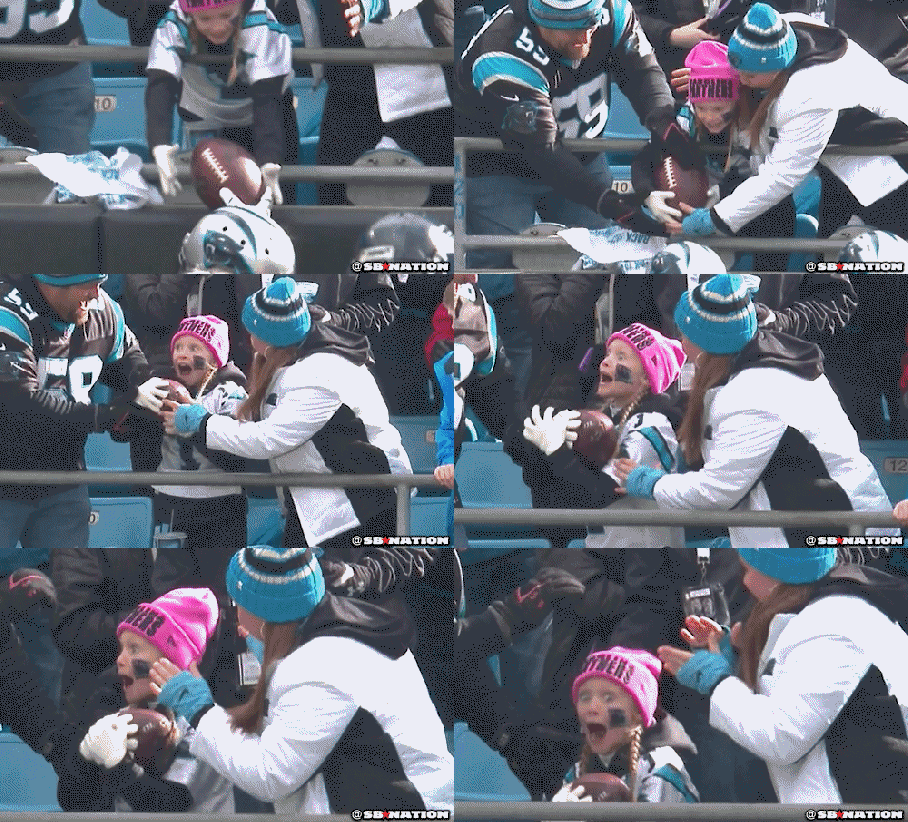
They were heavily represented by the media in a positive manner. The message was either about another Panthers victory, or something equally as amazing like Cam throwing his insane number of touchdown balls to kids in the stands.
Secondly, football fans are obviously more likely to root for a team that delivers wins. Panthers fans began to come out of the woodwork to see what “Super Cam” or “Luuuuuke” would do at each game. Advertising and social media material was at no shortage due to their strongly positive image in the media, as well as their ever growing, ever enthusiastic fan base.
The marketing and branding techniques of the organization seemed to shift in a new direction after the crushing Super Bowl loss to the Denver Broncos. The social media updates, advertising, and media coverage transitioned to a much more humble, appreciative tone. The constant stream of “Keep Pounding” updates quickly transformed into a message of “We will work harder” and “next year is our year.”
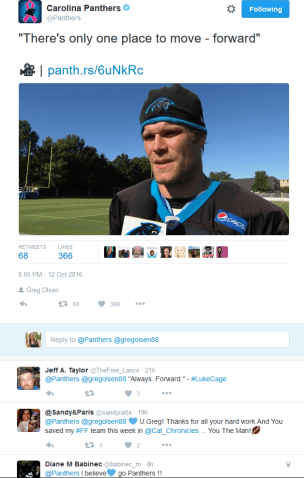
Unfortunately for the Panthers, the 2016 season has certainly not been their year. So far the team’s record is 1 win and 5 losses. Even worse, their MVP sustained a concussion along with several other key players being placed on injured reserve. This has placed the organization at the bottom of the NFC South Conference. Their current struggle has caused a shift in the typology of the organization’s communication methods. Instead of relying on positive media attention and bandwagon fans, the focus has been more on philanthropy, hard work, and the “ride or die” fan base. Without the epic victories and record breaking plays to broadcast, the Panthers are forced to look for content that comes from within its organizational culture and soul. Recent communication from the Panthers places a larger impact on team motivation and hope for the future:
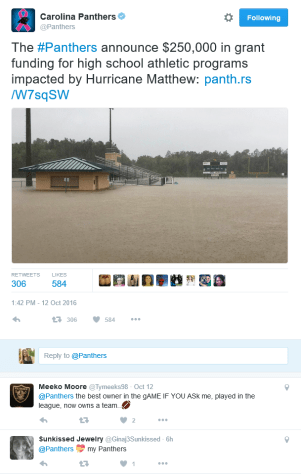
While other messages highlight the organization’s charitable efforts and donations.
A small sigh of temporary relief likely comes from the generally supportive response the Panthers have received from their true fans:
Although the NFL audience may be harsh and unforgiving at times most fans stay loyal to their favorite team, no matter how stormy the weather. The determination and optimism found within the typology of the Panther’s messages will likely resonate with true fans and keep them coming back for more!
(Jeff Siner, The Charlotte Observer)
Are you a Panthers fan? If so, are these communication strategies keeping you hopeful for your team, or are you fed up and just ready to see some wins? Let us know what you think!
-“PR and IMC: The Benefits of Integration” Public Relations Quarterly, Fall, 1994, 38-44
Applying for jobs has many young adults worried. There are ways, however, to boost your chances of landing that job. Creating a Linkedin Profile is one way to show your professionalism and is a good way to network with countless other people, but you are probably thinking that many people have these profiles. How can you make yours stand out? We have some tips that you can use when crafting your profile.
Join as Many Groups as You Can
Linkedin allows it users to connect with others and start groups. It is important to be in groups because the more groups you are in the more likely you will be found when searched by an employer. Be sure to only join groups that are relevant to the jobs you want to get. The more groups you are a part of the more times your name your will appear in front of someone looking to hire. You can really make yourself standout by leading a group too.
Be Very Descriptive in Your Summary
The more descriptive you are in your summary the better your chances will be in attracting attention to your profile. This space allows you to tell what separates you from your peers. It is a good resource to share your story. Also, be sure to include many keywords in the “speciality” section so that when searched, your profile will show up sooner.
3. Keep it Professional
Your Linkedin profile should be completely different than your Facebook profile. Linkedin is not a place to chat with your friends or create a profile to see how many shares or likes it can get. It is about networking and giving companies an online representation of who you are. Your profile needs to be organized. If your profile is a mess then whoever is looking at your page will assume that you are a mess too.
Show off Your Work
Linkedin gives its users the opportunity to attach files or link websites in the profile. It is important to utilize this so that employers have a direct link to see the work you have done. Do not be afraid to show off your work and be proud of what you have done. Remember confidence is key. Make your profile a confident one.
Keep it as Updated as Possible
Your Linkedin profile should not be outdated. A profile is not created and then left to be alone. It should be in motion and kept up to date. Your profile needs to constantly be updated so that employers see all your experience. If you leave important information out then they will have no way of knowing of it. They can only see what you put out there. Adding that extra information could mean the difference between getting hired or getting overlooked. If you have experience then be sure to let them know. Do not limit yourself.
Let us know what you think of our tips and be sure to comment below if you have any of your own that you would like to share!
Although it’s only in Wilmington, NC, once you step through the doors of Indochine Restaurant you are transformed into a Vietnamese wonderland. Guarding the front entrance, a 6-foot golden statue of Buddha welcomes the guests that come to dine. Statues, paintings, and nicknacks line the walls of the interior of the restaurant, all collected by the restaurants owners during their many travels throughout Asia.
The true enchantment begins when you pass through the back doors into the garden. With just over an acre, the Bartsch family has created a Vietnamese-inspired garden that will leave you speechless. From koi ponds to individual tiki-huts for guests to dine in, the garden is a true transformation to a new “far east” destination.
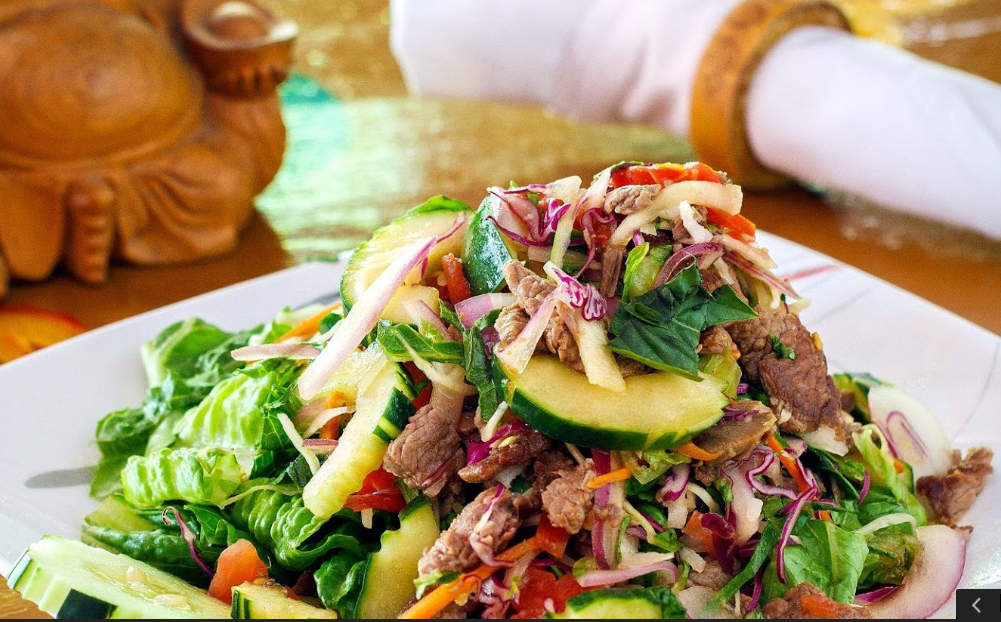
After opening its doors in 2001, Indochine quickly became one of Wilmington’s most popular attractions. Voted Encore’s Best Restaurant Overall for over 15 years, each visit to Indochine is a handcrafted experience. On top of a beautiful atmosphere, the cuisine only enhances the experience. Staying local and true to Thai culture, each dish is freshly prepared based on family recipes.
Indochine has built a brand based on every factor of the dining experience. Atmosphere, service, and cuisine are just a few examples of where the Indochine staff focuses their attention to ensure every guest is experiencing a true taste of Vietnam. Staying true to culture is very important to the owners and doing so has allowed them to build a strong brand awareness in the Wilmington community.
Based solely on word of mouth marketing, Indochine relies heavily on their reputation. Through their success it is clear that staying true to culture and providing the very best experience to the customer is vital in surviving in the restaurant business. Although the owners choose not to advertise in the community, Indochine is a name we all recognize and has become a staple in Wilmington culture.
The race for our next presidential candidates has been nothing short of entertaining this year, to say the least. The Republican Party’s posterchild, Donald J. Trump, is currently the frontrunner in polls. When Trump announced his presidential campaign, our nation couldn’t help but look incredulously at the millionaire mogul who’s already built his successful brand through business, franchises and TV networks. Despite bluntness, controversial statements and even discrepancies in political speeches, Trump has garnered the support of thousands of Republicans and the praise of being one of the most candid, or “authentic” candidates—but how and why?
Perceptions of Authenticity
Can a political candidate, or anyone for the matter, be authentic? In short, no. Or at least this is what Andrew Potter argues, author of The Authenticity Hoax, a 2010 book that criticizes the modern individual’s search for an ultimately unattainable “authentic” self.
In his chapter titled “Vote for me, I’m Authentic” Potter delves into the issue of voter apathy in democratic societies and how political campaigning and the media affect this. Most of us are used to manufactured speeches and the all-talk-no-results perception of politicians—and there’s been a trend of voter apathy, or the choice to not vote, in developed countries.
Trumps political extremism manufactures a perception of authenticity which could motivate U.S. citizens to vote who may consider themselves apathetic. He delivers seemingly uncensored and extemporaneous speeches—however questionable they may be—that echo his results-oriented business background. Why does he have a larger following than, say, Carly Fiorina, former CEO of HP and businesswoman alike?
The Media Controls It
Agenda-setting theory, anyone? This communication theory says that the media manipulates what the public thinks is important. Basically, whatever stories have the most coverage in the news become the “important” issues—the flavor of the week. Trump, for a variety of reasons, has been covered practically every day by some type of media outlet since he announced his participation in the race. You probably have read a story or two about Trump, even if you didn’t want to.
In a recent example of agenda setting not involving Trump—who won the first Democratic debate? Major media reports that Hillary Clinton was the clear winner when, according to online polls, Bernie Sanders was voted the winner by viewers. Is this a disparity of choice or opinion? Potter writes, “The media’s pundit class feeds this gladiatorial conception of political debates by treating them as a boxing match, with the post-debate analysis invariably focused on who scored what points, and whether any of the candidates was able to strike the mythical “knockout blow” (p. 172). While the media like to sensationalize, there are other factors involving what the media cover. In short, the media, across multiple outlets, can report that Hillary Clinton won when voters disagree. How do we evaluate the ways we receive our news?
Trump’s Brand
Like all political candidates, Trump is a brand. Donald Trump is a symbol, a message and a vehicle for his message. Trump is a business icon and has built an empire over many years, but why is Trump running for president, too? Political IMC is integral to the success or failure of a candidate’s campaign—establishing ethos, effective marketing, political advertising, event planning and speech writing are just some components that go into the branding of a politician.
“‘’Some people think this will be good for my brand,’ Trump concluded, as deep as he probes. ‘I think it’s irrelevant for my brand.’” This blasé quote came from Trump himself in a feature written by Mark Leibovich in the New York Times Magazine.
I disagree with Mr. Trump. For public figures, every extension of oneself, every action, participation, speech, statement, declaration affects one’s brand. One’s brand is the essence and the story of who they are. While Trump will probably only gain revenue and face time with his campaign, to say that it doesn’t affect his brand is nonsense. Whether it’s good or bad is a value judgment, but it’s fair to say that is not now, Trump’s brand will see the effects of this year’s political campaign.
Whether it be the NFL, Yoplait’s pink lids, or local breast cancer benefit events, like UNCW Communication Studies Society’s Rock for a Cure this Friday night, the color pink is plastered all over the nation during the month of October. As it stands, the pink ribbon is a universal symbol representing the fight against breast cancer. Over the past few years some critics have emerged saying this beacon of hope has merely become an annual marketing campaign. Nancy Stordahl, a blogger for the Huffington Post, criticizes the campaign and in 2012 she composed a list of the ten things she felt were wrong with the pink ribbon.
You can find the full article here, but there are two points in particular she relates back to marketing that raise an interesting discussion. The first is that the pink ribbon is being used to sell stuff and has lost its original purpose, a purpose to unite this country and show our commitment to finding a cure. Today, marketers are using the pink ribbon to tie the cause to the products they are trying to sell. Stordalh even calls breast cancer the “shopping disease.” Customers are no longer buying just the product but they are now buying into the pink ribbon and what it has traditionally stood for. The typeology approach to IMC acknowledges that companies have products that look like another company’s products and services. However, it also points out that the market depends on common interests between themselves and the people who can help their company thrive. While the number of pink ribbon branded products on the market may be alarming, maybe marketers are giving consumers what they want – a deeper connection to a brand that allows them to make a contribution to something that has seemingly impacted them both.
The second point Stardahl makes is that marketers are selling the idea of “selling good will.” If the consumer purchases a product that will lead to a company’s contribution, the consumer views this purchase as their contribution to the cause. This tactic allows corporations and organizations to sell more products and increase profits while enhancing their corporate social responsibility at the same time. In turn, consumers are able to buy into the commodity culture that surrounds the pink ribbon. They become part of the fight and part of the cure all while donning their pink ribbon branded merchandise.
Next time you have the opportunity to join the fight, think local and try to avoid the marketing tactic of “selling good will” and supporting the “shopping disease.” If what critics say is true, and the pink ribbon has lost its symbolism for hope, strength and a unified commitment to a cure, is it ethical for marketers to continue using this symbol on their products? Let us know what you think about the national attention that is brought to the pink ribbon. Do you think it has become a marketing tactic or does it still representation of the fight to find cure?
Cucalorus is Wilmywood’s premiere quirky film festival, showcasing independent films from local, national and international artists. Film connoisseurs sporting chunky glasses, artsy students in their thrift-store best and less interesting folk like you and I file into Thalian Hall (or one of the many other venues), settle down and wait for the lights to dim. This November will be the 21st year this little slice of art and culture draws people to downtown Wilmington.
I could barely convince people to keep coming after my twelfth birthday party, so how does Cucalorus garner a big crowd each consecutive year? A cohesive brand narrative, that’s how. And Cucalorus’ brand narrative is nothing short of weird—but in the good way. Let’s explore what makes Cucalorus cool.
It’s in the copy
While none of these factors are ranked in any specific order of importance, I am a word person and always like to read and evaluate the voice of an organization. Many organizations forget about this, not capitalizing its subtle importance. Bad organizations.
Cucalorus, on the other hand, has got its copy down pat. The copy, whether it’s online, in print or broadcasted on the radio, is how an organization communicates not only its news or events, but its personality, its voice and its image. Here’s a snippet of copy from Cucalorus’ donation page on their website:
“Hey Cucalorians!!! Do you need to get rid of unwanted cash? Make a donation and we’ll send you a tax deduction letter to send your fuzzy little friends at the IRS (they don’t need your money and clearly don’t know what to do with it!!). We do know what to do with it – we’re already plotting and scheming for the 21st annual Cucalorus Film Festival – taking place November 11-15, 2015!!! Help us fund the dreams and visions of artists all over the world by making a donation today.
Dreaming of eggnog omelettes!
Cucalorius.
The Cucalorus Film Foundation is a 501c3 non-profit and your donation is tax deductible to the fullest extent of the law.”
On first glance this might sound unprofessional and not the voice an organization would want to convey. The context, though, is important. Cucalorus’ audience is mostly the aforementioned artists, hipsters and independent film connoisseurs and Cucalorians. These types of people generally like funny, creative and quirky things (like Cucalorus). These types of people also tend to be skeptical of the IRS—not to mention the state cutting NC’s film incentive last year. So yes, it might be OK for Cucalorus to be a bit irreverent, and it’s their creative risk.
Digital presence, dude
If your business doesn’t have some sort of online presence (an email address counts), I would like you to write to me immediately by carrier pigeon and explain how you’re still surviving. An online presence is increasingly important each year, and now just having a website and Facebook isn’t cutting it. Brand cohesion across appropriate social media networks and inter-connectivity between them is vital.
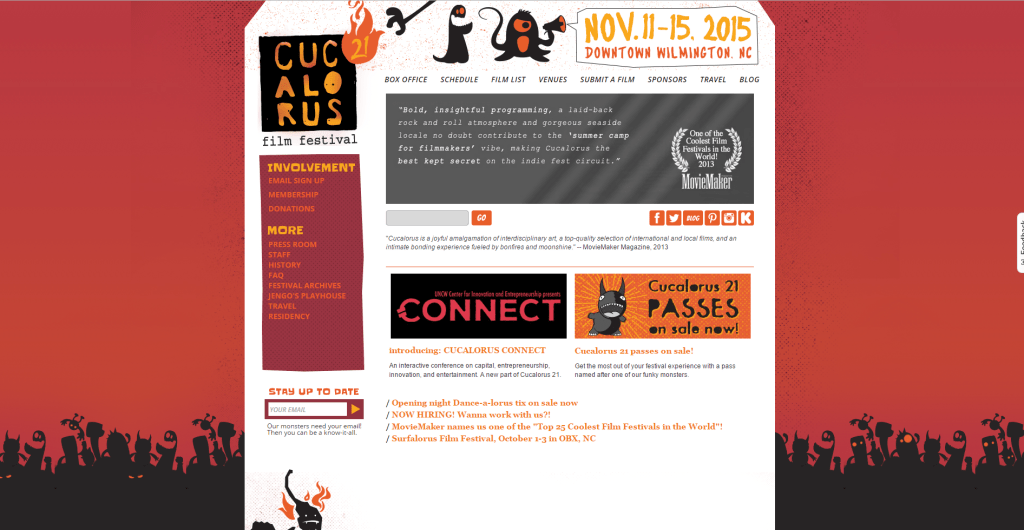
Cucalorus not only has a website, Facebook, Twitter, Pinterest, and Instagram but their own blog and—drum roll—they are all updated. Bravo, Cucalorus. Content creation and audience engagement are essential to a successful IMC strategy.
Creepily consistent image
This one is tandem with the digital presence. IMC consists of advertising, public relations, marketing and every other single communication an organization can perform with its publics. Consistency in corporate communication allows the organization and its audiences to construct a narrative and image of the brand. This is what people can relate to. This is how we can see the quirkiness, irreverence and artsy personality of Cucalorus as if it were that weird kid in your English class who would always have some snappy reference to an obscure book even your professor hadn’t read. But less annoying.
The color scheme and design is consistent. The font-faces, graphics and little cartoon dudes are consistent. There’s well-organized navigation and that copy I was talking about earlier. The social media pages follow suit. There’s an article on this if you’re into academic papers. Basically, the author, Simon Torp from Odense University in Denmark, says that as an organization your communication through all channels must be consistent, accessible and in line with your self-image, public image and meta-image for people to take you seriously.
Zany staff workers
When I said all channels of communication, I meant all of them. Even the staff workers and volunteers need to be carefully selected and even briefed on an organization’s code of conduct. One time I went to a screening of a Cucalorus film at Thalian Hall and, not to get into too much detail, I, with the rest of the audience, was sternly asked by staff to partake in a ritual involving whipped cream, button pins and our tongues. Was I offended? No, but I could have been if I had been misguided by thinking Cucalorus was actually a convention for neo-Puritans. Because their self-branding and self-image don’t suggest that, I could expect something out of the ordinary. It’s the risk that Cucalorus takes to maintain its image and appeal to its target audience.
High-quality product
When it comes down to it, a business or organization is only as good as its product. Silly brand narrative and image aside, Cucalorus does a good job at what it does. It recruits and selects excellent film talent from around the world and showcases it in quality and entertaining venues. This is where word-of-mouth comes into play. Word-of-mouth marketing or WOM is an organic and invaluable means of public relations, advertising and marketing. Have you ever read a positive news story about an organization you love? Or has a good friend of yours recommended a product or service they favor? These are examples of WOM that can make or break an organization depending on whether they are in favor or against it. Maintaining the balance between brand narrative, professionalism and good business sense is how an organization thrives. While Cucalorus does an outstanding job of its own branding and controlled media, its reputation for quality and intrigue reign in filmmakers and spectators every year.
I am no way affiliated with the Cucalorus film festival professionally, nor do I represent it. I recognize good IMC in organizations and talk about it here. But, if you are tired of what the local theaters are playing, check out a showing of something interesting between November 11 and 15 downtown at Cucalorus.














 IMC Hawks Blog