Category: Advertising

  • So You Want To Be A Media Planner?

    Everyday a city dweller is exposed to 5,000 advertisements. With this many advertisements it is amazing that we actually remember some of them. Part of the remembrance is due to the work of media planners.

    Media planning is the science of message dissemination. It specifically “refers to the process of selecting media time and space to disseminate advertising messages”. In order to find out more about this division and the work they do our blog group reached out to Zimmerman Advertising Assistant Media Planner Mariel Oweida.

    mariel photo

    Oweida, a May 2013 graduate of the UNCW Cameron School of Business, began working for Zimmerman Advertising in December of 2013. She referred to media planning as,

    “…finding appropriate media platforms for a client’s brand/product to use by determining the best combination of media to achieve the client’s marketing objective; media could include print, TV, radio, digital, OOH (out of home advertising- billboards, bus wraps, etc.)”

     Media planning begins with a Media Action Request (MAR) and ends with a media buy. Although the media planning division doesn’t actually negotiate the buying, they do work closely with buyers and account executives to make sure the plan is well executed.

    Media planning is fast paced. Owieda explains she was surprised at the quick turn around. Having concentrated in marketing as an undergraduate, media planning was a new career path for her. Usually you need specific degree for advertising or experience from another ad agency but, she says, ad agencies look for candidates that are willing to learn and grow with the company.

    Specifically, Zimmerman Advertising is a full-service agency that focuses on building national retail brands. Over the past 30 years it has become 14th largest advertising agency in the world and they currently bring in revenue of $100 million a year.

    zimmerman photo

    Recently they moved their headquarters to Ft. Lauderdale, FL. Their brand new office is beautifully constructed to promote a more casual, creative, and collaborative environment. Although this brand new building seems friendly and relaxed, it is full of hardworking individuals who go above and beyond to help clients meet their advertising objectives. In a previous interview with Elizabeth Harrington, Oweida described her typical workday as untypical. “You should never expect to go in at 8 a.m. or leave at 5 p.m. [You] almost always end up going in early and leaving later- that extra dedication is unpaid.”
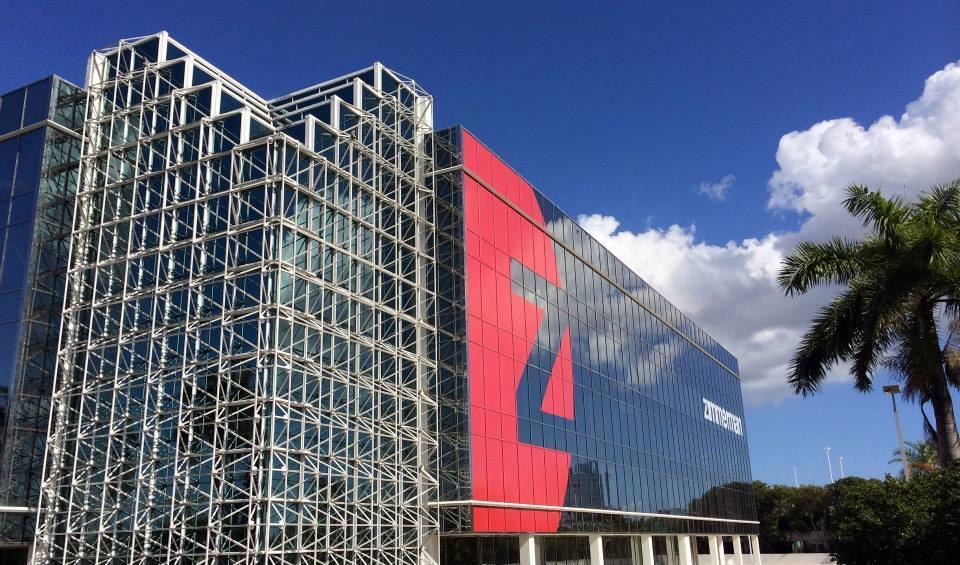
    Zimmerman photo of building

    During her day Oweida works on budgeting clients money, conducting market research, and media placement. Already she has worked on accounts for Ashley Furniture, Boston Market and AC Moore. “The most challenging part of being an assistant media planner is paying attention to detail, executing the plan we provide, and dealing with clients,” Oweida says. “As a media planner it is your job to let clients know why they are spending their money the way you are telling them. It is important to keep up with research from Nielsen ratings, to demographics, income, and even how long people have owned homes. They all help you plan the media and explain the why to the clients.”

    So as soon to be graduates we asked for the inside scoop on what to do if you want a career as a media planner. She said work on knowing Excel and basic Excel math, but most importantly have great communication skills. She also told us to be up to date on the newest and important trends in the field, which as of right now are social and digital media.

    We would like to thank Ms. Oweida for taking the time to speak with us. If you have any questions or advice about media planning comment below!

    Caroline Robinson, Elizabeth Harrington , Savannah Valade

  • Wilmington Appreciates Advertising: Local Marketing

    In the Wilmington community, local advertising agencies offer their services to all of the town’s local businesses. Our small beach town is filled with local companies that are in need of advertising agencies that are familiar with the area and the target audience. Fortunately Wilmington is the home to several advertising agencies that are willing to go the extra mile to provide effective services for our small businesses in the area.

    Colonial Marketing Group is one of Wilmington’s own award-winning advertising agencies. Colonial Marketing provides TV, print and radio advertising for 72 local businesses in Wilmington. Founded and based in our town of Wilmington, this firm aims to develop the relationship between the brand and the consumer for each of their clients. The strategy of their agency can be explained in three words: consult, create and connect. They will first form a close bond with their client so that they will gain a good understanding of the business. Then they will dive into the creative process to convey the company’s brand effectively to the target audience. Colonial Marketing will finish of their process by combining their marketing knowledge and qualitative data to ensure effective advertisements will be executed to reach the target audience. Before a company chooses to work with Colonial Marketing, they have the opportunity to see the firm’s previous work for other businesses. The agency is especially eager to help businesses that like themselves, are Wilmington based.

    One advertising agency that has been a huge local success is Ford Design Group. This agency has developed into being one of the most utilized ad agencies in Wilmington, North Carolina and their work can be found all throughout the city. Ford Design is a multi-faceted advertising agency that offers a wide range of branding, marketing services, print media, logo design, SEO services, and website design. Ford Design Groups goal is to always exceed their clients’ expectations. Their philosophy proudly states, “We’re only as good as our last project.

    “BRAND. MARKET. IMPACT!”.

    “Isn’t it interesting how definitions of words have evolved over the years? Each of these words can either be a noun or a verb, and stand on their own totally unrelated to one another. But, for our team at Ford Design Group, they are all equally important to perform best used in conjunction with one another”. -Greg Ford

    images30E9KW5F

    Greg Ford, founder of Ford Design Group, began running this agency from his own bedroom as a one-man business in 1992. He graduated with a Communication Studies degree from East Carolina University in 1987. Over the past twenty-two years, Greg Ford has turned his one man firm into a talented team of expert programmers, designers, copywriters, photographers and many more to add to the success of this local business. Ford Design Group has customers throughout the southeast and across the country! Their clientele are very diverse, from small business owners to large corporations.

    In the city of Wilmington, Ford Design Group has worked with clients from The Blockade Runner, Hibachi Bistro, Wilmington Development Group, YoSake Downtown Sushi Lounge, to K38 Baja Grill. They have designed logos, print ads, and websites for all of these companies and many more.

    FDG_Port_LOGO_br1Ford Design Group

    A company that focuses on quality keeps clients happy, and Ford Design Group has done just that. Below are some testimonials from some of Ford Design Groups satisfied clients.

    “Greg and his group have been very creative in supplying the designs we need. From web site design to t-shirts, they can do it all.”

    -Blockade Runner Resort

    “Greg Ford and his team coached us through the whole process including developing a new logo for our 50-year-old company. They were technically excellent, creative and very customer focused. They listened to what we told them about our industry and developed a customized approach; no “cookie cutter” components. I would use them again!”

    -John S. Clark Co.,LLC

    “Eyecare Center’s corporate identity dated back to the late 1970’s and it looked it.  Ford Design Group took our company into the new millennium with an entire new identity makeover.  Their professionalism, talent and attention to detail were a perfect fit for our company.”

    -Eyecare Center

    With a plethora of local advertising firms in the port city, small businesses in Wilmington have the chance to work directly with companies that are concerned with their success. Not only do they have the chance to meet in person to be able to communicate their wants/expectations effectively, they also have the benefit of assisting fellow local businesses. These advertising firms depend on the support from local businesses, just as the small companies depend on Wilmington’s firms to market their content. What other benefits do you think small, local advertising firms experience? Do you think the recent economic recession affected their business?

    Hannah Turner, Emily Foulke, Briana McWhirter

  • FCC Reviews Rules and Regulations

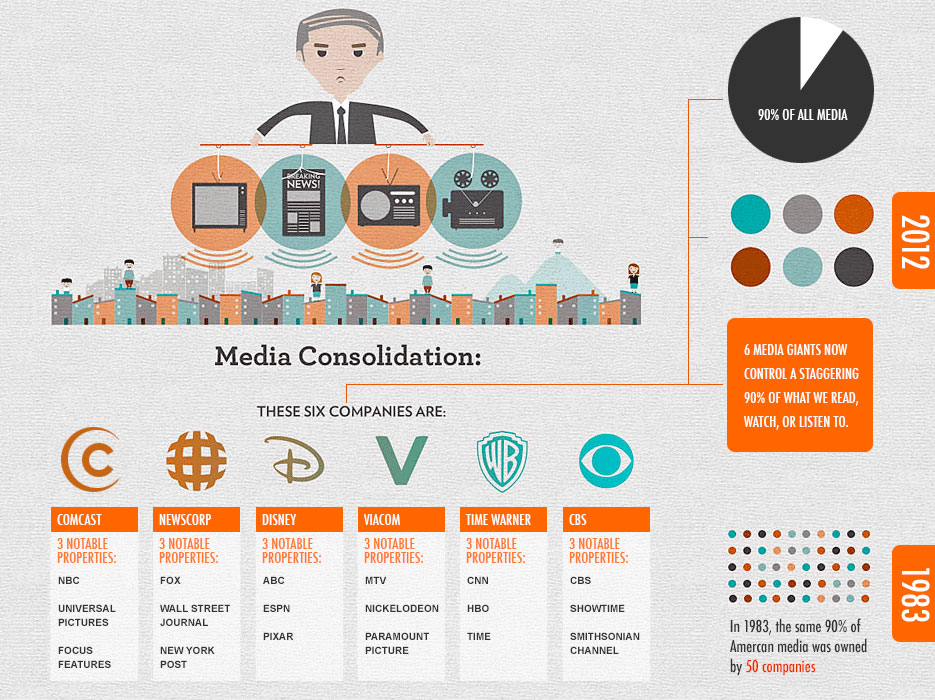
    As the final four teams prepare to battle it out in March Madness, it’s a sure bet that sports fan are waiting to see what else the tournament has in store this season. With coverage, updates, and analysis, it’s also a pretty sure bet that these fans are tuning into ESPN – the station that has become the sports authority. But did you know that the testosterone filled station is owned by a company that producers princesses fairytales – Disney? Did you know Disney also owns ABC, Marvel, Pixar, and Touchstone. Part of what’s known as the “Big Six” – Comcast, News-Corp, Disney, Viacom, Time Warner, and CBS – account for 90% of media ownership across the ­states.

    media_consolidation

    The process of consolidation through mergers and acquisitions, has led to media conglomerates – few companies owning all of the media outlets.

    Many argue that media consolidation hurts competition by blocking out new media companies. According to Senator Wellstone, media give people access to a wide variety of opinions, analyses, and perspectives and it holds concentrated power accountable to people. With only a few companies controlling all the media the two functions of media (listed above) are compromised. Specifically related to advertising, a combination of media also leads to monopoly over audience and advertisers.

    Today, the Federal Communication Commission (FCC), an independent US government agency responsible for controlling media regulation, will vote to make TV station’s joint sales agreements (JSAs) subject to current ownership rules. The commission will also vote on a rule that prohibits two or more of the top four TV stations in a market from jointly negotiating agreements with pay TV providers.

    Tom Wheeler, FCC Chairman, cited that the considered changes were motivated by evidence that suggested the rules that protect competition diversity and localism have been circumvented.

    JSAs are an arrangement many see as a loop hole around the limits on owning no more than two TV stations in a market. With endorsement from the Department of Justice, the FCC is now moving ahead with the rule “that if the owner of one station in a marketing sells 15 percent or more of the advertising time for another, then it will be deemed to have ownership interest in the station.”

    Broadcasters are fighting back. Gordon Smith, president and CEO of the National Association of Broadcasters, says, “The real loser will be local TV viewers. This proposal will kill jobs, chill investment in broadcasting, and reduce meaningful minority programming and ownership opportunities.”

    Stations that do have JSAs will have two years to dismember deals. However, stations can apply for a waiver in which JSAs will be examined on a case by case basis to determine if public interest is served by keeping the agreement.

    Additionally, as part of the 2014 review, the FCC will propose to keep the ban on owning more than two TV stations, but question whether the cross-ownership ban between TV, radio, broadcast, and newspapers should be lifted.

    However, while the five commissioners of the FCC will all vote on the issue, the ultimate decision may be left in the hands of just one, Democratic commissioner Mignon Clyburn. The issue has split the five down party lines with the GOP commissioners, Ajit Pai and Mike O’Rielly speaking out against the proposal. In order to advance the ruling, Wheeler will need the favor of both democratic commissioners.

    While the commissioners are deciding, we are left wondering to what degree will these rules affect our media markets? Will Clyburn’s decision trend toward more or less regulation?

    Tell us what you think. Should the FCC approve the JSA rule? Are media conglomerates affecting the free flow of information to society? Or has the Internet made possible enough independent outlets?

    Savannah Valade, Caroline Robinson

  • Banking on Bracketology

    Even if you’re not a fan of college basketball, you’ve likely heard friends and colleagues exclaim about their “busted brackets” as of late. The NCAA Division I men’s basketball tournament, billed as “March Madness” runs throughout the month of March and is one of the most popular spring sporting events. The tournament begins with 64 teams and ends with the championship game in April. Part of the fun of March Madness, is Bracketology, the science of pitting teams against each other to predict the outcome of the tournament. It gets pretty serious–billionaire Warren Buffett of Berkshire Hathaway even offered $1 billion to whoever fills out the perfect bracket.

    Where does Bracketology intersect with IMC? The answer lies in the “good hands” of Allstate. 2014 is the insurance company’s third year as official sponsor of the NCAA tournament. This year, Allstate’s antagonistic character, Mayhem, is breaking brackets in a series of Tweets, Facebook updates, and Vines. While Mayhem is infamously known for causing car wrecks and burglaries, the Leo Burnett-created “March Mayhem” campaign makes light of Bracketology. Watch as Mayhem breaks, bends, and even blends busted brackets.

    March is Mayhem

    “March Mayhem” is Allstate’s social media component of its NCAA tournament campaign. During TV coverage of the tournament, the company sponsors the “Good Hands Play of the Game” and is rolling out increased advertising for its homeowners insurance. Pam Hollander, Allstate’s senior IMC director, points out that the campaign goes on as the tournament progresses, taking into account how different teams perform in the tournament. She says the campaign features direct engagement with fans. Mayhem acts as a direct engagement tool to connect and learn more about Allstate’s social media-savvy audience. With Mayhem, interpersonal communication takes place in an ad campaign, personifying the brand’s relationship with the consumer.

    Mayhem isn’t the only insurance character with social media presence. Representing insurance companies big and small: the Gecko, Flo, Jake, and J.J. Hightail each interact with their Twitter followers. One of the strong points of the March Mayhem campaign is how it takes advantage of the Bracketology phenomenon to establish a connection with the consumer. Using a popular social trend in a social media campaign exemplifies the personification of brands.

    Do you believe using Bracketology in advertising is effective? How have you seen other brands use social phenomena in their advertising?

    Nathan Evers

  • The “Instructional” Campaign

    According to the calendar, Spring has officially sprung. And while we are still experiencing some chilly days, it’s undeniable most of us are ready to shed our winter gear for shorts and sandals. As with all season changes, clothing companies are eager to help you exchange your wardrobe.

    Recently, clothing company Lands’ End launched their new “How to Spring” advertising campaign, showcasing, “How fun and fashionable it is to add bright colors, graphic prints and floral patterns with a few perfect pieces from the women’s spring collection”. It could be argued that every spring campaign that will launch this season will have a similar goal; however, Lands’ End decided to do something a little different this season by adding a sweepstake to its promotional and marketing strategy.

    The sweepstakes works by first connecting with Facebook or entering your email. Once you’ve connected, you are asked to fill out your name, email, and zip code. Filling out this information unlocks the game. The rules are simple, select an outfit and click “spin”. If the outfit that the player selected matches the three tumblers, the player automatically wins a gift card with a balance of $25, $50, or $1,000. That’s it! Simple right? Not to mention, everyone is eligible to enter every day for the grand prize of $1,000 shopping spree. You can view the official rules of the sweepstakes here.

    While we like to think that games, contests, and sweepstakes’ only motives are for fun and entertainment, they are actually a smart marketing move – encouraging consumption of the product by creating consumer involvement. This involvement builds fan base, engages the audience, and enables consumers to do your marketing for you. Not to mention, user generated content often provides quality, innovative, and creative ads for free.

    In addition to promoting brand visibility, contest and sweepstakes are strategies that provide valuable quantifiable benefits for companies as well. They are cost effective, they help build search engine optimization (SEO), and increasingly important, they provide a rich source of consumer data for the company about existing and potential customers – emails, product preferences, location, etc.

    With every click essentially producing some sort of user information, online contests are growing in use on websites and especially on social media. The most popular initiatives include: photo and video contests, tagging contest, hashtag giveaways, and website raffles.

    Top Rank, an online marketing blog, named some of their picks of the best contest use on social media.
    Facebook: When Frito-Lay began their campaign for searching for new potato chips flavors, the company bypassed focus groups and turned to Facebook to connect directly with the customers who would be eating them.
    Pinterest: AMC Theaters have an entire Pinterest board, AMC Giveaways, where all users have to do is follow the board to stay up to date on the latest AMC contests. The basics are simple, when users see a prize they want, clicking on the image takes them to a landing page that collects their information.
    Twitter: In a “retweet to win” twitter contest, Doritos tweeted a message that simply asked followers to retweet for a chance to win. The tweet was retweeted over 500 times in a day with winners snagging products that ranged from Doritos to widescreen tvs.
    Instagram: As many clothing company are starting to do, Vera Bradely’s instagram contest asked users to post pictures of them and their favorite Vera Bradley bag using the hashtag #VBStyleShare. At the end of the contest, winners received a wrislet, followers of the hashtag could receive fashion inspiration, and staff could see how consumers were pairing their products.

    The benefits contests can provide seem like an almost no-brainer for companies to increase brand awareness while also gaining consumer data, but as they start to trend they are also subject to overuse. To combat becoming another form of clutter, companies will have to make sure their contest are increasingly interactive, engaging, creative, or lucrative.

    Have you ever participated in an online contest? Did you win? Did it make you feel more favorable towards the brand? Scrolling through your social media feeds have you seen brands using contests similar to the ones above? What are some of the best/most creative ones you have seen?

    Elizabeth Harrington, Caroline Robinson, Savannah Valade

  • LinkedIn: Your Future Just Got Easier

    Are you are a job-seeking college student, getting closer to the day you receive your diploma, and need help finding a professional career? For you social media consumers (which is everyone, right?) the next app you download should be LinkedIn, and it’s free! LinkedIn is a resourceful social media website that assists you in creating and shaping your professional identity. There really is no other website that makes all the hard work you’ve already done in college, more organized, and it’s free to join! Just like other social media websites, you create a log-in, password and your own profile. It’s basically a professional, public resume which includes your education, skills and areas of expertise. LinkedIn allows you to search for people, jobs, and companies and all the while networking in the world’s largest professional internet site. You can also stay connected with colleagues and classmates. The site is especially beneficial for discovering professional opportunities, business deals, and new ventures. You can also get the latest news, inspiration, and useful insights. With more than 250 million people “linked in” to LinkedIn, the site is obviously a professional networking success!

    link

    LinkedIn is not just used for networking yourself but also for other businesses to reach their direct audiences. Whether you are a large brand or a direct response marketer, you can gain new customers or professionals for your business for a minimum of $10 a day. LinkedIn has limb site just for these groups called, LinkedIn Marketing Solutions. LMS is an all-encompassing tool that gives professionals the ability to build relationships and increase brand awareness of their business by targeting, publishing and extending engagement. Targeting specific content on LinkedIn allows businesses to reach a specific audience of educated individuals on social media. LinkedIn promises companies a premium display of their advertisements in an uncluttered environment, increasing the chances it will be noticed by a direct target audience. LinkedIn also offers companies the opportunity to utilize a feature called Sponsored InMail to deliver content through targeted email marketing.

    By publishing quality content, businesses effectively increase their marketing solutions to ensure their target audience receives imperative information. In order to publish content, sponsored updates can be used to increase your company’s brand awareness, generate leads through content sharing and building strong relationships with the target audience. In addition to sponsored updates on the website, companies can also use company pages for marketing purposes. Important content about the company can be updated here, as well as information regarding the company’s product or service for others to view.

    customers

    Extending engagement is the last feature of LinkedIn’s Marketing Solutions. By sharing information on LinkedIn, this information can then be shared on various other social media platforms, thus extending the reach of the message. It also increases traffic to your company’s main website. When the messages reach the target audience through LinkedIn, they are inclined to follow the message back to your main company website which increases exposure.

    LinkedIn Marketing Solutions has generated quite the success story for the world’s leading PC company, Lenovo. The company began using the social media platform with the goal of forming better relationships with their target audiences via engagement marketing. Lenovo used sponsored updates to fuel their new content strategy on LinkedIn that ended up increasing their brand favorability by 17%. Ron Strother, the Director of Digital and Social Center of Excellence, says that while content has always been tied between the company and their audience, it seems like they can never create enough.

    images

    Sponsored updates on LinkedIn allow them to give the desired content to a variety of audiences and then use their feedback to improve their strategy in moving forward with the campaign. These sponsored updates contain targeted content revolving around four key themes: brand, products, thought leadership and trends. Seeing updates about Lenovo’s business and products gives audience members the opportunity to truly engage and express their thoughts, while Lenovo is able to use this feedback to continue improving and moving forward. Lenovo has shown that they care about customer engagement, which is likely to have been a major component in the percentage increase of their brand favorability.

    Lenovo and other large companies have used LinkedIn to network and reach their target audiences with success. LinkedIn has allowed professional achievement for brand awareness and individual branding for millions of people all throughout the world. It really is the most beneficial social media site out there today. Do you think that while the economy improves, will LinkedIn prevail? Will businesses and individuals continue to flock to LinkedIn in the same numbers and exhibit the same behaviors?

    -Bri McWhirter, Emily Foulke, Hannah Turner

  • Instagram Strikes Ad Deal

    Advertising seems to be cluttering most forms of media we consume daily, including our favorite: social media. Facebook is surrounded by personal advertisements, Twitter is filled with promoted tweets, and Pinterest lets the users do the advertising. Instagram, a social network dedicated to images and short videos, is now hopping on the advertising bandwagon. Instagram has recently signed a deal valued around $40 million dollar with Omnicom Group Inc.

    Image

    This deal means that Instagram users will begin seeing advertisements within their news feed for certain Omnicom clients, such as AT&T and Pepsi. The advertisements will look similar to native Instagram posts, supposedly making them less intrusive to users. It is already known that Instagram has been a platform for indirect advertising and celebrity endorsements, but this deal will intensify the sense of sponsored advertising on the particular social media.

    Instagram has experimented with sponsored advertisements recently with brands such as Michael Kors and Ben and Jerry’s. The reviews from users was mixed. Some felt like advertisements were entering into a place they felt as if they owned, while some felt like it was an inevitable conclusion.

    michael-kors-instagram-ad

    Instagram is a unique social media in that many use it to gauge their self-worth, even more so than other social media. Instagram is their place to build self-esteem as well as build or tear down other’s self-esteem, and now this “personal space” for doing so is being subjected to advertising.

    Many have acknowledged the promise of the deal with Omnicom. The deal is flexible in that Instagram gets a say in which clients Omnicom promotes and the format in which they do so. Instagram wants to make sure the advertisements fit the platform because they want to stay true to their users. Some might think this is impossible, while others might believe it is irrelevant. Ultimately advertisements infiltrate all forms of media, and maybe it was just Instagram’s turn.

    Will Instagram be able to stay “true” to their users and advertise for Omnicom’s clients at the same time? Does it even matter?

    – Rachel Gracy