Author: imcclass

  • Super Bowl Mixed With Red and Pink Flowers?

    Super Bowl XLV had 111 million viewers throughout the entire game, but it doesn’t stop there.  “A record-breaking 169.2 million people tuned in to the program for at least a portion of the game” according to Fox News.  With this many people, and a majority of the audience being male, what else could be better than reminding men about Valentine’s Day?  The game is played a week before V-day, still allowing the men with crushes, significant others, and spouses to order flowers and various other red and pink gifts.

    The Super Bowl submerges men into drinking beer with their buddies, talking about football and, thanks to Go-Daddy commercials, hot chicks.  Teleflora was able to combine all these aspects into an effective, realistic and catchy commercial.  Speaking on behalf of the female population, men are stereotyped into not knowing how to express their feelings, especially around Saint Valentine’s Day.  In the commercial, the guy expresses his feelings for Kim in a not-so-romantic way; “your rack is unreal” doesn’t really scream romance.

    Teleflora’s effectiveness of this commercial is outstanding.  Targeting men and illustrating a guys perspective on Valentine’s Day and translating that into the beauty of flowers is what the overall audience of the Super Bowl will enjoy.  Comical, yet true, this commercial and Teleflora as a company, will be remembered.

    -Lauren DeHart

  • Super Brand: Chrysler’s Super Bowl Success

    Though the Super Bowl commercials are known for their celebrity appearances and (sometimes) hilarious gimmicks, rarely do the viewers get a look into the heart & identity of a company while also being entertained. Last year, Google’s “Search Stories: Parisian Love” set a new standard for showing Super Bowl viewers what a company’s product actually did while also making a touching commercial that triggered an emotional response.

    Google didn’t have a spot in this year’s game, but one company capitalized on using the ad time to set a definition for their brand and that company was Chrysler.  Chrysler’s lengthy 2-minute spot focused on defining the building blocks of their brand’s identity.  Although the commercial was essentially a straight minute of voice-over narration, the use of the urban backdrop of Detroit and celebrity endorser Eminem’s riff for his mega-hit “Lose Yourself” still provided viewers with a chilling emotional response.  Chrysler may have been using the commercial to announce its new 200 model, a “luxury” car, but the ad focused primarily on the American grit and hard work that goes into each and every one of its vehicles.

    During a time when America is constantly being classified by how behind we are in the global marketplace, Chrysler chose to define its brand as purely American. Everything from the visuals, to the voice over, to Detroit born & raised celebrity Eminem provided a united identity for Chrysler that culminated in the company’s new tag line: “Imported from Detroit”.

    Anna Kate Babnik, Katie Eagle, Deji Adeleke, Tiffany Evans, and Carissa Niederkorn

  • Who really came out on top during the Super Bowl? The Packers or Bud Light?

    Overall, this years Super Bowl commercials were not as satisfying and did not meet the expectations that previous years commercials met. Usually there is a wide array of different brands being represented, but this year the same ones were repeated. Nonetheless, there were a few that caught our eye.

    Bud Light, which always creates entertaining commercials, did not disappoint. The first commercial that appeared mimicked Extreme Makeover Home Edition and other similar shows.

    The target audience for this commercial is women, different from their usual predominantly male target audience. It begins seeming like the couple, with the typical crazed anticipation of the woman, was going to receive a new kitchen.  Surprise! Only Bud Light was added to the room. The wife was shocked at first and a little unsure, but as people started to party in the kitchen, the host says “now this is a room that everyone wants to be in!”. This adds emphasis to their slogan of “a sure sign of a good time.”

    The second one (our favorite) that spoofed how outrageous product placement has become.

    Product placement is meant to be subtle, something to quietly promote a brand name without interfering the television show or movie (for example, a soda can on a kitchen counter). Bud Light took this fad to the extreme by mentioning how every time you place a product, you get free stuff. Bud Light appears almost twenty times in the thirty-second ad. Since it is such a recognizable brand, they do not have to explain what their product is or why you should buy it. Instead, they are able to use they creativity to make funny and memorable ads that people will talk about. This strengthens their brand by creating a buzz (figuratively and physically).

    They also created a commercial in which the dog sitter throws a party and has the dogs do all the work.

    The dogs open the door, serve beer, DJ, bartend, cook, basically running the party. This is memorable because most people can relate to owning a pet but by having the dogs personify human actions, it creates a humorous and different twist. This ties directly into their current slogan. Even though the commercial does not demonstrate the benefits of drinking Bud Light, it creates an image of how much fun you can have while drinking Bud Light.

    As one of the only three beers represented during the Super Bowl, they stood out as the frontrunner in beer ads for the year.  This indicates their financial prosperity as a company.

    -Allison Day, Jessica Berinson, Megan Canny, Melissa Gagliardi, Scott Burgess

  • Facebook vs. Twitter

    Social media has become such an important aspect of our culture and now provides businesses the chance to market to their potential and current consumers. It is interesting to notice whether having, for example, a Twitter or Facebook account will make a difference for your company.

    To keep with the theme of competition going for our IMC-Hawks blog, we’ll ask,
    Which is a better social network to market a business: Facebook or Twitter?

    Facebook: We all know the story of Mark Zuckerberg and his genius creation of Facebook in 2004. Facebook has now grown to have over 500 million active users and about 70% of those million are from outside the U.S.

    What makes Facebook appealing to businesses? It’s community based. Facebook allows you to know who is interested in your product and allows you find out what specific target market to aim for, as well as updating the users of any new information. Facebook gives the business an opportunity to upload multi-media information and gives users the chance to speak their minds about the specific product or service.

    Twitter: Twitter has 175 million registered users and about 95 million tweets go out a day. I like to think of Twitter as basically a site for multiple Facebook status’ (if you want to put it that way).

    So why choose Twitter for your business? The 140 character limit allows you to keep the message short while containing the most important information you want to deliver. Twitter is all about messaging at a fast pace. If you want to get something out fast, Tweet it! You also can see who is following you and what consumers are saying about your product (a similarity to Facebook). However, most tweets for businesses usually contain a link that drive the reader, if interested, to a specific site or article.

    Twitter offers a link for businesses on their website: http://business.twitter.com/

    If you weigh the comparison out, it seems that both Twitter and Facebook offer important social media marketing tools. It all comes down to what will be more appealing for your company or what will be more effective.  In my opinion, as a consumer, Twitter and Facebook work together in a positive way. You can tweet out a link to your Facebook page and you can connect your Facebook page to your Twitter account. Nowadays, having both Twitter and Facebook isn’t necessarily a bad thing. Involving your company one way or another on a social networking site is crucial for your company, especially on the customer satisfaction side. It is appealing when the company is involved and connects on a more personal level.

    Which one do you think is more successful in connecting with customers? Facebook or Twitter?

    -Micaela Fouhy

  • Healthy Competition

    Ever heard of the term “Healthy Competition?” Well perhaps instead of seeing competition as a driving negative force behind brands going head to head in their advertisements (i.e PCvsMAC or PEPSIvsCOKE), we as consumers actually get an insight into a wider variety of products that we can choose to purchase/support.

    First, let’s look at the how competition helped, rather than hurt, pepsi/coke in these advertisements.

    Coke zero was implemented into markets in 2006, starting out in western Europe. Considering it is still in stores, selling out shelves and soda machines is not only encouraging, but motivating! Just after two years of selling and marketing this new Coke product, sales went up 34% from when Zero began! USA Today reports, “Men are about 45% of Diet Coke drinkers but about 55% of Coke Zero buyers. It has a stronger, more Coke Classic-like flavor and seems to be holding onto Male customers who’ve become more calorie-conscious with age but still want more flavor than most diet colas.”

    Seeing the success in Coke Zero, Pepsi knew that such a strong competitor couldn’t go unnoticed. While PepsiMAX was created in 1993, Pepsi took action in response to Coke Zero’s success, as they strategically changed their name “Diet Pepsi” to “PepsiMAX” in 2009. These advertisements prove that the two companies have the exact same product, can cause argument between better tastes, but ultimately, they are putting each other in the spotlight for the consumer to decide for themselves.

    Also, PC got their fair share of shots from MAC, with the MACvsPC commercials featuring Justin Long and John Hodgman.

    MAC took focus on how much “cooler”, more “Attractive”, more “Stylish” and efficient their models were to PC. One can’t deny that these commercials weren’t strategic, effective, and fun to watch, but they were so hard to touch on PC’s weaknesses that Window’s gained enough strength to improve and implement an entire new Vista system.

    It mimics the idea of MAC’s leopard operating system, all while adding non-mac features like the tablet touch screen, TV recorder, and WiFi with WPA 2 support. But what did MAC do in return? Welcome, Snow Leopard.

    So hopefully we see now that competition is nothing short of evoking advancements in every product/line in the business. Competition helps business’s not only thrive upon existing technology, but drive improvements and innovations in this evolving economy.

    -Maxann Keller

  • Battle of the Blues

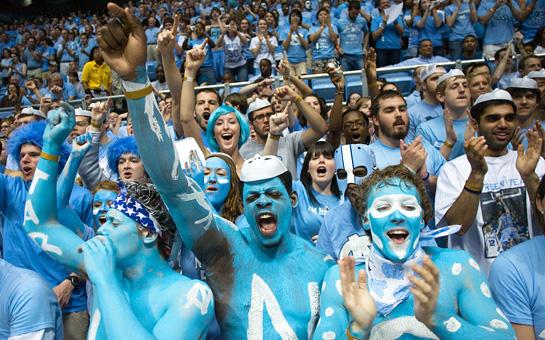
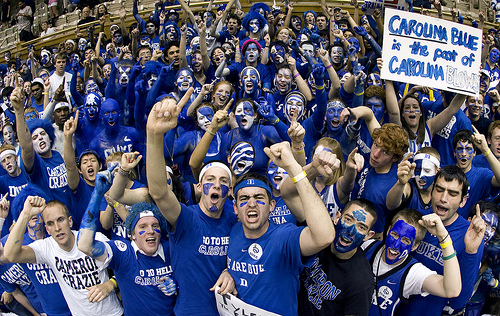
    How do you market one of the most watched sports programs when it doesn’t have as grand advertising sponsorships as the Super Bowl? The answer is you let the fans advertise for you. The historic game I’m referring to is the infamous and arguably most intense rivalry in college basketball- the UNC Tarheels vs. Duke University Blue Devils. At least twice a basketball season, these two juggernaut teams battle it out for who is King of Tobacco Road (the literal 8 miles of road that separate each university).

    The feuded rivalry between both schools is long and exhausting but no one has taken it any more serious than the fans and the schools’ students. These fans through word-of-mouth advertising taunt their opposing fans to the point where no matter what the current team’s ranking or accomplishments, everyone must watch the game between Carolina and Duke that will shut their rival’s jabbering faces. To some die hard fans it doesn’t even matter how great the season, if Duke didn’t beat Carolina or if Carolina didn’t beat Duke, the rest of the season hardly matters.

    It also doesn’t help that not only bragging rights between fans are on the line, but each school’s newspaper gets in on the action and goads one another. This is truly the best representation of how the game should be advertised, capturing the essence of each school’s spirit. The day before each match Duke’s newspaper, The Chronicle, runs a phony page titled “The Daily Tar Hole” to ridicule UNC’s The Daily Tar Heel. To punch back, The Daily Tar Heel, publishes the “Insider’s Guide to Hating Duke” by Ian Williams. Also, to add gasoline to the flames, each newspaper has agreed on a bet to if their school loses they will place the logo of the winning team in their newspaper announcing that they are “still the best” and change their newspaper’s masthead to the opposing school’s color. Nothing could entice fans anymore to watch the big game than knowing that if their opposing team loses, that loss will be sensationalized in print.

    The Duke and Carolina opposition is one of the best illustrations of competition itself and the definition of rivalry in college basketball. It is no surprise that it is one of ESPN’s most watched sports games each year. Next Wednesday, February 9th, when the Tarheels and Blue Devils face again for the Battle of the Blues the ultimate reward for the winning school’s students will not only be the bragging rights, but to take part in the performance of their school’s celebration ritual (the massive crowding of people on Franklin Street in Chapel Hill or the bonfire of burning benches at Duke University). However, luckily for whatever team loses, both schools always meet at least twice each season, and the next matchup after February is scheduled for March 5th.

    – JC Salter

  • [Black & Yellow] VS. [Green & Yellow]

    Thanks to the infamous song “Black and Yellow” by notorious rap artist Wiz Khalifa, the Pittsburgh Steelers find themselves with a bit of a theme song going into their seventh super bowl appearance this weekend. Khalifa is a Pittsburgh native who wrote the song to represent the main colors of the sports teams of the city of Pittsburgh, Pennsylvania. This interesting method of branding the city of Pittsburgh through the city’s athletic team’s main colors has brought a lot of attention to the Pittsburgh Steelers now that they are playing in the Super Bowl once more.

    Branding has been a driving force within the confines of IMC since the mid 1980’s when competition among products began to drastically increase. Without branding, a car is just a car, a school is just a school, and a football team is just a football team. There is no room for differentiation and no reason for a consumer to choose one over the other.  Each individual brand demands the support of loyal customers, and in this case, fans. Placing such emphasis on the color of the teams creates a more recognizable brand. Just upon hearing the words “black and yellow” fans feel a sense of ownership and camaraderie.

    Just to stimulate things even more, their opponent’s main colors are Green & Yellow. The Green Bay Packers are just as historic, prolific, and nationally recognized as the Steelers and naturally one could anticipate that it would only be a matter of time before imitations and remixes of the song “Black and Yellow” would be replaced with “Green and Yellow.” Sure enough, one of the most famous remixes has been done by two young men known as Pizzle and Prophetic titled “Green and Yellow” (See video below). The video already has garnered over 200,000 views on YouTube in just its second week. As this intense and historic competition between the two cities escalates, sides will be chosen with the question, “Black & Yellow or Green & Yellow?”

    -Katie Eagle, Deji Adeleke, Anna Kate Babnik, Tiffany Evans, and Carissa Niederkorn