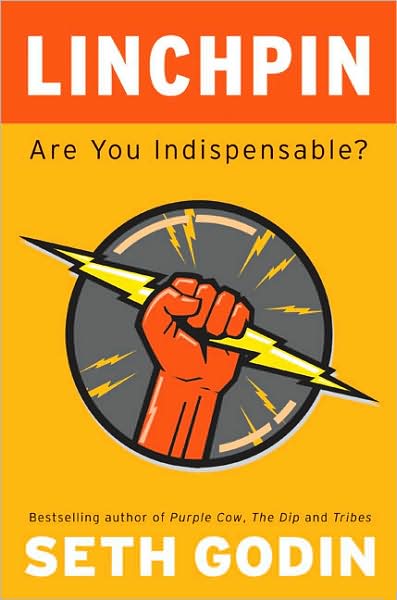
 Are you indispensable?
Seth Godin asks this question in his new book, Linchpin. And one response is “no, I’m not indispensable, I’m part of a bigger story that will go on without me.”
But this is not what Godin is saying. He’s not waiting for you to be deemed indispensable by others. He’s asking you to see how acting as a linchpin makes you inherently indispensable, not because of who you are but what you do.
Full disclosure: I require my Intro to IMC class to follow Seth’s Blog. I don’t do this because I’m a blind Seth Godin parroter who thinks every word he utters is chocolate-covered goodness. I require my IMC class to follow him so that they are introduced to a new way of thinking, to see the possibilities of a productive, virtue-driven life. Agreeing or disagreeing with Seth is not the issue. What is the issue is that he makes plain what he believes, and he tries to deliver on that every day. This coherence between word and deed is what makes him worth following and reading. Of course you should question what Seth says. I would think he’d be disappointed if you didn’t.
Back to Linchpin. Reading it is like reading his blog; it’s brimming with short, manageable bites of observation. He observes that being a cog in a machine is what we’ve been trained to do through school society, culture – what he calls “the industrial machine” (6). Being a linchpin, however, is a process through which we can break free from mediocrity.
The most applicable parts of this book for undergraduate students are when he talks about how to become a linchpin while in college. Getting passing grades, finding the easy way through school, and partying all the time are not – surprise!- the ways through which you become a linchpin.
However, Godin gets a little heavy-handed when he talks about teachers who do nothing more than keep students quiet and unquestioning. I’m sure there are teachers who fit this profile, but I personally don’t know any. I’d like to offer a different perspective – and students, take note: most of the teachers and professors I know are trying to stimulate their students’ intellectual curiosity in every way possible.
Every academic conference I attend offers formal and informal spaces for sharing teaching ideas that encourage active and engaged learning. We are officially assessed by our institutions in performance reviews for teaching capability, and we are unofficially assessed by students every day, online and off. We have Centers for Teaching Excellence on campus whose staff offer us training, inspiration, and encouragement to teach, delight, and move our students. I have met faculty at other universities who promote the theory and practice of our field through their online presence. My colleagues in my department and my professors in my graduate program model this commitment to helping students become linchpins. Godin got it almost right in Linchpin; I thought I’d offer a more textured account of what is going on in the academy from a front-row seat.
To conclude IMC-Hawks Book Week, I’d like to recommend everyone – especially students – read Linchpin and the other four books we’ve reviewed this week. Keep demonstrating the intellectual curiosity that will help you become a linchpin in a productive life.
–Jeanne Persuit, Ph.D.


 IMC Hawks Blog
Leave a comment