Tag: youtube

  • Celebrity Branding Through Social Media

    Nowadays, there is a wide variety of ways to advertise and promote one’s image as well as many products through personal branding. Celebrities are among the first to take advantage of the new social media phenomenon to further promote themselves and products they have endorsed.  Social media outlets such as Facebook, Twitter, YouTube, Instagram, Tumblr, Pinterest, etc. have been in a state of constant growth, as they cater to both the average consumer as well as celebrities. Interconnectivity has played a crucial role in keeping celebrities globally connected to a wider public in order to further promote themselves and gain a higher level of exposure.

    When it comes to many things such as self-branding and the use of social media, one must elaborate a thought-out, cohesive strategy in order to achieve optimum results. First of all, it is important to keep in mind that not all celebrities wish to accomplish the same thing through their social media outlets.  There are many reasons for a celebrity to join a social media site, from simply connecting with fans to promoting a product or event.  Also, each social media medium serves a different purpose and targets a more specific audience. In a recent trend, celebrities have been representing themselves by “opening up” and increasing their level of self-disclosure through many forms of social media. This could be due to the fact that it is believed that social media can be used to build trust with fans as well as build and develop a more personal connection with them by allowing them to see the “real” superstar.  For example, it is difficult to feel a personal connection to President Obama.  By following Obama on Twitter or Facebook, one might feel that this personal relationship has greatly improved.  Not only is this beneficial for the average American, but it could indirectly help Obama.  For example, someone that does not currently have a stance on politics could follow Obama on Twitter, like what they see, and vote for him in the next election.  This is just one example that portrays that social media outlets are a powerful, mass communication tool.  That being said, it is important for one to remain very conscience about what they say.  It does not take much for a tweet by a celebrity or political figure to create a huge controversy, whether or not they intended it to.  We sometimes forget that celebrities are human beings that make mistakes, and one of these mistakes could be by putting too much personal information on the internet.  Voicing an opinion can easily offend many other people.  The celebrity could in theory remove the tweet, but that does not mean it will be deleted from the Internet.  With the millions of followers many celebrities have and the fact that celebrities tend to keep social media outlets as public as possible, almost anyone could snap a screenshot of the tweet immediately and continue to circulate it through the web.

    While there are disadvantages for celebrities putting their lives on the World Wide Web, outlets such as social media can also be used as a free type of advertising or promotion.  Almost all main-stream celebrities have utilized multiple forms of social media from blogs to Twitter.  Britney Spears, Kim Kardashian and Justin Bieber are all examples of celebrities that have endorsed various products and used social media (more specifically, Twitter) to promote them. This has shown to be an effective marketing technique at little or no cost to them.
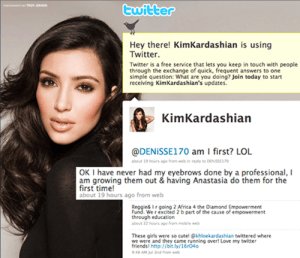
    Not every celebrity endorses a certain product, but they do essentially brand themselves when they decide post on social media sites.  Whether they mean to or not, the content they post reflects their personality and in turn, allows followers to characterize them.  Mastering how to effectively brand one’s self on these sites has in essence became a modern day art.  In today’s day and age, a social media suicide could destruct the celebrity’s image as a whole.

    Sasha De Vecchi, Lindsay Gallagher, Jay Reilly, Cary Welborn

  • An “Augmented” Look Into the Future of Advertising

    Last week Google unveiled Project Glass, their latest developmental project set out to design and build augmented reality eyeglasses. Google upload a video to YouTube entitled “Project Glass: One day…”, which shows viewers what Project Glass could potentially look like. Project Glass would allow you to communicate with friends, schedule appointments, get directions, take pictures, and even hold video conferences all by using the augmented reality interface and voice commands. While this technology is in the earliest stages of development, Project Glass has the potential to be a realistic and marketable product in the future.

    While the announcement of Project Glass is only a week old, there is already concern about user privacy and advertisements. Google already uses search terms to customize advertisements, and are even beginning to push ads based on your location, so just how far would Project Glass go? Would advertisements pop-up in front of you if you are close enough to a store? Could marketers use where you go and what you look at throughout the day to better understand what type of consumer you are? The parody video below shows how pop-up ads with Project Glass might look if they were implemented:

    While this idea of “forced advertising” seems a bit extreme, it’s already happening with several other projects. Twitter now adds Promoted Tweets to your timeline, which are sponsored announcements from businesses that merge together with the other tweets from people you follow. Pop-up ads are common with free Android and iPhone apps, and some applications even send ads as a notification. Amazon sells discounted Kindle e-Readers with “special offer” advertisements that appear on your screen. It seems that with every new piece of technology, the first idea that is addressed is how to advertise on it. With Project Glass, the possibilities for customized advertising are much more personal. How will marketers adapt to changing technology? Will consumers be willing to sacrifice their privacy and accept interruptive advertisements in order to use Project Glass? Only the future will tell.

    -Hunter Wilson, Joshua Vester, Ashley Oliver, Molly Jacques

  • Shave Time. Shave Money. Go Viral.

    You may have seen the latest viral ad campaign that has surged through the Internet and created quite the buzz. It’s a video from DollarShaveClub.com, a recent startup company that ships high quality razors for as little as $1 a month. The video has reached close to 700,000 views on YouTube in just two days.

    The video features Michael Dublin, founder and CEO of Dollar Shave Club, leading the viewer through the company’s warehouse. Michael claims that their blades aren’t just good, they’re “f***ing great”. Michael continues by bashing the competition and “fancy razors” with high-tech gear, saying how handsome your grandfather was with just one razor. The level of absurdity in the video has been compared to the success of the Old Spice campaign, which features deadpan humor and ridiculous situations.

    The marketing campaign may have been more than Dollar Shave Club bargained for. The reaction was so strong that the company’s website crashed soon after the video launched due to the amount of traffic they were receiving. With the website shut down, Dollar Shave Club potentially lost revenue from the overwhelming demand. In the world of modern business, success can literally happen over night, as displayed by Dollar Shave Club’s huge viral impact. With startup companies trying to get their name out there in the fastest and cheapest way possible, creating a hit video may be the way to go, as long as your prepared for the traffic flow afterwards.

    The popularity of the campaign raises some questions regarding the changes in modern advertising. Having your CEO star in a video where you pronounce that your blades are “f***ing great” is risky,  but it seems that the risk, blatant honesty, and the ability for a company to poke fun at itself is what drives a business to viral success. In comparison to the Old Spice campaign, Isaiah Mustafa’s character became so popular that Old Spice went beyond TV adverts and began answering viewer questions on YouTube. While this is still just a character that sells deodorant, it became much more than that to viewers because it didn’t feel like a commercial. If commercials have a self-awareness of what they are, the audience recognizes that awareness and is more lenient to simply enjoy an advertisement as entertainment. Perhaps this is what Dollar Shave Club was going for, simply telling people what they are in the most honest, exciting, and fun way that they knew how.

    By: Hunter Wilson, Josh Vester, Ashley Oliver, Molly Jacques