Tag: youtube

  • Can YouTube Define YOU?

    When you hear the name Tyler Oakley, what comes to mind? If it’s YouTube and over 7 million subscribers, then you’re on the right track! Tyler Oakley is a 26 year-old who became famous through YouTube. Oakley made his initial claim to fame in 2007 when he uploaded his first video as a freshman at Michigan State University. His videos have since gone viral. What is it that makes an ordinary Michigan State college student so popular? Could it be his open nature and willingness to speak about controversial issues? Is it due to others’ ability to relate to a normal college student? Although Tyler Oakley now receives money from sponsors as a result of his amount of subscribers, is he perceived as more authentic than other celebrities simply because he became famous through YouTube and is not actually a paid actor?

    Screen Shot 2015-11-09 at 10.27.09 AMIn his first video, titled “Why Gay Marriage is WRONG,” Oakley takes a satirical approach and provides ten irrational reasons why gay marriage has to be wrong. Despite the title of his first video, Oakley identifies as gay and has obtained a large following from the LGBT community.

    Screen Shot 2015-11-09 at 10.27.49 AM

    Members of the LGBT community, along with many others, now view Oakley as a role model. Whether or not this was Oakley’s intention, he is largely in the public eye and has now has a profound influence on his audience. In a recent interview with TIME magazine, Oakley indicated it does not matter whether or not he intends to be a role model for others. If people are looking up to him, he has the potential to influence their lives in a positive or negative way, which is where authenticity comes to play. When Oakley uploaded his first video in 2007, he was not following a script. No one was telling him what to say or how to say it. Instead, he was simply sharing his own views. At that time, it likely would have been difficult for Oakley to imagine he would one day have over 7 million subscribers. Now that Oakley receives sponsorship via YouTube, does this make the content he produces less authentic? Or has he stayed true to the values and beliefs expressed prior to receiving money from sponsors?

    We live in a commodity culture, which means we define ourselves by the commodities we consume. Although Tyler Oakley’s YouTube videos are intangible, they can be viewed as commodities that help define his audience members. The messages Oakley conveys, whether intentional or unintentional, inevitably influence his viewers. Some may choose to watch Oakley’s videos because they identify with the LGBT community. Others may watch Oakley’s videos simply because they find him humorous or they enjoy his hipster image. Regardless of their reasoning, Oakley’s 7 million plus subscribers have found a way to connect with him and the brand narrative he has created for himself.

    Why do you think Tyler Oakley has become so popular? Are viewers more likely to buy in to what YouTubers say as opposed to paid actors? Are Oakley’s videos worthy of over 7 million subscribers? Do you agree that simply watching videos on YouTube help can define you as a person? If so, how? Please share your thoughts in the comment section below!

  • So If I Make A YouTube Video Will I Get Famous Too?

    pewdiepie

    Felix Kjellberg aka PewDiePie

    “Creativity out of necessity.” In 2005 the most successful free video streaming site was created by three college graduates who had a major dilemma…

    …They couldn’t find footage of the famous Janet Jackson “wardrobe malfunction” during the 2015 Super Bowl halftime show….

    And so YouTube was born.

    YouTube has evolved to so much more than a free and easy way to see inappropriate videos of celebrities. Now it’s so sophisticated that people can earn their livings video blogging, or vlogging, about anything they want. The site started with one unfortunate (or maybe fortunate, depends on how you look at it…) celebrity “wardrobe malfunction,” and now YouTube is making a whole new category of celebrities; self-made vloggers.

    bilde

    Jenna Mourey aka Jenna Marbles: YouTube personality, vlogger, comedian, and actress

    Just as YouTube has changed over the years, the vloggers that scramble to be the next big internet sensation have started to move from computer screens to larger ones. Jenna Mourey or Jenna Marbles as she is known on YouTube is the top female vlogger with well over 15 million subscribers which ranks her channel seventh overall. Mourey now can be seen in episodes of Epic Rap Battles in History, Fake n’ Bacon, and Ridiculousness. Hannah Hart who rose to fame with My Drunk Kitchen, and hosting cameos on Mental Floss sat down with People last week to promote her upcoming TV mini-series Electra Woman & Dyna Girl airing in 2016. Then there is PewDiePie, with 40 million subscribers and over 6 billion views Felix Kjellberg has raised YouTube vlogging to an art form. By basically inviting the world into his living room to watch him play video games, Kjellberg makes $12 million dollars a year and is helping to shape the indie gamer market. Like the Oprah effect, when Kjellberg mentions a game it sees a spike in sales.

    According to People.com, these YouTube blogger channels make the most money:

    1. Felix Kjellberg

    – $12 Million a Year

    Channel: PewDiePie

    Subscribers: 40 million

    Shtick: Playing video games and making jokes

    2. Ian Hecox and Anthony Padilla

    – $8.5 Million a Year

    Channel: Smosh

    Subscribers: 21 million

    Shtick: Live-action comedy sketches

    3. Benny and Rafi Fine

    – $8.5 Million a Year

    Channel: Fine Brothers Entertainment

    Subscribers: 13 million

    Shtick: Reacting to things

    Screen-Shot-2014-07-01-at-11.40.44-AM

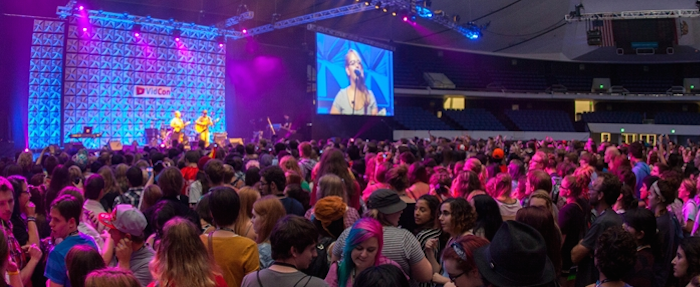
    2014 VidCon Youtuber Convention

    YouTube has become so popular that they have dedicated a whole convention, VidCon, to the videos and YouTube “stars”.  VidCon features workshops and speeches on how to launch your own YouTube career, video highlights, and YouTube celebrities waiting to meet their fans.  For a few hundred dollars fans can attend the three-day conference, with varying levels of entry to events.  Tickets range from general entry at only $100 for the “Super Early Birds”, to $750 for the Industry Standard Price.  For those interested in the online video industry beyond basic video production the industry ticket is the way to go.VIdCon offers a variety of events for industry professionals including: seminars, keynote speakers, and helpful tips on how to use online video to promote your company.

    There are many benefits for marketing your brand via YouTube:

    1. Capturing attention: Posting creative content on YouTube is an easy way to catch viewer’s attention.
    2. High Traffic Volumes: There are over 1 billion users on YouTube which is an excellent platform to reach people all over the world.
    3. Viral Marketing: YouTube videos are easily shared between friends and family members and can be shared with others, thus creating a ripple effect.
    4. Multiple Video Marketing Channels: Creating and posting videos to YouTube is a powerful and recognizable way for users to view your content.
    5. Search Engine Rankings: Google owns YouTube, which why it is so highly ranked when you search for videos on Google’s page.
    6. Social Media Marketing Integration: YouTube videos can be shared via email, Facebook, Twitter, Linkedin, Reddit and other social media platforms.
    7. World-Wide Accessibility: Posting content on YouTube can be seen in 75 different countries, since YouTube is available in 61 languages. This is one the most effective marketing strategies since YouTube is available 24/7.

    Who are your favorite YouTube stars? Do you have your own YouTube channel? Share with us in the comments below!

    Aki Suzuki, Carey Poniewaz, Carey Shetterley, Lexie Trimnal, June Wilkinson

  • One Country Painted Red

    With the rapid growth of new products, brand extensions and the blurring of traditional and new age advertising, marketing and advertising to target audiences has reached a new level of competitiveness. Brands now must adapt to this changing environment and contest with competitors to stay at the top of their market and target to audiences in creative, attention-grabbing tactics.

    The most iconic brand in the soda market, and throughout the world, is undoubtedly that of Coca-Cola. In the summer of 2011, Coke created an original marketing strategy to run a campaign that would inspire people to connect with the brand both online and offline in order to acclimate to the changing marketing environment. The campaign’s prime objective was to increase consumption of Coke over the summer season and to get people to fall in love with the iconic brand again. Particularly, in Australia, at the time nearly 50% of teens and young adults had never tasted a Coke and this drove the brand to reconnect with the country.

    Established in Australia, the ‘Share a Coke’ campaign immediately received positive media attention and consumer responsiveness. The idea of the ‘Share a Coke’ campaign was to place Australia’s 150 most popular names on the front of millions of Coca-Cola bottles, simple right? This was the first time in 125 years that Coke had made such a paramount transformation to it packaging, and it was revolutionary.

    “We used publicly available data to review the most popular names in Australia and ethnic representation in Australia to ensure the diversity of our multi-cultural nation was represented appropriately.”

    – Coca-Cola Spokesperson.

    The Coca-Cola brand wanted to initiate conversations by putting Australians front and center and inspire them to connect with people and ‘Share a Coke’. The central theme that gave ‘Share a Coke’ its power was the way a brand so universal could replace its logo with individual names by reaching out to consumers and personalizing its brand to individuals.

    “We are using the power of the first name in a playful and social way to remind people of those in their lives they may have lost touch with, or have yet to connect with”

    -Lucie Austin, Marketing Director for Coca-Cola South Pacific.

    The ‘Share a Coke’ campaign strategically exhibited that when personalization in advertising is done the right way, it can be highly appealing and extremely effective. While Coke got personal, media was buzzing with talk over what the brand was implementing behind the personalization. Coke remained silent until Australia’s highest rated media weekend. The campaign was revealed to the public and aired across the biggest weekend in Australian sport, during the AFL (Australian Football League) and NRL (National Rugby League) grand finals which reached over 30% of the population.

    Succeeding the campaign launch, requests for more names were coming in the thousands. Coke was prepared for this boom of requests by setting up kiosks that toured 18 Westfield shopping centers attracting consumers to personalize any name on a Coca-Cola bottle.

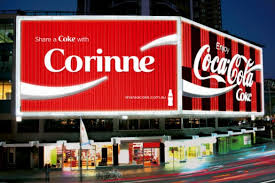
    Coke wanted to especially reach out to the 50% of young adults that had never tasted a Coke in Australia, and there was no better way to reach this target market than online. Participation and mass allocation was achieved through Facebook by providing consumers with the resources to connect and ‘Share a Coke’ by creating a personalized virtual Coke bottle to share with a Facebook friend. Consumers were tagging friends in pictures with personalized Coke bottles and sharing stories on social media platforms like Twitter, Facebook and YouTube. Coke consumers also could create their own commercials! With the abundance of requests still pouring in, Coke told consumers to put in a vote of “who do you want to share a Coke with the most?” via Facebook. After 65,000 people voted, Coke bottles with 50 new names were released. “Consumers were invited to SMS a friend’s name, which was projected live onto the iconic ‘Coca-Cola’ sign at Sydney’s King’s Cross. They then received an MMS enabling them to share their friend’s name up in lights, via Facebook and email.”

    untitled

    The multi-platform communications strategy was implemented to ‘Share a Coke’ with someone you know, or want to know and ultimately gave people the resources to find, connect and share. After 3 short months of running the campaign, young adult Coca-Cola consumption increased significantly in Australia by up to 7%, making 2011 Coke’s most fruitful summer season in history. The ‘Share a Coke’ campaign resulted in 76,000 virtual coke cans shared, 378,000 extra coke cans printed at kiosks, and 5% more people were drinking coke. Coca-Cola had successfully won over Australia and became a part of popular culture again.

    -Briana McWhirter

  • #YTMA… What’s that?

    This past Sunday, November 3rd, YouTube decided to take a leap and reinvent the fundamentals of music video awards as we know them; YouTube held their inaugural YouTube Music Awards (YTMA). The live-streamed event, sponsored by Kia, took place in New York City. Directed by Spike Jonze, YTMA was an interesting and unconventional mix of miscellaneous acts, unscripted hosts (Jason Schwartzman and Reggie Watts), and awkward moments. Although they received criticism of their “home made” feel they did one-up their MTV awards competitors in one aspect, along with live performances by popular artist such as Eminem, Lady Gaga, and Arcade Brothers they also incorporated “live music videos”.

    According to Ad Age, YouTube averages more than 1 billion viewers each month and is owned by Google, the most powerful of all internet companies. With this is mind we can only assume that the YTMA was a huge success. Wrong! The viewership was astonishing low, it was only viewed by 220,000 people at its peak; to put this into perspective the MTV VMA’s viewership was at 10.1 million this year.

    So where did they go wrong? Although both Kia and Youtube advertised on their websites’ homepages for some time prior to the event. YouTube neglected to realize the importance of advertising on their mobile app.  This was a huge miss to their prime public because mobile apps are 40% of where their user base are present.

    Also, unlike watching music video awards on TV, YouTube had a social media disadvantage.  Like many live TV events YMTA did have a hashtag, #YTMA, for viewers to tweet while watching the event. The hashtag reached a decent number of about 30,000 tweets, but there was potential to have had much more. Once again they forgot to keep in mind that many of their viewers watch from mobile devices, making it difficult to watch and tweet at the same time. This resulted with a large decrease of tweets about YTMA when the event went live, which possibly hindered other tweeters to start viewing.

    These two factors alone go against the Audience Theory by Chaïm Perelman and Lucie Olbrechts-Tyteca which states “approaches will achieve the greatest adherence according to an ideal audience.”  YouTube’s target audience is the social media and mobile users, and because YouTube did not take into account these minor but impacting factors, it may have cost them viewers.  Nicholas Carr the author of The Shallows says, “most TV shows and movies are also trying to become more Web-like”. I think YouTube may be going in the wrong direction. They have excelled as an online video website, for their sake they should keep it that way and stop trying to be more TV-like.

    -Kelsey Raskob

  • Now You Know What The Fox Says

    Music is a universal language. No matter what country you are from or what form of dialect you speak, music can touch souls and be listened to by everyone, regardless if you can understand the words or not. With this being so, music comes in many forms and continues to evolve throughout the generations. The pressure in the music industry has always been to create the newest, most creative style of music and present it in a fresh approach. The expectancy violation theory explains one’s reaction to an unexpected event or behavior. Violating this is a tactic that is actually the objective for many artist today. Catching viewers off guard by showing them something different they would never expect, is what sells records. Bard Ylvisaker and his brother Vegard accomplished just this when they posted their Youtube video “The Fox.” Their goal was to create a funny video by singing about something totally random in a serious looking manor. The video by the Norwegian duo was never expected to reach the popularity it did, having more than 120 million views to date. What set this video and song apart from the other millions of video’s that have been posted to Youtube, is the fact that it does exactly what this theory states, it violates all expectations viewers had prior to watching it.

    Image

    Who would have guessed by simply looking at the title “The Fox”, that this video would take something random such as the sound made by a fox, and create a serious and professional music video revolving around the amusing topic. Saying the video has gone viral is an understatement. The brothers and their video have done everything from playing live at a Lower East Side club, to making appearances on the Today show, and even having an article written about them in the world-famous magazine Rolling Stone. They quote in the magazine “We’re exhausted, but like, a happily exhausted.” The popularity of this music video has thrown them into a whirlwind of publicity, with their appearances being sought after as the hottest thing to date. Youtube was the perfect platform for a video such as this. Having the visual addition of the music video to accompany the song are what made this concept such a success. A song such as this would have never became such a hit if it were to have been included on a CD track list. As music evolves, so does the ways in which is it presented to the public and the Ylvisaker brothers hit the musical jackpot with their creation, and presentation of this song.

    -Kaitlin Batson, Alex Corrigan, Parker Farfour & Caitlin Ford

  • Humor: The Helper

    It’s undeniable that cancer is a scary subject, and breast cancer is no exception. One simple statistic summarizes just how un-discriminatory and prevalent breast cancer is: breast cancer is the most common form of cancer in women, no matter your race or ethnicity. With the whole month of October designated as National Breast Cancer Month, reminders for women to get mammograms and to screen themselves appear regularly. So how do you get people to face one of the scariest diseases out there? The answer is humor.

    Rethink Breast Cancer is an organization dedicated to changing the perspective of breast cancer from scary, to preventive and manageable. Most notably, they want to change how awareness is taught. Rethink Breast Cancer has moved away from fear-based education tactics to using “fear-free, cutting edge messaging, multi-media platform reach and positive energy [that will] revitalize the breast cancer movement and motivate young people to action.” The YouTube video they have created for awareness has done just that.

    With over six million views, the video Rethink Breast Cancer produced in 2011 has done a remarkable job of not only raising awareness for breast cancer, but also doing so in an approachable manner. Based on the premise that “women are more likely to watch a video if it features a hot guy,” it stars male models that educate the audience on how to check for breast cancer. Humor is interwoven throughout the video in scenes such as a female nurse tripping over a stool, and a slow motion of a male model bathing himself.

    Together, all of these humorous scenes combine with raw education to make breast cancer awareness fun to learn about. By using a pop-culture medium, such as YouTube it is even harder to ignore the message. But most importantly, Rethink Breast Cancer is living up to its goal of helping to educate from a perspective of humor rather than fear. This is exactly the kind of video that women (and even men) will pass on to their friends, helping to spread the importance of proactively approaching breast cancer.

    Carefully balancing humor and sex appeal, Rethink Breast Cancer has created the ultimate advertisement for spreading awareness on how to help catch breast cancer. By using humor the ad becomes persuasive and makes examinations less of a chore and more of a self-service. But is this particular message the way that survivors would want to caution the public? While it seems appropriate to use humor on occasion, could there be a point where humor starts to detract from the sincerity of the situation at hand? If ads like this can be successful for breast cancer could this type of levity be introduced in messages of other health campaigns?

    Meghan Carey, Caroline Robinson

  • The Importance of Social Media in the 2012 Election

    More and more are the variety of social media through which voters are able to use.  These are convenient and simple tools that are effective ways to express the opinions of voters and influence the course of the electoral campaign. The role that social media has been critical in drawing conclusions about the outcome of the 2012 election. According to various studies, websites like Facebook have caused an increase in voter registration. Ultimately, social media networks are the powerful influencers that are often capable of moving large quantities of votes. It is important to recognize that an electoral campaign that is closer and pays closer attention to real human dynamics has a completely different approach than the traditional campaign. Nowadays, an effective campaign should be based less on the money spent and more on the intelligent use of new technologies to create new bonds with the everyday voter.Ultimately, the roles of social networks, new media as well as the weight of the establishment are all factors that will have a crucial role in deciding the electoral dispute.

    As previously stated, social media has encouraged many young eligible voters to register and vote. For many of the past elections, the young demographic is not properly represented in voting. This year, there are record numbers for college aged students voting.  Much of this can be attributed to social media outlets.  Young people in general use social media more than any other demographic (to date). Also, social media websites such as twitter allow you to follow each candidate and get quick, short, and frequent updates on what they plan to make their policy be if they are to be elected. This is only the second election that we are able to follow Candidates directly on Twitter since it did not exist prior to 2006. Also, Twitter has gained a substantial amount of users since the 2008 election. On Twitter, there are trending topics, and subjects regarding the recent presidential election have been trending at record numbers. Social Media allows people to get quick and easy access to information about the election.

    Both presidential candidates devoted much time and effort to boost the collection of information and social media sharing amongst voters. In the current election, Barack Obama and Mitt Romney have predominately utilized Facebook, Twitter, and YouTube, which are the top powerhouse tools of social media today. As the election progresses, candidates have concentrated their efforts on “swing voters”. Swing voters are voters who have yet to make up their minds and plan to wait till the very last minute to make a decision about who to vote for. Social media can establish a medium for interchange between our presidential candidates and many of these swing voters, avoiding an influence on votes that have already been established.  This reveals the importance of social media and web video usage in terms of voting. Not only can social media institute this medium that allows a campaign to be specifically modified for particular voters, but it provides value for each candidate, resulting into fewer costs for ads. The cost of advertising through social media is much less than the cost of paying T.V. channels to run advertisements; not to mention the impact of online ads have been reported as just as good or perhaps even better than the ones shows on television. All political parties in the current election have greatly benefited from these recent online updates and social media enhancements.

    Sasha De Vecchi, Lindsay Gallagher, Jay Reilly, Cary Welborn