Tag: Washington

  • Government Shutdown Affecting Others Outside of Washington

    The government shutdown that is upon the country has many in Washington wondering: what do we do now? However, this congressional budget stalemate has trickled into many areas of our country that lie outside of Washington, DC. The shutdown has had an especially big impact on all service academies’ athletic programs across the country. These student athletes and coaches have been in limbo since the announcement of the shutdown.

    Image

    At first, all athletics employees were sent home and put on leave. The Air Force Academy golf team has already cancelled a tournament since the shutdown and apparently the decision wasn’t taken very well by the people involved. What is making situations like this so difficult is that coaches of these schools are essentially government employees, leaving them no option but to have little to no communication with their players. That being said, Air Force golf has not been the only ones affected. Cross country meets, soccer games and tennis matches have been cancelled or rescheduled at all three service academies, leaving these young people forbidden from doing what they love.

    Image

    The interesting thing is that all three schools’ football teams still competed over the weekend. Initially, all athletic functions were to be cancelled due to the shut down. However, the 3 schools decided to challenge the decision, which was then reviewed by the secretary of defense. The secretary of defense decided that the games could continue, as long as no government funds were spent on the day. Even so, many have speculated that this decision was solely a monetary decision. Navy’s athletic director, Chet Gladchuck, certainly provided some evidence for this thought with his comments that were given to CBS New York. Gladchuck was quoted saying that cancelling a game would be “devastating to the Navy athletic program budget.” While these football teams were still given the opportunity to compete and do what they love, others like Air Force golf were forced to cancel or wait to have the opportunity to do the exact same.

    The expectancy violations theory has been rampant this entire situation as every team has been affected in some way, positive or negatively. The expectations of players and coaches have not been met due to issues that are outside of their control, essentially invading their personal lives and causing a change in their daily routine. With that being said, it just doesn’t seem fair. In the end, it all seems about “par” for what has been going on in Washington as of late.

    -Ryan Nagy

  • Government Down, Ratings Up

    The political landscape of today is a far cry from what it was just a few decades ago. Radio chats and newspaper headlines are obsolete in comparison to the speed and accessibility the Internet offers for political communication. This past week, headlines on every major network ringed “government shutdown”.

    As usual, polarized politics have kept the Republicans and Democrats in gridlock as Congress disputes the budget and Obamacare. Inability to reach consensus has left millions of workers temporally furloughed, while others are unable to attend work at all. The turmoil of the national government continues as the shutdown advances into this week, which leaves us wondering, could the media be enjoying all this anxiety?

    With the introduction of the 24/7 new cycle, cable networks are now in constant competition to fill news holes and beat competitors ratings. What is news, what is analysis, and what is entertainment are supposed to be notably different, yet the three are becoming harder for the public to differentiate between. Has the constant monitoring of the shutdown become the perfect manifestation for the media?

    News networks’ websites are filled with headlines, sidebars, and blogs about the shutdown. Their social media sites are providing hourly updates of Congress, urging people to follow the bombardment of links going to their website articles. And their programming has become a mixture of analysis and entertainment as their “bipartisan” debate on the subject often features a right-wing versus left-wing commentator “discussing” (yelling) their opinions.

    cnn

    As outlets continue to label the shutdown as a “showdown”, it becomes evident horse race journalism is no longer only applicable during election coverage, but has transcended into the way politics are viewed and reported every day.

    Matthew C. Nisbet describes the reporting style and its features. Horse race journalism focuses predominantly on which players are most adept at gaining power while undermining the chances of the opponents. Rather than foregrounding the context of political issues or policy proposals, journalists focus on: who’s ahead and who’s behind in the policy battle, the primary persons involved, and the shifting tactics that are employed.

    Polling and public opinion surveys are central feature in horse race journalism. Claiming they supply “objective” data, reporters use the results to define who is winning while gaining additional news pegs for the reasons of such successes or failures.

    Public opinion surveys act as a competitive advantage in the news marketplace, filling the demand for “anything new” in the 24 hour coverage cycle. “Polls say” and “Poll show” headers allow journalists to make their own independent attributions without relying on consensus of experts. As a result, a constant emphasis arises between sets of ideologies and/or sets of political actors.

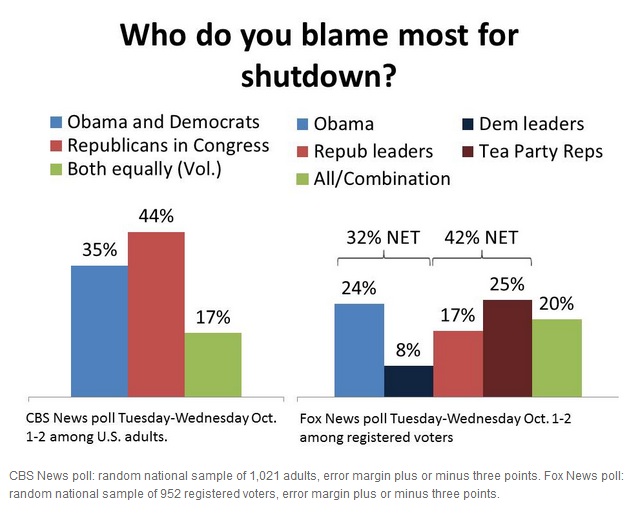
    Almost every major news network has been asking its viewers and readers to chime in on “Who’s to blame?”

    poll 3

    Rather than explaining policy, media outlets have framed the shutdown into a simplistic game of winners v. losers, Democrats v. Republicans, Obama v. Congress. Outlets are then using their polling results to create further news articles that act as nothing more than a survey report.

    poll 4

    Their strategy has not been in vain.  During prime-time, Monday through Thursday of the past week, ratings for CNN were up 68%, MSNBC up 54%, and Fox up 49%. As viewers continue to tune in, we are left begging the questions: Is the press providing an informative medium for exercising the public’s right to know? Or has the shutdown turned into another political spectacle for media to cash in on?

    – Savannah Valade

  • Name Changer

    Tailgating, body paint, jerseys, good luck rituals, and an unparalleled fraternity all exist as part of sports fandom. People love their teams – and love anyone else who also loves their team. Such loyalty has become an integrated part of sports culture sociology.

    Social Identity Theory states that by wearing team colors, attending games, knowing the players’ names, positions and stats, a fan begins to feel as if they are an integral part of the team – they connect with the team as if they were playing the game themselves. This connection explains why even poor performing teams have avid supporters. However, it is ultimately marketing that fosters fan identity. After all teams are brands; encompassing colors, logos, and mascots.

    fans, blog 3

    Fan loyalty has elevated sports to become part of our commodity culture; a product to be bought and sold, meaning big bucks for team owners. High-level sport has been transformed into a commercialized, commodified, and massified phenomenon. Therefore, fan identification and brand commitment become two key factors in managing and marketing a team. Building a brand is hard, but building and maintaining a culture of fans is much harder.

    As we transition into fall, we know that means one thing in sports,  football is king. With the NFL season in bloom, one team in particular, the Washington Redskins, are off to a rough start. The return of RG III has been very anti-climactic and on top of the team’s poor performance, a greater worry looms in the background: the franchise is under pressure to change the team name.

    Many believe the team’s name, “redskins”, is derogatory and racist due to its historical connotation and use to alienate and belittle Native Americans. The acclaimed Peter King from sports illustrated has even decided to stop using the name, saying, “I don’t want to add to the offensiveness.” Pressure to change the team’s name has been mounting for years and this past spring 10 congress members sent letters to the team owner and NFL requesting them to change the name. One Native American group, the Oneida Indian Nation, has started to take action and run ads in D.C. about the offensive name in hopes of rallying up support.

    rs logo, blog 3

    Whether you are an avid supporter for the name change, an avid supporter of the Redskins, or just don’t care, you can’t deny that team names mean a lot in the sports industry. Which leads us to the question: does a new name mean a new team? Does the team culture change when a team redesigns?

    These are exactly the questions the NBA juggled this past summer when they chose to revert the Charlotte Bobcats back to their former team name, the Charlotte Hornets. Coming onto the basketball scene in the ’90s, the Charlotte Hornets created a unique culture. With Hugo the Hornet as the mascot and teal uniforms, the Charlotte Hornets were a recognizable brand. So when the NBA decided to change the team name it was a hard transition for many loyal and devoted fans. Unable to identify with the new team and culture the fans gave up support and the fall of the Bobcat brand ensued.

    Reverting back to the original team name rejuvenated Charlotte fans. There was an immediate increase in the amount of ticket sales; quantitative proof that the Hornet name had been sorely missed. By keeping the team name consistent with what the fans wanted, the Charlotte basketball team re-strengthened their brand significantly.

    However, Washington, unlike the Bobcats, doesn’t have a sorely missed brand. In fact, the Redskins name is so beloved the proposition of changing the team’s name is being met with great opposition. Owner Daniel Snyder commented he would never change the name saying, “the Redskins’ fans understand the great tradition and what it’s all about and what it means.” Even NFL Commissioner, Roger Goodell, described the team name as a “unifying force that stands for strength, courage, pride, and respect.”

    Even if Snyder wanted to change the name it would be hard to change the minds of brand followers who have spent years identifying with the team, purchasing the merchandise, rooting for the players, and most importantly making memories. Ditching the derogatory name may ultimately come to a forced decision but the implications involved are massive. It boils down to a relatively simple equation: fan identification and brand commitment work together to produce the main goal in sport commodity, revenue. So the most important factor to ponder: the fans. How is the team going to remarket and rebrand to get fans to commit to a team they may no longer identify with?

    Savannah Valade, Caroline Robinson, Meghan Carey, Morgan Jones