Tag: walmart

  • Walmart: A Rebranding Genius.

    Consumers all over the world are becoming more savvy and sophisticated with each passing year. In order to survive in today’s marketplace, companies have to update and revitalize their identity while retaining brand equity. This is the unavoidable challenge that companies must face. Brands are struggling to maintain relevance in the eyes of evolving consumers and even the most established companies have to undergo brand re-inventions. Losing loyal customers in an effort to attract new ones is always a pitfall of making a possible change for the worse… but that’s just a risk many brands are willing to take.

    Walmart had one of the most successful rebranding campaigns ever. It is the world’s largest retailer and one of the most distinguishable brands in history. Since its first store opening in 1962, Walmart has evolved from a rural American company to a globally recognized corporation. Historically criticized for having hostile corporate practices, mistreating employers, and being a target for environmentalists, Walmart reconsidered their brand identity and took action in creating a fresh image for their company.

    In 2008, Lippincott brand designers developed a strategy to shift the focus of Walmart from just low prices to an overall positive shopping experience. They unveiled the new tag line “Save money. Live Better.” to highlight the emotional benefits of shopping at Walmart. They hoped to get the message across to consumers that spending less allows people to live better lives, not only save money.

    Image

    A new logo and innovative store design was also implemented. The logo no longer showed a choppy, antiquated Wal-Mart; it now showed a fluid, refreshing Walmart. The star in between all caps was replaced by a bright orange starburst for a finishing touch. The new store design included higher ceiling, lower shelves, wider aisles, and a color palette of vibrant orange, yellow, and green. The signaling of Walmart’s appetizing products in the grocery department and the creation of a more enjoyable and friendly shopping environment was the goal of the new design.

    Image

    This rebranding campaign proved to be a tremendous success for Walmart. The customer ratings for how “clean,” “fast,” and “friendly” Walmart is increased radically between 2008 and 2010. Not even the Walmart haters can deny that in the world of branding, Walmart takes the crown.

    Erin Kiffmeyer, Hannah Eure, Ally Walton, Lauren Habig, Eugene Lee

  • So is it not hip to be hip anymore?

    “Hipster”. By now, I’m sure everyone reading has probably heard this word thrown around to describe someone. It has a great deal of meanings now, some more relatable than others. Urbandictionary.com defines a hipster as ” a subculture of men and women typically in their 20’s and 30’s that value independent thinking, counter-culture, progressive politics, an appreciation of art and indie-rock, creativity, intelligence, and witty banter”. What sounds like a common description for a large group of people has been boiled down now into an image, one which companies and a select group of consumers have been embracing recently.

    So what makes a “hipster”? Some people believe it’s the type of music you listen to, or the clothes you choose to wear. Other people think it’s the attitude about the music and clothes you have also chosen to wear. “Skinny jeans, cardigan sweater, and listening to Neutral Milk Hotel…yeah, that guy’s a hipster”. Ironic sayings on t-shirts, listening to obscure music on their vinyl records, and drinking home-brewed fair trade blend coffee. These seem to be the most common conceptions of what classifies a person as a “hipster”. With such a large trend being developed, of course fashion companies are going to developing products appealing to the trend.

    Like many fads from the past, "hipsters" are just an evolution from the previous popular trends.

    Urban Outfitters and American Apparel are both companies that cater to a more “hip” lifestyle. Carrying a large variety of plaids, cardigan sweaters, and tight jeans, both companies have been considered a “hipster haven”. Both companies know this, have accepted it and are now running away with it. Urban Outfitters now sells 35mm cameras and Holga copies, because there is a common interest in those who some would call a “hipster” and their interest in photography. Also on their site, you can make your own screen prints, and even build your own fixed gear bicycle, both things targeting directly to those who are attempting to follow the “hipster” trend.

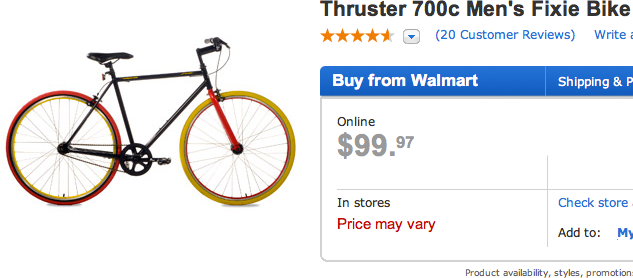
    Walmart attempts to capitalize on the fixed-gear craze by offering a low-priced bike called "The Fixie".

    Companies today are smart. They realize that the trend of “hipsters” including their fashion sense and their interests have been on the rise, and are adjusting to the demand in order to deliver what sells best. They also are targeting this demographic through their advertisements via email and internet ads featuring models who roughly resemble “hipster fashion”. The trend does not seem to be dying out any time soon, as more and more people are starting to embrace it for themselves, so we can expect to see more and more companies reaching out to these consumers in an attempt to show how “hip” they can be in order to sway them into buying from them. What it simply boils down to is another label for another trend that is ripe for the capitalization on, and it seems like many companies are doing just that.


    -Joshua Vester, Hunter Wilson, Ashley Oliver, Molly Jacques