Tag: Tumblr

  • Networking, Personal Branding, and Tumblr


    Personal Branding is an important tool in order to introduce and further promote one’s self to a target market in an effective and decisive manner. Industry guru, Colin Bates says, “A brand is a collection of perceptions in the mind of the consumer.” But the concept of “brand” does not apply – as we are often led to believe – just to companies, their products and their services, but also individuals, regardless of the profession they practice. 

    It is important to keep in mind that strategies for personal branding often revolve around three main tactics: 


    • Competence – analyze and improve the characteristics and attitudes of your own persona by producing value on the market.


    • Visibility – stand out from the crowd through communication strategies, which may be coordinated both online and offline.


    • Networking – be consistent with your own personality, while being open to dialogue and exchange in order to further broadcast yourself and create your own network of contacts with whom to interact.


    Ultimately, a personal brand that is strong and empathic is built by offering uniqueness and originality: it is necessary to orient your public and target audience towards values that are positive ​​and consistent at every level. In order to successfully accomplish this it is necessary to establish resources, along with a consistent and constructive dialogue with others. 


    Different social media outlets are ways to create one’s personal brand. Specifically, Tumblr offers a very unique way for people and brands to express themselves. It’s a relatively new type of blog that features all types of small niches; something for everyone to find. It’s a little bit like a more informal Pinterest.  One chooses to follow certain blogs, and only posts from those blog show up on one’s “dashboard”. It’s also quite interesting because unless you know someone’s Tumblr URL, there is no way to search for anyone specifically. One finds pages they like through tags and going to the pages of people they follow to find other people and tags. 

    This makes me think of the book, “The Filter Bubble” by Eli Pariser. In this book he talks about how people have “click signals” when they use the Internet. For instance, everything that shows up on one’s Facebook news feed is due to their click signal, as well as all of the advertisements. Facebook saves information from what one clicks on, to what one likes, to how long one is on a certain page, and uses this info to create one’s Facebook home page. Meaning one only sees information that is filtered for them; only information click signals believe they will like.  This creates one to be more close-minded due to the fact that they only see things they prefer to see, and not things people with different opinions post. I believe Tumblr somewhat breaks the filter bubble though, because even though one chooses which blogs to see, there are very few blogs that only post one specific subject. Most blogs have a variety of different types of posts, from movies and music, to science and politics, even adult entertainment. Unlike Pinterest, there aren’t specific boards one can choose to follow on another’s page; instead it shows everything that user posts. So even though one follows a blog because they see a post they like, chances are they are going to see a variety of other things as well. 

    Although Tumblr is still gaining awareness and users, it is still a fun, new way to express one’s personality on the Internet in a truly unique way from the rest.


    Jay Reilly

  • Slimful or Sinful?

    It is no secret that women in America are under extreme pressure to be slim. Products like Slim-Fast, QuickTrim, and Hydroxycut are just a few examples of what women are buying to live up to this cultural expectation. I’ve seen these items and have simply written them off as another weight loss scheme. Nothing about them really struck me as odd, or even unhealthy. However, the other day I heard a commercial that made my jaw hit the floor. That commercial was for Slimful. Take a look for yourself.

    I honestly thought it was a parody commercial that was making fun of how idiotic some products are, but, oh, how wrong I was! I immediately began researching this product to see if it was really as ridiculous as it sounded. The commercial ends with the statement “eating less is a beautiful thing,” and this is exactly what the product promises and promotes. The idea is simple: eat a Slimful chew, drink a glass of water, and you won’t be hungry for hours.

    skinnyThere is no mention of combining the product with an exercise program or a healthy diet. The website does say that the idea is to eat less, not to stop eating at all. However, it is no secret that many girls and women struggle daily with eating disorders. What message is a commercial like this sending to those struggling with anorexia or bulimia? It sounds an awful lot like encouragement to me. The commercial blatantly says it is not only okay to eat less but that actually it is a beautiful thing to eat less.  Looking at this advertising campaign from a health communication perspective, it becomes increasingly hard to ignore how dangerous a commercial and product like this could be. In advertising, the meaning of the message is often defined by the audience receiving it. Ignoring the impression this commercial could make on someone struggling with an eating disorder is heinous. The campaign helps to perpetuate the idea that thinness, and therefore frailty is beautiful in women, not strength. The commercial also further extends the idea that eating less, rather than doing more is the way to achieve a desired weight or look.

    Advertisements like this are just one of the many factors that play a large role in the creation of the cultural expectations women are held to. The rise of social media sites such as Twitter, Pinterest, and Tumblr, have accelerated the spread of these unrealistic expectations to a new level. Media still sets the tone for cultural stereotypes, but social networking sites have the power to expand and develop them unlike any tool in the past. Individuals are able to chime in with their opinions and like-minded groups begin to form.

    What troubles me the most about this advertising campaign is the life it could potentially take on in the Pro-Anorexia (Pro-Ana), and Pro-Bulimia (Pro-Mia) social media communities. This article from the Huffington Post begins to explain the debate currently happening on Twitter and in these online communities. The hashtags “#proana” and “#promia” are used on Twitter to indicate support and encouragement for those with eating disorders. These hashtags raise concerns because often the users are not trying to help each other beat the disease but rather they exchange advice on how to become a more “successful” anorexic or bulimic. As the article explains, this is truly a complicated issue. Some people are callingpinterest warning for a ban on this type of communication and support. Tumblr and Pinterest, which are largely centered around visual content, have already begun to take steps to slow down the spread of Pro-Ana and Pro-Mia content. However, censoring Twitter content quickly brings up arguments over the first amendment which will slow down any ban decisions in progress.

    Additionally, as this article from the New York Daily News discusses, some people argue that these communities can actually provide support for girls trying to recover. This argument grew out of a study published in Health Communication. The study interviewed bloggers that write for Pro-Ana websites. The bloggers explained that the online communities provide a place where they can be understood. Eating disorders are a stigmatized illness that can often lead to feelings of isolation. If these online communities can provide emotional support for those suffering from an eating disorder that is unavailable elsewhere, how can destroying them be justified?

    The Slimful commercial was released only a month ago and hasn’t received much attention yet. Only time will tell if the results will be as detrimental as one may imagine. There is no simple answer to the questions I’ve raised in this post. I’ve only touched the tip of the iceberg. It seems that more vicious circles are being created as social media continues to evolve, and this could be just the beginning.

    Alexandra Huss

  • Tumblr: The New Frontier of Advertising?

    When you hear the words ‘social networking’ images of Twitter, Facebook, Instagram, and Pinterest will most likely flash through your mind.

    But have you ever heard of tumblr? If you haven’t, it’s because tumblr thrives on an almost underground vibe, where users can post original content or reblog posts they relate to.  If you have then you are most likely a tumblr user, who prides themselves on the individualized, and therefore authentic, blogging experience. As a precursor to Pinterest, tumblr pioneered the use #’s and reblogging as a way to drive traffic to blogs.

    While Twitter and tumblr are very similar -in the sense that you can follow other users and use #’s – tumblr attracts a different kind of blogger. These bloggers are generally highly creative, or artistic and do not hesitate to post their own artwork or current thoughts about the world around them. There is almost a prestige to tumblr that is not present on other social media platforms, which is generated by the genuine self-reflexivity of its users.

    With this said, you may think that the presence of advertisements are minimal on tumblr, due to it’s user generated content. In fact, most tumblr users falsely believed the same thing not too long ago. While advertisements aren’t quite as visible as they are on other platforms (i.e. Facebook and Twitter), they are still very present and becoming a more popular way to reach new audiences. Companies are allowed to make as many tumblr accounts as they wish. This leads to the repeated reblogging of their product’s photos, consequently inundating user’s dashboards to promote their brand.

    Users have begun to feel cheated or taken advantage of by the advertisements that target them on tumblr. The belief that this platform was an untapped and authentic society diminishes daily with the growing presence of advertisements. The question is now: will users accept the fact that advertisements are present on every media platform or will they find a way to keep tumblr the way it has always been, advertisement free?

    – Ally WaltonLauren HabigErin KiffmeyerHannah EureGene Lee

  • Celebrity Branding Through Social Media

    Nowadays, there is a wide variety of ways to advertise and promote one’s image as well as many products through personal branding. Celebrities are among the first to take advantage of the new social media phenomenon to further promote themselves and products they have endorsed.  Social media outlets such as Facebook, Twitter, YouTube, Instagram, Tumblr, Pinterest, etc. have been in a state of constant growth, as they cater to both the average consumer as well as celebrities. Interconnectivity has played a crucial role in keeping celebrities globally connected to a wider public in order to further promote themselves and gain a higher level of exposure.

    When it comes to many things such as self-branding and the use of social media, one must elaborate a thought-out, cohesive strategy in order to achieve optimum results. First of all, it is important to keep in mind that not all celebrities wish to accomplish the same thing through their social media outlets.  There are many reasons for a celebrity to join a social media site, from simply connecting with fans to promoting a product or event.  Also, each social media medium serves a different purpose and targets a more specific audience. In a recent trend, celebrities have been representing themselves by “opening up” and increasing their level of self-disclosure through many forms of social media. This could be due to the fact that it is believed that social media can be used to build trust with fans as well as build and develop a more personal connection with them by allowing them to see the “real” superstar.  For example, it is difficult to feel a personal connection to President Obama.  By following Obama on Twitter or Facebook, one might feel that this personal relationship has greatly improved.  Not only is this beneficial for the average American, but it could indirectly help Obama.  For example, someone that does not currently have a stance on politics could follow Obama on Twitter, like what they see, and vote for him in the next election.  This is just one example that portrays that social media outlets are a powerful, mass communication tool.  That being said, it is important for one to remain very conscience about what they say.  It does not take much for a tweet by a celebrity or political figure to create a huge controversy, whether or not they intended it to.  We sometimes forget that celebrities are human beings that make mistakes, and one of these mistakes could be by putting too much personal information on the internet.  Voicing an opinion can easily offend many other people.  The celebrity could in theory remove the tweet, but that does not mean it will be deleted from the Internet.  With the millions of followers many celebrities have and the fact that celebrities tend to keep social media outlets as public as possible, almost anyone could snap a screenshot of the tweet immediately and continue to circulate it through the web.

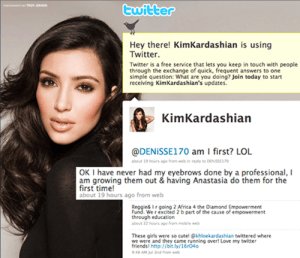
    While there are disadvantages for celebrities putting their lives on the World Wide Web, outlets such as social media can also be used as a free type of advertising or promotion.  Almost all main-stream celebrities have utilized multiple forms of social media from blogs to Twitter.  Britney Spears, Kim Kardashian and Justin Bieber are all examples of celebrities that have endorsed various products and used social media (more specifically, Twitter) to promote them. This has shown to be an effective marketing technique at little or no cost to them.

    Not every celebrity endorses a certain product, but they do essentially brand themselves when they decide post on social media sites.  Whether they mean to or not, the content they post reflects their personality and in turn, allows followers to characterize them.  Mastering how to effectively brand one’s self on these sites has in essence became a modern day art.  In today’s day and age, a social media suicide could destruct the celebrity’s image as a whole.

    Sasha De Vecchi, Lindsay Gallagher, Jay Reilly, Cary Welborn