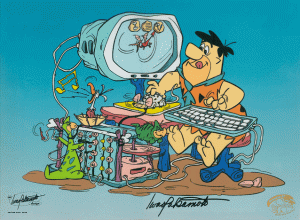
What in the world is a tablet? Last I checked, tablets were being used in the Flinstones to share information and, somewhere along in the Bible, Moses used them to share everyone’s favorite commandments.
It all started with a device known as the Kindle. A simple, yet very effective e-reader created by Amazon. Its target market audience was certainly specialized in the sense that the only people purchasing this product would be those that could see the Kindle aiding in their avid reading habits. Then something happened. Technology-friendly giant Apple revealed to the world the iPad: basically a really, really ginormous iPhone. And what a success it has been. The iPad has sold over 2 million units. That translates to an iPad being sold every 3 seconds. Apple knew exactly the amount of lure and desire its iPad product would have on its loyal Apple customers because, as you may know, it costs a company five times as much to attract a new customer rather than to invest in the loyalty of its current customers. The amount of marketing and advertising that Apple has done for the iPad has exceeded well beyond any other tablet competitor on the market. The way they advertised it was also pretty ingenious. They marketed their product by showing the relevance of the iPad and how similar its functioning was to a laptop and PC; but it is perceived as cooler, sleeker, and geared towards the ever-evolving, fast paced, give-it-to-me-now technological society.

So naturally, with the success of the iPad, came the injection of other technology giants to capitalize on this groundbreaking movement that somehow seems to be the next phase in this apparently unstoppable migration from big, clunky PCs to sleek, portable tablets.
At the 2011 Consumer Electronics Show (CES), an unprecedented 45 new tablets were unveiled as being in the developing stages or already being moved into production. This mass influx of tablets is going to prove to be quite the competition for these companies as they begin to advertise and market their products towards consumers. One of the most important questions that all of these corporations are going to have answer is, “Why would someone need a tablet if they already have a laptop?” Apple seems to have already answered this question with the amount of exclusive user friendly applications designed specifically for their tablet that literally, cannot be accessed on any other device.Relevance and receptivity are going to be major components of the five Rs (relevance, receptivity, response, recognition, and relationship) of IMC that need to be addressed by companies somersaulting into the tablet arena. When will customers and prospects be most receptive to advertisements about tablets and at what point of brand contact will the customer be most receptive to the incentive to buy a tablet?
It is going to be quite interesting to see how the market changes with this upcoming inoculation of tablets. Technology establishments will need to pay close attention to aggregation to determine just how many of their consumers are likely to jump on the tablet bandwagon. Instead of using segmentation to break down customers into different demographics, aggregation will allow companies to determine what exactly it is that customers do and how their behavior in the marketplace determines whether or not they will purchase a tablet. It was popular back in Fred Flinstone’s era; let’s see what happens in the next couple of years.
-Deji Adeleke, Anna Kate Babnik, Katie Eagle, and Tiffany Evans
 IMC Hawks Blog