Tag: Sponsorship

  • Ambush Marketing, Rule 40, and the Sochi Controversy You Aren’t Hearing About

    Have Olympic advertising partnerships gotten too big? Have rules and restrictions protecting these “official sponsors” gone too far?
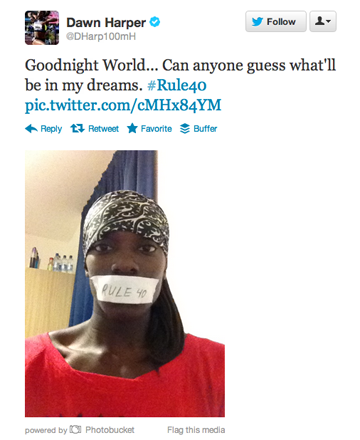
    Dawn Harper Tweets her Opinion of Olympic Rule 40
    Dawn Harper Tweets her Opinion of Olympic Rule 40

    Two-time track and field medalist Dawn Harper thinks so.  That’s why she posted this tweet with #Rule40 in protest of the IOC’s infamous Rule 40 during the 2012 Olympics in London.

    If you aren’t yet familiar with Rule40, it is a total ban on an athlete’s promotion of personal sponsors and their ability to acknowledge those who helped them get where they are today. It is especially focused on social media, where it has become a commonplace for athletes to thank sponsors with pictures and personal statements.

    Harper isn’t the only athlete to voice her displeasure with the effective “gag order” on competitors, but with companies spending upwards of $100,000,000.00 to associate their brands with the Olympics Games, is it really that hard to see why #Rule40 is in effect?

    Some have even gone as far to refer to the situation as a “battle”. Yet, despite the activism surrounding #rule40, without a doubt the biggest threat to the official Olympic sponsors is the ever-pervasive ambush marketers, silently stalking and waiting for their chance to steal some the Olympic brand name.

    These controversial ambush marketing campaigns attempt to capitalize on high-visibility events and locations through brand association without having to pay for the high-cost of officially sponsoring an event. My favorite example of ambush marketing involved the Minnesota Timberwolves selling this advertisement on the side of their stadium, where it happens to only be viewable from inside the nearby Minnesota Twins baseball stadium (where the official sponsor is Target).

    View of Timberwolves basketball stadium from inside the Twins baseball stadium
    View of Timberwolves basketball stadium from inside the Twins baseball stadium

    Ambush marketing may have been around in the advertising world for years, but the Olympics are seen as “the flagship event for ambush marketing”. Creative campaigns by infamous ambush advertisers like Nike often times attract more online buzz and conversation than the actual official sponsors.

    During the 2010 World Cup in South Africa officially sponsored by Reebok, advertising juggernaut and infamous ambush marketer Nike, placed an eye-catching ad on the fourth tallest building in the entire city of Johannesburg. When paired with a lengthy viral video, many agreed that Nike had effectively hijacked the sponsorship from Reebok and gained closer brand association with the World Cup event.
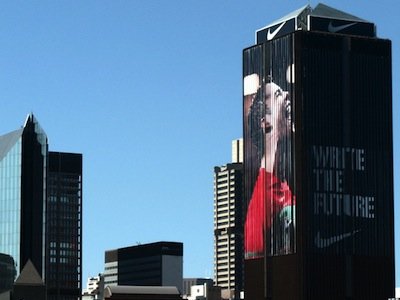
    Nike ad in Johannesburg during World Cup 2010
    Nike ad in Johannesburg during World Cup 2010

    Another ambush marketing giant, Subway, has already launched its attempt to steal some association from the upcoming Sochi games.  Summer Olympian Michael Phelps and retired speed-skating icon Apollo Ohno both appear in TV commercials for Subway’s “$5 foot long campaign” due to some legal loopholes discovered by Subway.

    So is it reasonable for the IOC to implement Rule 40 to help protect sponsors? Freeskiier David Wise recently commented that, “[he] understand[s] the Olympics are a moneymaking game, but it’s sad for [him] to have all these sponsors who have really taken care of [him]…[he’s] on the biggest stage [he] can possibly be on and [he] can’t give them the representation they deserve.”

    Another athlete and social media enthusiast, Nick Goepper, has stated that he will be completely off of social media for the entirety of the Olympics. “I think it might be safer not to tweet anything,” said Nick, the 19-year-old favorite to win Ski Slopestyle gold. “All I know, it’s pretty much zero tolerance for branding.”

    The Sochi games are only 3 days away, but the media blackout protecting the games’ sponsors has been in effect since January 26. When the final medal is awarded and the closing ceremonies complete, which brands will you associate with the games? Which advertisements and commercials will be the most talked about and discussed? Is $100,000,000 too much to pay for a loose association with the Olympic rings?

    Will the “ambushers” steal the spotlight once again?

    – Greg Rothman

  • Athletes Support Obesity

    For those who tuned in to the one-sided beat down that was Super Bowl XLVIII, it is tough to look past Peyton Manning’s subpar performance throughout the entire game. For someone who had a record-breaking regular season, coming into the game with the #1 ranked offense in the league, he really failed to deliver.  At least his buddies at Papa Johns can still deliver, and hopefully in 15 minutes or less! Peyton Manning has proven himself to be a heavy endorser of Papa John’s, especially after purchasing 21 franchises in Colorado. Riddle me this, how is it that professional athletes are the best endorsers for unhealthy food choices, yet their physiques and life styles are not aligned with their sponsors? Maybe Peyton made the mistake of actually eating some of the delicious pizza before the big game. Let’s face it; a big greasy pizza is not an ideal pregame meal for any sort of competition. Not to mention how slippery it will leave your fingers (which may result in a few interceptions).

    Sponsorships are used in advertising to endorse products through the featured prolific person, whom would assume to be relatable to the product or service. Some people choose their products carefully, whereas others appear to care only about the personal gains. Many sponsorships prove to be for monetary gain when using unrelated people for products. For example, irony is apparent when an athlete endorses an unhealthy food service, such as Anderson Silva, a UFC middleweight champion. Although Anderson also sponsors athletic corporation NIKE, the UFC fighter is a well-known advocate for fast food chain Burger King.

    Just a little over a month ago, on one of the most eagerly awaited UFC rematches of all time, Anderson Silva entered the octagon with his Burger King logo stamped right on his thigh.  For those of you unfamiliar with Silva, he is widely regarded as the pound-for-pound best fighter in the world. However, midway through the second round Silva finished himself by snapping his own shinbone over the side of Chris Weidman’s knee. The type of healthy life style decisions Silva makes in order to be best of the best does not accurately reflect his endorsement for Burger King.

    289035_257179540971054_209999859022356_833217_1849863_o

    Here the athlete presents himself with a fighting glove in one hand, and a triple burger with bacon in the other. Aside from the fact that the burger is full of some sort of protein, which athletes consume to gain muscle, the advertisement demonstrates a winning athlete endorsing an obvious unhealthy meal. This endorsement, like a few others is an ironic match with an arguably more ironic ending. Furthermore, a burger like such may be easily burned off by the strenuous activity and amount of energy exuded by a professional athlete. The everyday average Joe on the other hand, may only burn off the fries that came in the combo with the enormously sized burger. Professional athletes are then supporting and encouraging the very things that cause obesity within America, just not for their own bodies.

    The frequently shown fast food endorsements among some of the most popularly watched professional sports could be an indirect factor and influence of obesity within America right now. If Athletes supported the healthy alternatives instead, perhaps there would be a lesser percentile of overweight and obese diagnoses within the United States. Is fast-food sponsorship among professional athletes problematic, or would sales remain the same among the fast food industry because of the convenience?

    -Austin Johnson, Jade Lester, Jami Rogers, Ty Thomas

  • To Sponsor or Not to Sponsor: That is the Question.

    Currently, one of the biggest trends in music is the presence of music festivals. These festivals host a number of bands from all different genres, pulling large audiences of varied consumers in to enjoy the shows. Festivals are generally a couple of days long and promote a laid-back lifestyle complete with camping tents and hammocks. We can thank Woodstock for this specified musical platform. However, is it also a platform for something else? In recent years, music festivals have also hosted a number of sponsors, who market their brands by simply surrounding festival goers with advertisements and products.

    But what is the benefit for companies that sponsor these events? Since companies spend time and money to become an integral part of the festival atmosphere there must be some sort of profitable gain. The major draw for companies is the audience. Generally speaking, attendees are in their late teens to late 20’s. This generational demographic, once targeted, are often very loyal consumers to their favorite brands. Companies hope to capitalize on this while festival-goers are having a good time, enjoying the music, and are open-minded. This audience is also very important because they have a larger disposable income than most. The ability to spend upwards of $400 for a two day music festival, says to companies that this demographic is, for the most part, either affluent or avid consumers.

    However, there is also a downside to being a sponsor at one of these events. Companies have to be very aware that if the audience does not perceive their product as one that coincides with the overall experience and atmosphere of the festival then they will either be completely ignored or considered an annoyance. For instance, a brewing company will do a lot better and be viewed much more positively than a law firm or insurance agency. In order to be successful as a sponsor you have to ensure that your product will enhance the mood, environment and fit the audience profile.

    One of the best examples of sponsorships working harmoniously with the specific nature of music festivals is Firefly, which was held for the first time this summer in Delaware.  Firefly made all of their vendors and sponsors local companies who brought a higher class of food and drink to the campsites. Instead of bombarding attendees with big named company sponsors Firefly chose to keep the music festival experience more authentic. Dogfish Head, their beer sponsor, even unveiled a new brew named the “Firefly Brew.” The event also had a TOMS Shoes tent, where you could purchase a pair of canvas slip-ons to be painted on-site by a local artist.

    Firefly was successful because they accompanied their musical line-ups with relevant sponsors, which in the end created a newer, more evolved and authentic version of a music festival experience.

    Lauren HabigHannah EureErin KiffmeyerAlly WaltonGene Lee

  • Anything you can do, I can do better… and cheaper!

    In the world of sports, it is never a surprise to see Gatorade as a major sponsor. Their product has been placed into events including NHL games, the MLB home run derby, and the Super Bowl. With that being said, not seeing Gatorade as one of the official sponsors of the 2012 Olympic games in London was a surprise. The reason for Gatorade’s absence in the 2012 London Games is because Powerade, a product of Coca-Cola, bought the sponsorship for over 100 million dollars and blocked Gatorade out. Gatorade did not fret when they were faced with this challenge. Instead of accepting defeat and letting Powerade run all of the sponsorships and advertising, Gatorade decided to respond with a commercial of their own.

    In this commercial, Gatorade not only openly states that they did not sponsor the 2012 Olympics, but also to spin it into an extremely effective advertising technique. They portrayed the overall message stating that they were not there on the billboards and buses, but instead they were there “for real” inside the best athletes in the world. Gatorade did an excellent job in embracing the fact that they could not officially sponsor the event, but still being present in the advertising and overall experience of the event

    In accordance, Powerade also plays an interesting role in their advertising by pointing out the fact that you may not know the athletes that they sponsor. This brings another aspect to the table that can be compared directly to Gatorade. Everyone knows the big time athletes like Derek Jeter, Tiger Woods, and Usain Bolt who are sponsored by Gatorade; but there are few people who are familiar with the athletes that Powerade sponsors. Powerade decided to base their commercial on the athletes that are not as famous, but the underdogs of the world.

    Coca-cola spent over 100 million dollars to sponsor the Olympics and Gatorade attempted to catch their audience’s attention with one commercial. The bigger the risk, the bigger the pay off, right? So what do you think… did Powerade come out ahead?

    – Alexandra Huss, Caroline Merrill, Alyssa Morrello, Lauren Van Trigt, Dann Williams