Tag: SocialMedia

  • Modern Twist on Italian Cuisine

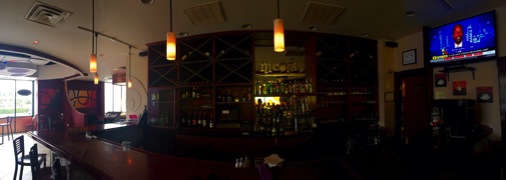
    Wilmington, North Carolina – home to dozens of locally acclaimed restaurants, all with unique flares. One of the most popular tastes in town is authentic Italian, and one of the most popular Italian restaurants is Nicola’s. Located on Oleander Drive, Nicola’s is nothing special upon first glance; however, the establishment envelopes customers in fragmatic waves of garlic and spices, while the modern interior displays playful colors and organic designs. Their menu offers a modern twist on italian cuisine, such as homemade pastas and wood oven pizzas – pair one of these signature entrees with a house wine an customers are guaranteed to leave happy.

    Nicolas1

    Founded by Nicola (Nick) Pittari, Nicola’s was purchased in 2006. Nick’s family is from Sicily, which is prevalent in every dish on the menu. Nick is still head chef of the restaurant, which is a personal touch that many local establishments lack. Offering a variety of entirely homemade sauces, pastas, and even an extensive gluten-free menu, Italian-with-a-twist has never tasted so good.
    Nicolas2

    Like many business owners, Nick turns to social media to promote his business. Nicola’s can be found on Facebook (Nicola’s Wilmington), Instagram (nicolaswilmington), and Twitter (nicolasitalian). The difference between Nicola’s and many other local businesses, is that every social media site is updated FREQUENTLY. The most recent Facebook post? 2 days ago. The most recent Instagram picture? Yesterday. The most recent Tweet? Same thing. Maybe this is because Mr. Pittari understands the concept of Media Ecology.

    Media Ecology states that media environments, and such modes of communication, can actually play a key role in the way humans act and react to situations. With multiple social media accounts supporting a business, said business is likely to get more customers than a competitor with a smaller social media presence. Nicola’s Facebook page, displays a specials menu and a wine selection at least three times a week. To all of the page’s subscribers, this could be a driving force or a decision-maker, regarding where someone wants to eat dinner. Having a personal connection via social media is incredibly important to a business, especially in a town like Wilmington that is full of incredible local food. Nicola’s definitely aims to stand out with such a presence, and Chef and owner Nick Pittari should chalk this business up to a success.
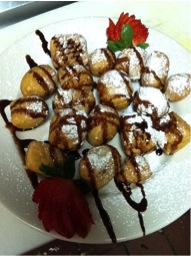
    Nicolas3

    What are some other restaurants you’ve seen that make a local connection with the community through social media outlets?

    -Nick, Melanie, Mary & Patrick

  • Social Media to Help Others

    The invention of social media has changed the way we communicate as individuals. Today we are constantly connected to one another whether or not we prefer to be. Social media has not only been used to keep individuals in contact with other individuals, but as a way for businesses to communicate and connect with their consumers. Social media interactions focus on building customer relations and fulfilling the expectation “that customers expect brands and businesses to be there for them everywhere, across mobile and social media.” 

    While for-profit businesses try to drive consumerism behavior, non-profits try to drive behavior towards volunteering, donating, rallying, etc. Social media offers an inexpensive but powerful way to recognize and encourage desired behavior. Social networking sites allow non-profits to quickly announce, update, or reiterate the needs or goals of the organization itself or the publics they are trying to help, to vast numbers of people. This becomes largely helpful in raising awareness of time sensitive or unexpected events, in particular during times of crisis. Whether natural or humanitarian, social media can allow to-the-minute updates of the severity of the situation and the needs of the victims. One recent event in Kenya has proven just how successful a non-profits needs can be filled when using social media.

    On September 21, 2013 terrorists with the Islamist militant group Shabab in Somalia (linked to Al Queda) invaded a Kenyan mall. Westgate Mall is a 5-story upscale mall that represents the country’s growth and prosperity. A little before noon the Shabab conducted a double attack on the mall with heavily armed attackers storming into the mall from two different entrances and opening fire on shoppers. The shooting rampage soon turned into a hostage situation as many of the shoppers were trapped inside. As night fell, two special units moved in to try and rescue hostages and stop the attackers. The situation lasted for four days and concluded with over 60 deaths and 175 people injured.

    During the Westgate crisis the Kenya Red Cross (KRC) stepped up their game and became a prominent first responding unit. Performing the normal duties of any Red Cross organization they helped to alleviate those involved in the Westgate disaster by holding blood drives, setting up triages, and creating missing persons list, but what the Kenya Red Cross did the best during this crisis was communication.

    From the start of the shoot out the KRC began sharing information about the crisis through the social media platform Twitter. As the events unfolded their tweets consisted of calls for blood donations, updates to where people could report and find the status of missing persons, and updates on changing traffic patterns.

    example of info & blood tweets

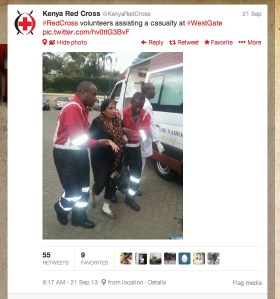
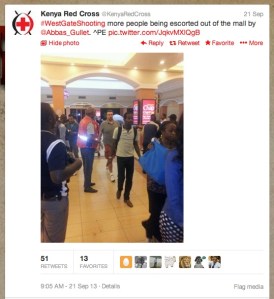
    They even tweeted pictures giving Kenyans and people around the world a first look at the crisis.

    KRC helping victims people being escorted out of mall

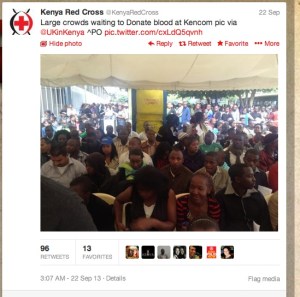
    Using Twitter was a way the KRC could not only rally support and share information, but show their role as a non-profit to the world. Unifying the people of Kenya in this moment of crisis was their biggest accomplishment. This success was shown in the turnouts of volunteers and blood donors they received in the following days of the ordeal.

    large crowd turnout

    Even though the terrorist attack ended days ago the Kenya Red Cross is continuing their efforts to help those affected through the social media platform. They have collected 11,293 units of blood and are reporting the money raised and what it is being used for to the public – all through tweets. Their ability to reconnect people after disaster through Twitter makes them a shining star in non-profit social media use.

    The Kenya Red Cross used social media to inform people all over the web of an important issue, as well as what solutions could be offered to help. This represents agenda setting, the theory that the media have the ability to tell people what issues are important around the world. This also involves controlling the topics people discuss and become concerned with, so by using Twitter, the Kenyan Red Cross regulated the conversation of many people who were directly affected by the disaster. An awareness of the situation was presented, therefore the crisis was held at a higher level of importance because of the media outlet that was used.

    It is clear through the Westgate Crisis that social media can be used successfully by non-profits that respond and work through disasters.  Social media will prove again and again to be a useful medium to help victims, bring together volunteers and unite the world in times of crisis.

    Caroline Robinson, Jade Lester, Meghan Carey, Morgan Jones, Savannah Valade.