Tag: Social Media

  • New Rules For Celebrities Who Advertise On Twitter

    Not all tweets are created equal: the U.S. Federal Trade Commission has decided to impose new regulations for celebrities who advertise on Twitter. The agency involved in the regulation of business activities has updated the rules on consumer protection for online business, publishing a specific document that explains how the VIPs should be tweeting their promotional messages.

    Image

    When a celebrity mentions a product or a service in social media, the sales can often skyrocket. But is the celebrity really a fan of what is being advertised or is he/she simply being paid to say something nice? After an incident when celebrity Lauren Bacall showed up on “The Today Show” promoting a drug without disclosing she was being paid, the Federal Trade Commission warned celebrities, as well as the marketers that use them, about not disclosing paid endorsements. Afterward, the FTC took steps to ensure social media bloggers disclose when they are being compensated for their comments.

    Image

    To make it as clear as possible, the FTC has invented a fictional celebrity, named Juli Starz. The fake star promotes a pill “Fat-away” that would help her lose 30 pounds in six weeks. The message also contains a direct link to the product’s website for those who may be interested. According to the FTC, this is an example of how one should not tweet promotionally. Juli in fact has made two mistakes: she did not specify that it was an ad, and secondly, the ad also lacked more precise information on the possibility that others could expect to obtain an identical result.

    In a second example, an identical tweet is presented, which contains however the hashtag #spon abbreviation of “sponsored.” In this case Juli still fails to comply with the FTC guidelines. The hashtag #spon, in fact, is still too ambiguous for many potential followers of the diva. It would be much better if the tweet contained the hashtag “ad” ie “advertisement.”

    Image

    Twitter has hundreds of millions of users, and it is interesting to think about the reach and impact of these free forms of advertising and online promotions. Another thing that is important to emphasize on is the ethicality of these advertisements. In fact, celebrities until now have been free to advertise on social media without really having to disclose whether they are being paid for that endorsement. I think it is important that followers and fans not be deceived and know when it is not a personal opinion, in order for them to make an informed choice about whether they also support the brand or product.

    The stars, in either case, are now warned. If you want to advertise, you must comply with the rules. “The same consumer protections laws that apply to commercial activities in other media apply online, including activities in the mobile marketplace,” the FTC said in its guidance. “Required disclosures must be clear and conspicuous.”

    Sasha De Vecchi

  • “Checking In” to Spring Break

    Happy Spring Break! Many students have spent the last couple months (or longer) trying to figure out where their Spring Break time is best spent. If you’re like me, this preparation may have involved a thorough internet search to find the perfect hotel for your week off. An increasing number of hotel chains have discovered the perks of social media use and are developing ways to satisfy the needs and wants of their customers on an increasingly personal level.

    Social media sites such as Foursquare, Twitter and Facebook Places, allow a user to “check in” or log their current location. While some companies may be skeptical about the relevance of such tools to the business that they do, the hotel industry has discovered that these services create a greater feeling of inclusion and personalization to their guests. Now hotels can invite guests to “check in” both literally and virtually, completely committing to their stay. Another added benefit of location-based check-in tools is the ability to track and incentivize a guest’s stay. Hotels participating in incentive programs for social media have been known to use a variety of rewards to reach out to their social media circle; examples include anything from a discounted meal in the hotel restaurant to late checkout times for the final night of your stay. Some hotels have gone so far as to collaborate with airlines or credit card companies to create an unofficial “rewards program”; offering discounts and frequent flier miles for using your American Express card or staying at the Hilton.

    Of course with programs such as these, there can (and will) arise questions of security and privacy. Many savvy social media users are hesitant to place their exact location online. The flip side of this is that many users don’t want the world to know where they are NOT (for instance at home…protecting their belongings). While safety and security concerns are understandable, potential thieves and “bad guys” are not the only party with a vested interest in your location and personal information. Some of the aforementioned hotels have begun tracking mentions of their brand to create a more customized experience. For instance, say you book a night at a Marriott and tweet about how excited you are to stay there for your anniversary. With the use of these tools it’s not unlikely that you will open the door to find a chilled bottle of Champagne with a note from the staff wishing you a “Happy Anniversary”. Or, on a creepier note, a woman on the local radio the other day described checking into a hotel to find a wrapped dog bone and a note saying “Snickers misses you”, a response to her Facebook status the day before where she stated that she “ hate(s) to leave Snickers (her dog) at home when she goes on vacation”… To me, this was a little bit too personalized.

    As is typical with this type of marketing, it is necessary to find a happy medium between discovering a guest’s needs and invading their privacy. How far is too far and is there such thing as too personal? While this may not be a topic that concerns you too much while lounging on the beach in Florida or soaking up the culture in a foreign country, it’s important to keep in mind that while logging your location, you may be signing up for more than you recognize. So what do you think? Will you be
    “checking in” before you checkout this Spring Break?

    Lauren Habig

  • Have You Experienced the Rainbow?

    If you haven’t been to the Skittles website in a while (or perhaps, ever) now would be a good time to take a peek.  What you might expect to be a typical site, designed to provide advertisement and purchase opportunities, has undergone quite a facelift.  Unlike most sites, the website for Skittles has been reborn as a social media machine disguised as a blog.  Near the top of the page is the familiar Skittles slogan, “Taste the Rainbow.”  Scroll down a bit, and you’ll find an entirely irrelevant tweet from the Skittles Twitter account. @Skittles says, “It’s all fun and games until the chinchillas show up with the karaoke machine.” Next come a few phrases like “lace the train slow,” “trace the vein bro,” and “encase the faint glow,” all with coordinating pictures and all rhyming with the original slogan of “taste the rainbow.” Add a few quirky videos, more interesting tweets from fans, and many opportunities to share things via social media, and  you’ve pretty much summed up Skittles’ entire online marketing tactic.

    The Skittles commercials take on a similar level of oddity as their website.  Whether it’s a teenager catching “Skittles pox” from a “highly infected” friend with the message to “contract the rainbow,” or a guidance counselor eating Skittles out of a student’s unibrow with the message to “pluck the rainbow,” these commercials seem to be getting stranger and more extreme year to year.  So, do these weird messages work to promote their product?  Their 23 million Facebook fans, 47,000 followers on Twitter, and nearly 10 million views on YouTube would suggest that they do.

    As a product that has been a favorite with candy-lovers since their appearance in 1979, Skittles has little need for getting their brand noticed so much as keeping their brand relevant.  That’s exactly the idea behind their weird marketing.  By showcasing their social media followers on their website, and giving fans something different to talk about, Skittles is making people rethink what they already know about Skittles and driving them back to their brand.  The genius behind this tactic is that the product hasn’t changed.  What they are changing is stated right at the top of their site.  “Experience the rainbow.”  Skittles is changing the whole experience associated with their little chewy candies in a colorful shell to be more exciting and hilarious than before.

    What seems to appeal to consumers these days, especially to Skittles’ target market of pre-teens and adolescents, is the eccentric and the humorous.  Skittles has mastered both of these arts.  Not only are they staying relevant, they’re staying interesting.  As advertising trends continue to shift, Skittles will doubtless continue to meet the needs of their consumers and remain a favorite fruity snack to all.  The only question now, is what comes next.

    Ally Walton, Hannah Eure, Gene Lee, Lauren Habig, Erin Kiffmeyer

  • The Importance of Social Media in the 2012 Election

    More and more are the variety of social media through which voters are able to use.  These are convenient and simple tools that are effective ways to express the opinions of voters and influence the course of the electoral campaign. The role that social media has been critical in drawing conclusions about the outcome of the 2012 election. According to various studies, websites like Facebook have caused an increase in voter registration. Ultimately, social media networks are the powerful influencers that are often capable of moving large quantities of votes. It is important to recognize that an electoral campaign that is closer and pays closer attention to real human dynamics has a completely different approach than the traditional campaign. Nowadays, an effective campaign should be based less on the money spent and more on the intelligent use of new technologies to create new bonds with the everyday voter.Ultimately, the roles of social networks, new media as well as the weight of the establishment are all factors that will have a crucial role in deciding the electoral dispute.

    As previously stated, social media has encouraged many young eligible voters to register and vote. For many of the past elections, the young demographic is not properly represented in voting. This year, there are record numbers for college aged students voting.  Much of this can be attributed to social media outlets.  Young people in general use social media more than any other demographic (to date). Also, social media websites such as twitter allow you to follow each candidate and get quick, short, and frequent updates on what they plan to make their policy be if they are to be elected. This is only the second election that we are able to follow Candidates directly on Twitter since it did not exist prior to 2006. Also, Twitter has gained a substantial amount of users since the 2008 election. On Twitter, there are trending topics, and subjects regarding the recent presidential election have been trending at record numbers. Social Media allows people to get quick and easy access to information about the election.

    Both presidential candidates devoted much time and effort to boost the collection of information and social media sharing amongst voters. In the current election, Barack Obama and Mitt Romney have predominately utilized Facebook, Twitter, and YouTube, which are the top powerhouse tools of social media today. As the election progresses, candidates have concentrated their efforts on “swing voters”. Swing voters are voters who have yet to make up their minds and plan to wait till the very last minute to make a decision about who to vote for. Social media can establish a medium for interchange between our presidential candidates and many of these swing voters, avoiding an influence on votes that have already been established.  This reveals the importance of social media and web video usage in terms of voting. Not only can social media institute this medium that allows a campaign to be specifically modified for particular voters, but it provides value for each candidate, resulting into fewer costs for ads. The cost of advertising through social media is much less than the cost of paying T.V. channels to run advertisements; not to mention the impact of online ads have been reported as just as good or perhaps even better than the ones shows on television. All political parties in the current election have greatly benefited from these recent online updates and social media enhancements.

    Sasha De Vecchi, Lindsay Gallagher, Jay Reilly, Cary Welborn

  • Are You Checked In?

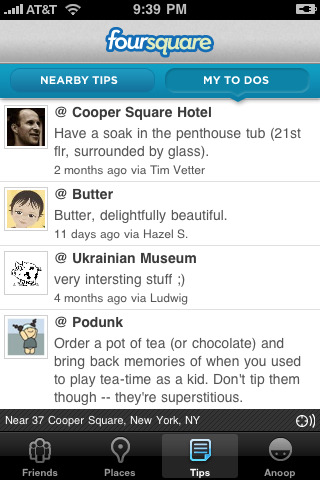
    Social media has created a new obsession with knowing what everyone else is doing and where they are at all times. Foursquare takes this obsession to a whole new level. Users of Foursquare check in to various places, comment on their service or products with tips for other users, post pictures, and gather points to become the “mayor” of their favorite restaurants or stores. There are currently over 25,000,000 people who use Foursquare to connect to places and over 1,000,000 businesses.

    ImageBusinesses take advantage of this social media site in order to brand themselves and attract new customers. Foursquare offers several free methods to improve the buzz about a brand. A business can create updates to local users by uploading pictures of specials or events that are taking place at their location. They can also offer discounts specifically to users. For example, Chick-fil-a offers free chicken minis the first time you check in. Some local businesses offer 10% discounts on the first purchase. Sports, non-profits, entertainment, and music can also utilize Foursquare to get their name out to potential fans. The television network Bravo has a page to share tips from individual Bravolebrity’s about locations they frequent.

    Image

    Although many businesses benefit from using Foursquare, there is also a risk of costumer’s damaging your reputation. Users can leave tips for their friends or strangers about whether or not the product is good. This uncontrolled form of advertising can be very dangerous. On Best Buy’s page, tips range from “make sure the people who work there know what they’re talking about. The TV department there lacks in this area” to “Dig the environment!!” Tips left by customers can be read by anyone looking at your page and have the ability to either damage or build your reputation. Businesses are unable to defend themselves or respond to these tips.

    Businesses considering joining the Foursquare network must weigh the pros and cons and consider the risk of bad tips. With over 25,000,000 users and growing, businesses can get their brand spread to new and potential customers and create hype about exclusive Foursquare discounts. Do you think it is worthwhile for businesses to jump on the Foursquare band wagon?

    Jessie Butner, Meaghan Beam, Zach Abramo, Jack Lane

  • HubSpot: The Transformation From Outbound Marketing to Inbound Marketing

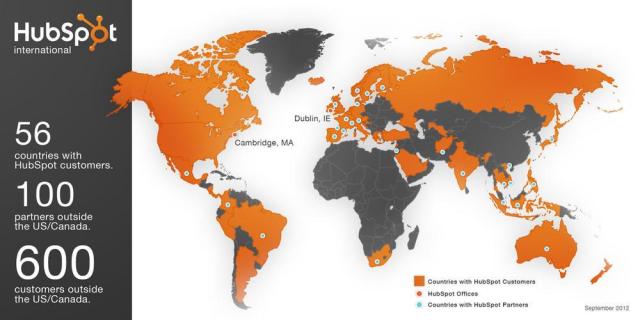
    Among the large variety of social media in today’s society, HubSpot, although not very well-known, has been a major pioneer within its field and has generated great success. HubSpot was created by Brian Halligan and Dharmesh Shah at the Massachusetts Institute of Technology (MIT) in June of 2006 and has been rapidly growing ever since. It is new strategic marketing software that is actively helping over 7,500 companies within 46 countries by generating personal research including blogging, social media, email marketing, etc. Hubspot’s marketing techniques have been used for online companies such as Twitter, LinkdIn, among many others.

    Brian Halligan, one of the co-founders of HubSpot, stated the following in one of his blog posts on the site: “Rather than doing outbound marketing to the masses of people who are trying to block you out, I advocate doing “inbound marketing” where you help yourself “get found” by people already learning about and shopping in your industry. In order to do this, you need to set your website up like a “hub” for your industry that attracts visitors naturally through search engines, the blogosphere, and social media. I believe most marketers today spend 90% of their efforts on outbound marketing and 10% on inbound marketing, and I advocate that those ratios flip.” This is the driving force behind the company today.

    With the competition that is present in today’s business world, it is crucial to have a tactical plan to further market one’s brand. HubSpot achieves this by taking the best inbound marketing techniques and combining them into one spot, which is exactly what HubSpot accomplishes. This innovative tool is not free, but there is a free trial run that one can sign up for prior to buying a full subscription. In a country where the use of social media has increased a whopping 356% in six years, it is no secret that social media is now a competitive market. A company generally needs to be utilizing social media better than their competitors to be successful. HubSpot helps with this because it compares a company to their competitors on a social level and teaches a company how to develop and grow faster than its competitors. It also educates companies on how to create exciting, new content for the public and how to use cross-channel campaigns. These services that HubSpot offers allow businesses to stand out in today’s very crowded business market.

    The proof that HubSpot is effective is in the statistics. Studies show that on average, after three months of use, HubSpot users experience 32% more leads per month and 24.6 times more leads after twelve months of use. In 2011, HubSpot grossed over thirty million dollars in revenue. Internationally, HubSpot is growing at a rate of 200% a year and even has scheduled to open a new headquarters in Dublin in 2013. The opening of this new headquarters is expected to provide 150 jobs for the citizens of Ireland and already employs 300 people in the United States.

    Since the creation of HubSpot in 2006, the company has been quickly evolving. Not only are more companies using it, but the company has provided many jobs in a time where new jobs are a worldwide necessity. With the increase of social media influence in society today, companies such as HubSpot are essential in aiding a company convey its message to a large pool of consumers.

    Sasha De Vecchi, Lindsay Gallagher, Jay Reilly, Cary Welborn

  • Celebrity Branding Through Social Media

    Nowadays, there is a wide variety of ways to advertise and promote one’s image as well as many products through personal branding. Celebrities are among the first to take advantage of the new social media phenomenon to further promote themselves and products they have endorsed.  Social media outlets such as Facebook, Twitter, YouTube, Instagram, Tumblr, Pinterest, etc. have been in a state of constant growth, as they cater to both the average consumer as well as celebrities. Interconnectivity has played a crucial role in keeping celebrities globally connected to a wider public in order to further promote themselves and gain a higher level of exposure.

    When it comes to many things such as self-branding and the use of social media, one must elaborate a thought-out, cohesive strategy in order to achieve optimum results. First of all, it is important to keep in mind that not all celebrities wish to accomplish the same thing through their social media outlets.  There are many reasons for a celebrity to join a social media site, from simply connecting with fans to promoting a product or event.  Also, each social media medium serves a different purpose and targets a more specific audience. In a recent trend, celebrities have been representing themselves by “opening up” and increasing their level of self-disclosure through many forms of social media. This could be due to the fact that it is believed that social media can be used to build trust with fans as well as build and develop a more personal connection with them by allowing them to see the “real” superstar.  For example, it is difficult to feel a personal connection to President Obama.  By following Obama on Twitter or Facebook, one might feel that this personal relationship has greatly improved.  Not only is this beneficial for the average American, but it could indirectly help Obama.  For example, someone that does not currently have a stance on politics could follow Obama on Twitter, like what they see, and vote for him in the next election.  This is just one example that portrays that social media outlets are a powerful, mass communication tool.  That being said, it is important for one to remain very conscience about what they say.  It does not take much for a tweet by a celebrity or political figure to create a huge controversy, whether or not they intended it to.  We sometimes forget that celebrities are human beings that make mistakes, and one of these mistakes could be by putting too much personal information on the internet.  Voicing an opinion can easily offend many other people.  The celebrity could in theory remove the tweet, but that does not mean it will be deleted from the Internet.  With the millions of followers many celebrities have and the fact that celebrities tend to keep social media outlets as public as possible, almost anyone could snap a screenshot of the tweet immediately and continue to circulate it through the web.

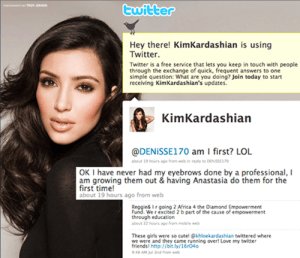
    While there are disadvantages for celebrities putting their lives on the World Wide Web, outlets such as social media can also be used as a free type of advertising or promotion.  Almost all main-stream celebrities have utilized multiple forms of social media from blogs to Twitter.  Britney Spears, Kim Kardashian and Justin Bieber are all examples of celebrities that have endorsed various products and used social media (more specifically, Twitter) to promote them. This has shown to be an effective marketing technique at little or no cost to them.

    Not every celebrity endorses a certain product, but they do essentially brand themselves when they decide post on social media sites.  Whether they mean to or not, the content they post reflects their personality and in turn, allows followers to characterize them.  Mastering how to effectively brand one’s self on these sites has in essence became a modern day art.  In today’s day and age, a social media suicide could destruct the celebrity’s image as a whole.

    Sasha De Vecchi, Lindsay Gallagher, Jay Reilly, Cary Welborn