Tag: Social Media

  • Instagram: The New Era of Advertising

    Everyday millions of Instagram users spend hours scrolling through their smart phones to view filtered photos, typically those that they “follow” or come across through #hashtags. According to the brand’s website, there are currently 150 million users, 60 billion photos uploaded, and an average of 1.2 million “likes” per day.  (website: http://instagram.com/press/) As consumers, it is understood that these photos are a reflection of such users “brands”, and the photos they choose to share are typically selected and edited to portray a desired image of themselves. Whether it’s goods they just purchased, activities they partake in, or flattering photos of themselves, Instagram gives consumers the opportunity to advertise their individuality for free.

    Aside from everyday consumers trying to convey an image of themselves, products, celebrities, and other organizations are able to use this platform to brand themselves however they choose. In some cases, celebrities intertwine their “brand” with a product or service that they endorse. For example, singer Ellie Goulding, who recently became an advocate and endorser for “Nike” products, shares several photos of her outlandish lifestyle to all 2.3 million followers.. Known for her eccentric, hip, and alternative style, Goulding also posts photos of herself in her athletic gear, where there is always a “Nike’’ logo.

    Within IMC, it is understood that there are both controlled and uncontrolled messages. Advertising is a a controlled and planned message that is executed through a particular medium to reach target audiences. The “Nike” brand is consistently advertised through Goulding’s photos, however, Nike does not have control over which photos she captures. It seems as though Nike and Ellie Goulding have a sort of symbiotic relationship right now, with Ellie promoting Nike products and Nike in turn supporting/promoting Ellie’s Music.

    “Nike and recording artist Ellie Goulding are releasing an exclusive remix album from Goulding’s second album, “Halcyon,” to inspire the thousands of women joining Ellie to run 13.1 miles on April 28.” (Nike inc.)

    It is important to note however that Ellie is not an employee of Nike and that while it may be in her best interest to safeguard their relationship could she inadvertantly tarnish the Nike brand without being aware of it? This raises an important question: How much control do companies have over the “brand” that their endorsers convey? In the meantime however the relationship between the two will most likely prove beneficial for both parties as many fans of Goulding follows her on her Instagram page. Will it soon become commonplace for all celebrities to endorse particular products in exchange for publicity of their own?

    This social media phenomenon has given advertisers a plentitude of opportunities to shape and select their brand image, and then after share it in a “likeable” manner.

    -Austin Johnson, Jade Lester, Jami Rogers, Ty Thomas

  • Snapchat: A New Social Trend For Brands?

    Today, brands dominate social media. It is almost impossible to find a company without a Facebook or Twitter account. Even newer platforms like Instagram and Vine are being taken over, but there is one social network that has yet to be fully explored—Snapchat.

    snapchat

    Snapchat is a mobile app that allows one to share pictures and videos. The special component of this network is that the captioned picture is deleted after 10 seconds; this is much different from the “out for the world to see” social media we are used to.

    The majority of Snapchat users are between the ages of 13-25. This age, as James Twitchell reminds us in his book Lead Us Into Temptation, is the “number one focus of almost every marketer”. Why? Younger demographics are still choosing what brands to align themselves with. A survey sent out by Sumpto, a marketing group that works to gather information about the “most difficult to reach demographic”, found that 77% of college students use Snapchat once per day. Their findings also concluded that 70% of respondents wouldn’t mind adding a brand as a friend on Snapchat if they already followed them on another social network.

    So, why haven’t brands jumped onto this platform? Unlike other social media Snapchat is more intimate and personal— like a text message instead of a public wall. This very direct connection leaves brands with a problem. What type of content could they send via snap? Would people be interested in interacting with them this way?

    DoSomething.org, HBO’s TV show Girls and the Association of Surfing Professionals (ASP) have all been using Snapchat in a variety of ways. DoSomething.org described in an interview with Mashable that their strategy is to make interactive Snapchat stories that are ridiculous and fun. They see Snapchat as a tool for “opening up more options for brands”. The Girls Snapchat account has been used to remind fans of the upcoming season premiere date and give exclusive insider looks.  ASP says Snapchat is a way to “bring fans closer to the athletes and events”. They also point out there is “lots of room for experimentation and innovation”. Click on the image below to learn more about how Snapchat is being used by companies.

    Marketo_Snapchat

    Patrick deHahn from CNN Money stated that Snapchat “has more funding and a higher valuation than Instagram and YouTube when they were at Snapchat’s stage in their startup lifespan”. So it seems Snapchat itself is a viable platform and with a growing 350 million snaps per day, brands should consider its possible benefits.

    Would you follow brands on Snapchat? Do you think Snapchat is a worthy social media investment? How do you think brands will begin to use Snapchat?

    Caroline Robinson

  • Out With The Old, In With The New: Technology Decides It All

    Everyday you as a consumer are exposed to hundreds of thousands of brands. Over the decades the shopping industry has exploded with most brands disappearing at the same rate new ones appear, yet some brands have stood the cluttered test of time – one of those is Macy’s.

    Created in 1858 by Rowland Hussy Macy the Macy’s store was originally a dry goods store. Macy’s started to gain notable recognition in the 1900s with its holiday window displays and the hiring of Santa Claus for the stores. In 1924 the store moved to its current NYC location, on the corner of Broadway and 34th Street. This year was also the first Macy’s Day Parade, which was organized to celebrate immigrant employees new American Heritage.

    macys6n-2-web

    In 1944, Macy’s became apart of the Federated Department Stores, Inc., renamed Macy’s Inc. creating the world’s largest department store. Today, Macy’s has 800 stores in the United States and sells merchandise online.

    Macy’s isn’t the only iconic retailer – Sears Roebuck ring a bell? Starting in 1886, the mail order company prospered as it was able to provide low cost alternative to farmers. As mail order plants transitioned into stores, Sears found their place in city life and the retailer soon became a retailer giant. Today the store owns 863 mall-based operations and 1200 other locations including hardware, outlet, tire, and battery stores.

    sears catalogue

    Nowadays Macy’s and Sears are direct competitors, but it seems Sears, the company who invented mail order, can’t quite figure out online order.

    Holiday sales account for a large indicator of profit margins and often depict the health of a company. Sears seems to be in critical condition – US stores suffered a 9.2 percent drop. In decline for some time now, and with little to no improvement, some speculate the store could be gone by 2017.

    The history of an iconic brand is something that should be cultivated in your identity – it induces credibility, shows longevity, and prompts nostalgia. Yet being historic isn’t merely enough to remain vibrant. Iconic companies remain iconic because they are able to cultivate lasting relationships with consumers – at all time periods – and that means evolving.

    Looking at each retailers attempt to reach customers during the holiday seasons could explain Sears 9.2 percent drop in sales. Both have social media accounts, yet social media presence is widely disproportionate. Macy’s Instagram account has 150,00 followers while Sears has two Instagram accounts – “Sears” and “Sears Style” – yet both of the followers combined don’t even reach 8,000. A huge missed opportunity for Sears – Instagram is leading the way in social media, growing faster than Facebook, Twitter, and Pinterest combined.

    According to Gary Vaynerchuk’s article “The Road to Black Friday: Macy’s vs. Sears”, the use of social media by Sears is lazy. Choosing to ignore the social media culture they have posted irrelevant and uninteresting content such as a link to one of their commercials and an original YouTube video. While Macy’s post content that is culturally relevant, trendy, and formed around pop culture.

    Our culture today has switched, as James Twitchell describes it, “In the last generation we have almost completely reversed the poles of shame so that where we were once ashamed of consuming too much (religious shame), we are now often ashamed of consuming the wrong brands (shoppers’ shame)”. In this day in age a brand establishes and remains relevance by relationship cultivation, reinforcement, and engagement forged through technology – the Internet and social media. It seems Sear’s inability to adapt to technology has prevented them being able to participate in the younger crowds culture leading in profit and brand influence. As an American brand we hope Sears can get back into the groove but as they stand now they are the weakest link.

    In what other ways do old brands stay new? Can you think of any others that have had a hard time capturing new generations of shoppers? Or others that have done well?

    Caroline Robinson, Savannah Valade, Elizabeth Harrington

  • Ambush Marketing, Rule 40, and the Sochi Controversy You Aren’t Hearing About

    Have Olympic advertising partnerships gotten too big? Have rules and restrictions protecting these “official sponsors” gone too far?

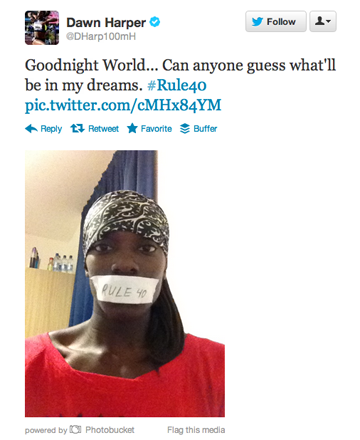
    Dawn Harper Tweets her Opinion of Olympic Rule 40
    Dawn Harper Tweets her Opinion of Olympic Rule 40

    Two-time track and field medalist Dawn Harper thinks so.  That’s why she posted this tweet with #Rule40 in protest of the IOC’s infamous Rule 40 during the 2012 Olympics in London.

    If you aren’t yet familiar with Rule40, it is a total ban on an athlete’s promotion of personal sponsors and their ability to acknowledge those who helped them get where they are today. It is especially focused on social media, where it has become a commonplace for athletes to thank sponsors with pictures and personal statements.

    Harper isn’t the only athlete to voice her displeasure with the effective “gag order” on competitors, but with companies spending upwards of $100,000,000.00 to associate their brands with the Olympics Games, is it really that hard to see why #Rule40 is in effect?

    Some have even gone as far to refer to the situation as a “battle”. Yet, despite the activism surrounding #rule40, without a doubt the biggest threat to the official Olympic sponsors is the ever-pervasive ambush marketers, silently stalking and waiting for their chance to steal some the Olympic brand name.

    These controversial ambush marketing campaigns attempt to capitalize on high-visibility events and locations through brand association without having to pay for the high-cost of officially sponsoring an event. My favorite example of ambush marketing involved the Minnesota Timberwolves selling this advertisement on the side of their stadium, where it happens to only be viewable from inside the nearby Minnesota Twins baseball stadium (where the official sponsor is Target).

    View of Timberwolves basketball stadium from inside the Twins baseball stadium
    View of Timberwolves basketball stadium from inside the Twins baseball stadium

    Ambush marketing may have been around in the advertising world for years, but the Olympics are seen as “the flagship event for ambush marketing”. Creative campaigns by infamous ambush advertisers like Nike often times attract more online buzz and conversation than the actual official sponsors.

    During the 2010 World Cup in South Africa officially sponsored by Reebok, advertising juggernaut and infamous ambush marketer Nike, placed an eye-catching ad on the fourth tallest building in the entire city of Johannesburg. When paired with a lengthy viral video, many agreed that Nike had effectively hijacked the sponsorship from Reebok and gained closer brand association with the World Cup event.

    Nike ad in Johannesburg during World Cup 2010
    Nike ad in Johannesburg during World Cup 2010

    Another ambush marketing giant, Subway, has already launched its attempt to steal some association from the upcoming Sochi games.  Summer Olympian Michael Phelps and retired speed-skating icon Apollo Ohno both appear in TV commercials for Subway’s “$5 foot long campaign” due to some legal loopholes discovered by Subway.

    So is it reasonable for the IOC to implement Rule 40 to help protect sponsors? Freeskiier David Wise recently commented that, “[he] understand[s] the Olympics are a moneymaking game, but it’s sad for [him] to have all these sponsors who have really taken care of [him]…[he’s] on the biggest stage [he] can possibly be on and [he] can’t give them the representation they deserve.”

    Another athlete and social media enthusiast, Nick Goepper, has stated that he will be completely off of social media for the entirety of the Olympics. “I think it might be safer not to tweet anything,” said Nick, the 19-year-old favorite to win Ski Slopestyle gold. “All I know, it’s pretty much zero tolerance for branding.”

    The Sochi games are only 3 days away, but the media blackout protecting the games’ sponsors has been in effect since January 26. When the final medal is awarded and the closing ceremonies complete, which brands will you associate with the games? Which advertisements and commercials will be the most talked about and discussed? Is $100,000,000 too much to pay for a loose association with the Olympic rings?

    Will the “ambushers” steal the spotlight once again?

    – Greg Rothman

  • “How REAL Will American Idol Get This Season?”

    It’s that time of year again! All our favorite shows are returning, after a seemingly long-awaited hiatus. The longest running singing competition, American Idol, has returned for its thirteenth season. But this season, Idol has been forced to change things up. The show is taking on a fresh, new approach to increase the amount of viewers by revamping their marketing schemes.

    In previous seasons, the show directed promotions towards the judges, featured cities, and upcoming drama. The initial aspirations of the show to seek out raw talent has slipped within the past seasons and in return, turned away viewers. At the shows peak, American Idol attracted 30.4 million viewers in season eight. Since then, viewer ratings have only decreased and reached an all time low with 14.3 million viewers for season twelve. As a result, Fox has decided to rebrand the show by bringing in a new team of producers, less drama-filled judges, and a more heartwarming advertising campaign.

    Within the past seasons, focuses of promoting the show featured drama among the judging panel rather than the actual talent of the contestants. Producers recently have realized the show has drifted away from the heart and original purpose of the show–discovering real people with real talent around the country. In an effort to rebrand their image, season thirteen marketers began focusing on the background stories of the contestants in hopes to return Idol to its initial purpose.
    American-Idol-2014-spoilers-480x265

    American Idol

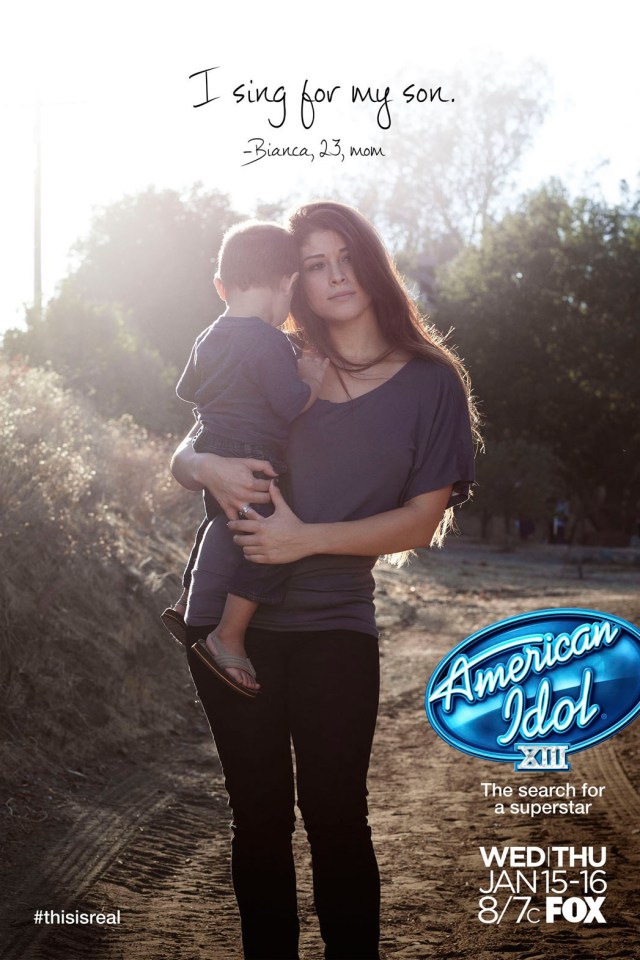
    One component of the new advertising campaign features eight contestants in their hometowns sharing their personal motivations as to why they sing. Producers felt this new type of advertisement would help viewers identify with the stories and be able to relate to the contestants. Viewers are invited to participate in the hopeful journey of the “average Joe’s” transformation into a superstar.

    American Idol’s new video promotion of the upcoming season also focuses on introducing new contestants and excluding any drama or glamour of the judges (hallelujah). In addition to highlighting real contestants, marketers have incorporated social media by producing a new tag line for the show, #ThisIsReal, to encourage audience conversations on Twitter. Producers hope that the incorporation of social media marketing will increase the show’s ratings and reputation. The advertising of real people and their real aspirations are designed to appeal to a variety of audiences on social media platforms, especially the younger demographics.

    By incorporating a variety of platforms such as television, print and social media, American Idol hopes to attract a wide array of audiences through this new and improved IMC campaign. Do you think this new campaign will be effective in increasing and engaging audiences? Or will American Idol continue its downward spiral?

    -Briana McWhirter, Emily Foulke, Hannah Turner

  • Dogfish Disaster Averted

    As we have gravitated towards becoming a society submerged in technology, in recent years, outlets of social media have become essential marketing tools for many companies and organizations.Facebook, Twitter, Instagram and Vine are few forms of social media utilized by most. While social media can strongly influence consumer behaviors and increase consumer awareness it can also be detrimental to a company’s image. In some cases social media can be the cause of a PR crisis. Crisis management is the process by which an organization deals with this major event that threatens to harm the organization.

    The American Red Cross is a prime example of an organization who exemplifies strong crisis management skills. This honorable humanitarian organization managed to dodge-a-bullet back in 2011 when an intern fired off a personal tweet on the company’s twitter account. The tweet read “Ryan found two more 4 bottle packs of Dogfish Head’s Midas Touch beer…when we drink we do it right #gettingslizzerd”.

    red cross

    This uniquely unorthodox and unprofessional tweet received a lot of negative attention from the general public. In this particular circumstance social media proved to be the cause of the crisis. When responding to the tweet the Red Cross avoided disaster by acknowledging that the tweet went out, deleting it, and explaining with humor that is was a mistake. This is an example of crisis management where the Red Cross turned a potentially harmful tweet in to an opportunity for engagement.

    Thankfully, the Red Cross realized the potential of social media and understood the power that it has to bring down a major organization. Now, other companies can look at this experience and utilize it to learn for themselves. After understanding the Red Cross’s response it is easy to break down their post-crisis steps and keep them in mind for other emergency situations. First, they were able to assess the situation. They realized the crisis was a major problem but they came to the conclusion that they could handle it which brought them to their second step, adapting their message. They considered their stakeholders and created a strong message to appeal to them. Lastly, they were able to analyze and learn from the situation post-crisis. Although this could have led to a horrific downfall for one of the greatest humanitarian organizations, everyone was able to benefit, understand, and learn from this experience.

    red cross 2

    -Parker Farfour, Caitlin Ford, Alex Corrigan, Kaitlin Batson

  • A Ghost In Their Own Campaign

    When you think of Halloween, you probably aren’t thinking of laundry detergent. Tide is innovatively trying to change this perception by incorporating the spooky tradition into their brand. On their website, Tide has provided a list of common Halloween candy stains and directions on how to get them out of clothing. Tide even suggests several Halloween costumes that can be put together last minute. Furthermore, Tide has included a special tip list for making Halloween fun and stress-free. By the end of reading all of these posts, what you wouldn’t have originally paired together (Tide and Halloween) makes total sense.

    Hoping to capitalize on Halloween even further, in mid-October, Tide posted a video to their Vine page to begin their “Scared Stainless” campaign.

    Vine, created in late January 2013, is an app that allows users to create short, looping videos.  In line with other social media frameworks, users can “like” others’ posts and can follow other users. Sporting a 400% growth rate between the first and third quarters of 2013, Vine is the fastest growing social media outlet in the world.

    Tide jumped on the Vine bandwagon this year, posting their first video in August. Focusing in on Discovery Channel’s Shark Week, their Vine featured an animated drawing of a shark jumping out of water, biting a piece out of the Tide logo and showing the copy “we get out blood, too”. This fun video caused a buzz in social media news, and left many wondering if Tide would be a future leader in the Vine world.

    Until the end of Halloween, Tide will be posting scary movie themed Halloween videos, all featuring the Tide bottle. So far, only four Vines have appeared showing the Tide bottle in the scene of the movie Carrie, the mother in psycho, and a replication of the popular scene of the Poltergeist.

    Click here to watch a Scared Stainless Vine by Tide

    However, since their first post the company has neglected to keep the creative and fun videos coming. As of October 27th, the Tide Vine only has 2430 followers and only five total posts.

    Laundry detergent is predominately targeted at women because they are estimated to control around 80% of household decisions.  Tide strives to have middle-class women between the ages of 18-54 act as the purchasers and users of their variety of washing powder products. By expanding campaigning practices to Vine for six quick seconds, is Tide really reaching the target market that they would like to impact? It is no surprise that the higher in age, the lower the chance of a woman using Vine throughout her day to discover these snippets Tide has placed online for the season. This short-lived effort may very well be a wasted attempt at reaching the targeted consumers of their products.

    An underwhelming response from the company leaves us asking: Is it effective for companies to have a social media account just to say they have one even if they fail to utilize it? With Halloween only four days away and barely any notoriety, was the campaign even worth it?

    Meghan Carey, Morgan Jones, Jade Lester, Caroline Robinson, Savannah Valade