Tag: sex appeal

  • Foxy Roxy

    Life near the beach means seeing surf shops by the dozen.  And what do you think lies inside these surf shops? Brands like Roxy, of course.

    In 1990, Quicksilver began a venture to create Roxy, a swimwear brand that encompassed the female surfer, the first of its kind in a sport dominated by men. The brand grew and was well received by the surf-ette, and Roxy even created the first women’s board short.

    sports summer surf surfing skating

    So what can we learn from Roxy’s brand identity?

    1. Their products are for women.

    2. They target these products to women.

    The logo, two Quicksilver logos reflected against each other to create a go to feminine symbol, a heart, encompasses the brand’s feminine spirit.


    Image result for roxy quicksilver logo

    Daring, confident, naturally beautiful, fun, alive: Roxy

    Roxy took a plunge into a market dominated by menswear, and came out drenched in success. But Roxy faces a definite challenge-

    How do you advertise an all women’s surf-wear brand, especially swimsuits, without receiving backlash for objectifying women’s bodies?

    The answer? I don’t think Roxy has been able to do it yet.

    Critics were quick to comment on this ad for the Roxy Pro Biarritz competition from 2013 featuring surf pro Stephanie Gilmore.


    This is the teaser video that doesn’t reveal Gilmore’s face, but the focus on her body was enough to send consumers into a critique frenzy

    Advertisements seek to sell the product to the consumer, and noise, like a consumer not paying attention, can affect the ads effectiveness. The problem is that women’s bodies, even men’s, are often objectified as a tactic to break the noise that can distract consumers. Sex appeal holds attention, it gets consumers talking.

    objectification

    What are some alternatives when advertising a ‘women’s’ brand? Vera Bradley tried last year in 2016 with their #itsgoodtobeagirl  campaign that was supposed to celebrate the everyday woman, and sell the luggage and handbag company’s products of course.

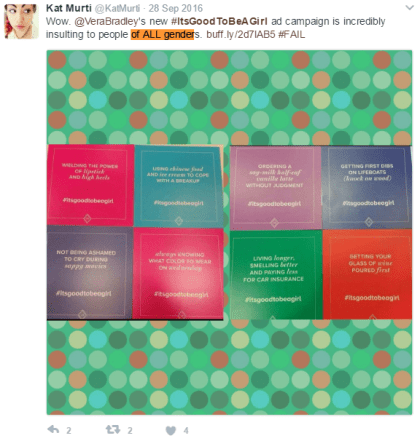
    Image result for #itsgoodtobeagirl

    verabradley
    @KatMurti

    Consumers were OUTRAGED, calling the campaign sexist and offensive not only to women, but men as well (ouch). The campaign eventually released less abrasive content, and called on a more girl-power type approach by quoting inspiring women.

    sassy model girlpower stumblrndxfblqidm1qk08n1o1250


    The hashtag #itsgoodtobeagirl is still trendy on Twitter today #PRsave.
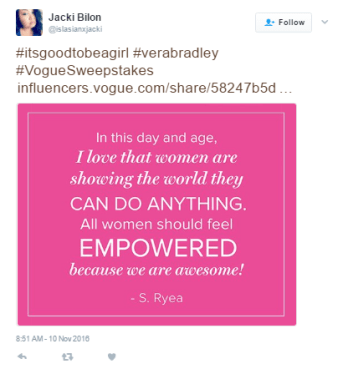
     

    verabradley.PNG
    @islasianxjacki

    Gender objectification in advertising is obviously a hot topic to critique, but as everyone knows, sex sells. And when you’re trying to sell a product, you need to sell.

    There has GOT to be a way in advertising that can celebrate and use the human body without objectifying it.

    Since the Roxy Pro Biarritz scandal, Roxy has laid pretty low in terms of video advertisements.

    The question is this, if you were Roxy, how would you continue to advertise your all women’s apparel and surf wear? Keep in mind surfing isn’t done in hoodies and sweatpants; it is done in swimwear, boardshorts, and wetsuits.  So…would you use sex appeal, or pull a Vera Bradley and try something risky and innovative (even if it could possibly fail at first)?


    Kayla Millie


  • What is Sex Really Selling?

    Everywhere you turn, you see it — advertisements that feature models in seductive poses or racy images that entice customers to purchase the product. Advertisers are increasingly utilizing the theory that “sex sells” in order to promote their products. Why? Because it works.

     The link between sex and advertising has been traced back all the way to the beginning of advertising in the 19th century. One of the earliest known advertisements that used sex to sell were trading cards tobacco companies placed into their cigarettes packages. These collectible cards featured women wearing scandalous outfits (for their time) with excessive skin exposure, encouraging men to smoke a specific brand of cigarettes.

     However, the use of erotic images in advertising didn’t stop there. Later in the 19th century, Woodbury’s Facial Soap released an advertisement suggesting intimacy between a man and women. With the tag line, “A Skin You Love to Touch,” the man faces the female model while embracing her, clearly showing the mans desire. It is apparent that the continued use of erotic advertising over the years has stuck, simply because it works.

    The use of sex in advertising has been a long-standing tradition in the history of advertising and continues to increase in today’s society. Researchers conducted a study looking at 3,232 full-page advertisements in popular magazines such as Cosmopolitan, Time, Newsweek and Playboy, published in three different decades –1983, 1993, and 2003. In 1983, 15% of advertisements used sex to promote their products and increased to 27% in 2003.

    Sex appeal could arguably be the leading technique that advertising agencies use in America to attract certain audiences. So it comes to no surprise that Hardees would use attractive females eating a large, oh-so-juicy hamburger in slow motion. So the question being asked is, “Is it ethical for the new Hardees advertisements to set a new standard for sexualizing food by using a sexy woman making love to a burger?”. Objectifying women in advertising is very prominent for the targeting to male audiences. The message Hardees would appear to be establishing is, “Hey, boys, you have next to no chance of ever having sex with a woman who looks like Kate Upton unless you save your money and pay for it. But you can satisfy your hunger with one of these salacious sandwiches she has blessed”.

    untitled

    The burger giant, Carl’s Jr. hired socialite and reality TV star Paris Hilton to star in several commercials and print ads for its Spicy BBQ burger. The advertisements utilizes sex appeal with the famous male anatomy logo “She’ll tell you size doesn’t matter. She’s lying”. The intention of this ad was targeted mainly for men to relate that size really does matter, and to women that fit girls can still indulge a greasy cheeseburgers. But the hair flipping, sliding around on a wet car minute long video was too over sexualized and banned from airing during the Super bowl. Carl’s Jr. did not consider ethical approaches or consider the different audiences that would see this ad as morally wrong, like the Parents Television Council. mqdefault[10]Carl’s Jr. CEO Andy Puzder responded to this threat with, “This isn’t Janet Jackson — there is no nipple in this. There is no nudity, there is no sex acts — it’s a beautiful model in a swimsuit washing a car.” But it’s not just the act of having a woman half-naked in a commercial, it is mostly about the misleading message in the commercial. But, as always, there are people who are going to be offended by this kind of publicity by stating that they are portraying women as sexual objects. What’s your opinion on this?

    Food companies weren’t the only ones using sex as a selling point. Last Fall, Adidas also joined the sex appeal craze. They created a controversial advertisement that essentially showed a woman stripping her clothes purely because she was a fan of his Adidas shoes. The ad is being directed toward younger men who thrive to appear attractive through their style. However, it is questionable whether it is actually selling the shoes, or the idea that a woman is easily convinced to undress for a reason such as one’s appearance. Adidas has continuously presented their brand as one that stands for teamwork and the value of sports. They slightly re-branded themselves in this advertisement as a company that also cares about the style Adidas shoes can bring into your social life. A little re-branding is necessary every now and then to keep a product’s image fresh, however an ad such as this one also represents a gender stereotype that women will strip their clothes as soon as they see a pair of stylish clothes. There is a very thin line between proper sex appeal and the use of offensive gender stereotypes, and it is difficult to tell if Adidas actually crossed this line.

    In today’s culture, audiences are bombarded with advertisements left and right. In order to distinguish themselves from the crowd, some advertisements are using sex appeal to grab the attention of consumers. Is it ethical to use sex appeal as a way to persuade consumers? Have advertisements gone too far?

    -Briana McWhirter, Emily Foulke, Hannah Turner

  • Humor: The Helper

    It’s undeniable that cancer is a scary subject, and breast cancer is no exception. One simple statistic summarizes just how un-discriminatory and prevalent breast cancer is: breast cancer is the most common form of cancer in women, no matter your race or ethnicity. With the whole month of October designated as National Breast Cancer Month, reminders for women to get mammograms and to screen themselves appear regularly. So how do you get people to face one of the scariest diseases out there? The answer is humor.

    Rethink Breast Cancer is an organization dedicated to changing the perspective of breast cancer from scary, to preventive and manageable. Most notably, they want to change how awareness is taught. Rethink Breast Cancer has moved away from fear-based education tactics to using “fear-free, cutting edge messaging, multi-media platform reach and positive energy [that will] revitalize the breast cancer movement and motivate young people to action.” The YouTube video they have created for awareness has done just that.

    With over six million views, the video Rethink Breast Cancer produced in 2011 has done a remarkable job of not only raising awareness for breast cancer, but also doing so in an approachable manner. Based on the premise that “women are more likely to watch a video if it features a hot guy,” it stars male models that educate the audience on how to check for breast cancer. Humor is interwoven throughout the video in scenes such as a female nurse tripping over a stool, and a slow motion of a male model bathing himself.

    Together, all of these humorous scenes combine with raw education to make breast cancer awareness fun to learn about. By using a pop-culture medium, such as YouTube it is even harder to ignore the message. But most importantly, Rethink Breast Cancer is living up to its goal of helping to educate from a perspective of humor rather than fear. This is exactly the kind of video that women (and even men) will pass on to their friends, helping to spread the importance of proactively approaching breast cancer.

    Carefully balancing humor and sex appeal, Rethink Breast Cancer has created the ultimate advertisement for spreading awareness on how to help catch breast cancer. By using humor the ad becomes persuasive and makes examinations less of a chore and more of a self-service. But is this particular message the way that survivors would want to caution the public? While it seems appropriate to use humor on occasion, could there be a point where humor starts to detract from the sincerity of the situation at hand? If ads like this can be successful for breast cancer could this type of levity be introduced in messages of other health campaigns?

    Meghan Carey, Caroline Robinson