Tag: persuasion

  • Persuasion Through Customization: Moto X

    “If you wish to persuade me, you must think my thoughts, feel my feelings, and speak my words. -Cicero

    Spoken nearly 2000 years ago, this statement still rings true today. Philosophizing rhetoric and the art of persuasion, Cicero understood the importance of connecting with an audience at the mental and emotional level.

    The above quote points out three of his main claims. To persuade an audience one must “think their thoughts”.  People are more likely to be persuaded when the rhetorician communicates in a way that embraces the individual’s own point of view. Focusing solely on changing point of view results in discomfort and suspicion. Rhetoricians must also “feel their feelings”. To do so, one must ask themselves what the deep-seated feelings are that drive the listeners. Asking this question and reflecting on the answers is an essential part in the pathway to connecting. Finally, according to Cicero, to persuade an audience, one must “speak their words”.  People need to understand what you have to say in order to care about it.  If they don’t care, they won’t do the ultimate goal – act.

    In the age of advertising, these classical concepts are still prevalent as we transcend into the postmodern era. In postmodernity the “self” becomes the ultimate selling point. Marketers strive to persuade their audience that their product does more than whatever its mechanical purpose – the pitching point becomes that their product is an extension of oneself. As a result, individualization and customization are reigning themes. Furthermore, because individuals are immersing themselves as an object, consumers become an actual participant in customization. Products are increasingly less of a finished object, allowing consumers to provide direct input – ultimately and simultaneously becoming a producer as well.

    Therefore, it is no coincidence products today are increasingly individualized. An example of this is the new Motorola Moto X phone. Check out it’s commercial, Customize below.

    After watching this how do you feel? This is a pretty cool phone, right? You can make it however you want! Notice how this commercial mentions nothing about tech specs, mobile web speed, or how the phone will be used in your every day life. Its persuasion strategy focuses on “you” – “your ride”, “your pet”, “your body” and now “your phone” – the idea that you can be in charge of customizing your phone, just as you do everything else, as an expression of your self. You are the producer. No longer are the only options either black and white. Your options are whatever you think brands yourself best.

    This commercial is the essence of Cicero’s idea of persuasion combined with post-modernism ideals. By knowing what its postmodern consumers think and feel about individualization, Motorola has created a product that speaks to every thing you as a consumer expects and wants – customization. Not only do you become a buyer of the Moto X, but a producer of it. Their persuasion hook is that you can directly produce their product as a means of your own expression.

    Has this commercial persuaded you? What other brands and products use customization and self-expression as a persuasion tool?
    Savannah Valade, Caroline Robinson

  • The Personality Behind PETA

    “Animals are not ours to eat, wear, experiment on, use for entertainment, or abuse in any way,” is the brand proposition of the world’s largest animal rights organization, PETA. The acronym PETA stands for People for the Ethical Treatment of Animals, and is known for their extreme stance on the treatment of animals.  This non-profit organization is based in Norfolk, Virginia and has over 3 million supporters who avidly believe in it’s mission.  The four main areas that PETA focuses on where animals suffer the most are factory farms, clothing industries, laboratories, and the entertainment industry.  There are many reasons for PETA’s success as a non-profit organization since its founding in 1980.  One main reason for the organization’s success is how they have fostered their strong brand personality.

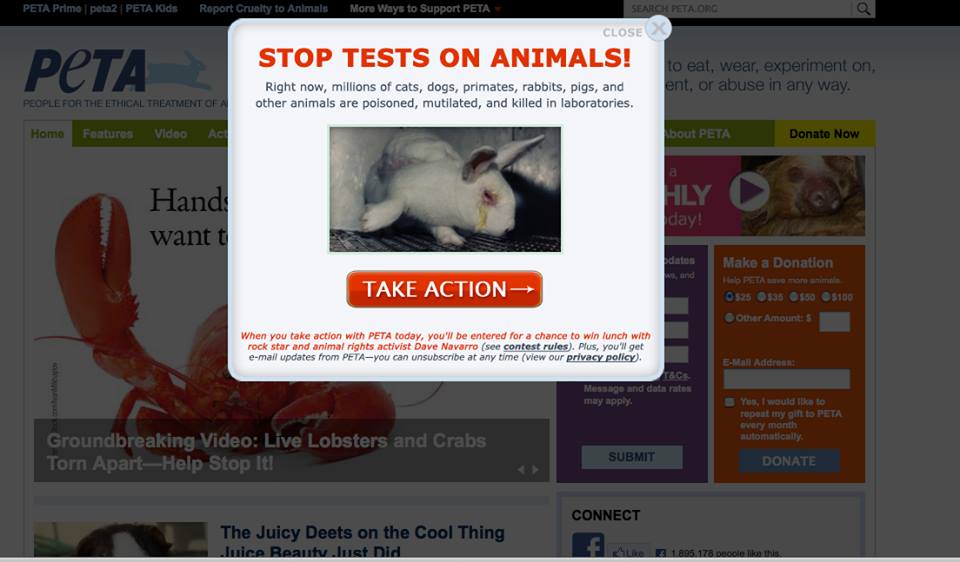
    PETA’s brand personality can be described as aggressive, emotional, and persuasive.  These characteristics can be seen in their advertisements, commercials, endorsements, and website.  Aggressiveness can be seen on the organization’s website through its use of language and tone.  The language used can be seen as aggressive because it is dramatic and creates a serious, yet sad and drastic tone.  One example from the website (even before you arrive at the main page) is a pop-up that takes up the entire screen.  The pop-up “greets” visitors the first time they view the website and features a graphic image of an ill-treated animal.  Language on the pop-up is bold, red, and uses exclamation points.  The message states, “Right now, millions of cats, dogs, primates, rabbits, pigs and other animals are poisoned, mutilated, and killed in laboratories.”

    Image

    Emotional appeals come into play as you continue onto the main page of the website and see horrific images of distressed or dead animals.  PETA uses this technique to form their brand personality because people’s emotions are triggered when they see either sad photos of animals, or even victory stories of animals that PETA has saved. PETA keeps their promise of saving more animals by having a readily available donation section on the homepage. Supporters who are moved by PETA’s mission are able to fill in their information and donate to save more animals with just one click. This allows supporters to create an emotional attachment because they aspire to create an ideal self by donating to the cause.

    Image

    A large portion of PETA’s success can be attributed to their use of celebrity endorsements as a means of persuasion. Celebrities such as Bob Barker, Carrie Underwood, Simon Cowell, and Audrina Patridge have all teamed up with PETA to support their mission and cause. One campaign in particular that remains consistent with PETA’s brand personality is represented by former Miss USA winners who advocate the idea that they would rather go naked than wear fur. These advertisements are meant to make the viewer feel uncomfortable in an attempt to call people to action. Even Academy Award winner, Joaquin Phoenix, has paired up with the organization to make an influential video that relates to his own personal experience dealing with animal cruelty.

    PETA’s brand personality continues to be strengthened because supporters are able to express their identity by representing the organization.  The combination of these three characteristics create an overall concept of what to expect of PETA, which is both distinctive and enduring.  Other than these three characteristics (aggressive, emotional, and persuasive) what comes to mind when you think of PETA? Do you feel that their brand identity is distinctive and memorable?

    – Aaron Love, Kara Zimmerman, Rachel Clay, Rebecca Hobbs