Tag: Penn State

  • The Race to be First

    Reporting any new information to the public can be risky, especially when it is a headlining topic.  As any social media expert, one should always make sure that the information they are providing the public is 100% accurate.  Any false information can put you and your company’s reputation at risk.

    With overwhelming attention surrounding the football program at Penn State, every tweet, wall post and blog comment brings more and more Internet traffic to the school and community.  In a society that completely thrives and relies on Internet access, acquiring information has never been easier or faster.  Along with the ability to supply millions with information via Twitter, Facebook or other social media sites, comes the responsibility to maintain an ethical mindset when sharing information.

    Joe Paterno, the recently released Penn State head football coach who served for 42 years, passed away at 9:25 am this past Sunday. On Saturday night, several hours before Paterno’s death, Onward State, a student-run news organization, reported through a tweet that the community icon had passed. The Onward State managing editor, Devon Edwards claims the tweet was based on an email hoax and has since resigned.

    It is shocking that a student organization (which presumably is more focused than professional organizations on performing tasks “by the book”) that is tied to an institution which has been so heavily shrouded in controversy recently, would fail to perform such a basic and necessary task as confirming information, especially when dealing with such an emotionally charged topic as the passing of Joe Paterno. Unfortunately, this is just the latest occurrence in what seems to be an ongoing problem with many forms of media.

    Managing Editor of Onward State’s Apology

  • Will JoePa Rest In Peace?

    Anyone who has been tuned into ESPN recently knows that Joe Paterno, “JoePa”, was the football coach at Penn State for 42 years, starting in 1966.  In the wake of a child abuse scandal centered around Jerry Sandusky, Penn State’s former assistant coach, Paterno was fired this past November. He was the face of Penn State and his brand was ultimately tarnished due to the scandal. Some are concerned that his tainted brand will overshadow his lifelong legacy. Sadly, Joe Paterno passed away on January 22nd due to his battle with lung cancer making it impossible to mend his stained brand.

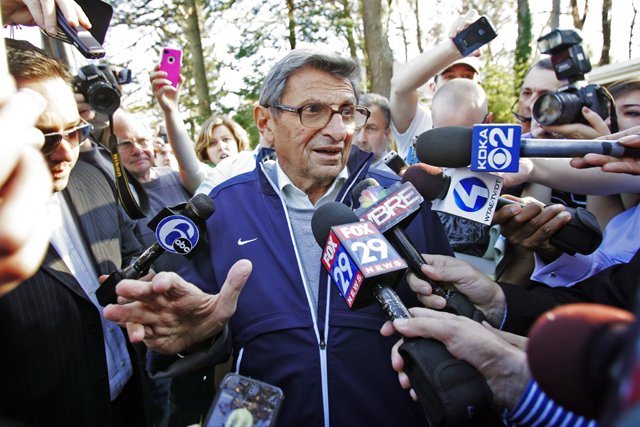
    The media has been criticized for how they handled the situation regarding Joe Paterno; some even question if the media’s involvement aided in tarnishing his brand. The question is not whether the media has a legal right to report whatever they find newsworthy because the First Amendment guarantees that they do. The issue is how media managers should employ that freedom in their own decisions about what is ethical and professionally responsible. Some may view that the media took their interrogations too far by harassing Paterno at his home and accusing him of allegations before they even knew the whole story.

    “The media jumped to the conclusion that Paterno was trying to cover up the scandal when it broke out.  Because his name is so iconic, linking his name to the scandal would attract more viewers on their websites as opposed to Sandusky… more has been written about Joe Paterno’s involvement than Sandusky in the media.” – Chris Moore, Penn State University Senior  

    Is it ethical for the media to do whatever it takes to get the story out first even if it damages a man’s reputation beyond repair? On another note, people have a right to know what is going on in today’s world, so is doing whatever it takes to get the news as bad as it seems? Some argue that the media is just doing their job and presenting breaking news to the public. It was already too late for his reputation when the news came out that Paterno had told superiors about the issue in 2002. According to the Penn State Board of Trustees, their reasoning for terminating Paterno was partially based on his failing to uphold a moral responsibility to report allegations made in 2002 against Sandusky to authorities outside the university.

    There is no question that Paterno let the victims, their families, and the university down by not pressing the issue with the police after he approached his superiors. In our opinion, Joe Paterno deserves to be remembered for who he was as a coach and as an individual; not as a man who was in over his head dealing with the worst scandal in his university’s history.

    Kelsey Bendig, Brian Burch, Brooke Keller, Andrea Blanton

  • To sponsor or not to sponsor…

    Penn state is an iconic brand it itself. This brand’s football team alone generates $53 million in revenue annually from the football games, and the entire athletic program receives an additional $24 million in sponsorships and merchandising deals. The team’s brand: The Nittany Lion, has been in jeopardy since the sexual abuse scandal began unraveling and continues to be making headlines in the news. With the story still on the minds of students and faculty, it is still a heavy situation for the sponsors of the school and team. Pepsi announced on Wednesday that it will remain a sponsor of the school and its team. Pepsi has been one of the university’s largest corporate partners, and is on prominent on both in both the sports stadiums as well as Penn State’s main State College campus. In its original deal with the school in 1992, Pepsi Co. paid Penn State $14 million over 10 years for exclusive vending and advertising rights. In this deal, soft drinks are served in Pepsi cups on game day and the signage is anchored by a permanent Pepsi logo on the scoreboard of the 106,537-seat football stadium.

    The Penn State situation eerily reflects the Tiger Woods scandal along with his loss of sponsors. The status of Penn State’s other advertisers other than Pepsi remains uncertain. Mohegan Sun Casino in Uncasville, Conn, on Wednesday expressed that the casino’s deal with Penn State football “technically” ended for the year. Penn State also has sponsors from AT&T (T), Berks Hot Dogs and Chesapeake Energy (CHK). For now, these sponsors still remain, but the future of their sponsorships of the university are uncertain.

    Other high-profile sponsors such as Chevrolet, PNC Financial, John Deere, State Farm Insurance and the American Red Cross are staying put for now. So what does this all mean? Large corporations are also in jeopardy of being in the line of fire for continuing to sponsor a school that has done nothing to protect victims of sexual molestation. Iconic Brands like Penn State and Pepsi have a developed a strong relationship over the years, and will continue to keep their partnership. It poses the question that when is a situation too much for a corporation; what is the breaking point? With modern-day heroes such as Joe Paterno (Penn State) and Tiger Woods, being the center of major scandals which in turn led to the loss of major sponsorship and thus embarrassment for them and their sponsors;  is it in the best interest of Pepsi to remain with Penn State? You be the judge?

    — Michela Noreski, Jordan Hill, Ashley Nelson

  • Gone, but never forgotten: Joe Paterno

    Fact: Joe Paterno is and will always be a legend in the sport of college football.

    Fact: Joe Paterno is the winningest coach in top-level college football.

    Fact: After 46 years as head coach, Joe Paterno is no longer the leader of the Nittany Lions.

    Previous to this week, Joe Paterno was considered the most respected man in college football. He is small in physical stature, greying, wears outdated glasses, and has a soothing-yet rough voice; basically, he fits the description of a typical grandfather. To his fans, the thousands upon thousands of Nittany Lions across the nation, he is their grandfather. His abrupt and unexpected departure from his long-held post as leader of Penn State Football has left his fans in a state of hysteria.

    Students at the university are outraged over the board of trustees’ decision to fire Paterno. These students fully support their beloved coach, regardless of this situation, but why? How can anyone support a person who was aware of such wrongdoing and allowed it to go unreported? Penn State students are different. On Wednesday night, students hit the streets voicing their love for “Joe Pa”, knocking down sign posts, yelling at police, shattering car windows, and turning over trash cans and newspaper boxes. Students even overturned a television news van in an attempt to illustrate their infuriation with the media, which they largely blame for the boot of the beloved coach.

    Under Paterno’s leadership, and motto of “success with honor,” a program was able to defy records and challenge teams across the nation. Although ‘Joe Pa’ was an amazing coach on the field, it takes more than Saturday games and weekly practices to make a good coach. Because Paterno neglected to consider the other duties of being a leader, a man was allowed to repeatedly desecrate innocent young children. In a 15-year period, 8 boys were sexually abused by one man, Jerry Sandusky. This one man has been charged with 40 counts of child abuse, 21 of which are felonies; however, because of him a powerhouse program has been forced to start all over.

    Paterno had announced Wednesday morning that he would step down as coach at the end of the season. But amid the outrage, Penn’s State’s Board of Trustees held an executive session late Wednesday night and fired him and the schools President Graham Spanier, triggering the protests and media frenzy.

    The Penn State story has been a lesson in what not to do in terms of crisis management from a public relations perspective. In a world filled with social media and news happening 24/7, companies, and in this case a university, cannot afford to mishandle a major crisis. It requires preparation and nurturing. One cannot just announce the events in such a manner that Penn State did.  They waited too long to address the allegations after the story had gone live-online, and began being broadcast on news outlets. Not only this, the university cancelled Paterno’s weekly-football press conference, which then caused chaos among the media. If anything good can come out of this, it will be that horrific instances such as this, and men such as Jerry Sandusky, never happen again.

    – Jordan Hill, Michela Noreski, Ashley Nelson

  • For The Kids by The Students

    What kind of student-run fundraiser involves more than 15,000 students, goes on for more than 32 years, involves celebrity involvement, and raises over $69 million for its cause? Penn State University’s THON, of course. The Penn State IFC/Panhellenic Dance Marathon is the largest student-run philanthropy in the world, raising an incredible amount of money for pediatric cancer patients every year. Not only do students show their dedication to the cause by working year-round to raise awareness, but they also have one of the most incredible student-run IMC plans I’ve ever seen.

    The THON Press page is as comprehensive as any professionally run fundraiser, with students assigned to state, local, and national media. There is a student-run THON Tumblr Blog, THON Facebook Profile, THON Twitter Account, and THON Facebook Fanpage, all to keep the public aware of THON related news year-round. Penn State students live tweet from the event and update their statuses regularly with the “FTK” (“For the Kids”) hash tag to keep their friends and family members informed. One notable THON supporter is none other than socialite Khloe Kardashian, who regularly blogs about the THON efforts and sends her support to the Penn State students.

    It’s obvious that the Penn State students are passionate about their cause and are channeling this passion into one of the most impressive student-run IMC campaigns out there.  Any student organization in the world could benefit from checking out the THON efforts and channeling them into their own student event.

    – Anna Kate Babnik, Carissa Niederkorn, Deji Adeleke, Tiffany Evans, & Katie Eagle