Tag: Olympics

  • Ambush Marketing, Rule 40, and the Sochi Controversy You Aren’t Hearing About

    Have Olympic advertising partnerships gotten too big? Have rules and restrictions protecting these “official sponsors” gone too far?
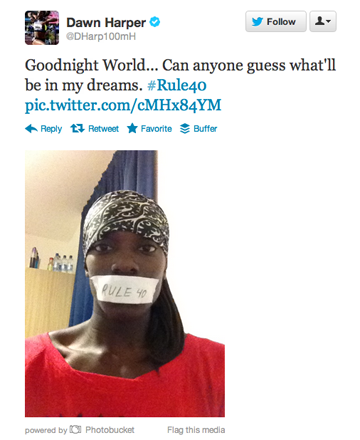
    Dawn Harper Tweets her Opinion of Olympic Rule 40
    Dawn Harper Tweets her Opinion of Olympic Rule 40

    Two-time track and field medalist Dawn Harper thinks so.  That’s why she posted this tweet with #Rule40 in protest of the IOC’s infamous Rule 40 during the 2012 Olympics in London.

    If you aren’t yet familiar with Rule40, it is a total ban on an athlete’s promotion of personal sponsors and their ability to acknowledge those who helped them get where they are today. It is especially focused on social media, where it has become a commonplace for athletes to thank sponsors with pictures and personal statements.

    Harper isn’t the only athlete to voice her displeasure with the effective “gag order” on competitors, but with companies spending upwards of $100,000,000.00 to associate their brands with the Olympics Games, is it really that hard to see why #Rule40 is in effect?

    Some have even gone as far to refer to the situation as a “battle”. Yet, despite the activism surrounding #rule40, without a doubt the biggest threat to the official Olympic sponsors is the ever-pervasive ambush marketers, silently stalking and waiting for their chance to steal some the Olympic brand name.

    These controversial ambush marketing campaigns attempt to capitalize on high-visibility events and locations through brand association without having to pay for the high-cost of officially sponsoring an event. My favorite example of ambush marketing involved the Minnesota Timberwolves selling this advertisement on the side of their stadium, where it happens to only be viewable from inside the nearby Minnesota Twins baseball stadium (where the official sponsor is Target).

    View of Timberwolves basketball stadium from inside the Twins baseball stadium
    View of Timberwolves basketball stadium from inside the Twins baseball stadium

    Ambush marketing may have been around in the advertising world for years, but the Olympics are seen as “the flagship event for ambush marketing”. Creative campaigns by infamous ambush advertisers like Nike often times attract more online buzz and conversation than the actual official sponsors.

    During the 2010 World Cup in South Africa officially sponsored by Reebok, advertising juggernaut and infamous ambush marketer Nike, placed an eye-catching ad on the fourth tallest building in the entire city of Johannesburg. When paired with a lengthy viral video, many agreed that Nike had effectively hijacked the sponsorship from Reebok and gained closer brand association with the World Cup event.
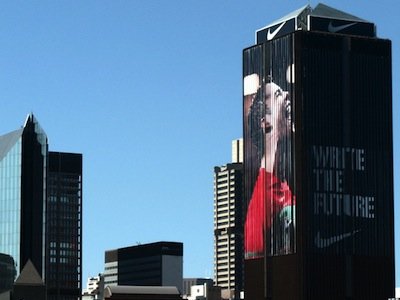
    Nike ad in Johannesburg during World Cup 2010
    Nike ad in Johannesburg during World Cup 2010

    Another ambush marketing giant, Subway, has already launched its attempt to steal some association from the upcoming Sochi games.  Summer Olympian Michael Phelps and retired speed-skating icon Apollo Ohno both appear in TV commercials for Subway’s “$5 foot long campaign” due to some legal loopholes discovered by Subway.

    So is it reasonable for the IOC to implement Rule 40 to help protect sponsors? Freeskiier David Wise recently commented that, “[he] understand[s] the Olympics are a moneymaking game, but it’s sad for [him] to have all these sponsors who have really taken care of [him]…[he’s] on the biggest stage [he] can possibly be on and [he] can’t give them the representation they deserve.”

    Another athlete and social media enthusiast, Nick Goepper, has stated that he will be completely off of social media for the entirety of the Olympics. “I think it might be safer not to tweet anything,” said Nick, the 19-year-old favorite to win Ski Slopestyle gold. “All I know, it’s pretty much zero tolerance for branding.”

    The Sochi games are only 3 days away, but the media blackout protecting the games’ sponsors has been in effect since January 26. When the final medal is awarded and the closing ceremonies complete, which brands will you associate with the games? Which advertisements and commercials will be the most talked about and discussed? Is $100,000,000 too much to pay for a loose association with the Olympic rings?

    Will the “ambushers” steal the spotlight once again?

    – Greg Rothman

  • Anything you can do, I can do better… and cheaper!

    In the world of sports, it is never a surprise to see Gatorade as a major sponsor. Their product has been placed into events including NHL games, the MLB home run derby, and the Super Bowl. With that being said, not seeing Gatorade as one of the official sponsors of the 2012 Olympic games in London was a surprise. The reason for Gatorade’s absence in the 2012 London Games is because Powerade, a product of Coca-Cola, bought the sponsorship for over 100 million dollars and blocked Gatorade out. Gatorade did not fret when they were faced with this challenge. Instead of accepting defeat and letting Powerade run all of the sponsorships and advertising, Gatorade decided to respond with a commercial of their own.

    In this commercial, Gatorade not only openly states that they did not sponsor the 2012 Olympics, but also to spin it into an extremely effective advertising technique. They portrayed the overall message stating that they were not there on the billboards and buses, but instead they were there “for real” inside the best athletes in the world. Gatorade did an excellent job in embracing the fact that they could not officially sponsor the event, but still being present in the advertising and overall experience of the event

    In accordance, Powerade also plays an interesting role in their advertising by pointing out the fact that you may not know the athletes that they sponsor. This brings another aspect to the table that can be compared directly to Gatorade. Everyone knows the big time athletes like Derek Jeter, Tiger Woods, and Usain Bolt who are sponsored by Gatorade; but there are few people who are familiar with the athletes that Powerade sponsors. Powerade decided to base their commercial on the athletes that are not as famous, but the underdogs of the world.

    Coca-cola spent over 100 million dollars to sponsor the Olympics and Gatorade attempted to catch their audience’s attention with one commercial. The bigger the risk, the bigger the pay off, right? So what do you think… did Powerade come out ahead?

    – Alexandra Huss, Caroline Merrill, Alyssa Morrello, Lauren Van Trigt, Dann Williams

  • I’m Lovin It! McDonalds Dominates Olympic Marketing Scene

    McDonald’s is the top sponsor for this year’s winter Games in Vancouver. Sportsfeatures.com describes how they have branded themselves as the Official Restaurant of the Olympic Games while opening three restaurant areas in the Olympic Villages in Vancouver and Whistler and the main press center in Vancouver.

    Much of the advertising is athlete-themed while embracing a “Share the Gold” slogan with Chicken McNugget promotions.  Along with the golden Chicken McNuggets, stores here in the U.S. are offering a new limited time sauce.

    McDonald’s is using three new advertising campaigns specifically targeting the Olympic season.  New items that have been added to the menu are the S’mores Pie and the Crème Brulee, and Crunch McFlurry.  To further support the Olympic themes, Happy Meals will include interactive toys of the 2010 Winter Games mascots.

    Outside of the Olympic themed advertising, McDonald’s is also continuing their Champion kids program which began at the Beijing 2008 Olympic Summer Games.  This program offers children ages 6-14 from all around the world the opportunity to personally experience the Games first-hand.  A panel of ten ambassadors at the Vancouver Games along with Olympic athletes judge essay entries to award the winners.

    As the Official Restaurant of the Olympic Games, McDonald’s focuses their advertising on supporting the Games and branding themselves through new winter themed menu items.  Their Champion kids program embraces the Olympic spirit while reaching out to involve young kids all around the world.

    Taylor Diehl

  • Vancouver 2010 Heightens Mobile Advertising Technology

    The Olympics have come a long way since they began in 776 B.C., and with current mobile advertising technology, the games will continue to expand and reach new audiences. During the Beijing Summer Olympics, NBC executives were shocked to see that 6.5 million viewers visited their mobile website during the games. This is the inspiration that caused NBC to add two applications, a smartphone version of the NBC Olympics mobile site, and new social media features to its mobile offerings.  In addition, NBC said they have been “able to attract advertisers to mobile—not because it was part of a large media TV or online buy—but because of the strong performance numbers from Beijing.” The applications offer news results, videos and the opportunity for viewers to follow athletes’ Twitter feeds and Facebook; however, there are no live coverage links of the events. With changing technology, many fear that such an ancient tradition that has contributed so much to our world history may be lost. However, with advances such as smartphone applications and mobile coverage, the games will be further preserved.

    Lacey Inman

    Stephanie Saulsbury