Tag: non-profit

  • Towels For Troops: Supporting Our Heroes

    I cannot speak for others, but one of the most quickly used products in my household is paper towels. Often times, it seems that they have to be bought on a weekly basis. Thankfully, Brawny, the paper towel company, recognized the necessity that paper towels have become and leveraged their product to help out a worthy cause.

    Last year, Brawny partnered with the Wounded Warriors Project to launch an “Inner Strength” campaign. For two years, Brawny has prided itself on standing strong alongside the Wounded Warrior Project (WWP) as a means of honoring injured service members. In 2012 alone, Brawny raised more than $500,000 for the WWP.
    hahahahaha

    For those of you who are unaware of the Wounded Warriors Project, it is a form of charitable support for members of the armed forces who were injured in the line of duty. Donations made to WWP help thousands of wounded warriors and their families as they return home from current conflicts.

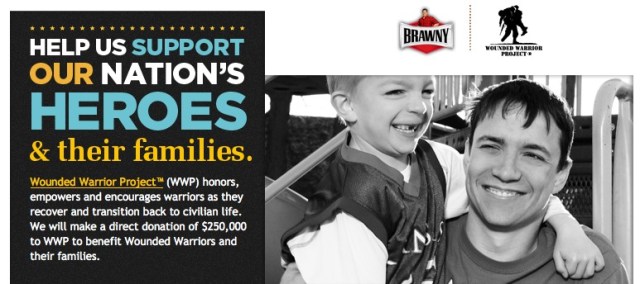
    With great success, Brawny decided to continue this cause marketing initiative committing to raise $600,000 this year. As a means of accomplishing this goal, Brawny has promised to make a direct donation of $250,000 to benefit the WWP. They have also announced their pledge to donate an additional $1, up to $350,000 for every individual who: shares a “Thank You” note on the Brawny Facebook page, “likes” Brawny paper towels on Facebook, or texts THANKS to 272969.

    Large goals like this are often hard to achieve, but worth it when it comes to a good cause. In the study of rhetorical theory, Greek philosopher, Aristotle teaches the three modes of persuasion: ethos, pathos, and logos. In this example, Brawny is able to use cause marketing to appeal to pathos or the emotion of the audience, but this tactic is commonly used in cause marketing. Pathos is the strongest mode of persuasion; making it a more frequently used appeal.

    Personally, when I hear the word “persuasion” I immediately make the connection to an interchangeable and more frequently used term…Influences. Persuasion is a process directed towards changing or influencing people’s beliefs, attitudes, and intentions. Individuals are persuaded each and every day. Persuasion is a critical and underlying goal of all marketing and advertising efforts.

    The “Inner Strength” campaign is an effective form of cause marketing conducted by Brawny and the WWP. This particular campaign does an efficient job of persuading customers purchasing decisions by appealing to the audiences’ emotions. Customers are much more inclined to buy a product if they know that it is for a good cause.  It is that simple.

    In this case, customers are buying Brawny products because it is to their understanding that a percentage of the proceeds go to the WWP. This is because these consumers feel a sense of sympathy for wounded soldiers. This is a form of persuasion at its finest. Ultimately, cause marketing has proven to pay off in this scenario seeing how Brawny sales are through the roof and donations made to the WWP are at an all-time high

    Happy Thanksgiving!

    -Caitlin Ford, Parker Farfour, Alex Corrigan, Kaitlyn Batson
  • The Personality Behind PETA

    “Animals are not ours to eat, wear, experiment on, use for entertainment, or abuse in any way,” is the brand proposition of the world’s largest animal rights organization, PETA. The acronym PETA stands for People for the Ethical Treatment of Animals, and is known for their extreme stance on the treatment of animals.  This non-profit organization is based in Norfolk, Virginia and has over 3 million supporters who avidly believe in it’s mission.  The four main areas that PETA focuses on where animals suffer the most are factory farms, clothing industries, laboratories, and the entertainment industry.  There are many reasons for PETA’s success as a non-profit organization since its founding in 1980.  One main reason for the organization’s success is how they have fostered their strong brand personality.

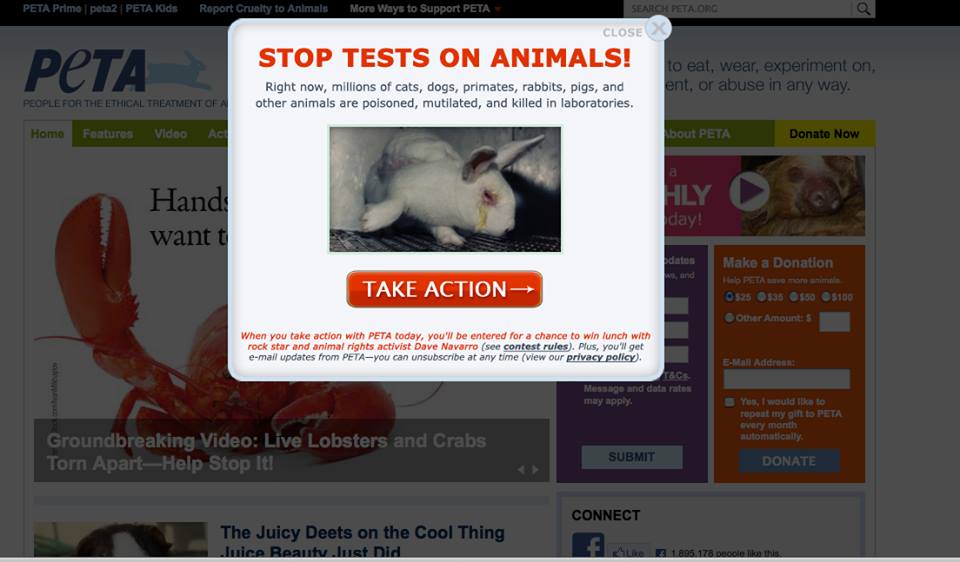
    PETA’s brand personality can be described as aggressive, emotional, and persuasive.  These characteristics can be seen in their advertisements, commercials, endorsements, and website.  Aggressiveness can be seen on the organization’s website through its use of language and tone.  The language used can be seen as aggressive because it is dramatic and creates a serious, yet sad and drastic tone.  One example from the website (even before you arrive at the main page) is a pop-up that takes up the entire screen.  The pop-up “greets” visitors the first time they view the website and features a graphic image of an ill-treated animal.  Language on the pop-up is bold, red, and uses exclamation points.  The message states, “Right now, millions of cats, dogs, primates, rabbits, pigs and other animals are poisoned, mutilated, and killed in laboratories.”

    Image

    Emotional appeals come into play as you continue onto the main page of the website and see horrific images of distressed or dead animals.  PETA uses this technique to form their brand personality because people’s emotions are triggered when they see either sad photos of animals, or even victory stories of animals that PETA has saved. PETA keeps their promise of saving more animals by having a readily available donation section on the homepage. Supporters who are moved by PETA’s mission are able to fill in their information and donate to save more animals with just one click. This allows supporters to create an emotional attachment because they aspire to create an ideal self by donating to the cause.

    Image

    A large portion of PETA’s success can be attributed to their use of celebrity endorsements as a means of persuasion. Celebrities such as Bob Barker, Carrie Underwood, Simon Cowell, and Audrina Patridge have all teamed up with PETA to support their mission and cause. One campaign in particular that remains consistent with PETA’s brand personality is represented by former Miss USA winners who advocate the idea that they would rather go naked than wear fur. These advertisements are meant to make the viewer feel uncomfortable in an attempt to call people to action. Even Academy Award winner, Joaquin Phoenix, has paired up with the organization to make an influential video that relates to his own personal experience dealing with animal cruelty.

    PETA’s brand personality continues to be strengthened because supporters are able to express their identity by representing the organization.  The combination of these three characteristics create an overall concept of what to expect of PETA, which is both distinctive and enduring.  Other than these three characteristics (aggressive, emotional, and persuasive) what comes to mind when you think of PETA? Do you feel that their brand identity is distinctive and memorable?

    – Aaron Love, Kara Zimmerman, Rachel Clay, Rebecca Hobbs

  • Social Media to Help Others

    The invention of social media has changed the way we communicate as individuals. Today we are constantly connected to one another whether or not we prefer to be. Social media has not only been used to keep individuals in contact with other individuals, but as a way for businesses to communicate and connect with their consumers. Social media interactions focus on building customer relations and fulfilling the expectation “that customers expect brands and businesses to be there for them everywhere, across mobile and social media.” 

    While for-profit businesses try to drive consumerism behavior, non-profits try to drive behavior towards volunteering, donating, rallying, etc. Social media offers an inexpensive but powerful way to recognize and encourage desired behavior. Social networking sites allow non-profits to quickly announce, update, or reiterate the needs or goals of the organization itself or the publics they are trying to help, to vast numbers of people. This becomes largely helpful in raising awareness of time sensitive or unexpected events, in particular during times of crisis. Whether natural or humanitarian, social media can allow to-the-minute updates of the severity of the situation and the needs of the victims. One recent event in Kenya has proven just how successful a non-profits needs can be filled when using social media.

    On September 21, 2013 terrorists with the Islamist militant group Shabab in Somalia (linked to Al Queda) invaded a Kenyan mall. Westgate Mall is a 5-story upscale mall that represents the country’s growth and prosperity. A little before noon the Shabab conducted a double attack on the mall with heavily armed attackers storming into the mall from two different entrances and opening fire on shoppers. The shooting rampage soon turned into a hostage situation as many of the shoppers were trapped inside. As night fell, two special units moved in to try and rescue hostages and stop the attackers. The situation lasted for four days and concluded with over 60 deaths and 175 people injured.

    During the Westgate crisis the Kenya Red Cross (KRC) stepped up their game and became a prominent first responding unit. Performing the normal duties of any Red Cross organization they helped to alleviate those involved in the Westgate disaster by holding blood drives, setting up triages, and creating missing persons list, but what the Kenya Red Cross did the best during this crisis was communication.

    From the start of the shoot out the KRC began sharing information about the crisis through the social media platform Twitter. As the events unfolded their tweets consisted of calls for blood donations, updates to where people could report and find the status of missing persons, and updates on changing traffic patterns.

    example of info & blood tweets

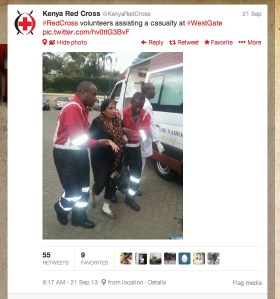
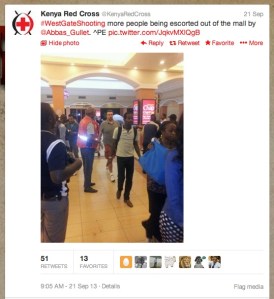
    They even tweeted pictures giving Kenyans and people around the world a first look at the crisis.

    KRC helping victims people being escorted out of mall

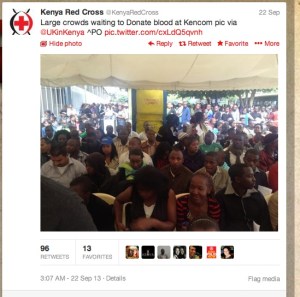
    Using Twitter was a way the KRC could not only rally support and share information, but show their role as a non-profit to the world. Unifying the people of Kenya in this moment of crisis was their biggest accomplishment. This success was shown in the turnouts of volunteers and blood donors they received in the following days of the ordeal.

    large crowd turnout

    Even though the terrorist attack ended days ago the Kenya Red Cross is continuing their efforts to help those affected through the social media platform. They have collected 11,293 units of blood and are reporting the money raised and what it is being used for to the public – all through tweets. Their ability to reconnect people after disaster through Twitter makes them a shining star in non-profit social media use.

    The Kenya Red Cross used social media to inform people all over the web of an important issue, as well as what solutions could be offered to help. This represents agenda setting, the theory that the media have the ability to tell people what issues are important around the world. This also involves controlling the topics people discuss and become concerned with, so by using Twitter, the Kenyan Red Cross regulated the conversation of many people who were directly affected by the disaster. An awareness of the situation was presented, therefore the crisis was held at a higher level of importance because of the media outlet that was used.

    It is clear through the Westgate Crisis that social media can be used successfully by non-profits that respond and work through disasters.  Social media will prove again and again to be a useful medium to help victims, bring together volunteers and unite the world in times of crisis.

    Caroline Robinson, Jade Lester, Meghan Carey, Morgan Jones, Savannah Valade.