Tag: Nike

  • Instagram: The New Era of Advertising

    Everyday millions of Instagram users spend hours scrolling through their smart phones to view filtered photos, typically those that they “follow” or come across through #hashtags. According to the brand’s website, there are currently 150 million users, 60 billion photos uploaded, and an average of 1.2 million “likes” per day.  (website: http://instagram.com/press/) As consumers, it is understood that these photos are a reflection of such users “brands”, and the photos they choose to share are typically selected and edited to portray a desired image of themselves. Whether it’s goods they just purchased, activities they partake in, or flattering photos of themselves, Instagram gives consumers the opportunity to advertise their individuality for free.

    Aside from everyday consumers trying to convey an image of themselves, products, celebrities, and other organizations are able to use this platform to brand themselves however they choose. In some cases, celebrities intertwine their “brand” with a product or service that they endorse. For example, singer Ellie Goulding, who recently became an advocate and endorser for “Nike” products, shares several photos of her outlandish lifestyle to all 2.3 million followers.. Known for her eccentric, hip, and alternative style, Goulding also posts photos of herself in her athletic gear, where there is always a “Nike’’ logo.

    Within IMC, it is understood that there are both controlled and uncontrolled messages. Advertising is a a controlled and planned message that is executed through a particular medium to reach target audiences. The “Nike” brand is consistently advertised through Goulding’s photos, however, Nike does not have control over which photos she captures. It seems as though Nike and Ellie Goulding have a sort of symbiotic relationship right now, with Ellie promoting Nike products and Nike in turn supporting/promoting Ellie’s Music.

    “Nike and recording artist Ellie Goulding are releasing an exclusive remix album from Goulding’s second album, “Halcyon,” to inspire the thousands of women joining Ellie to run 13.1 miles on April 28.” (Nike inc.)

    It is important to note however that Ellie is not an employee of Nike and that while it may be in her best interest to safeguard their relationship could she inadvertantly tarnish the Nike brand without being aware of it? This raises an important question: How much control do companies have over the “brand” that their endorsers convey? In the meantime however the relationship between the two will most likely prove beneficial for both parties as many fans of Goulding follows her on her Instagram page. Will it soon become commonplace for all celebrities to endorse particular products in exchange for publicity of their own?

    This social media phenomenon has given advertisers a plentitude of opportunities to shape and select their brand image, and then after share it in a “likeable” manner.

    -Austin Johnson, Jade Lester, Jami Rogers, Ty Thomas
  • Nike Knows How to “Just Do It”

    Nike, the leader in manufacturing footwear and apparel has been building and strengthening their brand since their first advertisement in 1982. Currently, Nike has become a household name and can be easily recognized by consumers by their iconic swoosh logo. Before running advertisements on television, Nike promoted their brand based on sponsorships and celebrity endorsements, both professional and college athletes. In order to differentiate their company from their biggest competitor, Reebok, Nike chose to promote their shoes as fashion accessories to consumers. They also began to focus their advertisements on the stories of the people wearing the product, instead of solely on the product.

    As their brand was quickly growing, Nike employees decided to sign on with Wieden and Kennedy (an advertising agency) to help promote their brand. The “Just Do It” tagline was created while in a meeting when Dan Wieden (one of the founders) said to the Nike employees, “You Nike guys, you just do it.” With just that one phrase, the history of Nike advertising changed.

    nike-just-do-it-logo

    When the famous tagline, “Just Do It”, was first brought into their marketing scheme, Nike was trying to regain its position as the industry leader. During the 1980s the aerobics industry climaxed giving competitors an open range of new business development within the sportswear industry. In order to show consumers that Nike was different from its competitors, Nike held a major product and marketing campaign in 1987. The campaign was supported by a memorable TV ad whose soundtrack was the original Beatles’ recording of ‘Revolution.’ From the “Revolution” campaign, Nike then launched a broad yet empowering series of ads with the tagline “Just Do It.” The beginning of the “Just Do It” ads was in 1988 when a commercial airing Walt Stack, an 80 year-old running legend, jogging across the Golden Gate Bridge stating that he runs 17 miles every day. In 1989, Nike’s cross-training business peaked and the brand slogan had regained the position as the industry leader back to its rightful owner and has held this title since.

    Nike entered the 1990s decade with a focus on sports players and designing national team uniforms around the world. In the past, Nike has designed apparel and footwear for golf and soccer. Nike decided to expand their sports designs to various sports including basketball, tennis, and football. Nike signed the World Cup winning Brazilian National Team as their uniform designing brand in 1995. Also they signed for the US men’s and women’s national soccer teams as well as many others. Nike also branded its company with by using iconic athletes in their commercials like Michael Jordan, Bo Jackson, Charles Barkley, Andre Agassi, Pete Sampras, and Tiger Woods. In 1996, Nike sponsored the young Tiger Woods a gracious amount of $5 million per year. Tiger Woods proved his golfing abilities to doubtful critics in the 1997 Masters after winning by 12 strokes. “I’ve heard I’m not ready for you. Are you ready for me?” are the final lines of Nike’s obstinate introduction of Tiger Woods. In the 1996 ad titled, “Hello World”, Nike foreshadowed the future dominance the golfing world was about to encounter.

    Nike boomed into the 20th century with the introduction of Nike Shox, which was a whole new type of shoe. Shox provide groups of small hollow columns in the middle of the shoe soles. These columns were designed to add an extra comfort factor to the shoe, as well as a spring that gives more power to an athlete. Shox have been one of Nike’s most successful products throughout their history. They also reinforced the idea that Nike truly cares about the comfort of the athlete. Throughout the 2000s Nike continued to improve their products and put time and effort into the advertising of the products. In 2003 Nike was named “Advertiser of the Year” by Cannes Advertising Festival, making it the first company to hold that title twice (the first time was in 1994). The following year their annual revenues exceeded $13 billion. Their obvious hard work was paying off.

    Within the past 10 years, Nike has introduced several new types of shoes such as the Air Jordan XX and their eco-friendly Nike Considered line. Currently Nike has developed a 5 year plan with their goal being to reach a $36 billion revenue by 2017. They plan to reach this goal by focusing on the growth of the brand and giving extra attention to their women’s apparel. If there is one thing that Nike has successfully done over the last 25 years, it’s expanded and branded their products effectively.

    Nike is a brand that never stops growing and developing. They continuously create goals for themselves as a company and seem know exactly how to keep reaching those goals. What do you remember most about the Nike brand over the past few decades?

    – Hannah Turner, Emily Foulke, Briana McWhirter

  • Ambush Marketing, Rule 40, and the Sochi Controversy You Aren’t Hearing About

    Have Olympic advertising partnerships gotten too big? Have rules and restrictions protecting these “official sponsors” gone too far?

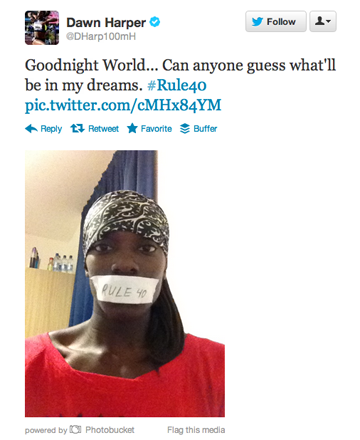
    Dawn Harper Tweets her Opinion of Olympic Rule 40
    Dawn Harper Tweets her Opinion of Olympic Rule 40

    Two-time track and field medalist Dawn Harper thinks so.  That’s why she posted this tweet with #Rule40 in protest of the IOC’s infamous Rule 40 during the 2012 Olympics in London.

    If you aren’t yet familiar with Rule40, it is a total ban on an athlete’s promotion of personal sponsors and their ability to acknowledge those who helped them get where they are today. It is especially focused on social media, where it has become a commonplace for athletes to thank sponsors with pictures and personal statements.

    Harper isn’t the only athlete to voice her displeasure with the effective “gag order” on competitors, but with companies spending upwards of $100,000,000.00 to associate their brands with the Olympics Games, is it really that hard to see why #Rule40 is in effect?

    Some have even gone as far to refer to the situation as a “battle”. Yet, despite the activism surrounding #rule40, without a doubt the biggest threat to the official Olympic sponsors is the ever-pervasive ambush marketers, silently stalking and waiting for their chance to steal some the Olympic brand name.

    These controversial ambush marketing campaigns attempt to capitalize on high-visibility events and locations through brand association without having to pay for the high-cost of officially sponsoring an event. My favorite example of ambush marketing involved the Minnesota Timberwolves selling this advertisement on the side of their stadium, where it happens to only be viewable from inside the nearby Minnesota Twins baseball stadium (where the official sponsor is Target).

    View of Timberwolves basketball stadium from inside the Twins baseball stadium
    View of Timberwolves basketball stadium from inside the Twins baseball stadium

    Ambush marketing may have been around in the advertising world for years, but the Olympics are seen as “the flagship event for ambush marketing”. Creative campaigns by infamous ambush advertisers like Nike often times attract more online buzz and conversation than the actual official sponsors.

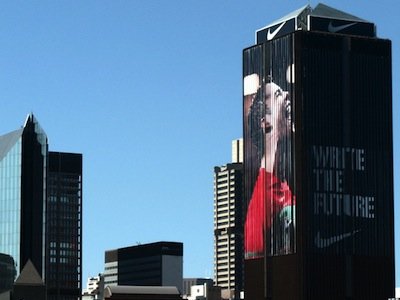
    During the 2010 World Cup in South Africa officially sponsored by Reebok, advertising juggernaut and infamous ambush marketer Nike, placed an eye-catching ad on the fourth tallest building in the entire city of Johannesburg. When paired with a lengthy viral video, many agreed that Nike had effectively hijacked the sponsorship from Reebok and gained closer brand association with the World Cup event.

    Nike ad in Johannesburg during World Cup 2010
    Nike ad in Johannesburg during World Cup 2010

    Another ambush marketing giant, Subway, has already launched its attempt to steal some association from the upcoming Sochi games.  Summer Olympian Michael Phelps and retired speed-skating icon Apollo Ohno both appear in TV commercials for Subway’s “$5 foot long campaign” due to some legal loopholes discovered by Subway.

    So is it reasonable for the IOC to implement Rule 40 to help protect sponsors? Freeskiier David Wise recently commented that, “[he] understand[s] the Olympics are a moneymaking game, but it’s sad for [him] to have all these sponsors who have really taken care of [him]…[he’s] on the biggest stage [he] can possibly be on and [he] can’t give them the representation they deserve.”

    Another athlete and social media enthusiast, Nick Goepper, has stated that he will be completely off of social media for the entirety of the Olympics. “I think it might be safer not to tweet anything,” said Nick, the 19-year-old favorite to win Ski Slopestyle gold. “All I know, it’s pretty much zero tolerance for branding.”

    The Sochi games are only 3 days away, but the media blackout protecting the games’ sponsors has been in effect since January 26. When the final medal is awarded and the closing ceremonies complete, which brands will you associate with the games? Which advertisements and commercials will be the most talked about and discussed? Is $100,000,000 too much to pay for a loose association with the Olympic rings?

    Will the “ambushers” steal the spotlight once again?

    – Greg Rothman

  • The Power of A Few Words

    In society today, there is an abundance of good slogans relating to the worlds of politics and advertising that adorn and surround our everyday life. Although many of these slogans often seem to be utterly vacuous, as they leave us with nothing, slogans still remain a very powerful example of the power of words and how their influence in motivating people and consumers. Advertising incorporates a series of crucial elements such as images, characters and music in order to further make their slogans even more memorable than the next brand or product.
    These often-superfluous gimmicks play a much larger role than one may expect. In fact, in the increasingly complex and ever-changing world we live in, simplicity counts in the form of communication.
    According to www.SloganPower.com, a powerful and efficient slogan should be able to:
    • Convey the essence of your organization or brand
    • Build your corporate or brand image
    • Establish your unique position in the marketplace
    • Attract and retain customers
    • Boost staff morale
    • Liven up your corporate literature
    • Enhance your competitive advantage

    Here are some examples of the most famous and successful slogans in our society:

    I’m lovin’ it – McDonalds
    What Would You Do For A Klondike Bar? – Klondike
    Yes We Can! – Obama Campaign 2008
    Just do it. – Nike
    Das Auto – Volkswagen
    All the news that’s fit to print. – The New York Times
    Let Your Fingers Do The Walking. – Yellow Pages
    Have it your way. – Burger King
    M’m! M’m! Good! – Campbell Soup
    The Citi Never Sleeps – Citi Bank
    Got Milk? – Milk Campaign
    Have a break. Have a Kit-Kat. – Kit Kat

    All of these examples are very successful slogans that most of us recognize instantaneously. Some of them may even instill sentiment into our hearts for one reason or another. But out of these examples, some stick out more than others. A good example is Nike’s slogan “Just Do It” because it is a very inspirational and successful campaign. The company has turned this slogan into a phenomenon and uses it to brand their products, including everything from t-shirts, to watches, to bracelets, to shorts and shoes, etc. The key is to motivate people to get up and get active, or essentially to go out there and literally “just do it.” These three words are very powerful.

    Today, even our schools have slogans help keep students motivated and give them a sense of community with the school. UNCW recently changed their slogan to “Together We Fly.” A slogan like this not only brands the school well, but it gives the faculty, staff, and students a sense of togetherness. The school then exemplifies a certain image about our university and how well we connect with each other. Bringing a positive image to our school is a huge part of our overall strategic branding. Effective branding will create a greater desire for prospective students to apply here and also help our image overall as an accredited university. Universities all over the world use their slogans to entice prospective applicants to become a part of their alma mater. Everyone in North Carolina knows exactly what school is being discussed when they hear “Tar Heels”.   The University of North Carolina Chapel Hill has established a dominating and elite brand reputation for their school since the 1700’s. When a slogan has motivation combined with pride, it can take the brand to a whole new level of accomplishment.

    Companies and institutions use slogans for a variety of reasons.  There are so many products available today, and consumers are not going to remember each product along with the entire marketing theme associated with such products.  Slogans are easy and catchy ways to grasp the general message that a company is trying to convey.  Just a few words can be extremely powerful in the effort to gain the attention of consumers.

    Sasha De Vecchi, Lindsay Gallagher, Jay Reilly, Cary Welborn

  • Losing It All After Winning Big

    Last week the U.S Anti-Doping Agency released a thousand page report on Lance Armstrong’s doping scandal.  The now retired cyclist hit headlines hard in late August when he was stripped of all seven of his Tour de France medals and was issued a lifetime ban from cycling. Since the story released, Armstrong’s four major lucrative sponsors have taken away their sponsorships one by one.

    Nike dropped Armstrong earlier this week due to his disgrace.  Nike released this statement “Due to the seemingly insurmountable evidence that Lance Armstrong participated in doping and misled Nike for more than a decade, it is with great sadness that we have terminated our contract with him.”

    Image

    The brewing company Anheuser-Busch also said it was ending its relationship with Armstrong when his contract expires at the end of this year.  Oakley Inc. and Radio Shack are waiting for the final decision from sport’s international authorities before conducting their final decision.  The other two sponsors that have immediately ended their relationships with Armstrong are Trek Bicycles and FRS, the energy drink maker.

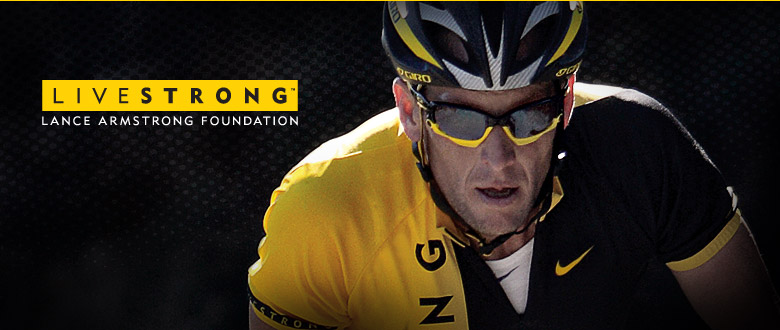
    Lance Armstrong has stepped down as chairman of the Livestrong cancer support charity that he founded.  His foundation is widely known for the 70 million yellow wristbands that were distributed worldwide.  His charity raises money not for research but to help cancer survivors with employment, financial obligations, insurance problems, and access to care, especially in third world countries.

    Image

    So far, donations have increased despite the Armstrong’s scandal.  Lance Armstrong released a statement on Wednesday stating “To spare the foundation any negative effects as a result of controversy surrounding my cycling career, I will conclude my chairmanship.”

    The road for Armstrong seems far from over.  Currently, the Olympic Committee is considering taking away Armstrong’s 2000 Olympic bronze medal, which will surely endure more loss and humiliation for him.  Predictions say he will continue to lose more sponsorships and countless lawsuits will be released of breach of contract between the companies and Armstrong.

    Meaghan Beam, Jessie Butner, Zach Abramo, Jack Lane