Gucci. Prada. Versace. These three symbols of “luxury” are high-end fashion companies that are flaunted around the world as brands of desire, wealth, and success. According to Forbes, luxury retail brands can be worth as much as 23 billion dollars. That amount shows the price consumers are willing to pay to feel as glamorous as the models who showcase the clothes, both through Advertisements and Mercedes-Benz Fashion Week, a buzz worthy week in New York City that features the spring collection of the most luxurious fashion brands in the world.


The hype of Fashion Week and the brands that are luxurious enough to present themselves there share the same quality: they give consumers a sense of desire. Rohit Arora, Strategic Planning Director of Bates Pan Gulf (BPG Group), studied the various reasons consumers’ desire these brands. One of the main reasons is notably the exclusivity to afford such brands, which changes over time as objects become less exclusive and more fiscally available.
Similar to the four P’s we learn about in IMC and marketing, Arora revealed a list of eight shared “P’s”- Pillars in Luxury Brand Marketing:
1.) Performance
2.) Pedigree
3.) Paucity
4.) Persona
5.) Public Figures
6.) Placement
7.) Public Relations
8.) Pricing
Each of these “P’s” must be highly considered by the brand’s marketing team in order to brand itself as luxurious while also justifying itself in price. Arora placed emphasis on the importance of both the pricing and placement phase, which can make or break a luxurious item as either desirable or unnecessary. “It is important for luxury brands to price themselves right – as setting the price lower than the consumer expectation and willingness to pay can potentially harm the brand value, whereas the reverse can potentially not give enough justification for consumers to go ahead and buy.” The marketing team of these brands has a lot to wrestle with in justifying their value, whereas less flashy brands are able to triumph off of their practical prices and convenience.
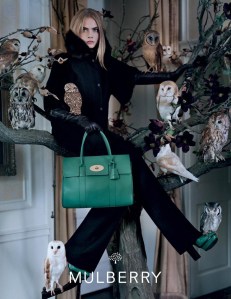
Following Fashion Week this spring, many luxury brands executed campaigns featuring public figures that were popular in both the fashion industry AND social media outlets. Luxury brand “Mulberry” selected 21 year old Cara Delevingne, currently one of the world’s most famous super models, as the new face for their campaign. The fact that Delevingne has nearly 5 million followers on Instagram helps give widespread exposure to Mulberry, which is a part of the “placement” phase of the marketing campaign. It doesn’t hurt that endorsements from popular top 40 tracks are always on the luxurious side of the spectrum. When is the last time you heard Drake talk about his reasonably priced jacket from TJ Maxx?

Luxury brands not only compete with the more cost efficient brands, but they also compete with one another to be the top selection among consumers. In 2010, “Louis Vuitton spent more than $22 million on advertising across all channels between January and June, compared to slightly more than $14 million during the same period last year, a 57 percent increase.” A year later, Marc Jacobs president Robert Duffy told the New York Times that Jacobs’ fall 2011 show cost at least $1,000,000 (or $1,750 per second). These painfully expensive prices are paid in order to keep status as a high-end fashion brand when winter fashion blooms into spring clothing. With the price of living going up just a few years beyond 2010 and 2011, one can’t fathom the funds needed to market luxury clothing items in 2014. As the temperature gets higher, the cost of advertising gets higher for these luxurious fashion brands!

 IMC Hawks Blog