Tag: Mitt Romney

  • #Eastwooding

    Clint Eastwood is a man of many roles: he’s a movie star, American badass, producer, director, and even politician.  Most recently, he can also add empty chair talker to the list.  Eastwood attended the Republican National Convention this past Thursday, August 30th. He was attending the convention to give an endorsement speech prior to Republican candidate Mitt Romney taking the microphone, and things got a little wacky.  Eastwood began talking and asking rhetorical questions directed towards Barack Obama to an empty chair on stage.   Almost immediately after the speech aired on television, Clint’s stint at the convention became a huge buzz on social media networks, such as Twitter, where #invisibleobama was trending.  Not only were people talking about Eastwood’s strange chair conversation, but people also began posting pictures of themselves reprimanding empty seats as well, giving rise to the internet’s newest sensation, #Eastwooding.

    Romney may not have known what the outcome of bringing Eastwood to the convention would be, but it was certainly a strategic move on his part. It is safe to say that even if no one was expecting such a social media buzz about the speech, Romney was definitely looking to add star power to his campaign. Barack Obama and his wife, Michelle, have become celebrities in their own right over the last four years. Obama has even taken to trying to downplay his celebrity in this election. This article from the Washington Times discusses Obama’s relationship with George Clooney. Obama is quoted as saying, “Clooney keeps his distance so that [the President] won’t be criticized for hanging out with Hollywood celebrities.” So it makes sense for Romney to try to bring in some celebrity credit, since after all, he is competing with the President who hangs out with George Clooney and was nominated by Oprah Winfrey. Who could be better to compete with those two celebrities than Clint Eastwood? Both candidates are trying to walk the fine line of celebrity endorsement. Obama has a little too much, and Romney has a bit too little. Why does celebrity endorsement even matter though? Celebrities are able to make campaign’s multidimensional and bring in more funds.
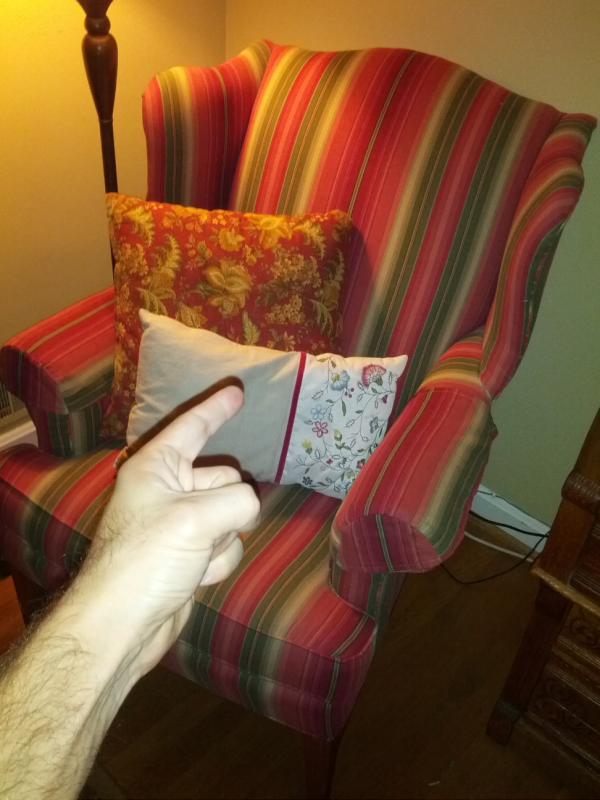
    Mitt Romney knew what he was doing when he brought in Clint Eastwood. He knew that Eastwood is a celebrated and respected actor that everyone can easily recognize. What the Romney campaign did not realize was the unintentional social media phenomenon that #Eastwooding would become. This trending topic got people from all over the country posting pictures of themselves speaking to empty chairs. Not only did it spark a riot via social media outlets, it also turned a national holiday, Labor Day, into National Empty Chair Day where people were encouraged to continue to post more pictures of empty chairs. Coincidence? We will let you decide that one. As for the Republican Party, their intentions of bringing in Mr. ‘Dirty Harry’ himself were well thought out and calculated in hopes that he would be able to rally the voters who are currently undecided to choose their candidate. Instead, the Republican National Convention of 2012 will forever be known for Clint Eastwood yelling at an empty chair as opposed to what issues the party stands for in this election. These unintentional acts can make or break a campaign. Will #Eastwooding have a lasting impact on the campaign? Will the President soon become #invisibleobama? Only time will tell.

    Alexandra HussCaroline MerrillAlyssa MorrelloLauren Van Trigt, Daniel Williams

  • “Keep America America”; Mitt Romney’s Slogan Backfires

    This year’s Republican National Convention in Tampa, Florida was not exactly a great success. In fact, the Gallup Poll showed us that Mitt Romney’s speech at the convention received “the lowest rating of any of the eight speeches Gallup has tested since Bob Dole’s GOP acceptance speech in 1996,” according to The Huffington Post.  The post also stated that the convention produced the worst voter intentions in history with a +2 percent, compared to +3 in 2004 and +5 in 2008. While there are many variables that contribute to such low ratings, the convenience and effectiveness of the mass media played a key role.

    Most people will not argue with the claim that media attention has become the basis for political attitudes in today’s society. The fact that the average American can essentially look up any information whenever and wherever they want can be very beneficial for presidential candidates in regards to reaching a large number of voters in a short period time. However, there is a downside to millions of Americans having the world at their fingertips. Mitt Romney first experienced the disadvantages to the Web 2.0 phenomenon when he spoke at the NAACP convention this past July. When reflecting on his speech, Romney stated, “I had the privilege of speaking today at the NAACP convention in Houston…when I mentioned I’m going to get rid of Obamacare, they weren’t happy … that’s OK…You remind them of this: If they want more stuff from government, tell them to go vote for the other guy — more free stuff. But don’t forget, nothing is really free.” When this statement went viral, Romney received a lot of negative press. While some argue that accusations against Romney’s statement were taken out of context, it shows how important media attention is to the public’s perception of a candidate. People made their own judgments about Romney’s statement, which in turn swayed their opinion about Romney one way or another. A more recent example of how detrimental the mass media can be consists of one of Romney’s recent catchphrases which simply reads “Keep America America”. People are outraged that Romney continually recited the phrase because the slogan “Keep America American” was used by the Ku Klux Klan in their 1920’s attempt to deface many groups including African Americans, Catholics, Jews, and homosexuals.

    Americablog, a progress political blog, was the first to provide the now popular examples of the controversial overlap. Much of the focus was put on a video of the multi-millionaire candidate in which he is found using the now controversial slogan. Mitt Romney was also quoted on the blog from an article found in the L.A. Times in which he repeats the phrase.

    Since Romney first used the slogan, people have been publicly bashing him on all social media sites. While Romney’s slogan “Keep America America” is eerily similar to the Ku Klux Klan’s rally to “Keep America American,”the two phrases are not one in the same. While Romney used the phrase to insinuate that we must keep American values incorporated in our government, the Ku Klux Klan used the phrase to convince people to discriminate against others. It is obvious that presidential candidates, or anyone associated with politics should be very careful about slogans and phrases they use because one wrong word can gain a lot of bad press. Therefore, while it is unknown why Romney used such a slogan for his campaign, he is going to have to deal with the consequences and try to regain some voters that he might have lost as a result of using it.

    The fact that Romney had a similar but not identical (while we must admit it may be too similar) slogan to that of the Ku Klux Klan has directly affected him.  Romney, in a sense has been “branded” by this one slogan.  It is likely that people who may have not even followed the presidential election have formulated an opinion against Romney upon hearing the controversy behind the “Keep America America” slogan.  The rise of technology’s role on mass media in today’s society has led to more branding than ever before.

  • Ron Paul, Who?

    Over the past eight years, the media coverage regarding Ron Paul has been very lackluster to say the least. Although most of the coverage he has received has been positive, the overall amount is significantly lower than the other candidates running. The messages he supports are often considered the most accurate and truthful by any candidate and many believe him to be the most qualified for the political office. However, the media seems to have its own agenda, and seem to have a different idea on who should be the frontrunner.

    Although there are four candidates, CNN seems to believe that only three are relevant. Missing from this photo is Ron Paul, sitting just left of candidate Santorum.

    Both CNN and Fox News are partially to blame for this so-called “media blackout”, and have not been giving fair coverage to Congressman Paul. When it comes to debates or discussion, Ron Paul seems to mysteriously disappear from the subject and is often overlooked. In a recent interview with Fox News, he states that he has observed that the amount of coverage on himself post-debate has a ratio of about 90:1 in favor of his opponents. This shows a tendency that the media does not believe that Ron Paul has the ability to win the candidacy and therefore neglects to give him adequate coverage.

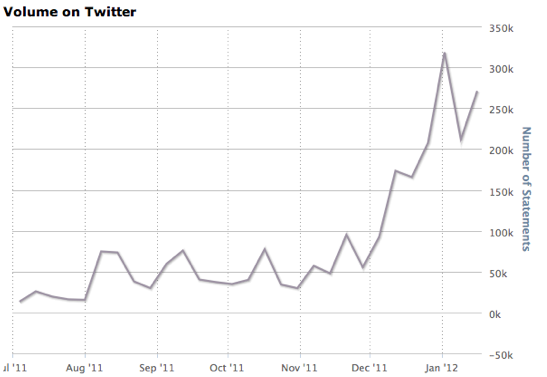
    Although the media coverage on Ron Paul is largely absent from television and news broadcasting channels, he receives overwhelming support on major social media networks. Seeing as the majority of his supporters are those of a younger generation, Twitter plays a large part of his support and communication between his fans. During a recent poll, the Washington Post found that from July of 2011 to January of 2012 that the amount of mentions on Twitter significantly increased from about 30,000 to almost 260,000. Compared to Newt Gingrich who had 294,000 mentions, Ron Paul still comes in second. Luckily, thanks to his many loyal supporters there is still a good chance for him to succeed despite the media’s lack of belief.

    Leslie Tyler, Leanna Marshall, Bryce Koonts, Julius Roberts

  • Today’s Politics in the Internet Age.

    With the Republican Primaries and Caucuses well underway, the candidates are narrowed down to the four main contestants. Mitt Romney, Rick Santorum, Newt Gingrich, and Ron Paul are campaigning across the nation and participating in debates to convince voters that they are what the nation needs in a candidate. How do the general public learn information about the candidates though, if they aren’t campaigning in their state? The answer is found on the candidates’ websites.

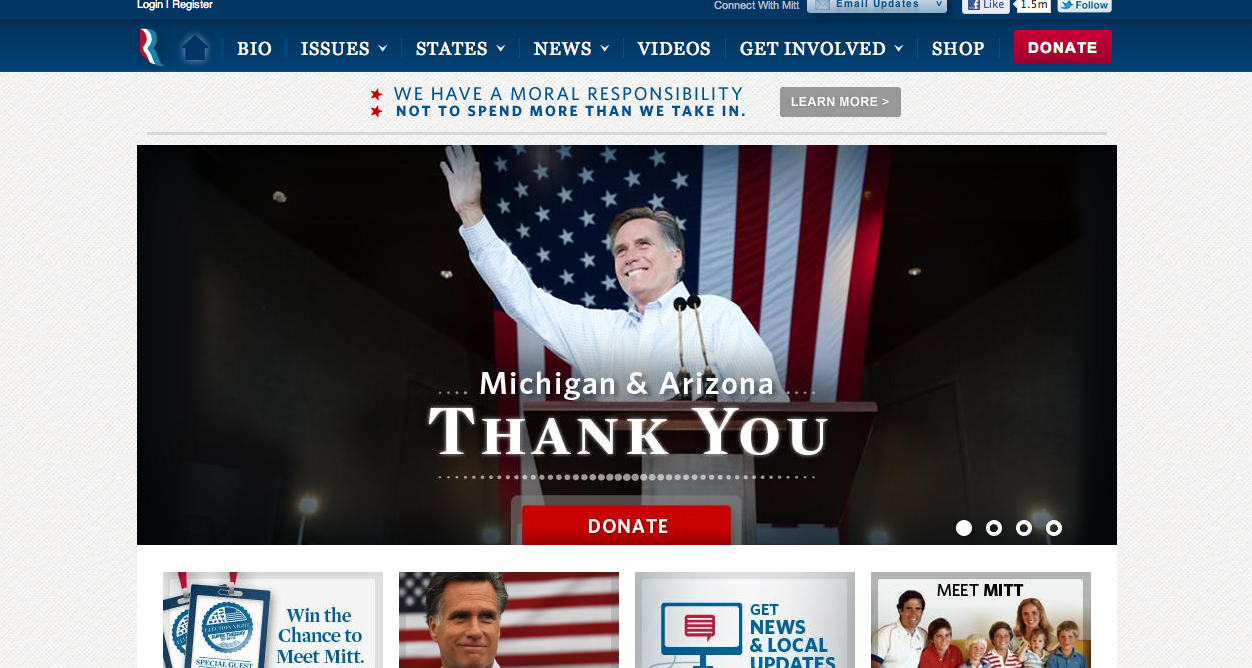
    Mitt Romney uses his website to thank the voters in the states in which he was victorious.

    Each candidate has their own website, run by their political team and volunteers that keep their information (like interviews, media, photographs and messages) up to date. On these sites are direct links to the candidate’s social media outlets, such as Facebook and Twitter, and their Youtube channels to watch ads that have been produced.

    Rick Santorum's website has his beliefs and campaign strategy on the main page.

    Something you will notice on each candidate’s page are donation links, most notable on candidate Ron Paul’s page who needs the money to continue his campaign. For those who want to support their favorite candidates, there is no better way than to go online and donate to their campaign using links found on each site.

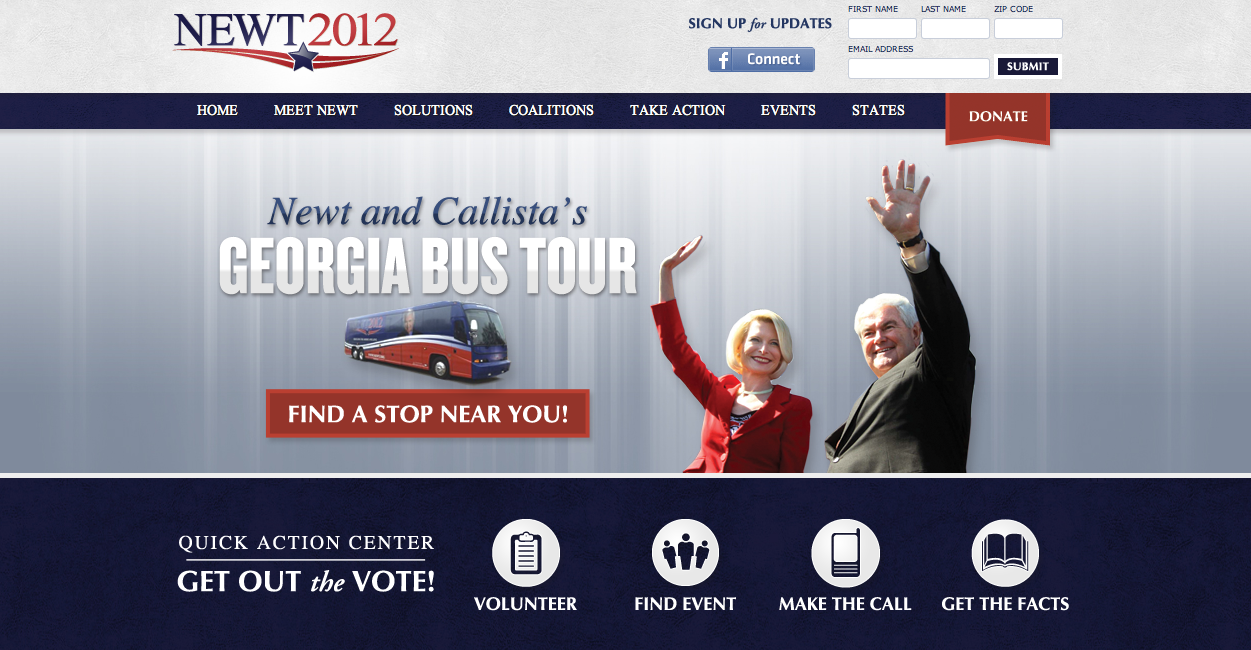
    Newt Gingrich uses his homepage to let supporters know where he will be next and how to contact him.

    These websites are also excellent outlets to connect to mass groups of people at once, without having to pay to run advertisements or receive television or print media coverage.  For candidates who don’t receive as much media coverage as they feel they deserve, this can be a vital part of their campaign. Since so much information is traded on the internet now, much of the general population is turning to the internet to learn more about the potential leaders of the United States.

    Ron Paul's main page takes you directly to his donation totals to try to get more support for his campaign.

    Joshua Vester, Molly Jacques, Ashley Oliver, and Hunter Wilson.