Tag: Louis Vuitton

  • Luxurious Advertising

    Gucci. Prada. Versace. These three symbols of “luxury” are high-end fashion companies that are flaunted around the world as brands of desire, wealth, and success. According to Forbes, luxury retail brands can be worth as much as 23 billion dollars. That amount shows the price consumers are willing to pay to feel as glamorous as the models who showcase the clothes, both through Advertisements and Mercedes-Benz Fashion Week, a buzz worthy week in New York City that features the spring collection of the most luxurious fashion brands in the world.

    1200x seenaroundlincolncenterday0mercedesdxpjhhhexa-l

    The hype of Fashion Week and the brands that are luxurious enough to present themselves there share the same quality: they give consumers a sense of desire. Rohit Arora, Strategic Planning Director of Bates Pan Gulf (BPG Group), studied the various reasons consumers’ desire these brands. One of the main reasons is notably the exclusivity to afford such brands, which changes over time as objects become less exclusive and more fiscally available.

    Similar to the four P’s we learn about in IMC and marketing, Arora revealed a list of eight shared “P’s”- Pillars in Luxury Brand Marketing:

    1.)   Performance

    2.)   Pedigree

    3.)   Paucity

    4.)   Persona

    5.)   Public Figures

    6.)   Placement

    7.)   Public Relations

    8.)   Pricing

    Each of these “P’s” must be highly considered by the brand’s marketing team in order to brand itself as luxurious while also justifying itself in price. Arora placed emphasis on the importance of both the pricing and placement phase, which can make or break a luxurious item as either desirable or unnecessary. “It is important for luxury brands to price themselves right – as setting the price lower than the consumer expectation and willingness to pay can potentially harm the brand value, whereas the reverse can potentially not give enough justification for consumers to go ahead and buy.” The marketing team of these brands has a lot to wrestle with in justifying their value, whereas less flashy brands are able to triumph off of their practical prices and convenience.
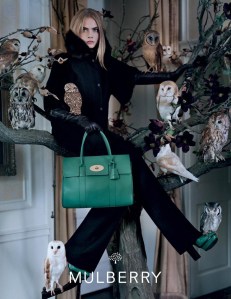
    Cara-Delevingne-Mulberry-Fall-Winter-2013

    Following Fashion Week this spring, many luxury brands executed campaigns featuring public figures that were popular in both the fashion industry AND social media outlets. Luxury brand “Mulberry” selected 21 year old Cara Delevingne, currently one of the world’s most famous super models, as the new face for their campaign. The fact that Delevingne has nearly 5 million followers on Instagram helps give widespread exposure to Mulberry, which is a part of the “placement” phase of the marketing campaign. It doesn’t hurt that endorsements from popular top 40 tracks are always on the luxurious side of the spectrum. When is the last time you heard Drake talk about his reasonably priced jacket from TJ Maxx?

    fashion_brand_luxury

    Luxury brands not only compete with the more cost efficient brands, but they also compete with one another to be the top selection among consumers. In 2010, “Louis Vuitton spent more than $22 million on advertising across all channels between January and June, compared to slightly more than $14 million during the same period last year, a 57 percent increase.”  A year later, Marc Jacobs president Robert Duffy told the New York Times that Jacobs’ fall 2011 show cost at least $1,000,000 (or $1,750 per second). These painfully expensive prices are paid in order to keep status as a high-end fashion brand when winter fashion blooms into spring clothing. With the price of living going up just a few years beyond 2010 and 2011, one can’t fathom the funds needed to market luxury clothing items in 2014. As the temperature gets higher, the cost of advertising gets higher for these luxurious fashion brands!

    Austin Johnson, Jade Johnson-Grant, Jami Rogers, Ty Thomas

  • Marc’s Makeover: Marc Jacobs’ decision to rebrand… is it the right one?

    Deciding whether or not to rebrand your company is an immense decision. Your brand is the face and personality of your company. It is what viewers connect with. Changing this identity will greatly affect your company, but if done right the market can soar.

    Fashion designer Marc Jacobs has decided it is time for his company, Marc Jacobs International to rebrand. In an interview with David Amsden from W Magazine Jacobs explains the troubles the Marc Jacobs brand had encountered. Describing the brand as having been “diluted” from his lack of creative supervision and merchandisers pushing his design team.

    In order to fix this Jacobs decided to leave his position at Louis Vuitton to grow his company, which includes boutiques, clothing lines such as Marc by Marc Jacobs and Little Marc Jacobs (a children’s clothing line), Bookmarc (a bookstore), and more.

    Some changes have already taken place such as his decision to move his offices from Manhattan to London and his decision to part with longtime campaign photographer Juergen Teller after he creatively disagreed on the Spring 2014 ad campaign which features Miley Cyrus. 

    marcmiley

    So what is Jacobs looking to do? He’s looking to redesign the logo and packaging, to build his shoe and handbag lines, and maybe even change the name, which he told W Magazine that he had always hated.

    Rebranding can be daunting between redefining research, audiences, creative campaigns, and even products, but for those experiencing continuous losses, it is often the best way to launch back into the market.

    In recent years, another clothing line, Burberry, underwent a widely recognized successful rebranding campaign. Over the years, the British line went from being known for its historically iconic outwear, to being associated with cheapest form of high fashion, and even gang wear.

    In 2006, the company hired Angela Ahrendts and in the next six years, she turned the ubiquitous brand back to luxurious. First, Ahrendts did what she called “buying back the company.” Reigning in the 23 licenses Burberry had around the world, control was brought back to the company with centralized executive and creative offices that could maintain product authenticity and exclusivity.

    Secondly, Ahrendts recognized we are in the age of digital consumption and a digital generation – tapping into the resources social media and technology offers. In stores, sale assistants are equipped with iPads, and mirrors transform into screens displaying catwalk images. Online, the company continues to grow its presence, attracting over 16 million fans on Facebook, and over 2 million followers on Twitter. Burberry also uses YouTube to broadcast campaigns, events, music, and even corporate news. 

    However, rebranding is not exclusive to high profile companies, the challenges above are things that can be experienced in all types of companies: personal, mid, or large. So how do you know if you should rebrand your own company? From Katie Morrell’s article “10 Signs You Should/Should not Rebrand” here are some warming signs that your company should rebrand.

    Macro problems

    Maria Ross, author of Branding Basics for Small Business: How to Create an Irresistible Brand on Any Budget (2010, Norlights Press) suggests that if a company notices that their target customers are choosing the competition over their own company and if a decrease in sales is also trending, rebranding should be considered.

    Look and function don’t match

    Another element that should be considered when having a decrease in customers is “From a cosmetic point of view, when you look old and your looks don’t reflect what you are or what you deliver, it may be time to rebrand,” said Susan Betts, senior strategy director for New York-based FutureBrand North America.

    Attracting the wrong customers

    Rebranding is beneficial when a company wants to change their target customers. It gives a company an opportunity to create a new brand identity that the new target audience has the chance to connect too.

    Management change

    When a company changes management, it is normal that policies and values change as well. When a companies values change, rebranding is a good idea.

    Philosophy/function change

    When a company changes it’s direction, rebranding can showcase to customers what they may or may not be aware of concerning this change. Betts also mentions rebranding should be considered when a company has a “New philosophy or a changed philosophy”.

    These signs are great examples to take heed from, but it is important to note rebranding should not be done unless it has been proven your brand identity is the root of your problems. Branding is the largest initial investment for a company, it sets the spring board for your identity, association, and customers. Rebranding is an even bigger investment – an attempt to reintroduce ideas to already established and preconceived perceptions is no easy task, it is one that must be thoroughly strategized. For Burberry, reigning in and refining their identity proved to be the best decision the company has made. For Jacobs, we will see what his creative vision produces.

    What companies do you think have faltered recently or over the years? Who needs to rebrand?

    Caroline Robinson, Savannah Valade, Elizabeth Harrington