
Cucalorus is Wilmywood’s premiere quirky film festival, showcasing independent films from local, national and international artists. Film connoisseurs sporting chunky glasses, artsy students in their thrift-store best and less interesting folk like you and I file into Thalian Hall (or one of the many other venues), settle down and wait for the lights to dim. This November will be the 21st year this little slice of art and culture draws people to downtown Wilmington.
I could barely convince people to keep coming after my twelfth birthday party, so how does Cucalorus garner a big crowd each consecutive year? A cohesive brand narrative, that’s how. And Cucalorus’ brand narrative is nothing short of weird—but in the good way. Let’s explore what makes Cucalorus cool.
-
It’s in the copy
While none of these factors are ranked in any specific order of importance, I am a word person and always like to read and evaluate the voice of an organization. Many organizations forget about this, not capitalizing its subtle importance. Bad organizations.
Cucalorus, on the other hand, has got its copy down pat. The copy, whether it’s online, in print or broadcasted on the radio, is how an organization communicates not only its news or events, but its personality, its voice and its image. Here’s a snippet of copy from Cucalorus’ donation page on their website:
“Hey Cucalorians!!! Do you need to get rid of unwanted cash? Make a donation and we’ll send you a tax deduction letter to send your fuzzy little friends at the IRS (they don’t need your money and clearly don’t know what to do with it!!). We do know what to do with it – we’re already plotting and scheming for the 21st annual Cucalorus Film Festival – taking place November 11-15, 2015!!! Help us fund the dreams and visions of artists all over the world by making a donation today.
Dreaming of eggnog omelettes!
Cucalorius.
The Cucalorus Film Foundation is a 501c3 non-profit and your donation is tax deductible to the fullest extent of the law.”
On first glance this might sound unprofessional and not the voice an organization would want to convey. The context, though, is important. Cucalorus’ audience is mostly the aforementioned artists, hipsters and independent film connoisseurs and Cucalorians. These types of people generally like funny, creative and quirky things (like Cucalorus). These types of people also tend to be skeptical of the IRS—not to mention the state cutting NC’s film incentive last year. So yes, it might be OK for Cucalorus to be a bit irreverent, and it’s their creative risk.
-
Digital presence, dude
If your business doesn’t have some sort of online presence (an email address counts), I would like you to write to me immediately by carrier pigeon and explain how you’re still surviving. An online presence is increasingly important each year, and now just having a website and Facebook isn’t cutting it. Brand cohesion across appropriate social media networks and inter-connectivity between them is vital.
Cucalorus not only has a website, Facebook, Twitter, Pinterest, and Instagram but their own blog and—drum roll—they are all updated. Bravo, Cucalorus. Content creation and audience engagement are essential to a successful IMC strategy.
-
Creepily consistent image
This one is tandem with the digital presence. IMC consists of advertising, public relations, marketing and every other single communication an organization can perform with its publics. Consistency in corporate communication allows the organization and its audiences to construct a narrative and image of the brand. This is what people can relate to. This is how we can see the quirkiness, irreverence and artsy personality of Cucalorus as if it were that weird kid in your English class who would always have some snappy reference to an obscure book even your professor hadn’t read. But less annoying.
Take a look at Cucalorus’ official website:
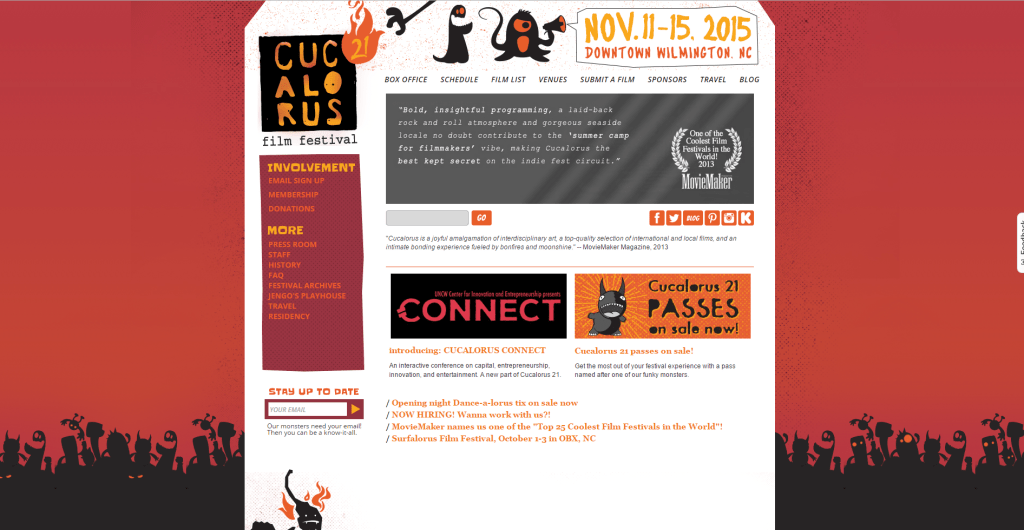
The color scheme and design is consistent. The font-faces, graphics and little cartoon dudes are consistent. There’s well-organized navigation and that copy I was talking about earlier. The social media pages follow suit. There’s an article on this if you’re into academic papers. Basically, the author, Simon Torp from Odense University in Denmark, says that as an organization your communication through all channels must be consistent, accessible and in line with your self-image, public image and meta-image for people to take you seriously.
-
Zany staff workers
When I said all channels of communication, I meant all of them. Even the staff workers and volunteers need to be carefully selected and even briefed on an organization’s code of conduct. One time I went to a screening of a Cucalorus film at Thalian Hall and, not to get into too much detail, I, with the rest of the audience, was sternly asked by staff to partake in a ritual involving whipped cream, button pins and our tongues. Was I offended? No, but I could have been if I had been misguided by thinking Cucalorus was actually a convention for neo-Puritans. Because their self-branding and self-image don’t suggest that, I could expect something out of the ordinary. It’s the risk that Cucalorus takes to maintain its image and appeal to its target audience.
-
High-quality product
When it comes down to it, a business or organization is only as good as its product. Silly brand narrative and image aside, Cucalorus does a good job at what it does. It recruits and selects excellent film talent from around the world and showcases it in quality and entertaining venues. This is where word-of-mouth comes into play. Word-of-mouth marketing or WOM is an organic and invaluable means of public relations, advertising and marketing. Have you ever read a positive news story about an organization you love? Or has a good friend of yours recommended a product or service they favor? These are examples of WOM that can make or break an organization depending on whether they are in favor or against it. Maintaining the balance between brand narrative, professionalism and good business sense is how an organization thrives. While Cucalorus does an outstanding job of its own branding and controlled media, its reputation for quality and intrigue reign in filmmakers and spectators every year.
I am no way affiliated with the Cucalorus film festival professionally, nor do I represent it. I recognize good IMC in organizations and talk about it here. But, if you are tired of what the local theaters are playing, check out a showing of something interesting between November 11 and 15 downtown at Cucalorus.

 IMC Hawks Blog