Tag: Halloween

  • Trick-or-Treatster

    Halloween can sometimes be repetitive. Costumes and decorations change but the act of trick-or-treating has stayed the same. However, one company is trying to change how people collect candy on Halloween. This company decided to not only change the process of buying costumes and decorations, but to be innovators of the holiday.Screen Shot 2015-10-29 at 10.41.54 PM

    Target created an interactive youtube video that allows viewers to virtually tour a haunted house decorated by products available at their stores. The six-part video series, dubted “The House on Hollow Hill,” targets Halloween enthusiast or those looking to throw a Halloween party. Kristi Argyilan, senior VP-media, guest engagement and measurement, says these particular people are very busy, so Target allows the viewers to buy the products in the videos. They offer a 10 percent discount to anyone who watches all of the videos — a real treat for Halloween lovers. Target is not only changing how to shop for Halloween but how to trick-or-treat. They did this by creating a website and cohesive smartphone application that allows trick-or-treaters to locate the best houses to visit. The mobile site, titled “Treatster,” relies on crowdsourcing to “upvote” registered houses. UserGuide

    Using the Diffusion of Innovation Theory, Target is introducing an innovation hoping to connect groups of people to reach a common goal. They do this through the channel of a virtual reality series and a mobile platform for consumers. Target is using these mediums as a communication channel to capture eventual repeat customers by offer a unique experience that consumers will remember and an incentive to buy their products. This is a new avenue of marketing they are exploring in hopes that it will catch on and create a culture for their brand.ABV-Treatster-Header
    Do you think Target will have success changing this aspect of Halloween? Why?

    Know of any good houses to trick-or-treat? Tag them!

    – Nick, Melanie, Mary & Patrick

  • Burger King’s Spooky Whopper

     Name three common fast-food restaurants in five seconds…. Go! Hopefully you came up with something along the lines of McDonald’s, Wendy’s, and Burger King. Since their creation, the trio have been constantly fighting for brand loyalty. In an effort to attract new consumers, each found ways of making their product unique. Recently, Burger King released the Halloween Whopper, a normal Whopper with a black, A.1 flavored bun.

    If you haveScreen shot 2015-10-28 at 9.54.51 PM Facebook, Twitter, Instagram or really any social media outlet, you probably experienced Burger King’s presence on social media. Before the launch of the Halloween Whopper, Burger King teased their consumers with a promo video featuring thunder, lightning, and a lunar eclipse with a black bun burger placed front and center – stating “Something Wicked is Coming” on Twitter.

    As the Halloween Whopper was announced publicly, Burger King released this press release: “Burger King Restaurants Unveil the A.1 Halloween Whopper Sandwich with A.1 Flavor Baked into the Black Bun.” stating this whopper was inspired by Japan’s specialized burger. They followed up by saying “
    We tailored the flavor of the black bun to the American palate with A.1. sauce, a flavor this country loves, and we’re delivering it in a way that’s never been done before by baking it into the bun. It may look Japanese but it tastes like America.” The hashtags of #HalloweenWhopper and #SomethingWickedIsComing filled Twitter and other mainstream social media outlets because of the non-traditional appearance.

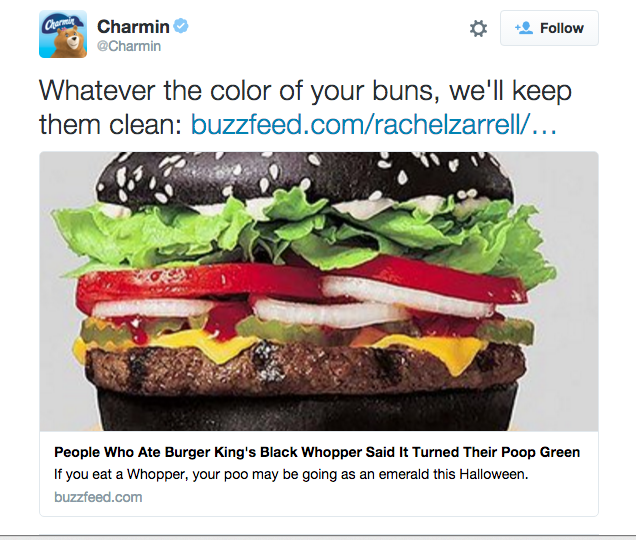
    Screen shot 2015-10-29 at 11.01.47 AMPeople who were daring enough to try it- are daring enough to share the results with the Internet. Twitter comments are consistent in complaining of a green stool (which admittedly sounds very unpleasant). This green situation might make you wonder, “What people are willing to try without pausing to consider what’s going into their bodies?” Burger King hasn’t publicly released the ingredients or replied to the negative comments. Burger King seems to be choosing silence as their strategy in this crisis, but Charmin has taken a clever chance to chime in. Comments such as “whatever the color of your buns, we’ll keep them clean”, posting a link to the Buzzfeed article on the green poo crisis. Negative or positive press, Burger King is taking over social media, 29,000 tweets in a single week. 

    America’s detachment from our food has reached crisis level proportions. We don’t know what the ingredients in our food are, where they come from, who grows and or genetically modifies them. And it’s not without its consequences; as a nation, we are morbidly obese and chronically unhealthy. This way of living is becoming very expensive. Health care for weight-related issues puts a huge strain on the health-care system. 

    Burgers turning our poo green is a light-hearted example, but shines light on the heart of the issue. We honestly have no idea what’s in our food, or how it affects our health, and we really don’t seem to care. This example reaches the point that a halloween themed hamburger is turning poop green and people think it’s hilarious. The food we eat literally affects all the cells of our body. This concept of detachment is what Marx calls commodity fetishism. When a culture forgets, ignores, or is otherwise separated from the source of a commodity (in this instance where food comes from), the culture becomes wasteful and overuses, almost always at the disadvantage of those who create the given commodity, and in this case ourselves as well.

    103027033-BK_Halloween_Whopper[2].1910x1000

    We implore anyone reading this to once a week, once a month even, get together with friends and family and cook a meal from scratch. Be grateful for every ingredient.

    Have you tried the #HalloweenWhopper yet? Let us know your thoughts on this controversial burger.

    -Jonathan Callahan, Erin Fouhy, Julia George, Joseph Hines, and Sarah Suggs

  • Halloween or ‘Howl’oween?

    As Halloween approaches, children and adults have been preparing for the holiday by buying costumes, decorations, and candies. Halloween is known as a night for children to walk around dressed up and get candy. However, recently the holiday has expanded to include all family members, even the pets

    This year, PetSmart has taken to Halloween just as much as other retailers, such as Walmart and Party City, usually do. The pet retailer advertises everything from pet costumes and collars to Halloween themed treats and toys. They also offer Halloween events such as in-store trick-or-treating, pet photo contests, and even Halloween “pet camp” for those that don’t want to leave their pets at home that night.

    Screen Shot 2015-10-25 at 12.49.54 PM

    https://www.petsmart.com/

    The home page for PetSmart’s website features everything a pet owner could need for their pet to be a part of the Halloween festivities. While the majority of their advertising is for their own products, the site also advertises at home do-it-yourself recipes and costume ideas. This form of advertising says to consumers that the retailer truly cares about the pets and wants them to be just as much a part of the holidays, therefore making pet owners trust their brand more.

    The communication design that PetSmart implements makes pet owners believe they need these Halloween items just as much as any other pet necessity. The company is making consumers buy into their narrative and purchase costumes for their pets. PetSmart holds a brand image that presents itself as a company for everything pet related. The company is seen as a go-to for food, toys, training, grooming, and in some stores, even veterinary services. By offering pet supplies and events for the holidays, even Halloween, PetSmart solidifies its image as still being the one-stop-shop for pet owners.
    One of the main aims of Integrated Marketing Communication is to affect behavior and not just attitudes. PetSmart has turned a once silly idea of dressing your family pet up for Halloween into a business opportunity to make a larger profit. The creation of not just products, but events too, draws customers in so that they feel they have a reason to buy character costumes for their pets and Halloween themed toys. For most pet owners, their animals are members of the family, and should be included in family fun. PetSmart allows that to happen with their holiday apparel and pet-oriented events.

    The pet Halloween industry has grown significantly to the point that CNN even offers the top 5 dog costumes of 2015 in their recent online article about Halloween Fast Facts, which can be found here: http://www.cnn.com/2013/06/13/us/halloween-fast-facts/  The top five costumes were as followed: pumpkin, hot dog, Batman, devil, and a bumblebee. Of those five, PetSmart offered every single one, some with multiple options, even for different sexes of dogs. Is it a coincidence that PetSmart sells the top five costumes? Probably not.

  • Scaring Up An Audience

    Halloween is a lucrative season. In 2013 the holiday generated around $7 billion in revenue. Most of this get split up between costumes, candy, and festivities, including haunted attractions. Haunted houses bring in over $300 million every year, and it’s no surprise that such a profitable market would invest in integrated marketing communication efforts.In order for haunted houses to stay competitive every year they have to push themselves to darker and scarier extremes, Blackout: Hell at the Armory is a prime example. “I personally found this to be one of Blackouts best shows…It is a relentless bombardment of images, notions, experiences, sounds, lights and sensations that is designed precisely to have a lasting effect on your psyche. Not a haunted house, but a haunting one (HorrorBuzz.com).” With a customer base that desensitizes themselves more every season, marketing efforts needs to be enticing without giving away the big scare.

    maxresdefault

    Haunted Houses represent a niche segment of consumer goods yet are successful in generating a respectable amount of hype for being such a  specialized product. Haunted houses must keep up with products that are relevant year round, even when their product only appeals for less than two months to audiences whom acknowledge the Pagan tradition. Experienced haunted house brands and experts who have thrived in the industry have confirmed strategies that work to showcase haunted houses, taking advantage of the entertainment, and community gathering aspect of the industry. We have compiled a list of those tips that stood out as most effective.

    Tips for marketing a haunted house:

    1. Free stuff! People love free stuff and it is a fast way to grab the public’s attention because their is no risk involved. Stickers, buttons, t-shirts with the haunted house advertised on them are just a few ideas!
    2. Local advertising through as many mediums as possible, whether that be radio ads or local television promotions. This encourages the community to unite to support a local business rather than traveling hours to pay for one that has no ties to the community.
    3. Paper advertising can also be an effective way to promote your haunted house. Come up with a logo, a print ad or brochure to market yourself and hand it out everywhere you go. Become a walking advertisement for your haunted house.
    4. Save a tree and start a blog. Social media is an effective way to reach a large audience.Take charge of these opportunities! Make a youtube channel, a Twitter which constantly teases the attractions highlights, and facebook facebook facebook. Facebook in particular has proved especially useful for promoting haunted houses through creating event pages and inviting friends which leads to a domino effect of community hype.
    5. Attention to year round marketing! The attraction may be once a year but that doesn’t mean the marketing gets to go into hibernation along with the house itself. Make sure to keep your audience’s attention year round by asking for them to subscribe to emails or social media updates that  build anticipation for the upcoming haunted house. This can also be done by updating the website and social media with monthly clues for new themes or mini contests that reward participants with discounted entry!

    1773517_zps9a172f21

    What are your Halloween plans? Feel free to check out the Museum of the Bizarre located in the heart of Downtown Wilmington. It is open all year round and offers a similar atmosphere to a Ripley’s Believe It or Not according to tripadvisor.com. Pick any spooky night in October to see the store transform into the Museum of Nightmares. Filled with special effects and actors, you will be sure to get your money’s worth for 20 dollars to visit this local attraction! Visit their Facebook page: Museum of Bizarre to find out more information!

    By Aki Suzuki, Carrie Poniewaz, Carey Shetterley, Lexie Trimnal, June Wilkinson

  • Spooky Scary… Roller Coasters?

    If you grew up in the Carolinas, chances are at some point you’ve been to Carowinds, our adrenaline filled pride and joy. For those of you who are unaquainted, Carowinds is an amusement park situated right on the border of the twin Carolinas off of Interstate 77. The park is in service starting March of each year. It closes in November, but not before it’s biggest event of the year: SCarowinds.

    2008_ScarowindsLogo_500

    SCarowinds is Carowinds’s annual Halloween event that was first introduced in 2000. The park is redecorated and showcased as a spooky Halloween adventure. Major traffic areas are repurposed as “scare zones” and several new mazes and attractions are opened with creepy undertones and scares waiting around every corner. Carowinds hires people every year as designated performers to both man spooky attractions and wander around the park scaring guests. SCarowinds is more than just a pretty remodel though. Every year, SCarowinds makes up some of the highest ticket sales and attendance numbers for the park, so much so that they are able to split sales between the daytime park and the SCarowinds event and charge admission for both. For a consumer, this can get expensive very quickly, especially when factoring in parking.

    scarowindsmazelinup2015

    So what is the draw of SCarowinds then? Why does it draw in so many people, even moreso than the regular daytime park? A big part of this is audience engagement. According to S. Alyssa Groom an organization can maintain its relevance , “by first recognizing how this moment of engagement and interactivity changes everything.” SCarowinds is an interactive event consistent with Halloween’s brand. As ghoul’s and goblins roam the park, the screams of fear are also screams of approval.

    Carowinds is a big draw during the summer, when everyone is off of school and work. However, during the later months, specifically after August, attendance numbers start to drop dramatically due to the removal of a large portion of their target market due to school. However Carowinds still has to make money, so shutting down the park for that time is not possible. Instead, Carowinds stops operating during the week, since their visitor counts would be so low, and moves to a more efficient method of opening for weekends with their SCarowinds facelift. Carowinds cashes in on this with their annual event by building on the hype and mystery of Halloween.

    Scarowinds 2015

    “Second, the pervasiveness of “engagement” as a way of life elevates the centrality of communication to human experience.” By allowing people to be involved rather than just be spectators SCrowinds has become so pervasive it is accepted as a Halloween tradition by many. In its 15th year SCrowinds continues to be an interesting example of a brand shifting their image to better fit the seasonal craze. In a way, it’s similar to pumpkin spice and peppermint in that it plays off of our preconceived notions of holidays. When explaining how SCarowinds became so successful, it really boils down to two concepts: targeted marketing and a unified message.

    “And third, marketing can no longer do it alone.” Carowinds focuses on penetrating the seasonal market during September and October and takes advantage of the craze around Halloween, using it to boost their numbers. Halloween is an incredibly popular holiday among younger children and older students, so Carowinds focusing on engaging the kids which in turn brings parents along. Carowinds unifies its advertising to show the SCarowinds event almost exclusively because then they can market both the park and the event at the same time.Furthermore, kids offer the unique advantage of instant viral marketing. By establishing themselves firmly in kid’s idea of Halloween, Carowinds gets the advantage of becoming the “cool” thing to do around school. While this isn’t a direct effort by Carowinds, it contributes greatly to their brand image and the sales of tickets.The parks ability to effectively communicate its ideas internally and externally allows for successful IMC throughout the event.

    Carowinds’ also engages their audience through their social media accounts. Their Facebook, Twitter, and blog attracts millions of people from the Carolina’s and surrounding areas to this frightful event. These social media outlets allow attendees to share their experiences and give newcomers an idea of what awaits, taking word of mouth marketing viral.

    So really, SCarowinds is just a big audience-centered advertisement for Carowinds. Carowinds knows that fads are powerful when it comes to advertising and caters to exactly what their audience wants to see in the best season to be spooky. By utilizing the engagement approach and cashing in on the seasonal craze, Carowinds firmly cements themselves as a part of Carolinian Halloween tradition.

  • Semiotics of Halloween

    Fall marks the start of the holiday season, none more mischievous than Halloween. Through semiotics we use signs and symbols to interpret the world around us. Ferdinand de Saussure originally defined semiotics as a science that studies the life of signs within society, part of both social psychology and general psychology. When thinking what signs or symbols constitute Halloween, pumpkins, costumes, and candy may come to mind. These are consistent symbols in our society, but Halloween begins to represents different things as we get older. Younger children are only interested in trick-or-treating, carelessly walking through the neighborhood getting candy as a cautious parent or two watch from the bottom of each driveway. Teenagers tend to use the holiday in a more rebellious way as they cover trees in toilet paper, throw eggs at neighbors’ houses, and scare their younger counterparts. College students embrace Halloween as a time for costume parties and excessive drinking.

    Alcohol always seems to increase the chance of risk for any situation. For those who tend to get a little too rebellious, Halloween can represent a night they wish they could forget. Outrageous, appalling actions will also change the image portrayed by an organization, a university, and its students. East Carolina University suffered such an incident last year the day before Halloween when a large party at Riverwalk Townhomes could not keep people from attending and eventually turned into a riot. The following night being Halloween, WITN news reported, “In an email to all students last night, Chancellor Steve Ballard said any student involved in illegal activities on Halloween or the day after will also face possible disciplinary action from the university.” Although a diverse group of people were responsible for the riot, ECU’s image was put to shame and must implement a plan to restore their image to their publics. Semiotics is the science of communication and sign systems and the ways people understand phenomena and organize them mentally. The students that were a part of the riot last year have a different understanding of the semiotics of Halloween than most others would that did not have such an experience. The pumpkins and costumes may have been replaced with handcuffs and drinking tickets, replacing the previous symbols they associated with the holiday.

    Particularly in America, symbolism is inspired by classic film like Dracula and Frankenstein, and characters such as these are artifacts for understanding a typical American Halloween. Black and orange define Halloween as the traditional colors, supernatural forces and spirits of the dead are brought back in the societal light, and black cats and spiders represent the bad omens that the holiday can bring about. For a number of ECU students, Halloween itself was a bad omen and the university is still dealing with image issues as they near the next Halloween. No organization seems like an inviting place after a major controversy that negated societal values. Remember to enjoy Halloween, but not too much!

    – Griffin Weidele, Austin Moody, Allen Wooten, Luci Keefer, Scott Uraro

  • Anna Rexia Makes Another Appearance

    Zombies. Ghosts. Serial killers. These are some popular symbols of Halloween that are frequently seen in movies, haunted houses and decorations. However, what I find more frightening are some of the costumes that I see while trying to find my own “original” costume idea each Halloween. This year, I came across the most frightening costume of them all, not because of a scary mask or fake blood, but because it is poking fun at a serious mental illness that affects millions of people around the world. The “Anna Rexia” costume first caused some serious uproar back in 2011, when retailers like HalloweenStore.com and Ricky’s NYC began carrying the costume, manufactured by Dreamgirls International, but they stopped after a great deal of media backlash and thousands signed a petition on Change.org.

    Now, two years later, this controversial and insensitive costume is apparently back up for sale on the website HalloweenParty13.com, which I discovered from a Facebook posting of a more recent Change.org petition. At first, all I could think about was how disgusting a costume like that is, and how I would judge anyone wearing it, but I want to turn this into a learning opportunity by relating this controversy to public relations. My question is: Did the companies handle the outrage and negative publicity surrounding this costume appropriately?

    As I did my research, I found articles on news sites such as The Huffington Post and other blogs, about the resurrection of “Anna Rexia.”  I saw on Buzzfeed that the retailer HalloweenStore.com posted a status to their Facebook page about one week ago, explaining that people should do research before signing a petition because the retailer hasn’t sold that costume since 2011.  This status was calling out people who angrily emailed the store about their distaste, when they weren’t actually the retailers currently selling the costume.   The wording was harsh, with certain words fully capitalized and many exclamation points, which detracts potential customers and pushes current customers away.  The post has since been deleted.

    enhanced-buzz-32177-1382713416-25
    via BuzzFeed

    During the original controversy in 2011, Dreamgirls International said the costume was a form of “dark humor,” and that people wearing it is a “matter of taste.”  However, the company is now saying that the costume was discontinued in 2007 and the matter is now out of their hands.  At first, Dreamgirls International was using the communication theory of framing, which highlights specific aspects of an issue and “frames” people’s perspective on it.  The company was trying to downgrade the offensive costume as being humorous and describing themselves as a “company run by women for women”; that just wanted to create an “eccentric” way for a woman to express herself on Halloween.  Now, they are denying all responsibility for any current sales of the costume.  This denial is not only inconsistent, but it is the opposite of what any student in an introductory PR class would learn—don’t deny ownership of a problem.

    I believe that neither of these companies handled the “Anna Rexia” backlash well.  If you, the reader, were the spokesperson of either company, how would you handle this situation?

    -Maggie Dowicyan