The Marijuana Policy Project advocates the use of marijuana for everybody, evidently. An issue arose when they decided to put a pro-marijuana, anti-alcohol billboard right outside the Denver Broncos stadium for the opening game of the 2013 NFL season. The billboard, pictured below, reads “Stop driving players to drink! A safer choice is now legal (here).”
The group gained national attention for their effort, but garnered no more reaction from the NFL than being ignored. No doubt a PR pro in a dark suit stepped out of the limo and calmly said, “We do not plan on changing our policies” to nobody in particular, before disappearing behind the fireworks, blinding stadium lights and logo of his employer to wait for the next NFL public relations hiccup.
But it is on the table now: How will the NFL react if marijuana becomes completely commercialized in America?
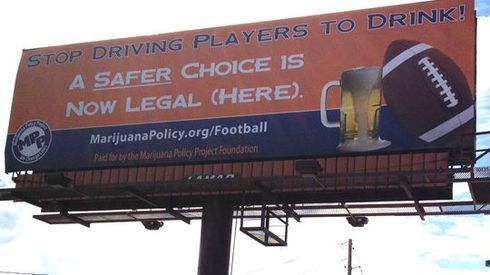
The billboard illustrates the cognitive dissonance that must resonate somewhere within the NFL right now, if only within the players who use the drug. Presumably, the NFL doesn’t allow its players to use marijuana because it is illegal, but if we remember, there was a time when alcohol was illegal, and many NFL players love that stuff. Look at what alcohol means to the NFL now. Anheuser-Busch spends hundreds of millions of dollars in NFL advertising every year. No one can watch a football game without seeing groups of guys and gals guzzling beers between plays, commenting on its many boons. Replays are brought to us by Coors Light, Miller, or Bud, and they even pay for “plays-of-the-game” to show after the games are over. Alcohol is imbedded in American football culture as deeply as the National Anthem. Beer is so prevalent in football it could be the background of a video playing the National Anthem at the start of the game, while people stand with one hand over their heart, and another on their bottle, sobbing sudsy tears of intoxicated satisfaction.
But it used to be illegal.
Maybe nobody in the NFL remembers that besides Dan Rooney, but the dissonance must have been there back then. It was probably much easier to deal with, there being so few media outlets and so much less media intrusion into players’ lives.
Alcohol prohibition ended before televisions appeared in about 100% of American households, but it may be deduced that another NFL (or AFL, back then) spokesperson said, in response to letting players drink after prohibition ended, “We do not plan on changing our policies.” But the policies changed. Social cognitive theory, and its application to football and the law, grew new roots and laid down new rules. If the rules change this time around, and marijuana becomes legal, and organizations start letting manufacturers of marijuana advertise, the NFL is going to hop right into that hurricane of dollars to get a piece. Will they do it first? Or will they watch others do it before jumping in? Social cognitive theory, and knowledge of the NFL’s motivators, suggest that they will either lead or be led in adopting the change, but we know they will definitely be a part of it.
If players who have been punished for marijuana are around when that happens, what will the NFL tell them?
Von Miller, a linebacker for the Denver Broncos, has been suspended for the first six games of the 2013 season for diluting a sample during NFL drug testing. The NFL’s substance abuse policy is extensive, but with enough digging, one can find that Miller failed to comply twice in the second stage of intervention, after having tested positive for marijuana. The takeaway message is that Von Miller likes to smoke marijuana. He may even have seen the billboard from the bus, experiencing some cognitive dissonance himself, waiting to go and sit on the sidelines, in his pajamas, for the big game.
Miller, who shows loyalty to the Mile-High city in his public relations efforts, has at least one of the same habits as the Detroit Lions’ players Nick Fairley, Johnny Culbreath, and Mikel Leshoure: smoking marijuana, which is a synonym for what they were charged with, “possession.” According to former NFL offensive tackle Lomas Brown, who played eighteen seasons in the league across five teams, this is nothing new. Lomas says at least half of NFL players are known to take (marijuana) smoke breaks from time to time. He says this is down from the at least 90% who used the drug when he joined in 1985. No one is suggesting that players should be doing bong rips on the sidelines, but is it possible that the NFL ought to revise its policy on marijuana to avoid future complications?
Legislation regarding marijuana is shifting more towards leniency than sanction in many states, and the drug is now legal to use in Washington and Colorado, but it has not fully caught on across the country. If it is legalized in most or all of the 50 states, what is the NFL going to do about it in regards to its players?
The commercial sale of marijuana becomes a reality in Colorado on January 1, 2014, and no one is really sure how it is going to go. But if history is any indicator, it will be picked up by manufacturers, branded, and sold to as many people as possible, like alcohol. When the NFL hears “sold to as many people as possible,” dollar signs flash, jingle, and dance like fire across its eyes, and they start the bidding on air time in their finest suits. What they are now punishing players for, they are likely to embrace if the time comes.
Most of us were not around to see what happened before and after prohibition in the realm of policies and marketing. But if we stay tuned, we might get a good look at what it was like if the NFL, the biggest outlet for advertising in America, is forced to turn the table on its marijuana stance.
Can you envision the day where Bud, Coors, and Miller are replaced by Bud, Cannabis, and Mota during commercial breaks? A day where NFL beer advertising takes a backseat to marijuana advertising?
I can’t imagine it, but some people in the Mile-High city can.
– Chad Darrah


 IMC Hawks Blog