This week the Department of Communication Studies was lucky enough to host Dr. Jacob Storch. Dr. Storch is the Senior Director of the consulting firm Attractor. His practices range from different areas such as organizational communication, coaching, leadership development, and organizational change. Within his lecture he focused on the application of communication theory to real world organizational practices.
Dr. Storch brought some interesting ideas to the COM Department. He emphasized the impact the language we use can have on our reality. Language is a fluid, ever developing system. By consciously choosing the way we label the world around us, we can purposely affect the situations that are presented to us. Dr. Storch gave an example of a choice he was faced with when the economy began to look bleak. His company wanted him to address the “recession” and he chose to speak about “re-session.” Instead of focusing on the challenging times ahead, Dr. Storch challenged his colleagues to “re-session.” He explained re-sessioning as thinking of the market in a new, open mindset. As consultants, he said, they should begin to prepare for new questions that clients will have in the face of an unpredictable market and anticipate the changes that may arise in client needs.
As we continued to listen to Dr. Storch’s lecture we began to notice his infectious realistic optimism. His example was just one demonstration of the impact our language can have on our world. By reframing the way we talk about our reality, we can positively impact the messages we send via language. Gatorade is a strong example of how positive language can impact a brand’s narrative. By promoting ad campaigns with headlines like, “Win from Within” and “Everything to Prove,” Gatorade is motivating their consumers to push their limits and give it their all with a positive and inspiring message. Their word choice intentionally gives their consumers a vision of motivation and success. From their commercials to the labels on the bottles, they are re-framing what most people may see as challenges as opportunities to improve.
Dr. Storch also made us think about how we are conditioned as students. Our education system conditions us to seek out patterns and follow the instructions explicitly given to us. Often we are so concerned with following the map we are given that we forget how to take a minute and observe the world around us. The problem with this is that businesses do not need someone who can follow all the instructions. As Dr. Storch pointed out, “imagination is much more important than certainty.” Businesses need someone who can critically analyze the world around them and envision the future in a way no one else has. No pressure. Seriously, though, as Dr. Storch stated, “there is no place for average in our end of the business world.”
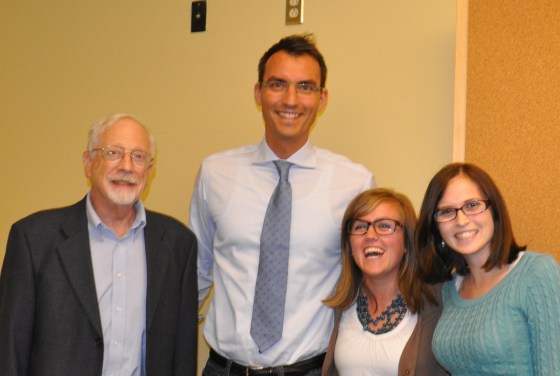
– Alexandra Huss, Caroline Merrill, Alyssa Morrello, Lauren Van Trigt, Dann Williams
 IMC Hawks Blog