Tag: fashion

  • Who is Emily Schuman?

    MTMzODg3MDEzMTAyMzI3MDU4

    Emily Schuman, better known as Cupcakes and Cashmere, captivates audiences with her unique approach to fashion, food, and everyday living. The now 32-year-old began Cupcakes and Cashmere in 2008, becoming one of the first bloggers to partner with a major brand. Cupcakes and Cashmere provides, “luxe yet achievable looks and refreshingly genuine style of writing,” making Emily Schuman a very popular blogger and known social media persona. Cupcakes and Cashmere includes popular brands of J.Crew and TopShop, while adding the “less-achievable” wardrobe items of Louboutin shoes and Celine bags.

    Brand Image

    Emily Schuman transformed Cupcakes and Cashmere into two books, clothing line, and home-goods line, while maintaining a large social media presence.

    Cupcakes and Cashmere: The blog allows fashion and food fanatics to explore Emily’s top picks, morning routines, favorite recipes, and her weekly outfits. Incorporating DIY aspects into a fashion-forward blog.

    Cupcakes and Cashmere: A Guide for Defining Your Style, Reinventing Your Space, and Entertaining with Ease: Emily Schuman’s first book, follows the same outline of style, beauty, home, food, and entertainment. Cupcakes and Cashmere: A Guide for Defining Your Style, Reinventing Your Space, and Entertaining with Ease became available August 1, 2012.

    Cupcakes and Cashmere At Home: Emily Schuman’s second book offers readers DIY tips and projects, party-planning tips, design ideas, and how to “mold your space into something you’ll love.”

    Cupcakes and Cashmere Fashion Line: Her Fall 2015 Collection will be available at Nordstrom.com and Shopbop.com. She combined her favorite pieces (shown in her blog) and her personal style, making 60 pieces of clothing anyone can wear. The price tag is on the higher end of $85-$200, including a few pieces around $400.

    Cupcakes and Cashmere Home-Goods Line: She expanded her product line into semi-affordable home decor.

    Cupcakes-Cashmere-Emily-Schuman-Decorating-Tips

    Creating and obtaining an audience for a personal brand can be tricky. The engagement approach is one theory in IMC to help explain how a brand reaches a wider audience. Emily Schuman engages with her audience through multiple channels and collaborations. Reaching out to an audience through social media and popular brands are examples of the engagement approach. Essentially it is a technique to attract an audience through different methods.

    Social Media

    • Facebook– Emily Schuman’s Facebook presence is very high, with over 400,000 likes. Sharing links and pictures to her newest blog posts.
    • Twitter– Emily Schuman maintains a “light and easy” Twitter- with links to Instagram and blog posts.
    • Instagram– Her account includes the blog features of style, beauty, home, food, and entertainment but on a more personal level. Sharing pictures of family, friends, and her everyday activities with fans and fellow bloggers.
    • Pinterest Over 200,000 likes on Pinterest, Emily Schuman pins her favorite beauty secrets, fashion pieces, home decor, recipes, and DIY projects.
    • YouTube Showing fans videos of makeup, hair tutorials, and a Q+A with Emily Schuman.

    Collaborations

    Birchbox: The partnership of Birchbox and Cupcakes and Cashmere is like many we see nowadays with the advent of modern social media marketing. The low-cost partnership allows both parties to benefit through increased exposure. Birchbox paired with Cupcakes and Cashmere to create the May 2015 box. It included her favorite beauty secrets. The Birchbox collaboration is a prime example of the engagement approach, where Emily Schuman can spark an interest in a wider audience.

    Estee-Lauder: Four-years after Emily Schuman started Cupcakes and Cashmere, Estee-Lauder and Emily Schuman collaborated on a guest blogger feature. Emily Schuman created content for Estee-Lauder’s site on a weekly basis, sharing beauty, fashion trends and sneak peeks at upcoming collections.

    Coach: Emily Schuman became one of the first fashion bloggers to partner with a large brand like Coach. Emily Schuman of Cupcakes and Cashmere designed a pale-cotton candy handbag, sold out within days.

    Screen shot 2015-11-10 at 11.50.11 AM

    Back in 2012, Emily Schuman stated, “I want to diversify the brand and ultimately design a Cupcakes and Cashmere product line.” Do you believe Emily Schuman completed her goal? Do you follow unique lifestyle bloggers? Let us know your thoughts below!

    -Jonathan Callahan, Erin Fouhy, Julia George, Joseph Hines, and Sarah Suggs
  • High Fashion Hits Home: Dolce & Gabbana

    If there is one fashion name that has never been afraid to add a splash of culture to their line of clothing, it is definitely Dolce & Gabbana. They have already made quite the impression during this Spring’s Mercedes Benz Fashion Week, which began on February 6 and is currently going on until tomorrow. During this particular fashion week, D&G made the decision to advertise the entirety of their displayed clothing line as an Italian tourist department. Their goal is to gear their clothing to those who want a taste of the true Italian culture, while serving as an overall advertisement of the country of Italy itself.

     images

    The decision to dedicate their Spring line to the Italian culture came from co-founder, Domenico Dolce’s wishes to include a taste of his hometown of Sicily, Italy. The team of designers wanted to bring archaeology of the Italian island to life, with its many layers of history, drama and religion. The other part of the collection represents the Greek ruins of Sicily, in all of its springtime beauty. Stefano Gabbana refers to this part of the collection as “a dream of Sicily.” The goal was to represent these different angles, and to invite people around the world to purchase a glimpse into this Sicilian lifestyle.

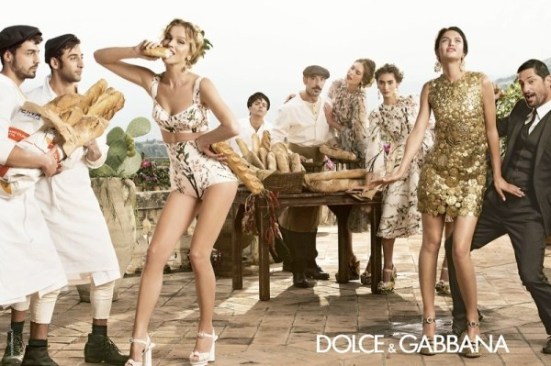
    The Italian theme of Dolce & Gabbana’s recent campaign is clearly depicted in their print advertisements. Each picture plays on stereotypes by humorously portraying the typical Italian culture (all in high fashion clothes, of course). Featured on-location in Italy, the photo-shoot captures the essence of a traditional Italian family, complete with the loud, boisterous women as the life of the party and their large families in tow.

    Dolce-and-Gabbana-Spring-2014-Ad-4-600x399

    Each advertisement exudes liveliness as models forgo their typical high fashion poses, and instead pour energy and Italian charisma into each shot. In the foreground, models can be seen wearing D&G’s new Spring collection, with fabrics and patterns that embody and were inspired by the Mediterranean’s local colors and Greco-Roman temples. The models also engage in stereotypical Italian activities, such as dancing, scorning their children, and buying goods such as fish and bread. Viewers are transported through the lens, across the world to experience traditional Italian culture in Dolce & Gabbana’s new campaign.

    DG PE 12_progetto donna.indd

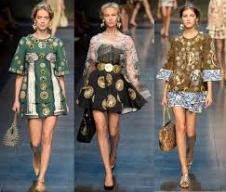
    There is no doubting that Dolce & Gabbana have, in all their departments, uniquely used their cultural approaches to differentiate themselves in the high fashion world. The embedded concepts of history and culture will attract a vast variety of publics. Through their advertisements and on the runway, D&G have raised the high fashion bar, especially with competing Italian designers (Prada, Gucci, and Georgio Armani). Dolce & Gabbana’s Spring 2014 collection can accommodate any rendezvous a conservative woman may attend. They have taken a sort of “back road” approach which more than likely sells than other high fashion brands. They went for more doable than the over-the-top, un-wearable line that the average woman could not wear to any event.

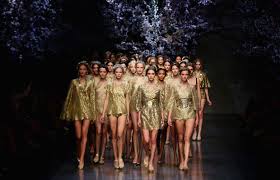
    Gabbana described the collection as “an unconscious dream,” in the sense that the clothes exemplified the blend of the real and the irrational that can only be found in dreams. The line is truly a dream and captivating at that. The Sicilian lifestyle has been opened for all to discover and enjoy through the D&G Spring 2014 line. The genius use of the culture of Sicily has provided limitless ideas of inspiration for Domenico Dolce and Stefano Gabbana, setting themselves apart from the rest of the high fashion domain. For the finale, the gilded army of women that strutted the catwalk offered another vision of female empowerment that has stirred conversations between other designers all week. Dolce and Gabbana have given the fashion world romantic maximalism at its best. The design duo’s cultural orientation without being too common or over the top. Innovative, not so much, but wearable, indeed!ewfew

    D&G have definitely grabbed our attention with their new look. Does adding a splash of culture make their line more desirable? Or do you think the typical “high fashion” is more successful on the runway?

    -Briana McWhirter, Emily Foulke, Hannah Turner

  • Marc’s Makeover: Marc Jacobs’ decision to rebrand… is it the right one?

    Deciding whether or not to rebrand your company is an immense decision. Your brand is the face and personality of your company. It is what viewers connect with. Changing this identity will greatly affect your company, but if done right the market can soar.

    Fashion designer Marc Jacobs has decided it is time for his company, Marc Jacobs International to rebrand. In an interview with David Amsden from W Magazine Jacobs explains the troubles the Marc Jacobs brand had encountered. Describing the brand as having been “diluted” from his lack of creative supervision and merchandisers pushing his design team.

    In order to fix this Jacobs decided to leave his position at Louis Vuitton to grow his company, which includes boutiques, clothing lines such as Marc by Marc Jacobs and Little Marc Jacobs (a children’s clothing line), Bookmarc (a bookstore), and more.

    Some changes have already taken place such as his decision to move his offices from Manhattan to London and his decision to part with longtime campaign photographer Juergen Teller after he creatively disagreed on the Spring 2014 ad campaign which features Miley Cyrus. 

    marcmiley

    So what is Jacobs looking to do? He’s looking to redesign the logo and packaging, to build his shoe and handbag lines, and maybe even change the name, which he told W Magazine that he had always hated.

    Rebranding can be daunting between redefining research, audiences, creative campaigns, and even products, but for those experiencing continuous losses, it is often the best way to launch back into the market.

    In recent years, another clothing line, Burberry, underwent a widely recognized successful rebranding campaign. Over the years, the British line went from being known for its historically iconic outwear, to being associated with cheapest form of high fashion, and even gang wear.

    In 2006, the company hired Angela Ahrendts and in the next six years, she turned the ubiquitous brand back to luxurious. First, Ahrendts did what she called “buying back the company.” Reigning in the 23 licenses Burberry had around the world, control was brought back to the company with centralized executive and creative offices that could maintain product authenticity and exclusivity.

    Secondly, Ahrendts recognized we are in the age of digital consumption and a digital generation – tapping into the resources social media and technology offers. In stores, sale assistants are equipped with iPads, and mirrors transform into screens displaying catwalk images. Online, the company continues to grow its presence, attracting over 16 million fans on Facebook, and over 2 million followers on Twitter. Burberry also uses YouTube to broadcast campaigns, events, music, and even corporate news. 

    However, rebranding is not exclusive to high profile companies, the challenges above are things that can be experienced in all types of companies: personal, mid, or large. So how do you know if you should rebrand your own company? From Katie Morrell’s article “10 Signs You Should/Should not Rebrand” here are some warming signs that your company should rebrand.

    Macro problems

    Maria Ross, author of Branding Basics for Small Business: How to Create an Irresistible Brand on Any Budget (2010, Norlights Press) suggests that if a company notices that their target customers are choosing the competition over their own company and if a decrease in sales is also trending, rebranding should be considered.

    Look and function don’t match

    Another element that should be considered when having a decrease in customers is “From a cosmetic point of view, when you look old and your looks don’t reflect what you are or what you deliver, it may be time to rebrand,” said Susan Betts, senior strategy director for New York-based FutureBrand North America.

    Attracting the wrong customers

    Rebranding is beneficial when a company wants to change their target customers. It gives a company an opportunity to create a new brand identity that the new target audience has the chance to connect too.

    Management change

    When a company changes management, it is normal that policies and values change as well. When a companies values change, rebranding is a good idea.

    Philosophy/function change

    When a company changes it’s direction, rebranding can showcase to customers what they may or may not be aware of concerning this change. Betts also mentions rebranding should be considered when a company has a “New philosophy or a changed philosophy”.

    These signs are great examples to take heed from, but it is important to note rebranding should not be done unless it has been proven your brand identity is the root of your problems. Branding is the largest initial investment for a company, it sets the spring board for your identity, association, and customers. Rebranding is an even bigger investment – an attempt to reintroduce ideas to already established and preconceived perceptions is no easy task, it is one that must be thoroughly strategized. For Burberry, reigning in and refining their identity proved to be the best decision the company has made. For Jacobs, we will see what his creative vision produces.

    What companies do you think have faltered recently or over the years? Who needs to rebrand?

    Caroline Robinson, Savannah Valade, Elizabeth Harrington

  • So is it not hip to be hip anymore?

    “Hipster”. By now, I’m sure everyone reading has probably heard this word thrown around to describe someone. It has a great deal of meanings now, some more relatable than others. Urbandictionary.com defines a hipster as ” a subculture of men and women typically in their 20’s and 30’s that value independent thinking, counter-culture, progressive politics, an appreciation of art and indie-rock, creativity, intelligence, and witty banter”. What sounds like a common description for a large group of people has been boiled down now into an image, one which companies and a select group of consumers have been embracing recently.

    So what makes a “hipster”? Some people believe it’s the type of music you listen to, or the clothes you choose to wear. Other people think it’s the attitude about the music and clothes you have also chosen to wear. “Skinny jeans, cardigan sweater, and listening to Neutral Milk Hotel…yeah, that guy’s a hipster”. Ironic sayings on t-shirts, listening to obscure music on their vinyl records, and drinking home-brewed fair trade blend coffee. These seem to be the most common conceptions of what classifies a person as a “hipster”. With such a large trend being developed, of course fashion companies are going to developing products appealing to the trend.

    Like many fads from the past, "hipsters" are just an evolution from the previous popular trends.

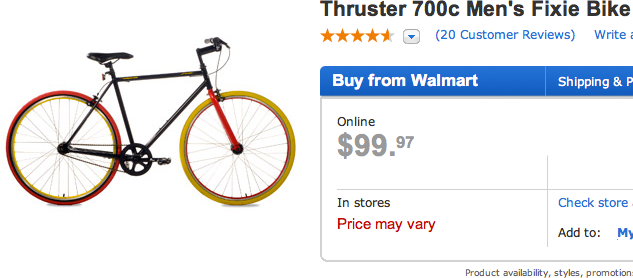
    Urban Outfitters and American Apparel are both companies that cater to a more “hip” lifestyle. Carrying a large variety of plaids, cardigan sweaters, and tight jeans, both companies have been considered a “hipster haven”. Both companies know this, have accepted it and are now running away with it. Urban Outfitters now sells 35mm cameras and Holga copies, because there is a common interest in those who some would call a “hipster” and their interest in photography. Also on their site, you can make your own screen prints, and even build your own fixed gear bicycle, both things targeting directly to those who are attempting to follow the “hipster” trend.

    Walmart attempts to capitalize on the fixed-gear craze by offering a low-priced bike called "The Fixie".

    Companies today are smart. They realize that the trend of “hipsters” including their fashion sense and their interests have been on the rise, and are adjusting to the demand in order to deliver what sells best. They also are targeting this demographic through their advertisements via email and internet ads featuring models who roughly resemble “hipster fashion”. The trend does not seem to be dying out any time soon, as more and more people are starting to embrace it for themselves, so we can expect to see more and more companies reaching out to these consumers in an attempt to show how “hip” they can be in order to sway them into buying from them. What it simply boils down to is another label for another trend that is ripe for the capitalization on, and it seems like many companies are doing just that.


    -Joshua Vester, Hunter Wilson, Ashley Oliver, Molly Jacques