Tag: disney

  • The happiest place to intern

    As Communication Studies majors, the department’s core skills have been cemented into our minds since COM 105. The department’s core skills give its majors direction as they navigate through their classes. When it comes to internships, every core skill is important but praxis allows you to apply knowledge outside the classroom. Knowing theories and knowing how to apply them is essential to being successful in an internship.

    Walt Disney World — the largest on-site employee establishment in the world — offers internship opportunities for almost any major. The eight-month internship is not like many others — Disney provides numerous benefits for their interns, including free park admissions, guest passes, discount-coupon books, and insider information which has not yet been released to the general public. Interns may also enroll in college classes while living in Orlando, and receive credit based on their major. Classes offered include engineering courses, leadership courses, marketing courses, and courses in the culinary arts. Students are also able to take a Disney Heritage course and learn about the history of Walt Disney World and the foundation the empire was built upon.

    Melanie Bower, a current senior and Communication Studies major at UNCW, completed the eight-month Disney Internship from May 2014 to January 2015. During her time in Orlando, Melanie also took classes on leadership and marketing, and is hoping to pursue a career back in Florida related to IMC or digital marketing. How is this internship suitable for COM majors?

    Picture1

    “The Disney College Program teaches the vital skills we study in depth as COM majors – we even utilized the core skills learned in COM 105 in my marketing course at Disney. Every class involved group-work, and we learned how to effectively act, dress, and contribute in a business setting when working for such a big-scale company. Students in any major could gain experience and valuable knowledge from this internship, but having a Communication Studies background gave me an upper hand because I was already aware of how to effectively and efficiently tackle the tasks at hand. Communication also came in handy when working in the actual park. Hollywood Studios during the summertime is hectic, and knowing important tips to communicate effectively to large groups of stressed people gave me a leg up. Public speaking is also paramount in the job I worked.”

     The idea of applying knowledge outside the classroom, or “praxis,” is key in this kind of internship. Interning with such a big company is far different than many local internships students find around Wilmington. COM studies students who decide to head to Walt Disney World must be prepared for a “small fish in a big pond” experience, and use their knowledge of group work, core skills, and conflict management to be noticed and successful within the company. Melanie suggests the longer internship (8 months rather than one semester), if one truly wants to understand the ebb and flow of a monumental enterprise and the way business is carried out throughout the seasons. If you, a COM Studies student, or any other student in a different major is considering the College Program, it is important to understand that the work is daunting and the hours are long; classes are not easy and the weather is sometimes unbearable. But the networking you do, the contacts you make, the lives you touch, and the magical moments you have every day will make this internship well worth it.

    Picture12

    What kind of internship opportunities have you been apart of or look forward to?

    – Nick, Melanie, Mary & Patrick
  • FCC Reviews Rules and Regulations

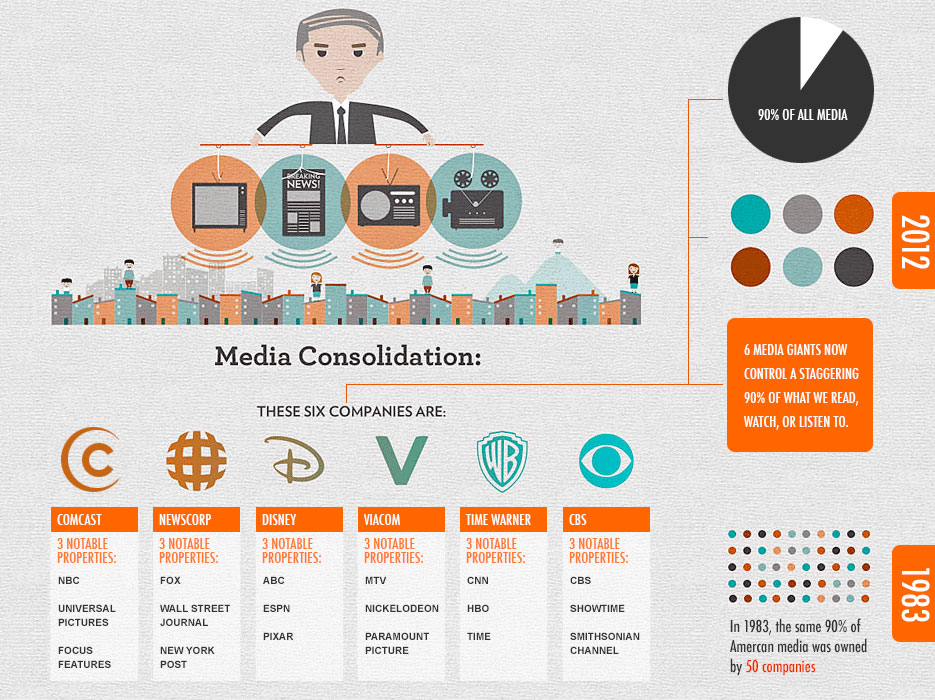
    As the final four teams prepare to battle it out in March Madness, it’s a sure bet that sports fan are waiting to see what else the tournament has in store this season. With coverage, updates, and analysis, it’s also a pretty sure bet that these fans are tuning into ESPN – the station that has become the sports authority. But did you know that the testosterone filled station is owned by a company that producers princesses fairytales – Disney? Did you know Disney also owns ABC, Marvel, Pixar, and Touchstone. Part of what’s known as the “Big Six” – Comcast, News-Corp, Disney, Viacom, Time Warner, and CBS – account for 90% of media ownership across the ­states.

    media_consolidation

    The process of consolidation through mergers and acquisitions, has led to media conglomerates – few companies owning all of the media outlets.

    Many argue that media consolidation hurts competition by blocking out new media companies. According to Senator Wellstone, media give people access to a wide variety of opinions, analyses, and perspectives and it holds concentrated power accountable to people. With only a few companies controlling all the media the two functions of media (listed above) are compromised. Specifically related to advertising, a combination of media also leads to monopoly over audience and advertisers.

    Today, the Federal Communication Commission (FCC), an independent US government agency responsible for controlling media regulation, will vote to make TV station’s joint sales agreements (JSAs) subject to current ownership rules. The commission will also vote on a rule that prohibits two or more of the top four TV stations in a market from jointly negotiating agreements with pay TV providers.

    Tom Wheeler, FCC Chairman, cited that the considered changes were motivated by evidence that suggested the rules that protect competition diversity and localism have been circumvented.

    JSAs are an arrangement many see as a loop hole around the limits on owning no more than two TV stations in a market. With endorsement from the Department of Justice, the FCC is now moving ahead with the rule “that if the owner of one station in a marketing sells 15 percent or more of the advertising time for another, then it will be deemed to have ownership interest in the station.”

    Broadcasters are fighting back. Gordon Smith, president and CEO of the National Association of Broadcasters, says, “The real loser will be local TV viewers. This proposal will kill jobs, chill investment in broadcasting, and reduce meaningful minority programming and ownership opportunities.”

    Stations that do have JSAs will have two years to dismember deals. However, stations can apply for a waiver in which JSAs will be examined on a case by case basis to determine if public interest is served by keeping the agreement.

    Additionally, as part of the 2014 review, the FCC will propose to keep the ban on owning more than two TV stations, but question whether the cross-ownership ban between TV, radio, broadcast, and newspapers should be lifted.

    However, while the five commissioners of the FCC will all vote on the issue, the ultimate decision may be left in the hands of just one, Democratic commissioner Mignon Clyburn. The issue has split the five down party lines with the GOP commissioners, Ajit Pai and Mike O’Rielly speaking out against the proposal. In order to advance the ruling, Wheeler will need the favor of both democratic commissioners.

    While the commissioners are deciding, we are left wondering to what degree will these rules affect our media markets? Will Clyburn’s decision trend toward more or less regulation?

    Tell us what you think. Should the FCC approve the JSA rule? Are media conglomerates affecting the free flow of information to society? Or has the Internet made possible enough independent outlets?

    Savannah Valade, Caroline Robinson

  • “The Evil Empire”

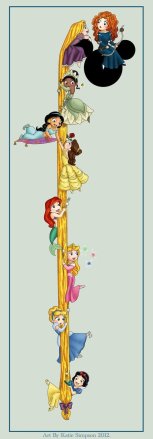
    When we were growing up, Cinderella taught us how important faith can be, Snow White taught us how important friends are, and Sleeping Beauty taught us how important following our dreams can be. However, the upcoming generation is growing up with extremely different Disney princesses than we knew. What began as the princess trifecta of Snow White, Cinderella, and Sleeping Beauty, has turned into nine princess movies all representing different images and values to the next generation of children. There is a question raised by many of whether or not the Disney princesses are teaching children the right lessons. Some have even ventured to ask: Is Disney really the evil empire?

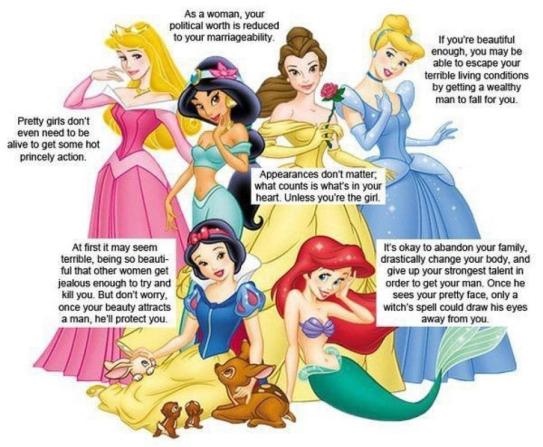
    As a brand, Disney has faced harsh criticism from the feminist movement due to the way they have portrayed women in the past. A recent meme surfacing all over the internet that de-glorifies the Disney movies from fairy tales to poor life lessons. For example, Belle is described as just a pretty face and the meme insinuates that the Beast only fell for her because of her looks. This is an oversimplification of Belle’s character as the Beast falls for her not for her looks but her intelligence, caring nature, and personality. However, the meme is not entirely wrong as not all of the early princesses are portrayed in such a dynamic manner as Belle. Cinderella and the prince barely shared a dance before they fell madly in love and Ariel ditched her entire family to marry her prince.

    In order to help manage their image, or perhaps in attempt to keep up with the times, Disney took on the challenge of making their newer princesses more dynamic and stronger female leads. Disney also released an African-American princess after receiving criticism for not having enough diversity in their fairy tale stars. An idea they really try to communicate with their new princesses is that princesses do not have to be damsels in distress. In Tangled, Rapunzel takes charge of her own life by disobeying her “mother’s” wishes. In the process, she discovers her real family and her true love. This could be seen as Disney’s ode to following your heart with more action than Cinderella took. However, the movie openly references alcohol blackouts, violence, and criminal behavior. Is this Disney trying to appeal to an older generation or avoid seeming old fashioned and out of date? Either way it wasn’t entirely in line with the identity of their prior princesses. Is this a new kind of Disney Princess we are seeing? Or a fluke straying from what Disney really represents?

    – Alexandra Huss, Caroline Merrill, Alyssa Morrello, Lauren Van Trigt, Dann Williams

  • The Happiest Place On Earth

    On October 25, 1971, Walt Disney World opened its doors to the world. The theme park is a tribute to the inspirational life of Walter Elias Disney and all of the dedication and loyalty he has contributed to the Disney organization. According to a Disney World history website, “Walt Disney World Resort was first envisioned by Walt Disney in the early 1960s to give millions of residents in the Eastern United States an opportunity to enjoy unique entertainment concepts which had become world-renowned at California’s Disneyland.” The Disney planning team at WED Enterprises (now known as Walt Disney Imagineering) decided to place this park in Florida for many reasons. The main one being that Florida is known for year-round wonderful weather. This allows operation to continue throughout the year so that their vacationers can come whenever they would like. Also, Florida is first ranked among the states in tourism.

    “The Walt Disney World Resort that burst on the scene in the 1970s rapidly became the world’s best-known destination vacation resort with guests coming from all parts of the world.”  When Disney first opened, there was only the Magic Kingdom Park and two resort hotels. As time passed, it didn’t take long for Disney World to expand. Within 10 years, Disney World welcomed two new parks and six new resorts. By this time, their attendance surpassed 100 million visitors. A few years after this major addition, Disney also created the Disney-MGM Studies, five more resorts including its first luxury resort, Pleasure Island, and a water park. Today, Disney world offers four major theme parks, two water parks, six golf courses, 21 resorts, and the Downtown Disney dining/shopping/entertainment complex. The four Disney theme parks have attracted more than 700 million guests total.

    Disney’s brand is one of the most powerful brands in the world.  Most people think of children’s movies when they hear “Disney,” but the magic appeals to groups of all ages.  The Disney brand encompasses adventure, fantasy, magic, fairytale, and happiness.  Disney World is the place where imagination is not only allowed, but also strongly encouraged.  With over 25,000 acres of enjoyment and possibilities, Disney World has become a staple for anyone planning a vacation.

    -Kelsey Bendig, Brooke Keller, Andrea Blanton, Brian Burch

  • The Mickey Mouse (Rehab) Club

    Miley Cyrus. Demi Lovato. Lindsay Lohan. What do these names have in common? They were all, at some point or another, cream of the tween crop for the Disney Corporation. But with Cyrus pole-dancing at concerts, Lovato going to rehab, and Lohan jumping between rehab and jail on a regular basis, the images of these celebrities hardly seem synonymous with a pair of Mickey Mouse ears.

    One of the key factors of IMC is the communication of one clear message to consumers through a variety of media channels. So, when Disney is trying to convince parents that they’re providing worthy role models for their daughters, but the tabloids are constantly covering the personal drama of the Disney stars, who do parents believe? At an initial glance, some might suggest that Disney should distance itself from the constant media mishaps of these tweens and move on to the “next big thing”. But when your company owns the rights to a teen star worth over $48 million (Cyrus’s estimated annual earnings according to the 2010 Forbes’ Celebrity 100), do you really want to let go of all that merchandising power?

    In the world of entertainment, making sure that one clear message is presented can be a tricky issue because the selling power often rests on the shoulders of a human being with free will instead of the reputation of a product. Especially with a company like Disney, who deals with celebrities that are often in the midst of teenage turmoil, controlling the talent is no easy task. But, as long as there are parents buying their little girls Hannah Montana wigs and Camp Rock backpacks, Disney’s marketing advantage seems to be doing just fine.

    Anna Kate Babnik, Tiffany Evans, Carissa Niederkorn, Deji Adeleke, & Katie Eagle