Tag: Communication Studies

  • Losing balance during tough economic times

    In the current economic climate, corporate mergers and takeovers are happening frequently for many reasons.  Many companies cannot afford to stay afloat, while others have shareholders wishing to maximize profits.  Either way, we are seeing the rapid consolidation of businesses everywhere.  To some, this issue is not bothersome at all, but to others, who worry about monopolies, corporate competition and consumer sovereignty, there is great concern and confidence is slowly starting to vanish.

    Today, while driving down the streets of Wilmington, NC, we noticed that two banks have changed names within the last year.  Both banks were native to the Southeast, and one even shared its name with our state.
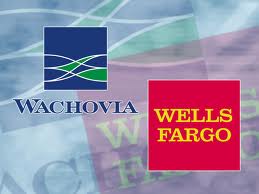
    Some customers identified those banks as area staples, since they were both based in the Carolinas, but now one is owned by a company from California, and one by a company from New Jersey.  In a snap, two banks from our region, gone and without a trace.

    Though many experts rightfully argue to the contrary, we have been hearing in the news that hefty government spending has led to our monstrous national debt and deficit, and that we must rely on private sector spending to spark the economy.  But private sector spending only takes place when consumers are confident that the markets are stable, otherwise, they hold onto their money in preparation for downturn.  When you notice familiar companies disappearing and being replaced by institutions from across the country, do you feel that all is well with the economy?  Probably not, which is why we ask: Why didn’t the companies retain the banks’ original names?  In our opinion, we do not feel like the world looks highly on only a few corporations controlling the majority of an industry.  In addition, the loss of thousands of jobs due to the takeover of a certain investment bank by the largest financial institution in the world is still fresh on the minds of many even though it happened almost four years ago.

    From an IMC standpoint, we understand that companies try to communicate consistent messages for branding reasons to encourage familiarity, but in this case, it may have been more important to keep things close to the way they were.  Some consumers are not welcoming to change, and others know that consolidation is indicative of a bad economy; therefore, they may not want to spend their money.  Could keeping old names around despite new ownership benefit consumer confidence?

    -Stephanie Bakolia, Claire Outlaw, David Glaubach

  • The Real Cost of Advertising

    Our economic troubles are hurting deeper than the punch from the gas pump, bruise from increased tuition costs, and stabs from the job market. These economically challenging times are also abusing the fundamental business principles that companies have relied on for years. In particular, these bad financial times are changing the way advertisements are valued.

    Many companies assume that when they are affected by hard economic times, it is best to pull the plug on various advertisement campaigns as a way to cut marketing costs. However, this kind of penny-pinching seems to only make the struggling financial situation worse. According to a study prepared for American Business Media by Yankelovich Partners and Harris Interactive, businesses who continue to run ads have a significant competitive advantage over those who choose to cut back.

    Simply: there is a value to spending money on advertisements, regardless of economic struggles.

    Darwin’s theory of “survival of the fittest” has never been so true in today’s economic downfall. Companies cannot risk pulling their advertising from the marketplace if they want to remain in the thoughts and minds of consumers. If only the fit survive, then a company should use aggressive advertisements and marketing strategies as a way to not only reach their audience, but to intimidate the competition. The continuation of building clientele through running advertisements establishes an image of loyalty, faith, and stability a company has in their product or service to the consumer. If the advertisements get pulled, then so will the opportunity to reassure to consumers that the company is prospering despite the economic hardships.

    If a company is facing the decision to pull advertisements as an attempt to adhere to budget cuts, it would be wise to think beyond the element of monetary cost. Because the cost of losing attention could be larger than the amount of money you may be saving without advertisements.

    -Oliver Evans, Sally Shupe, Jared Sales

  • Wonka Vision

    Have you ever gone out and bought something simply for the
    fact that you saw your favorite celebrity or athlete endorsing it? Or, have you
    watched your favorite show or football team-play on TV and be mesmerized by a
    product?

    Many companies use product placement on television shows to
    advertise their brand. A lot of times, the company will sponsor a certain show,
    and in return their brand may be used in various ways throughout an episode; it
    may be used as a product in the episode or the company’s commercial will play
    during a break. For instance, have you ever wondered why all three judges on American Idol are always sitting behind
    large glasses of Coca-Cola? It is not because they cannot get enough
    daily-intake of Coke; it is because American Idol is sponsored by the Coca-Cola
    brand. Television shows are a major source of advertisement. The reality show The Kardashians is a show focused
    around the life of the Kardashian brand and family. They now have a clothing
    line through the Sears Company which is marketed on the show, a boutique
    clothing and accessory store Dash, and even market perfumes because who doesn’t
    want to smell just like a Kardashian!

    Product placement is a way for companies to inject their
    products to be endorsed by celebrities so the product will then be “cool” and
    acceptable for everyone else to buy. The show The Restaurant, on the Bravo network, starring the high-end
    restaurant chef Rocco, was paid by the show’s three main sponsors: American
    Express, Mitsubishi Motors and Coors Brewing. Bravo
    did not pay a single penny of
    license fee to have the show made. To justify its investment, each of the shows’
    sponsors has received a prominent place in the show: American Express provides
    the financing for the restaurant and the show.

    Of course, in the early days of television, such
    integration between advertiser and show was quite common. Such links persisted
    into the 1970s from the movie Willie Wonka and the Chocolate Factory, which was entirely funded by Quaker Oats. The
    Quaker Oats brand used the movie to promote its new “Wonka” brand of
    candy and sweets. Beware and conscious of what you are buying.

    – Jordan Hill, Michela Noreski, Ashley Nelson

  • Walking Billboards

    When we first hear the term “product placement” our minds invariably flash to ill-disguised attempts by companies to sling their brands into popular television shows and movies. The movie Transformers 3 was bashed for looking like one giant advertisement for a litany of companies including Mercedes, Nokia, and Apple.

    But what about the infamous red carpet? As stars twirl their way down these crimson lanes, they will all face one important question: Who are you wearing? By having a star tout your brand, it raises its stock tenfold. For instance, in 1998, Kim Basinger arrived at the Oscars in an Escada gown raising the then relatively unknown German fashion house’s profile to an international status. Jewelry also has a big stake in the red carpet industry. Jeweler Harry Winston can usually be found dripping off of no less than 20 celebrities, but when rival brand Chopard wanted a part of the red carpet action they offered celebrities Hilary Swank and Charlize Theron a six-figure paycheck to wear a pair of their earrings.

    Off the red carpet, celebrities are still walking billboards for fashion companies. Take a look at the Australian footwear brand UGG. After the tabloids started picking up shots of Cameron Diaz and Kate Hudson flouncing around town in their boots, sales went through the roof. At this point, almost everyone either has a pair of UGGs or knows at least two people who do. And in this vein, when The Today Show featured a segment about Madonna’s infatuation with designer Steve Madden’s Iglou boots, the company racked in 240 orders for the boots in a grand total of 13 minutes giving the company a whopping $30,000 in profit. 

    So what does this all mean? Must our favorite celebs only be seen as walking product placements? Do they not have any taste of their own? Of course, they do. But the next time you run out and buy a pair of shoes because Kim Kardashian was wearing them at her birthday party, think how you might be doing exactly what their marketers intended.

    -Jessica Kingman, Alaethea Hensley, and Lauren Phelps

  • IMC Minus the C: The World Behind IMM

    With questions in my mind about product placement and how the book “The Authenticity Hoax” relates, we eagerly write this blog post.  Though there were many great points in the book, we were particularly interested in status seeking and materialism.  Do we want things because we really want them, or do we want things because we perceive them to be desirable?  What is our motive for buying?  Do these $250 Dylan George jeans do the job better than Wranglers… or are we seeking exclusivity? We think the answer has much to do with simple competition.

    We don’t think people were born with the inherent proclivity to seek out high priced designer fashions, We think their behaviors were molded by society saying, “These things make you important and envied.”  This brings us to the title of the post, IMM, Integrated Marketing Materialism.
    There is nothing wrong with promoting products; however, we have been wondering lately how early certain niche luxury markets are starting to target their audiences.  Of course, children of the stars have custom made Salvatore Ferragamo shoes, but it seems like serious materialism is rapidly affecting younger demographics even outside of Hollywood.

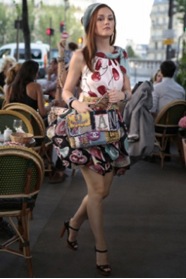
    Certain television shows like “Gossip Girl” are aimed at teens, but the characters always wear over the top, Haute couture only available at high end stores for outlandish prices.  Are these television shows telling our teens that it’s time to kick it up a notch and take a trip to Neiman Marcus for some Oscar de la Renta?  You can be the judge of that after you check out this picture of Blair Waldorf from “Gossip Girl.” Blair has a $2,100 dress by Moschino, $900 Quepi Reci platforms by Christian Louboutin and a $3,400 Chanel patchwork purse.  All together, her ensemble costs $6,400 plus tax and shipping (since most of us do not have access to such retailers).

    To people who are remotely knowledgeable about fashion, those products are easy to identify (especially because of the red soles on the shoes).  They are easy to recognize because they have been shoved in our faces for years now.  To our surprise, when we investigated these products, many retailers were sold out!  Obviously, their marketing strategy is working, which one do you think it is?

    -Stephanie Bakolia, Claire Outlaw, David Glaubach


  • Product Placement: The 90’s and Today

    Growing up in the 90’s was quite a rich experience. Alongside the bright colors, turtle necks, and psychedelic patterns that we all wore, an amazing new shoe graced the decade that had all of the kids talking. It was marketed as a shoe that could make any kid run faster, jump higher, and practically defeat gravity.

    It was the PF Flyer.

    These particular shoes were worn by Benny “THE JET” Rodriguez; the star of the movie, The Sandlot, who became the instant role model for every young boy dreaming of a baseball career. While wearing these shoes, Benny caught a baseball that was signed by the world famous player, Babe Ruth; diving for it against the clutches of a monstrous guard dog.
    After this movie hit screens, kids in the 90’s just had to get their hands on these PF Flyers. These shoes were marketed as something magical, all because of one slow-motion movie scene. They could not only make you run and jump higher, but these shoes were also instantly associated with the heroic catch made by Benny Rodriguez. If Benny could catch that ball, so could you. But only if you had your pair of PF Flyers.
    At the time, kids did not have the knowledge to dissociate Benny’s success among his friends and baseball from mere product placement. The placement of these shoes during such a critical point in The Sandlot was no mistake. Marketers from the brand knew very well what they were doing, and they did it well. The PF Flyers became a staple sneaker for every young kid in the 90’s. Perhaps the successful sales numbers were not solely because of the appearance on Benny Rodriguez’s feet, but it was simple placements such as this that made the brand attractive to families across America.
    Today, we see this kind of marketing everywhere we look. Movies and television programs lace their characters and settings with products as a result of eager marketers trying to solicit their image. When the marketer has the opportunity to take advantage of a hopeful, entertained audience through something as simple as product placement, they are diving into more than they may have originally intended. They are not only selling a product, but they are selling a brand message. By choosing which scene, character and setting to place products, the marketers are aiming to take advantage of a relationship that has been built between the audience and the movie. In doing so, they can only hope that the audience will feel so related to the movie that they will be reminded and persuaded about the “value” the product had in the film.
    So, would Benny Rodriguez have caught the infamous catch if he was wearing LA GEARS or NIKES? The marketers of PF Flyers want you to think not.

    Sally Shupe, Jared Sales, Oliver Evans

  • The Need for Nielsen

    Imagine being chosen at random to watch hours of television and get paid to rate the shows you watch.  Believe it or not, this is exactly how television shows get their ratings.  The Nielsen Company is the leading consumer research group that collects demographic as well as  media consumption data that produce television ratings- hence the name “Nielsen Ratings”.  Nielsen randomly surveys millions of households nationwide to find trends among viewers based on what they are watching.
    Ratings may not seem that important to you as the viewer, but to the companies that wish to market their brand, these ratings determine when and where they invest their money.  For instance, say you work for a brand whose target market is young adults; where are you going to place your commercial? Are you going to have it air during the premiere of NBC’s provocative new drama The Playboy Club or the season premiere of FOX’s “High-School-Musical-esque” show Glee? This should be a no-brainer, but for  shows that are in the same genre and marketing the same audience, firms depend on these ratings and the demographic data from “Nielsen families” to assist in making these types of marketing decisions.
    So thanks to you, Nielsen Company, for only airing what we want, when we want it.