Tag: Coca-Cola

  • “I’d like to buy the world a Coke”

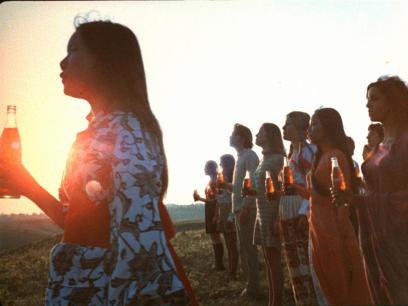
    In 1971 Coca-Cola launched one of its very first in-color TV commercials. It was named; “I’d like to buy the world a Coke” and has been called, “one of the best-loved and most influential ads in TV history”. It featured a multicultural cast with actors and actresses from over 20 countries singing together on a hilltop in Italy. All holding a cold bottle of coke in their hands.
    cocacolapic2

    The commercial has been called “groundbreaking” and was a part of the Coca-Cola campaign, “It’s the real thing”. The slogan, as well as the commercial was created by Bill Backer (creative director for the Coca-Cola account at McCann). The idea of the commercial came to Backer while in an airport on the way to London. He quickly wrote down the words, “I’d like to buy the world a Coke and keep it company” on a white napkin so that he would not forget it in the morning.

    cocacolapic1

    Backer got help from established song writers Roger Cook, Billy Davis and Roger Greenway to write the full song for the commercial. The song became such a hit it was recorded by the New Seekers, a British pop-band. It was so idolized that it was played on the radio as a full-on song.

    The lyrics read;

     “I’d like to teach the world to sing in perfect harmony”
    “I’d like to buy the world a Coke” 
    “And keep it company”
    “It’s the real thing—Coke is”
    “What the world wants today”


    The commercial has received praise throughout the years, and rightfully so. Davis truly captured the essence of Coca-Cola’s brand identity explaining that, Coke was more than a liquid refresher. Saying that, Coke is a “tiny bit of commonality between all people”.

     cocacolapic3.png

    The commercial gave hope to a multicultural world in where a bottle of Coke could be shared together amongst anyone in “perfect harmony”. The Coca-Cola bottle was used as a symbol of peace. By using a multicultural cast the commercial aimed for a world filled with greater acceptance and inclusion. Erasing divisions between people with different skin colors, ethnicities, and backgrounds.

    The commercial first aired in 1971. The same year as the US voting age was lowered to 18, Disney World welcomed it’s first visitors, the Pentagon Papers were published, and National Public Radio broadcasted for the first time.

    cocacolapic4

    A lot of things were changing at this time. You could possibly argue that in a state of doubt and anti-Vietnam war attitudes, Coca-Cola was ahead of its time releasing this “feel good” commercial focused on friendship and happiness. And it might have been a slight nod against the war oversees.

    Take a look at the commercial yourself! Why do you think this became such a hit? Why do you think it resonated with people?

    P.S. If you watched Mad Men, the final scene of the show is followed by the Coca-Cola Hilltop commercial. Showcasing just how iconic it was and still is today.

    – Olivia Nilsson
  • One Country Painted Red

    With the rapid growth of new products, brand extensions and the blurring of traditional and new age advertising, marketing and advertising to target audiences has reached a new level of competitiveness. Brands now must adapt to this changing environment and contest with competitors to stay at the top of their market and target to audiences in creative, attention-grabbing tactics.

    The most iconic brand in the soda market, and throughout the world, is undoubtedly that of Coca-Cola. In the summer of 2011, Coke created an original marketing strategy to run a campaign that would inspire people to connect with the brand both online and offline in order to acclimate to the changing marketing environment. The campaign’s prime objective was to increase consumption of Coke over the summer season and to get people to fall in love with the iconic brand again. Particularly, in Australia, at the time nearly 50% of teens and young adults had never tasted a Coke and this drove the brand to reconnect with the country.

    Established in Australia, the ‘Share a Coke’ campaign immediately received positive media attention and consumer responsiveness. The idea of the ‘Share a Coke’ campaign was to place Australia’s 150 most popular names on the front of millions of Coca-Cola bottles, simple right? This was the first time in 125 years that Coke had made such a paramount transformation to it packaging, and it was revolutionary.

    “We used publicly available data to review the most popular names in Australia and ethnic representation in Australia to ensure the diversity of our multi-cultural nation was represented appropriately.”

    – Coca-Cola Spokesperson.

    The Coca-Cola brand wanted to initiate conversations by putting Australians front and center and inspire them to connect with people and ‘Share a Coke’. The central theme that gave ‘Share a Coke’ its power was the way a brand so universal could replace its logo with individual names by reaching out to consumers and personalizing its brand to individuals.

    “We are using the power of the first name in a playful and social way to remind people of those in their lives they may have lost touch with, or have yet to connect with”

    -Lucie Austin, Marketing Director for Coca-Cola South Pacific.

    The ‘Share a Coke’ campaign strategically exhibited that when personalization in advertising is done the right way, it can be highly appealing and extremely effective. While Coke got personal, media was buzzing with talk over what the brand was implementing behind the personalization. Coke remained silent until Australia’s highest rated media weekend. The campaign was revealed to the public and aired across the biggest weekend in Australian sport, during the AFL (Australian Football League) and NRL (National Rugby League) grand finals which reached over 30% of the population.

    Succeeding the campaign launch, requests for more names were coming in the thousands. Coke was prepared for this boom of requests by setting up kiosks that toured 18 Westfield shopping centers attracting consumers to personalize any name on a Coca-Cola bottle.

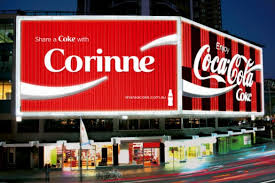
    Coke wanted to especially reach out to the 50% of young adults that had never tasted a Coke in Australia, and there was no better way to reach this target market than online. Participation and mass allocation was achieved through Facebook by providing consumers with the resources to connect and ‘Share a Coke’ by creating a personalized virtual Coke bottle to share with a Facebook friend. Consumers were tagging friends in pictures with personalized Coke bottles and sharing stories on social media platforms like Twitter, Facebook and YouTube. Coke consumers also could create their own commercials! With the abundance of requests still pouring in, Coke told consumers to put in a vote of “who do you want to share a Coke with the most?” via Facebook. After 65,000 people voted, Coke bottles with 50 new names were released. “Consumers were invited to SMS a friend’s name, which was projected live onto the iconic ‘Coca-Cola’ sign at Sydney’s King’s Cross. They then received an MMS enabling them to share their friend’s name up in lights, via Facebook and email.”

    untitled

    The multi-platform communications strategy was implemented to ‘Share a Coke’ with someone you know, or want to know and ultimately gave people the resources to find, connect and share. After 3 short months of running the campaign, young adult Coca-Cola consumption increased significantly in Australia by up to 7%, making 2011 Coke’s most fruitful summer season in history. The ‘Share a Coke’ campaign resulted in 76,000 virtual coke cans shared, 378,000 extra coke cans printed at kiosks, and 5% more people were drinking coke. Coca-Cola had successfully won over Australia and became a part of popular culture again.

    -Briana McWhirter

  • You can’t have your Coke and drink it too

    It’s one of the pillars of successful marketing, target your audience. Individualizing ads to particulars groups or regions of consumers ensure that messages have the most impact. But what happens when a company features a controversial scene in a spot, then removes it for some audiences and not others? Good marketing move or failure to take a stance?

    In its newest global campaign, “Reasons to Believe” Coca-Cola set out to inspire consumers that no matter what happens in life, it’s those small happy moments that make life worth living.

    Check out the commercial below.

    In most European countries the ad contains a scene of two gay men holding hands in front of their wedding party. However, in the Irish version (the video below) the scene has been replaced to feature a bride and groom.

    The Irish LGBT publication, EILE Magazine, brought attention to the issue, calling the removal an “inexplicable move”. In response to the criticism, Coca-Cola said that the advertisement had been tailored to individual markets so that the ad resonates with the people in each country where it is shown. The company defends the decisions saying that grooms were excluded from the Irish version because gay marriage is not legal in the country. EILE Magazine claims the Coca-Cola reasoning moot. The footage of the two grooms is known to be a video clip from a same-sex union ceremony in Australia – equivalent to a civil partnership in Ireland. Yet gay marriage is also illegal in Australia, but shown there. EILE claims the spot should have been suitable for Ireland as well.

    Coca-Cola has unequivocally made public their supporting stance on same sex marriage. Since 2006, the Human Rights Campaign continues to award Coca-Cola with a 100 percent ranking of their company polices and practices regarding LGBT. The Coca-Cola Company notes on their website, “To achieve a perfect score, companies must have fully inclusive equal employment opportunity policies, provide equal employment benefits, demonstrate their commitment to equality publicly and exercise responsible citizenship”

    Many are saying that Coca-Cola’s recent actions were hypocritical. Coca-Cola claims to support gay marriage, but their choice to remove a gay marriage scene from a commercial in Ireland, in which law does not prohibit such imagery, is misleading of the company’s values. Similarly, another beverage icon, Starbucks, has also gained attention for their hypocritical actions.

    Bryant Simon discusses the company Starbucks in his book Everything But the Coffee. Through his research he comes to discover that Starbucks isn’t delivering what they are promising in their brand – good coffee with little environmental impact. Claiming to buy fair-trade coffee from Rwanda and Nicaragua farmers, Starbucks was actually buying from bigger farmers and only buying 5-6 percent of fair-trade out of all the total coffee purchases.

    Much like Starbucks claiming to be environmentally friendly yet not taking the necessary steps in order to be green, Coca-Cola’s actions were just as misleading; claiming to support gay marriage yet removing a scene from one version of a commercial for the sole purpose of trying to please everyone.

    As future and current brand ambassadors we have to remember that every decision we make, including company policy decisions, become an integral part of brand, and when decisions are made that contradicts that it hurts the brand.

    On the other side of things, as consumers (and as Simon states in his book) we have to remember pursuing “solutions to highly complex social problems through buying and buying alone” doesn’t fix the problem or change the ideology. We have to stop relying and believing that buying certain brands is going to change a social issue.

    So, does Coke’s decision to take out the gay marriage scene hurt its brand identity? Should companies take stances on social issues? What practices do you follow to make sure this brand conflict doesn’t occur in your company or with your clients?

    Savannah Valade, Caroline Robinson, Elizabeth Harrington

  • A Soda With A Cause

    Are you shopping for a cause this holiday season?

    They don’t call it the giving season for nothing. Around the holidays you see and hear it everywhere “Would you like to donate a dollar to ______ to help sick children today? It only takes a $5 donation to _______! Or, shop here! We’re a good organization! We support ________. ” That _____ has a name: cause marketing.

    According to The Nonprofit Times, cause marketing, in a broad sense, is when  “a nonprofit and for profit corporation partner together with the purpose of advancing the mission-related work of the nonprofit, and the marketing goals of the corporation.” We regularly see this through traditional cause-related marketing on a day-to-day basis (donation-with-purchase of a product/service), but it seems as though cause marketing during the holidays is especially pertinent.

    Do you feel as though companies that don’t partake in cause marketing are more rare than those who do? This holiday season, Coca-cola is doing the opposite of advertising, while still partaking in cause-marketing. Confusing right? Well check this out.

    Starting November 18th, Coca-Cola decided to cut all advertisement funds and donate the money that would be used for relief efforts in the Philippines from Typhoon Haiyan. The company still plans to partake in holiday ads soon, but the pathos link that the company is creating by helping out those devastated by the disaster is sure to boost sales. The company has raised $2.5 million for the relief already. Way to go, Coke.

    So how about you? Does the pathos-oriented approach presented by cause-marketing make you more vulnerable to purchasing a product, or is it just expected now-a-days?

    Morgan Jones, Jade Lester

  • The New American “Diet”

    If you haven’t dined out, visited the drive through, or stocked up on packaged foods in the past week, I applaud you.  For the rest of us, with too little time, too much to do, and tight budgets, these can make up the majority of our diets.  Let’s face it, eating and cooking fresh can be pricey, and watching your produce waste away in the refrigerator is a little bit depressing.  In a country overrun with obesity and simultaneously fascinated with eating better, lighter options in stores and restaurants have become relatively commonplace.  So if we’re all buying the low-calorie options, why aren’t we getting thinner?

    Diet Coke, turkey burgers, and yogurt parfaits are only a few of the products often advertised and consumed as healthy alternatives to their higher calorie counterparts, but items like these can be the downfall of our healthy lifestyles.  Coca-Cola is a large offender, especially with their “all calories count” message in a recent anti-obesity ad campaign.  This campaign essentially highlights the improvements to Coca-Cola products and frames their beverages in a way that attempts to diminish their reputation as one of the biggest causes of obesity.

    Along with this beverage super-star, fast-food chains like McDonalds have focused ads on their lighter fare, restaurants advertise low-calorie menus, and snacks are packaged in smaller servings. The problem is, not all calories are equal, and not all low-calorie foods are healthy.  These companies position these products for the average American, looking to make improvements to their diet without much hassle, and it works.  Why you might ask?  It’s not because we don’t think about the choices we make, or are easily fooled.  It’s because advertisers utilize the fundamentals to communicate their messages.

    Advertisers are truly the kings and queens of Aristotle’s appeals of ethos, pathos, and logos.  They appear credible with FDA nutrition facts printed clearly on each label, appeal to our emotions by loading their ads with language and messages about healthy living or weight loss, and petition our logic with facts about what goes into different items and how the calories add up.

    This isn’t to say that most people will be quick to believe that a McDonald’s hamburger is part of a healthy diet because it’s part of the “under 400 calories” menu.  However, for those of us looking to do the best we can with the time and budgets we have, these ads can play powerful roles in decision-making.

    The big question about these types of ads, is whether or not it’s ethical to allow unhealthy products to be represented as the means to a healthier life.  For many people, shopping and eating well is a guessing game, largely impacted by packaging, print, and television ads.  In a world where being overweight or obese can cause health problems, social anxiety, and even death, should companies be required to avoid misleading their consumers?  It’s an age-old question unlikely to be answered anytime soon.

    Ally Walton

  • Anything you can do, I can do better… and cheaper!

    In the world of sports, it is never a surprise to see Gatorade as a major sponsor. Their product has been placed into events including NHL games, the MLB home run derby, and the Super Bowl. With that being said, not seeing Gatorade as one of the official sponsors of the 2012 Olympic games in London was a surprise. The reason for Gatorade’s absence in the 2012 London Games is because Powerade, a product of Coca-Cola, bought the sponsorship for over 100 million dollars and blocked Gatorade out. Gatorade did not fret when they were faced with this challenge. Instead of accepting defeat and letting Powerade run all of the sponsorships and advertising, Gatorade decided to respond with a commercial of their own.

    In this commercial, Gatorade not only openly states that they did not sponsor the 2012 Olympics, but also to spin it into an extremely effective advertising technique. They portrayed the overall message stating that they were not there on the billboards and buses, but instead they were there “for real” inside the best athletes in the world. Gatorade did an excellent job in embracing the fact that they could not officially sponsor the event, but still being present in the advertising and overall experience of the event

    In accordance, Powerade also plays an interesting role in their advertising by pointing out the fact that you may not know the athletes that they sponsor. This brings another aspect to the table that can be compared directly to Gatorade. Everyone knows the big time athletes like Derek Jeter, Tiger Woods, and Usain Bolt who are sponsored by Gatorade; but there are few people who are familiar with the athletes that Powerade sponsors. Powerade decided to base their commercial on the athletes that are not as famous, but the underdogs of the world.

    Coca-cola spent over 100 million dollars to sponsor the Olympics and Gatorade attempted to catch their audience’s attention with one commercial. The bigger the risk, the bigger the pay off, right? So what do you think… did Powerade come out ahead?

    – Alexandra Huss, Caroline Merrill, Alyssa Morrello, Lauren Van Trigt, Dann Williams

  • Wonka Vision

    Have you ever gone out and bought something simply for the
    fact that you saw your favorite celebrity or athlete endorsing it? Or, have you
    watched your favorite show or football team-play on TV and be mesmerized by a
    product?

    Many companies use product placement on television shows to
    advertise their brand. A lot of times, the company will sponsor a certain show,
    and in return their brand may be used in various ways throughout an episode; it
    may be used as a product in the episode or the company’s commercial will play
    during a break. For instance, have you ever wondered why all three judges on American Idol are always sitting behind
    large glasses of Coca-Cola? It is not because they cannot get enough
    daily-intake of Coke; it is because American Idol is sponsored by the Coca-Cola
    brand. Television shows are a major source of advertisement. The reality show The Kardashians is a show focused
    around the life of the Kardashian brand and family. They now have a clothing
    line through the Sears Company which is marketed on the show, a boutique
    clothing and accessory store Dash, and even market perfumes because who doesn’t
    want to smell just like a Kardashian!

    Product placement is a way for companies to inject their
    products to be endorsed by celebrities so the product will then be “cool” and
    acceptable for everyone else to buy. The show The Restaurant, on the Bravo network, starring the high-end
    restaurant chef Rocco, was paid by the show’s three main sponsors: American
    Express, Mitsubishi Motors and Coors Brewing. Bravo
    did not pay a single penny of
    license fee to have the show made. To justify its investment, each of the shows’
    sponsors has received a prominent place in the show: American Express provides
    the financing for the restaurant and the show.

    Of course, in the early days of television, such
    integration between advertiser and show was quite common. Such links persisted
    into the 1970s from the movie Willie Wonka and the Chocolate Factory, which was entirely funded by Quaker Oats. The
    Quaker Oats brand used the movie to promote its new “Wonka” brand of
    candy and sweets. Beware and conscious of what you are buying.

    – Jordan Hill, Michela Noreski, Ashley Nelson