Tag: budget

  • Commodity Fest

    Here at UNCW, you are more than likely going to hear someone rave about the upcoming annual Beer & Wine Festival in October. The tickets range from $40- $75. This is a relatively decent price for college students to pay to drink unlimited beer and wine, but more often times than not festivals are expensive…think Bonnaroo or Firefly. With bills, student loans and other debt it can be hard for students to afford the ‘extras.’ Because of this, some students look for more affordable ways to attend festivals. Students can volunteer and attend the festivals for free admission. They can help sell artist CD’s, setting up tents, chairs and other items, or even being a door monitor for the event making sure all patrons are wearing the correct wristband. If you aren’t interested in being a volunteer, you can always turn to the internet to help you find cheaper tickets.

    groupon
    groupon.com

    Groupon is a deal-of-the-day coupon service that has become widely popular in today’s consumer market. Groupon keeps its brand relevant by updating its electronic coupon offers every 24 hours, providing customers with recommendations for nearby businesses in addition to a 40 % to 60% discount upon purchasing the service.  As many internet based start-ups like Scoutmob and LivingSocial prove, marketing services online allows a much wider potential consumer base to become more aware of what commodities are out there and more likely to invest in them. Groupon typically is associated with promoting restaurants and stores, but consumers can also turn to Groupon to get access to their festival of choice. Groupon offers discounted entry into a wide variety of festivals from culinary to cultural or holiday themed fests.

    polish girls
    ststanspolishfestival.org

    Groupon contributes to the commodification of festivals by providing a means of access for people outside of the culture and community, and more affordable prices for everyone. Festivals are becoming more of a commodity than a cultural event. For example, St. Stanislaus Roman Catholic Church in Castle Hayne, NC holds an annual Polish Festival in November. On their website, they claim to be “authentically” Polish, featuring food, beer and wine, dancers and music, and traditional Polish activities. However, the festival loses its cultural authenticity by harnessing Polish culture and turning it into the opportunity to create a consumer experience with the selling of cultural foods, activities and entertainment. Commodifying festivals can even instigate business partnerships such as the Annual Polish Festival teaming up with Front Street Brewery to make a special Polish beer made for the occasion. Commodities are goods that are bought and sold in a social system and a commodity culture is when those goods are central to cultural meaning. From a small farming community celebrating the harvest to Bonnaroo, festival’s are a way to promote cultural goods.

    polish fest
    ststanspolishfestival.org

    http://www.ststanspolishfestival.org/

    http://www.lighthousebeerandwine.com/about-beer-festival/

    • Aki Suzuki, Alexis Trimnal, Carey Poniewaz, Carey Shetterley, and June Wilkinson
  • Government Shutdown Affecting Others Outside of Washington

    The government shutdown that is upon the country has many in Washington wondering: what do we do now? However, this congressional budget stalemate has trickled into many areas of our country that lie outside of Washington, DC. The shutdown has had an especially big impact on all service academies’ athletic programs across the country. These student athletes and coaches have been in limbo since the announcement of the shutdown.

    Image

    At first, all athletics employees were sent home and put on leave. The Air Force Academy golf team has already cancelled a tournament since the shutdown and apparently the decision wasn’t taken very well by the people involved. What is making situations like this so difficult is that coaches of these schools are essentially government employees, leaving them no option but to have little to no communication with their players. That being said, Air Force golf has not been the only ones affected. Cross country meets, soccer games and tennis matches have been cancelled or rescheduled at all three service academies, leaving these young people forbidden from doing what they love.

    Image

    The interesting thing is that all three schools’ football teams still competed over the weekend. Initially, all athletic functions were to be cancelled due to the shut down. However, the 3 schools decided to challenge the decision, which was then reviewed by the secretary of defense. The secretary of defense decided that the games could continue, as long as no government funds were spent on the day. Even so, many have speculated that this decision was solely a monetary decision. Navy’s athletic director, Chet Gladchuck, certainly provided some evidence for this thought with his comments that were given to CBS New York. Gladchuck was quoted saying that cancelling a game would be “devastating to the Navy athletic program budget.” While these football teams were still given the opportunity to compete and do what they love, others like Air Force golf were forced to cancel or wait to have the opportunity to do the exact same.

    The expectancy violations theory has been rampant this entire situation as every team has been affected in some way, positive or negatively. The expectations of players and coaches have not been met due to issues that are outside of their control, essentially invading their personal lives and causing a change in their daily routine. With that being said, it just doesn’t seem fair. In the end, it all seems about “par” for what has been going on in Washington as of late.

    -Ryan Nagy

  • Government Down, Ratings Up

    The political landscape of today is a far cry from what it was just a few decades ago. Radio chats and newspaper headlines are obsolete in comparison to the speed and accessibility the Internet offers for political communication. This past week, headlines on every major network ringed “government shutdown”.

    As usual, polarized politics have kept the Republicans and Democrats in gridlock as Congress disputes the budget and Obamacare. Inability to reach consensus has left millions of workers temporally furloughed, while others are unable to attend work at all. The turmoil of the national government continues as the shutdown advances into this week, which leaves us wondering, could the media be enjoying all this anxiety?

    With the introduction of the 24/7 new cycle, cable networks are now in constant competition to fill news holes and beat competitors ratings. What is news, what is analysis, and what is entertainment are supposed to be notably different, yet the three are becoming harder for the public to differentiate between. Has the constant monitoring of the shutdown become the perfect manifestation for the media?

    News networks’ websites are filled with headlines, sidebars, and blogs about the shutdown. Their social media sites are providing hourly updates of Congress, urging people to follow the bombardment of links going to their website articles. And their programming has become a mixture of analysis and entertainment as their “bipartisan” debate on the subject often features a right-wing versus left-wing commentator “discussing” (yelling) their opinions.

    cnn

    As outlets continue to label the shutdown as a “showdown”, it becomes evident horse race journalism is no longer only applicable during election coverage, but has transcended into the way politics are viewed and reported every day.

    Matthew C. Nisbet describes the reporting style and its features. Horse race journalism focuses predominantly on which players are most adept at gaining power while undermining the chances of the opponents. Rather than foregrounding the context of political issues or policy proposals, journalists focus on: who’s ahead and who’s behind in the policy battle, the primary persons involved, and the shifting tactics that are employed.

    Polling and public opinion surveys are central feature in horse race journalism. Claiming they supply “objective” data, reporters use the results to define who is winning while gaining additional news pegs for the reasons of such successes or failures.

    Public opinion surveys act as a competitive advantage in the news marketplace, filling the demand for “anything new” in the 24 hour coverage cycle. “Polls say” and “Poll show” headers allow journalists to make their own independent attributions without relying on consensus of experts. As a result, a constant emphasis arises between sets of ideologies and/or sets of political actors.

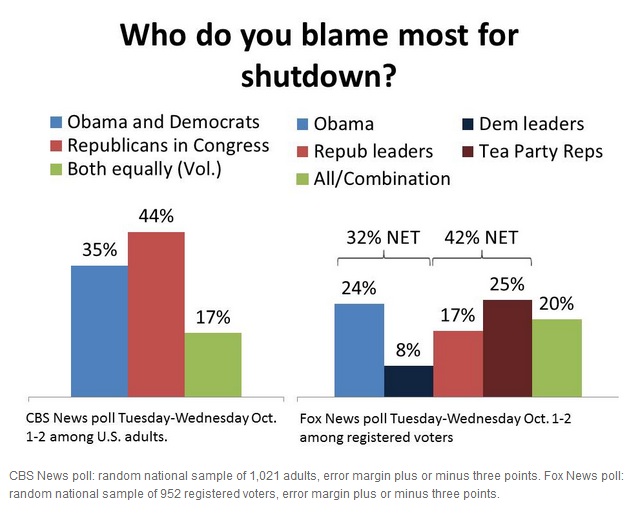
    Almost every major news network has been asking its viewers and readers to chime in on “Who’s to blame?”

    poll 3

    Rather than explaining policy, media outlets have framed the shutdown into a simplistic game of winners v. losers, Democrats v. Republicans, Obama v. Congress. Outlets are then using their polling results to create further news articles that act as nothing more than a survey report.

    poll 4

    Their strategy has not been in vain.  During prime-time, Monday through Thursday of the past week, ratings for CNN were up 68%, MSNBC up 54%, and Fox up 49%. As viewers continue to tune in, we are left begging the questions: Is the press providing an informative medium for exercising the public’s right to know? Or has the shutdown turned into another political spectacle for media to cash in on?

    – Savannah Valade