Tag: Branding

  • Deceptively Skinny

    How can a company or brand draw traffic to its website? How can a retail store capture people’s attention? Maybe by doing this:

    Released on March 20, 2013, American Eagle invited us to go to their website to purchase our own pair. If this is the first time you have seen or heard about this commercial, you might be wondering what is going on with those jeans and what is American Eagle doing? Thankfully, they are not actually trying to sell these “limited edition” Skinny Skinny jeans. The “jeans” featured in the commercial are in fact spray paint on the models, which American Eagle isn’t trying to sell either. I don’t think anyone wants that trend to start! Their goal with this ad campaign is to grab our attention, which I think it did. The commercial leaves viewers slightly confused and wanting to know more, and the obvious place to look for answers is American Eagle’s Website, which draws in traffic.

    Here you see the two “styles” of jeans, which are indeed spray paint cans. Prior to April Fools Day, it appeared you could buy the spray paint, but it was (always) out of stock. However, you could sign up to receive an email when more paint was available, resulting in the company capturing your email address. Now when you go to their site, you can receive a coupon for $10 off REAL American Eagle jeans.

    This campaign, while strategically deceptive, seems to be successful. As James Twichell explains in Lead Us into Temptation, “What advertising does and how it does it has little to do with the movement of specific goods.” This commercial was strategic in this way because it does not advertise a specific product, or even a product at all. The campaign, I feel, had more to do with American Eagle’s brand image and drawing attention to the brand. As Bob Holobinko, American Eagle’s vice president of brand marketing, said, “we just wanted to have fun, and have fun with our fans, and it was a good opportunity to kind of push it from a brand standpoint and the response has been incredible.” Taking a risk to deceive yet entertain their audience was worth it.

    While I commend their creativity and think this campaign is quite clever, I wonder what the impacts are for the future of advertising, especially the lines of deceptive advertising. While entertaining, it is deceptive from the commercial to the appearance that you can indeed purchase the spray cans. However, people tend to find this acceptable because it is rather funny and ten days later:

    AE April Fools

    So, do you think this kind of deceptive advertising is acceptable because of its entertaining and playful nature? Or do you think advertisements like this could lead to more issues and mistrust about the nature of advertising?

    Laura Tippett

  • Advertising Pranksters FOOL Consumers

    Bacon flavored mouthwash, lunchmeat DVDs, and glass-bottom airplanes?? This year’s April Fools holiday has caused an eruption of many brands’ foolish pranks going viral on social media. Some brands have even gone as far as creating spoof commercials and print ads along with their playful posts and tweets.

    For example, the P&G brand, “Scope” ran an ad on Facebook promoting their new “Bacon Flavored Mouthwash.” As you can see below, the company created a video spoof and several advertisements with catch phrases such as “Taste breakfast while washing it away” to promote this fictitious new product before they came out with the final phrase, “APRIL FOOLS!”

    Another brand having fun with this holiday is the movie rental company, Red Box, who is advertising “Sandwiches at Redbox.”

    To keep up with their April Fools promotional efforts, Red Box noted that they will be offering 50 cents off their rentals today only by entering the promo code “APRILFOOLS.”

    Virgin Atlantic Airways founder Richard Branson fooled customers in his blog featuring a new “glass-bottom airplane.” (Not for those afraid of heights!)

    The main reason marketers have chosen to embrace April Fools Day pranks is to make consumers laugh and create a lasting impression. However, these advertising pranksters may have another prerogative: by playing April Fools jokes via social media, these brands have the opportunity to go viral and target the new generation of social media natives.

    I think this is a smart tactic for advertisers as it shows that they can poke fun at themselves while promoting a playful culture that consumers can enjoy. Furthermore, as these spoofs go viral, they are gaining more traffic to their company webpages where actual products can be marketed and sold.

    Daniel Kahneman, author of Thinking Fast and Slow introduces the idea that our minds are associative machines where there are two systems at work. While advertisers may be promoting fictitious products to fool consumers, they are also taking advantage of our associative minds. By being playful and enjoying the holiday, consumers may associate these brands with being lighthearted and fun, further promoting a positive brand image.

    All in all, these April Fools pranksters have the right idea: using humor in advertising and focusing on building relationships with consumers should lead to a more positive brand image and (hopefully) increasing sales!

    Julia Tompkins

  • Reaching New Heights in Creativity

    How many billboards do you take notice to on your daily commute? I honestly could not recall the last one I saw or what it was promoting. I am sure I am not alone in this realization. These strategic advertisements are lined down the highway like dominoes, yet many do not even double take to see what they have to offer. That is the point, right? To be noticed? I am sure that advertisers do not spend thousands of dollars on outdoor advertising just to have it passed by without a second thought. However, surprisingly 71% of drivers notice billboard ads according to an article entitled The Strange Impact of Billboard Advertising. With that being said, agencies have some ammunition for their brands if executed correctly. Even though we may not remember every advertisement we pass, we are subconsciously taking it in. The challenge is to effectively present your brand so that they work as effectively as they are intended to. Here are a few that are quite bold and competitive:

    Okay, so we know, statistically speaking, they work well but the question is: what makes billboard advertising effective enough? The whole purpose in this choice of advertising is not to be informative, I mean we only have about 4 seconds in the drive by to take it all in, but rather to create a lasting impression of the brand. Stephen Littlejohn puts it well in his textbook on “Theories of Communication.” In chapter 7 he discusses the idea of ‘Message Reception and Processing.’ This theory implies that a communicator has 2 levels of intent: informative intention and communicative intention. Informative intention hopes that the audience is made aware of something and communicative intention being that the audience realizes the purpose of it. That is the goal with outdoor advertising. Within a matter of seconds the viewer should be visually made aware of the brand or product. Then, the advertiser has hopes that they made a big enough statement that they remember the brand, even if it is triggered in the depth of our sub-conscious somehow.

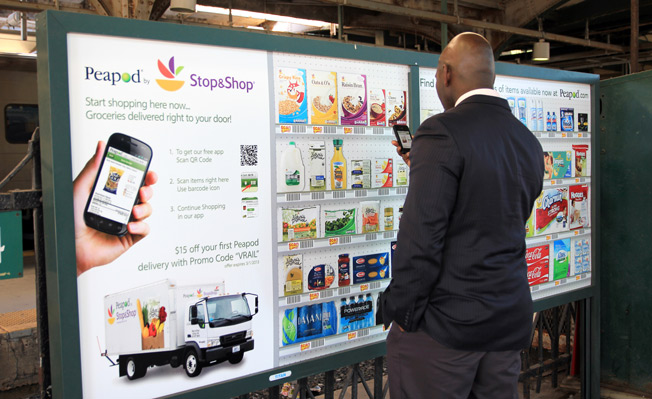
    What does this mean for advertising? In order to make the impression on people that they hope for, advertisers have to aim to be engaging, bold and informative all at the same time. The brands and products are resting on a visual representation…telling a story. Some of the ones seen today have accomplished just that and have been very beneficial to maintaining their brand names.  For example, the creative “Peapod” allows those on foot to access an interactive screen when they need to complete a quick grocery shop. Shopping on the go has never been easier. Image

    The target audience for this display is those who lead busy lifestyles and don’t permit much time to complete daily necessities. This type of shopping is entertaining and even seems enjoyable. The user-friendly screen only requires a smartphone, the free ‘Peapod’ app, and a quick wave over the bar code to scan the image above it. Instant groceries are right there, only a scan away.

    Needless to say, advertising is making some huge improvements in their promotion of products via billboard ads. The article 40 Absolutely Brilliant Billboard Ads displays images of some of the most recently developed billboards which have been highly effective.It seems that Outdoor Advertising is finally reaching new heights in creative presentation, communicating to the public that they are something worth looking at!

    -Katelyn Alston

  • Have You Experienced the Rainbow?

    If you haven’t been to the Skittles website in a while (or perhaps, ever) now would be a good time to take a peek.  What you might expect to be a typical site, designed to provide advertisement and purchase opportunities, has undergone quite a facelift.  Unlike most sites, the website for Skittles has been reborn as a social media machine disguised as a blog.  Near the top of the page is the familiar Skittles slogan, “Taste the Rainbow.”  Scroll down a bit, and you’ll find an entirely irrelevant tweet from the Skittles Twitter account. @Skittles says, “It’s all fun and games until the chinchillas show up with the karaoke machine.” Next come a few phrases like “lace the train slow,” “trace the vein bro,” and “encase the faint glow,” all with coordinating pictures and all rhyming with the original slogan of “taste the rainbow.” Add a few quirky videos, more interesting tweets from fans, and many opportunities to share things via social media, and  you’ve pretty much summed up Skittles’ entire online marketing tactic.

    The Skittles commercials take on a similar level of oddity as their website.  Whether it’s a teenager catching “Skittles pox” from a “highly infected” friend with the message to “contract the rainbow,” or a guidance counselor eating Skittles out of a student’s unibrow with the message to “pluck the rainbow,” these commercials seem to be getting stranger and more extreme year to year.  So, do these weird messages work to promote their product?  Their 23 million Facebook fans, 47,000 followers on Twitter, and nearly 10 million views on YouTube would suggest that they do.

    As a product that has been a favorite with candy-lovers since their appearance in 1979, Skittles has little need for getting their brand noticed so much as keeping their brand relevant.  That’s exactly the idea behind their weird marketing.  By showcasing their social media followers on their website, and giving fans something different to talk about, Skittles is making people rethink what they already know about Skittles and driving them back to their brand.  The genius behind this tactic is that the product hasn’t changed.  What they are changing is stated right at the top of their site.  “Experience the rainbow.”  Skittles is changing the whole experience associated with their little chewy candies in a colorful shell to be more exciting and hilarious than before.

    What seems to appeal to consumers these days, especially to Skittles’ target market of pre-teens and adolescents, is the eccentric and the humorous.  Skittles has mastered both of these arts.  Not only are they staying relevant, they’re staying interesting.  As advertising trends continue to shift, Skittles will doubtless continue to meet the needs of their consumers and remain a favorite fruity snack to all.  The only question now, is what comes next.

    Ally Walton, Hannah Eure, Gene Lee, Lauren Habig, Erin Kiffmeyer

  • “Dare to Soar”

    Colleges and universities are places that can unify people from all over the world.  They have sports, clubs, fraternities and sororities, honor societies and many other groups and opportunities to unify the student body.  Another way schools have started to unify people is with words.

    This year will be the first year with Gary Miller as the chancellor of UNCW.  When he was inaugurated in early May 2011, Miller brought with him a new way of thinking and a new school slogan: “Dare to Soar.”  With this new slogan, Miller wanted to try to echo the school motto, which is “dare to learn,” and bring students together in hopes of achieving higher goals than were previously set.

    Image

    Miller hopes that this new slogan will help build the UNCW brand.  The school already has a very solid brand because of its academic values and Miller hopes this new slogan will further better the brand name.  He hopes that this new slogan will show an aspiration to reach higher goals in the future and reflect the soaring growth of our school.

    As UNC Wilmington students, we noticed the attempt to unite the school and motivate the student body with words. There are many other schools which have created slogans that have utilized powerful words that were intended to convey specific messages to students, faculty, and the community surrounding these colleges. After the shootings at Virginia Tech, the school used the words “Together We Stand” to make sure that the students who had survived the horrific events could all unite to get through the tragedy.

    Some words have been associated with certain campuses for decades. Harvard University, for instance, has the word “veritas” written across the university arms. Originally, the phrase was long and dealt with the truth of Christ and the church. However, today the campus has changed the motto to simply mean “truth” and is a reminder of the morals and standards at Harvard.

    Image

    Many campuses attempt to bring these powerful phrases onto their campus to motivate and unite their students. The question is, do these words always create the campus environment that they are trying to create? Are these words really powerful, or are they just trying to be powerful? How long will the students remember these slogans and mottos?

    Zachary Abramo, Meaghan Beam, Jessica Butner, Jackson Lane

  • The Power of A Few Words

    In society today, there is an abundance of good slogans relating to the worlds of politics and advertising that adorn and surround our everyday life. Although many of these slogans often seem to be utterly vacuous, as they leave us with nothing, slogans still remain a very powerful example of the power of words and how their influence in motivating people and consumers. Advertising incorporates a series of crucial elements such as images, characters and music in order to further make their slogans even more memorable than the next brand or product.
    These often-superfluous gimmicks play a much larger role than one may expect. In fact, in the increasingly complex and ever-changing world we live in, simplicity counts in the form of communication.
    According to www.SloganPower.com, a powerful and efficient slogan should be able to:
    • Convey the essence of your organization or brand
    • Build your corporate or brand image
    • Establish your unique position in the marketplace
    • Attract and retain customers
    • Boost staff morale
    • Liven up your corporate literature
    • Enhance your competitive advantage

    Here are some examples of the most famous and successful slogans in our society:

    I’m lovin’ it – McDonalds
    What Would You Do For A Klondike Bar? – Klondike
    Yes We Can! – Obama Campaign 2008
    Just do it. – Nike
    Das Auto – Volkswagen
    All the news that’s fit to print. – The New York Times
    Let Your Fingers Do The Walking. – Yellow Pages
    Have it your way. – Burger King
    M’m! M’m! Good! – Campbell Soup
    The Citi Never Sleeps – Citi Bank
    Got Milk? – Milk Campaign
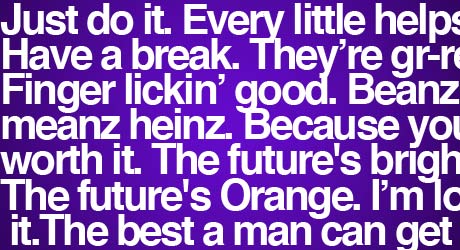
    Have a break. Have a Kit-Kat. – Kit Kat

    All of these examples are very successful slogans that most of us recognize instantaneously. Some of them may even instill sentiment into our hearts for one reason or another. But out of these examples, some stick out more than others. A good example is Nike’s slogan “Just Do It” because it is a very inspirational and successful campaign. The company has turned this slogan into a phenomenon and uses it to brand their products, including everything from t-shirts, to watches, to bracelets, to shorts and shoes, etc. The key is to motivate people to get up and get active, or essentially to go out there and literally “just do it.” These three words are very powerful.

    Today, even our schools have slogans help keep students motivated and give them a sense of community with the school. UNCW recently changed their slogan to “Together We Fly.” A slogan like this not only brands the school well, but it gives the faculty, staff, and students a sense of togetherness. The school then exemplifies a certain image about our university and how well we connect with each other. Bringing a positive image to our school is a huge part of our overall strategic branding. Effective branding will create a greater desire for prospective students to apply here and also help our image overall as an accredited university. Universities all over the world use their slogans to entice prospective applicants to become a part of their alma mater. Everyone in North Carolina knows exactly what school is being discussed when they hear “Tar Heels”.   The University of North Carolina Chapel Hill has established a dominating and elite brand reputation for their school since the 1700’s. When a slogan has motivation combined with pride, it can take the brand to a whole new level of accomplishment.

    Companies and institutions use slogans for a variety of reasons.  There are so many products available today, and consumers are not going to remember each product along with the entire marketing theme associated with such products.  Slogans are easy and catchy ways to grasp the general message that a company is trying to convey.  Just a few words can be extremely powerful in the effort to gain the attention of consumers.

    Sasha De Vecchi, Lindsay Gallagher, Jay Reilly, Cary Welborn

  • Less Cancer, More Birthdays

    “Imagine a world with more birthdays.” Everyone loves a birthday. Birthdays mean parties, presents, cake, maybe a few libations followed by the possible dancing, and just overall merriment. Birthdays celebrate life and represent another year in the world. It is pretty agreeable that birthdays insinuate a good thing and have an overall positive connotation. The American Cancer Society, which hosts Relay for Life-a walking event that is held across the nation and raises millions a year for cancer research and resources, has taken this phrase and integrated it into their marketing campaign to make people rally behind their cause. Now the phrase, “Imagine a world with more birthdays” has an even greater, even tear-jerking message. Imagine a world with less loved ones passing away from cancer and more people being able to be merry and on earth for another year.

    As the designated “Official Sponsor of Birthdays” the American Cancer Society takes hold of the emotional appeal of connecting their cause to everyday life.  The American Cancer Society uses slogans such as “Happy Birthday is a victory song,”  “A world with less cancer is a world with more birthdays” and many others to very effectively draw people into raising funds for the events.  Connecting something scary, like the often terminal illness of cancer, to the happy annual event of celebrating a birthday, something that everyone has, is a very innovative way to put the American Cancer Society’s cause at a relatable level for all.  Everyone may not have cancer, but everyone has a birthday.

    The fact that the American Cancer Society markets their events as a general celebration of life in general makes it appealing to those with cancer or those who have survived cancer because they are fighting and have fought to live and have more birthdays.  It also makes it appealing to those who haven’t had cancer because they get a chance to really celebrate, be grateful for their health, and the fact that they have been able to celebrate their birthdays without fear of them being shorthanded by cancer.  Finally, the message really digs emotionally when it comes to a person who has had a loved one pass away from cancer.  How amazing would it be to be able to celebrate one more birthday with that special person?


    As a society, we understand that messages are being thrown every which way to try to get us to do something.  While the American Cancer Society could use a percentage or amount of money to help get people to support the cause of cancer prevention and awareness, instead they opt to display their organization as one that can bring an immense amount of hope to all audiences.  It’s safe to say the proof is in the pudding.  The American Cancer Society’s Relay for Life had an astonishing 4 million participants and raises about 400 million dollars a year.  With a marketed identity of one that sponsors overall joy, the American Cancer Society has struck a chord causing a strong continued success that many charitable organizations long for.  Happy Birthday must be victory song after all.

    – Alexandra HussCaroline MerrillAlyssa MorrelloLauren Van TrigtDann Williams