Tag: Brand Management

  • 5 Days of Carnival Hell…but the Bathrobes are Complimentary

    Some companies serve as guinea pigs of how not to handle crisis brand management. Unfortunately for the 4,200 suffering passengers, Carnival Cruise Line set an example for the public relations world. The cruise line took a hit, after multiple incidents including the shipwreck of Costa Concordia off the coast of Italy, this past year. Most recently, America followed the second incident of the Carnival Triumph with horror, now commonly referred to as the “poop cruise,” after the ship lost electricity after an on-board fire. Passengers were stranded without electricity, air conditioning or working toilets for five days. As pictures of the floating cesspool emerged, the public watched carefully to observe how Carnival was handling the disaster.

    Carnival Cruise Line did irreparable damage during and immediately following the days of the rescue. Often in crisis management situations, people remember how companies handle the problem more than the actual incident itself. If Carnival had handled the incident accurately and swiftly, our memories of the event could be quite different. In retrospect of the cruise disaster, Carnival took a few costly missteps.

    1. Carnival did not communicate information clearly with passengers and press about the breakdown and rescue efforts.
    2. The CEO, Gerry Cahill, was spotted at a Miami Heat game while passengers were still on board in toxic conditions.
    3. During the press conference before passengers were able to get off the ship, not only did Cahill not properly apologize and take responsibility for the events, his comments minimalized the trauma the passengers endured. He was quoted saying, “We pride ourselves in providing our guests with a great vacation experience, and clearly we failed in this particular case.”
    4. The worst public relations move of all would be the tone-deaf tweet @CarnivalCruise sent out when 2,400 miserable passengers were disembarking from the ship. They tweeted, “Of course the bathrobes for the Carnival Triumph are complimentary.”

    Image

    http://i.dailymail.co. uk/i/pix/2013/02/14/article-2278616-1796A0C1000005DC-636_634x83

    Public relations and crisis management should understand the importance of how one incident can affect a brand. America’s limited attention span means acting strategically and promptly. Several months later, CEO Gerry Cahill resigned and Carnival Cruise Line offered their customers a “Great Vacation Guarantee” for unsatisfied customers to be able to get off the ship within 24 hours with a full refund. Brand management becomes more difficult once the damage is initially done. Will Carnival Cruise Lines campaign to regain trust be successful? Only time will tell.

    -Rachel Edwards, Ashley Creps, Dylan Fowler, and Ryan Nagy

  • America Runs on Dunkin’, but Will They Stay?

    Dunkin’ Donuts prides themselves in promoting their image as the coffee spot for the average Joe. However with Starbucks and McDonald’s as competitors, Dunkin’ Donuts has decided to revamp their stores in an effort to pull in more upscale coffee drinkers. Dunkin’ Donuts is now attempting to reach customers that are interested in the coffee-drinking experience rather than just a quick morning pit stop. Owners have the ability to choose from four different schemes that they can remodel their store as. These themes include “Original Blend,” “Cappuccino Blend,” “Dark Roast,” and “Jazz Brew.”

    Image

    -Pictured above is the “Jazz Brew” scheme.

    By redesigning their stores, Dunkin’ Donuts hopes to give their customers a better overall experience. In turn, customers will be more likely to form a strong attachment with their brand and chose them over Starbucks or McDonald’s.  Just as the CEO of Starbucks states in a quote from author Bryant Simon, “I think we have managed to, with a simple cup of coffee and a very unique experience, enhance the lives of millions of people, by recreating a sense of community, by bringing people together and recognizing the importance of place in people’s lives.” If Dunkin’ Donuts would like to be able to brand itself as what we call in IMC, a “third place,” they will have to take a page out of Starbucks’ marketing plan to create an atmosphere that draws people in to not just drink coffee, but stay.

    Image

    -Pictured above is the “Cappuccino Blend” scheme.

    So far the new change in atmosphere has led to positive results for Dunkin’ Donuts. The remodeled locations include new additions such as faux-leather chairs, digital menu boards, and relaxing music. These changes have already fostered a greater sense of community because more business professionals are stopping in around lunch time for business meetings and interviews.

    Improving the consistency in the appearance of their locations, Dunkin’ Donuts can reach a stronger brand identity. It is evident that their stores need to be redesigned after receiving the second lowest atmosphere score for beverage and snack shops in a 2012 survey done by Nation’s Restaurant News and WD Partners. As of June the company had redesigned 90 locations and hopes to have 600 finished by the end of 2013. Have you recently been to a Dunkin’ Donuts and noticed a difference in the atmosphere? Have you wanted to actually sit down and stay a while?

    -Aaron Love, Kara Zimmerman, Rachel Clay, Rebecca Hobbs

  • The Apple of Consumers’ Eye

    Everyone wants a bite of the Apple – Apple Inc., that is. The company has innovated the world of technology ever since the release of its first computer in 1976. Since then we have witnessed the evolution of all of their products, particularly the iPhone. Extreme supporters of the brand have been known to camp out in line for hours, even days, to get their hands on the newest version of the phone, and on any given day it’s not uncommon to hear the familiar sound of the iPhone ringtone. So what’s the secret to their success? The answer is their brand management.

    Part of the allure of Apple is its exclusivity. Apple Inc. was originally thought of as a company that offered products for rich professionals ahead of their time, and Apple seemed to be ok with that.  However, the creation of the iPod and then the iPhone expanded Apple’s brand to reach a larger demographic. The iPhone was groundbreaking in its launch in 2007 because it offered its customers an innovative smart phone, at a price that was in reach of most middle class Americans. Despite the fact that the iPhone was still significantly more expensive than others at the time, more people were able to join the Apple family because it was cheaper than many of its other products. People that purchased the iPhone still had money, but could justify spending the extra cash for the features it provided. Even today the iPhone is arguably in a class of its own, and has become the gold standard in the smart phone industry.  But the craze hasn’t ended. Apple announced it would be releasing not one, but two new significantly different, versions of the iPhone this fall: the iPhone 5s, and iPhone 5c.

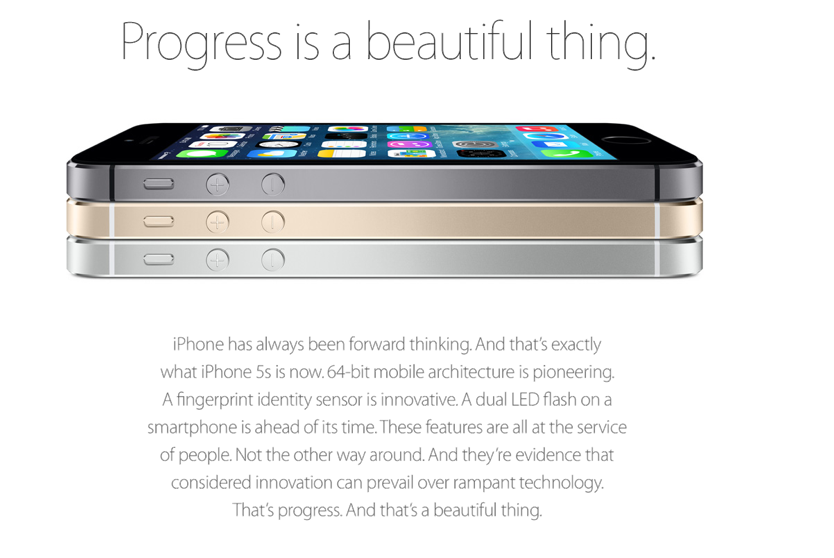
    The iPhone 5s is aimed at the same people who Apple has always targeted. It is the advanced version of the 5– still pricey, with the same design of its glass face and back. The newest features include on top of other things, a fingerprint scanner, higher quality camera, and a faster processor. The 5s also comes with a new top of the line operating system, the iOS 7, which technology enthusiasts everywhere have been excitedly waiting for. The 5c is in a completely different playing field.

    Image

    Image

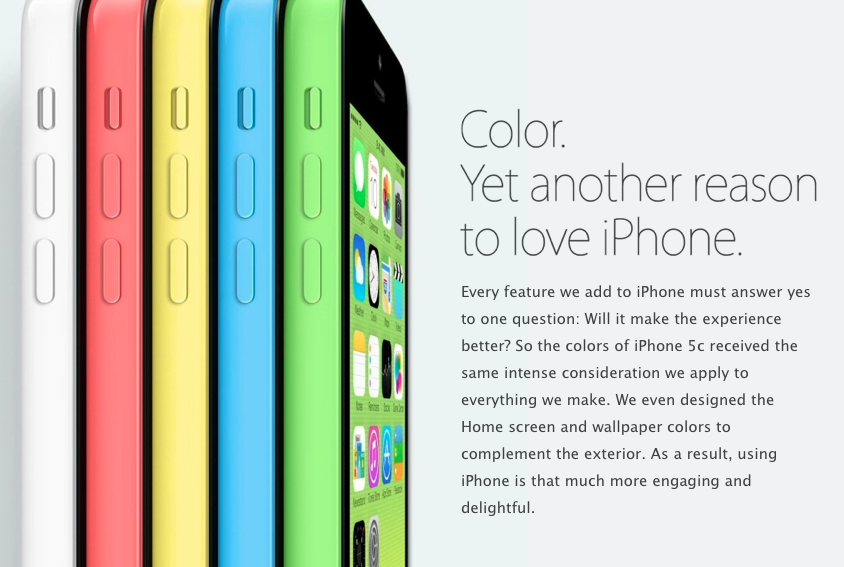
    The iPhone 5c is aimed at a different audience that Apple has never acknowledged. Operating under the new iOS 7 system, the 5c features improvements to the iPhone 5 such as longer battery life, the ability to support more LTE bands, and a slightly improved FaceTime camera. But here is the difference–the design and price. The 5c is plastic and comes in five different colors, and for a 16 GB iPhone 5c you will pay only $99 dollars. This is a 100-dollar difference from the starting price of the iPhone 5s and previous iPhone releases. Apple seems to be catering to potential customers that may not have been able to enjoy the apple experience due to high prices. So why the big change, Apple?

    James Twitchell, author of Branded Nation says, “Pay attention to your brand or lose your business” and CEO Tim Cook explained in Apple’s September keynote speech, “This allows us to serve even more customers.” So what do we make of all of this? With market prices that are less expensive than the average competitor prices, Apple appears to be confident reaching out to the completely new demographic. But will this help them beat out competition? Is it showing the public that competition has become a threat to the all-mighty iPhone? Will it turn off loyal customers who pride themselves in being able to afford the Apple experience? Only time will tell if introducing the 5c with the 5s will benefit the Apple brand.

    -Caroline Robinson, Jade Lester, Meghan Carey, Morgan Jones, Savannah Valade

  • Kmart Goes Back to School

    “What up y’all, it’s dem kids again” is the intro to the newest Kmart back to school commercial. The commercial, which is in the form of a music video, is being called racist by it’s viewers and is causing a stir among consumers.  The ad features a young hip hop group called “Da Rich Kidzz” who rap about the newest back to school trends.  Kmart’s attempt to appeal to the popularity of today’s hip hop culture has actually done the opposite of what their marketing strategy intended to do.

    The design of the commercial targeted a small demographic, causing their brand image to be misconstrued.  With the majority of the children in the video mimicking stereotypical rap video dancing and using incorrect grammar, it is easy to see how the message of the commercial could be misinterpreted.  Although it is safe to assume Kmart did not intentionally create the advertisement to bring negative light upon themselves, they are now faced with rebranding and reevaluating their marketing strategy.

    With all of the current back to school advertisements out at this time of year, it makes us wonder why Kmart chose to go this route with this campaign. With lyrics containing slang and grammatical errors such as “dem” and “can’t no one pass,” Kmart made the attempt to draw in the youth who listen to hip hop. Instead of making themselves stand out in a youthful way among the traditional back to school commercials, they further narrowed their consumer base.

    According to an article on Business Insider, Kmart’s brand has been suffering for the past six years.  After viewing the advertisement, would you be inclined to shop at Kmart for back to school items? Could this be Kmart’s last attempt to gain back a significant customer base? Seeing as how they have not made a public statement in response to the racial backlash, it will be interesting to see whether or not this campaign will pay off for Kmart.  To have a successful marketing campaign strategy, a business must always be able to recognize who their publics are.  They must also know that by alienating a certain demographic they have to expect that there will be positive and negative effects.

    When all is said and done, Kmart was successful in being memorable.  However, will their sales, in turn, reflect in a positive way?

    -Aaron Love, Kara Zimmerman, Rachel Clay, Rebecca Hobbs