Tag: brand

  • The Evolution of an Icon: Lady Gaga’s Brand Image

    This year’s Super Bowl showdown between the Atlanta Falcons and New England Patriots is just days away. More than 100 million people tune in to the football game annually, but many of these people only care about the iconic halftime show performance. Over the last few decades, some of the world’s biggest stars have hit the stage, drawing in viewers from all walks of life. This year’s Super Bowl halftime performer is the one and only Lady Gaga.

    maxresdefault

    When Lady Gaga came onto the pop music scene in 2008 with her hit single “Just Dance”, the world did know that a pop culture icon was being born. Over the next few years, she would go on to release single after single that topped the charts. Her fame grew exponentially and she gained a loyal fan following that would praise her every move. Lady Gaga began to refer to herself as “Mother Monster.” Gaga sent a message to the world that she embraces the weird in people rather than criticizing them, and encourages her fans to not be afraid of being a little different.

    Aside from her music, one of the most iconic aspects of her brand image would have to be her out-of-this-world fashion choices. Fashion critics and fans alike would anxiously await for Gaga to arrive at red carpet because there was no telling what she would wear next. Lady Gaga’s raw meat dress from the 2010 VMA’s was arguably (but really there is no argument) one of the most memorable fashion statements ever made. 2010 MTV Video Music Awards - Show

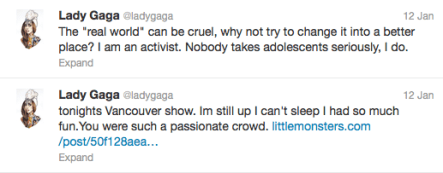
    While Gaga’s fashion choices seem to be a little less extreme in recent years, her advocacy for LGBT rights, women’s rights, and against sexual violence have certainly not slowed down. Lady Gaga has used her voice and massive following to fight for the rights of so many people. She has cemented her brand image as someone who advocates tirelessly for equality.
    lady-gaga-joanne-anderson-cooper-starting-conversation-on-sexual-assault-imasurvivor-whywomendontreport-tweet-3
    screen-shot-2013-01-13-at-8-56-35-pm

    With that being said, there is no doubt that Lady Gaga’s half time performance this Sunday will be anything short of iconic. What will she do with this massive platform? I think it is safe to say that a statement will be made. Do you think Lady Gaga will send a social message? Bring back the (now very very aged) meat dress? Or will she just captivate the world with her amazing vocals?

    Leave a comment down below telling us your 2017 Super Bowl half time performance predictions.

    -Jaime Mangold


  • So If I Make A YouTube Video Will I Get Famous Too?

    pewdiepie

    Felix Kjellberg aka PewDiePie

    “Creativity out of necessity.” In 2005 the most successful free video streaming site was created by three college graduates who had a major dilemma…

    …They couldn’t find footage of the famous Janet Jackson “wardrobe malfunction” during the 2015 Super Bowl halftime show….

    And so YouTube was born.

    YouTube has evolved to so much more than a free and easy way to see inappropriate videos of celebrities. Now it’s so sophisticated that people can earn their livings video blogging, or vlogging, about anything they want. The site started with one unfortunate (or maybe fortunate, depends on how you look at it…) celebrity “wardrobe malfunction,” and now YouTube is making a whole new category of celebrities; self-made vloggers.

    bilde

    Jenna Mourey aka Jenna Marbles: YouTube personality, vlogger, comedian, and actress

    Just as YouTube has changed over the years, the vloggers that scramble to be the next big internet sensation have started to move from computer screens to larger ones. Jenna Mourey or Jenna Marbles as she is known on YouTube is the top female vlogger with well over 15 million subscribers which ranks her channel seventh overall. Mourey now can be seen in episodes of Epic Rap Battles in History, Fake n’ Bacon, and Ridiculousness. Hannah Hart who rose to fame with My Drunk Kitchen, and hosting cameos on Mental Floss sat down with People last week to promote her upcoming TV mini-series Electra Woman & Dyna Girl airing in 2016. Then there is PewDiePie, with 40 million subscribers and over 6 billion views Felix Kjellberg has raised YouTube vlogging to an art form. By basically inviting the world into his living room to watch him play video games, Kjellberg makes $12 million dollars a year and is helping to shape the indie gamer market. Like the Oprah effect, when Kjellberg mentions a game it sees a spike in sales.

    According to People.com, these YouTube blogger channels make the most money:

    1. Felix Kjellberg

    – $12 Million a Year

    Channel: PewDiePie

    Subscribers: 40 million

    Shtick: Playing video games and making jokes

    2. Ian Hecox and Anthony Padilla

    – $8.5 Million a Year

    Channel: Smosh

    Subscribers: 21 million

    Shtick: Live-action comedy sketches

    3. Benny and Rafi Fine

    – $8.5 Million a Year

    Channel: Fine Brothers Entertainment

    Subscribers: 13 million

    Shtick: Reacting to things

    Screen-Shot-2014-07-01-at-11.40.44-AM

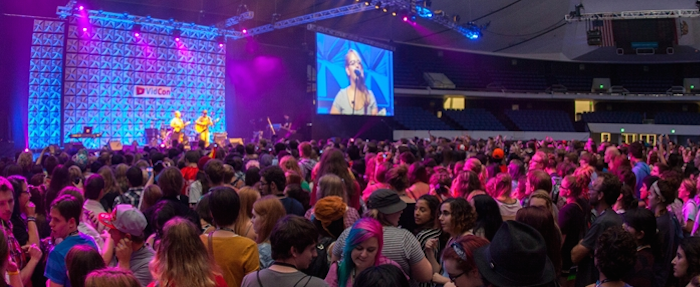
    2014 VidCon Youtuber Convention

    YouTube has become so popular that they have dedicated a whole convention, VidCon, to the videos and YouTube “stars”.  VidCon features workshops and speeches on how to launch your own YouTube career, video highlights, and YouTube celebrities waiting to meet their fans.  For a few hundred dollars fans can attend the three-day conference, with varying levels of entry to events.  Tickets range from general entry at only $100 for the “Super Early Birds”, to $750 for the Industry Standard Price.  For those interested in the online video industry beyond basic video production the industry ticket is the way to go.VIdCon offers a variety of events for industry professionals including: seminars, keynote speakers, and helpful tips on how to use online video to promote your company.

    There are many benefits for marketing your brand via YouTube:

    1. Capturing attention: Posting creative content on YouTube is an easy way to catch viewer’s attention.
    2. High Traffic Volumes: There are over 1 billion users on YouTube which is an excellent platform to reach people all over the world.
    3. Viral Marketing: YouTube videos are easily shared between friends and family members and can be shared with others, thus creating a ripple effect.
    4. Multiple Video Marketing Channels: Creating and posting videos to YouTube is a powerful and recognizable way for users to view your content.
    5. Search Engine Rankings: Google owns YouTube, which why it is so highly ranked when you search for videos on Google’s page.
    6. Social Media Marketing Integration: YouTube videos can be shared via email, Facebook, Twitter, Linkedin, Reddit and other social media platforms.
    7. World-Wide Accessibility: Posting content on YouTube can be seen in 75 different countries, since YouTube is available in 61 languages. This is one the most effective marketing strategies since YouTube is available 24/7.

    Who are your favorite YouTube stars? Do you have your own YouTube channel? Share with us in the comments below!

    Aki Suzuki, Carey Poniewaz, Carey Shetterley, Lexie Trimnal, June Wilkinson

  • Carolina BalloonFest

    Screen Shot 2015-10-19 at 1.52.45 PM

    What is it?

    Every year Statesville, North Carolina hosts the annual Carolina BalloonFest.  This is a three-day event full of hot air and fun.  With over 50 hot air balloons taking to the sky, Carolina BalloonFest will definitely leave you speechless.  This festival consists of numerous family-friendly events to keep everyone entertained.  From hot air balloon rides to a balloon 5k run, this festival has a little of everything.  The festival includes: ballon viewings, balloon flights, live music, beer and wine tasting, kite making and much more.

    Screen Shot 2015-10-19 at 1.52.34 PM

    Tickets are $10 dollars and can be purchased onsite at the festival.  For more information regarding the festival see: http://www.carolinaballoonfest.com.

    For a Cause

    Each year the festival chooses a variety of local charities to support.  Last year, over 17 charities received donations from the event.  Distributing over $76,000 dollars last year, Carolina BalloonFest not only provides fun and entertainment to the community, but also, a helping hand to those in need.  The organization states on their website that over the past five years they have contributed over $274,000 dollars to the community.  Ranging from cancer organizations to Boy Scout troops, many benefit from this weekend of fun.

    Screen Shot 2015-10-19 at 1.52.06 PM

    Com as Design

    Think of words you would use to describe fall.  Was “festival” one of the words?  To many, fall means dedicating weekends to a vast variety of festivals.  County fairs, pumpkin patches, corn mazes, and apple picking are all part of the fall theme.  But what is it we find so attractive about these events?  Is it the goods sold at them?  Or the idea of a group of people coming together for a united reason?  The design an organization or company decides to pursue for an event is very important.  Promoting what their target markets will find most attractive is crucial.

    By focusing on language in their design, Carolina BalloonFest uses phrases such as “help continue our charitable mission” and “experience the magic” to persuade their target audiences to attend their event.  This organization has decided to put a large emphasis on the charitable aspects of the festival.  The website has a section labeled “Our Mission” that describes exactly what charities benefit from the proceeds.

    The festival also places a large emphasis on being family-friendly.  Adding a list of activities that will take place over the course of the event, Carolina BalloonFest uses strategic naming of these activities to catch a parents’ eye.  “Kid Zone,” “Kid Fun Run,” and “Learning Center” are a few examples of designing language to fit a certain target market.

    Screen Shot 2015-10-19 at 2.02.27 PM

    It is clear when dealing with communication, design is key.  Remembering the power of design aspects, such as language, will ensure that you are successful in your communication efforts.

    Sources:

    http://www.carolinaballoonfest.com

  • PepsiCo Kickstart’s Spring Break 2014

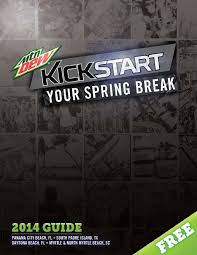
    At the start of every year, the Collegiate Marketing Group publishes a Spring Break Guide for college students across the nation. The guide was first published in 1992 providing travel tips, destination news and information on everything about Spring Break.

    kickstart

    The Collegiate Marketing Group specializes in the youth market and basically owns all territory related to Spring Break marketing. Their Spring Break Guide reaches an estimated one million students including the print and web publication as well as the students on social media.

    This year, Pepsi’s new Mountain Dew energy drink, Kickstart, is the featured annual sponsor, replacing Coca-Cola. The shift in sponsor seems to be due to PepsiCo’s efforts in supporting the Mountain Dew brand.

    kickstart2

    Kickstart was introduced in February 2013, and sales surged to more than 100 million in the first 6 months. PepsiCo is planning on supporting Kickstart even more in year two. Kickstart was given a 35% media spending boost compared to its first year on the market.


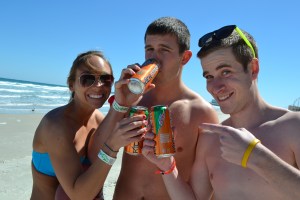
    This 35% can already be seen through the increased spring break advertising PepsiCo has been sponsoring. There are a number of things that PepsiCo reveals about themselves by choosing to spend their marketing budget on college spring break guides.  The first is that it identifies PepsiCo’s target audience for this campaign. A second thing is they are trying to associate this drink and its brand with the spring break scene (party, lights, sun, fun, etc).

    kcikstart3

    While these 2 things stand out, there are many other things to examine in this campaign.  While you are on spring break, will you notice Kickstart and give it a try? We’ll see how PepsiCo and Kickstart do with their promotional campaign.

    – Rachel Gracy & Greg Rothman

  • You can’t have your Coke and drink it too

    It’s one of the pillars of successful marketing, target your audience. Individualizing ads to particulars groups or regions of consumers ensure that messages have the most impact. But what happens when a company features a controversial scene in a spot, then removes it for some audiences and not others? Good marketing move or failure to take a stance?

    In its newest global campaign, “Reasons to Believe” Coca-Cola set out to inspire consumers that no matter what happens in life, it’s those small happy moments that make life worth living.

    Check out the commercial below.

    In most European countries the ad contains a scene of two gay men holding hands in front of their wedding party. However, in the Irish version (the video below) the scene has been replaced to feature a bride and groom.

    The Irish LGBT publication, EILE Magazine, brought attention to the issue, calling the removal an “inexplicable move”. In response to the criticism, Coca-Cola said that the advertisement had been tailored to individual markets so that the ad resonates with the people in each country where it is shown. The company defends the decisions saying that grooms were excluded from the Irish version because gay marriage is not legal in the country. EILE Magazine claims the Coca-Cola reasoning moot. The footage of the two grooms is known to be a video clip from a same-sex union ceremony in Australia – equivalent to a civil partnership in Ireland. Yet gay marriage is also illegal in Australia, but shown there. EILE claims the spot should have been suitable for Ireland as well.

    Coca-Cola has unequivocally made public their supporting stance on same sex marriage. Since 2006, the Human Rights Campaign continues to award Coca-Cola with a 100 percent ranking of their company polices and practices regarding LGBT. The Coca-Cola Company notes on their website, “To achieve a perfect score, companies must have fully inclusive equal employment opportunity policies, provide equal employment benefits, demonstrate their commitment to equality publicly and exercise responsible citizenship”

    Many are saying that Coca-Cola’s recent actions were hypocritical. Coca-Cola claims to support gay marriage, but their choice to remove a gay marriage scene from a commercial in Ireland, in which law does not prohibit such imagery, is misleading of the company’s values. Similarly, another beverage icon, Starbucks, has also gained attention for their hypocritical actions.

    Bryant Simon discusses the company Starbucks in his book Everything But the Coffee. Through his research he comes to discover that Starbucks isn’t delivering what they are promising in their brand – good coffee with little environmental impact. Claiming to buy fair-trade coffee from Rwanda and Nicaragua farmers, Starbucks was actually buying from bigger farmers and only buying 5-6 percent of fair-trade out of all the total coffee purchases.

    Much like Starbucks claiming to be environmentally friendly yet not taking the necessary steps in order to be green, Coca-Cola’s actions were just as misleading; claiming to support gay marriage yet removing a scene from one version of a commercial for the sole purpose of trying to please everyone.

    As future and current brand ambassadors we have to remember that every decision we make, including company policy decisions, become an integral part of brand, and when decisions are made that contradicts that it hurts the brand.

    On the other side of things, as consumers (and as Simon states in his book) we have to remember pursuing “solutions to highly complex social problems through buying and buying alone” doesn’t fix the problem or change the ideology. We have to stop relying and believing that buying certain brands is going to change a social issue.

    So, does Coke’s decision to take out the gay marriage scene hurt its brand identity? Should companies take stances on social issues? What practices do you follow to make sure this brand conflict doesn’t occur in your company or with your clients?

    Savannah Valade, Caroline Robinson, Elizabeth Harrington

  • Name Changer

    Tailgating, body paint, jerseys, good luck rituals, and an unparalleled fraternity all exist as part of sports fandom. People love their teams – and love anyone else who also loves their team. Such loyalty has become an integrated part of sports culture sociology.

    Social Identity Theory states that by wearing team colors, attending games, knowing the players’ names, positions and stats, a fan begins to feel as if they are an integral part of the team – they connect with the team as if they were playing the game themselves. This connection explains why even poor performing teams have avid supporters. However, it is ultimately marketing that fosters fan identity. After all teams are brands; encompassing colors, logos, and mascots.

    fans, blog 3

    Fan loyalty has elevated sports to become part of our commodity culture; a product to be bought and sold, meaning big bucks for team owners. High-level sport has been transformed into a commercialized, commodified, and massified phenomenon. Therefore, fan identification and brand commitment become two key factors in managing and marketing a team. Building a brand is hard, but building and maintaining a culture of fans is much harder.

    As we transition into fall, we know that means one thing in sports,  football is king. With the NFL season in bloom, one team in particular, the Washington Redskins, are off to a rough start. The return of RG III has been very anti-climactic and on top of the team’s poor performance, a greater worry looms in the background: the franchise is under pressure to change the team name.

    Many believe the team’s name, “redskins”, is derogatory and racist due to its historical connotation and use to alienate and belittle Native Americans. The acclaimed Peter King from sports illustrated has even decided to stop using the name, saying, “I don’t want to add to the offensiveness.” Pressure to change the team’s name has been mounting for years and this past spring 10 congress members sent letters to the team owner and NFL requesting them to change the name. One Native American group, the Oneida Indian Nation, has started to take action and run ads in D.C. about the offensive name in hopes of rallying up support.
    rs logo, blog 3

    Whether you are an avid supporter for the name change, an avid supporter of the Redskins, or just don’t care, you can’t deny that team names mean a lot in the sports industry. Which leads us to the question: does a new name mean a new team? Does the team culture change when a team redesigns?

    These are exactly the questions the NBA juggled this past summer when they chose to revert the Charlotte Bobcats back to their former team name, the Charlotte Hornets. Coming onto the basketball scene in the ’90s, the Charlotte Hornets created a unique culture. With Hugo the Hornet as the mascot and teal uniforms, the Charlotte Hornets were a recognizable brand. So when the NBA decided to change the team name it was a hard transition for many loyal and devoted fans. Unable to identify with the new team and culture the fans gave up support and the fall of the Bobcat brand ensued.

    Reverting back to the original team name rejuvenated Charlotte fans. There was an immediate increase in the amount of ticket sales; quantitative proof that the Hornet name had been sorely missed. By keeping the team name consistent with what the fans wanted, the Charlotte basketball team re-strengthened their brand significantly.

    However, Washington, unlike the Bobcats, doesn’t have a sorely missed brand. In fact, the Redskins name is so beloved the proposition of changing the team’s name is being met with great opposition. Owner Daniel Snyder commented he would never change the name saying, “the Redskins’ fans understand the great tradition and what it’s all about and what it means.” Even NFL Commissioner, Roger Goodell, described the team name as a “unifying force that stands for strength, courage, pride, and respect.”

    Even if Snyder wanted to change the name it would be hard to change the minds of brand followers who have spent years identifying with the team, purchasing the merchandise, rooting for the players, and most importantly making memories. Ditching the derogatory name may ultimately come to a forced decision but the implications involved are massive. It boils down to a relatively simple equation: fan identification and brand commitment work together to produce the main goal in sport commodity, revenue. So the most important factor to ponder: the fans. How is the team going to remarket and rebrand to get fans to commit to a team they may no longer identify with?

    Savannah Valade, Caroline Robinson, Meghan Carey, Morgan Jones
  • The Apple of Consumers’ Eye

    Everyone wants a bite of the Apple – Apple Inc., that is. The company has innovated the world of technology ever since the release of its first computer in 1976. Since then we have witnessed the evolution of all of their products, particularly the iPhone. Extreme supporters of the brand have been known to camp out in line for hours, even days, to get their hands on the newest version of the phone, and on any given day it’s not uncommon to hear the familiar sound of the iPhone ringtone. So what’s the secret to their success? The answer is their brand management.

    Part of the allure of Apple is its exclusivity. Apple Inc. was originally thought of as a company that offered products for rich professionals ahead of their time, and Apple seemed to be ok with that.  However, the creation of the iPod and then the iPhone expanded Apple’s brand to reach a larger demographic. The iPhone was groundbreaking in its launch in 2007 because it offered its customers an innovative smart phone, at a price that was in reach of most middle class Americans. Despite the fact that the iPhone was still significantly more expensive than others at the time, more people were able to join the Apple family because it was cheaper than many of its other products. People that purchased the iPhone still had money, but could justify spending the extra cash for the features it provided. Even today the iPhone is arguably in a class of its own, and has become the gold standard in the smart phone industry.  But the craze hasn’t ended. Apple announced it would be releasing not one, but two new significantly different, versions of the iPhone this fall: the iPhone 5s, and iPhone 5c.

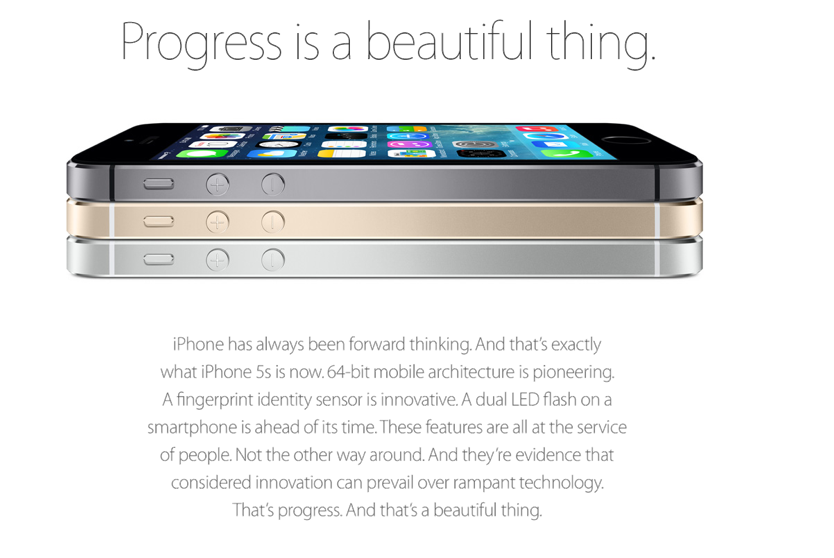
    The iPhone 5s is aimed at the same people who Apple has always targeted. It is the advanced version of the 5– still pricey, with the same design of its glass face and back. The newest features include on top of other things, a fingerprint scanner, higher quality camera, and a faster processor. The 5s also comes with a new top of the line operating system, the iOS 7, which technology enthusiasts everywhere have been excitedly waiting for. The 5c is in a completely different playing field.

    Image

    Image

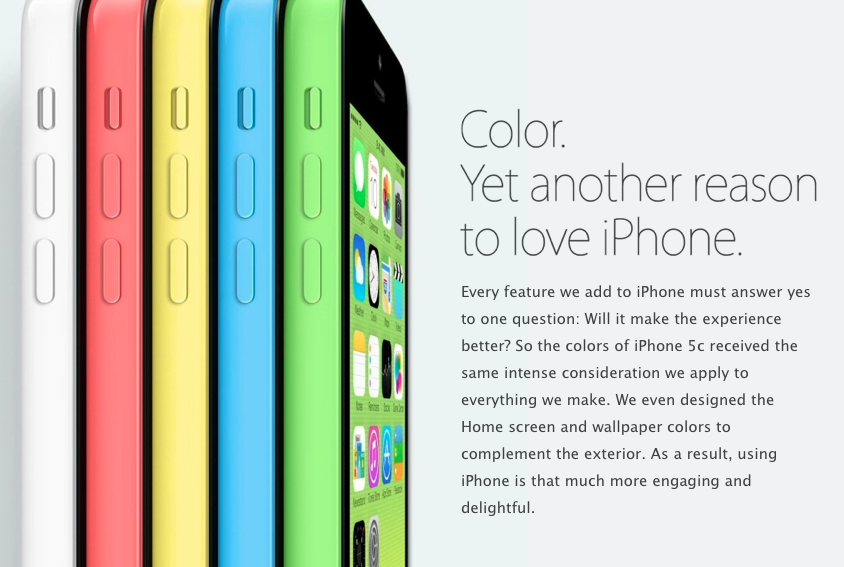
    The iPhone 5c is aimed at a different audience that Apple has never acknowledged. Operating under the new iOS 7 system, the 5c features improvements to the iPhone 5 such as longer battery life, the ability to support more LTE bands, and a slightly improved FaceTime camera. But here is the difference–the design and price. The 5c is plastic and comes in five different colors, and for a 16 GB iPhone 5c you will pay only $99 dollars. This is a 100-dollar difference from the starting price of the iPhone 5s and previous iPhone releases. Apple seems to be catering to potential customers that may not have been able to enjoy the apple experience due to high prices. So why the big change, Apple?

    James Twitchell, author of Branded Nation says, “Pay attention to your brand or lose your business” and CEO Tim Cook explained in Apple’s September keynote speech, “This allows us to serve even more customers.” So what do we make of all of this? With market prices that are less expensive than the average competitor prices, Apple appears to be confident reaching out to the completely new demographic. But will this help them beat out competition? Is it showing the public that competition has become a threat to the all-mighty iPhone? Will it turn off loyal customers who pride themselves in being able to afford the Apple experience? Only time will tell if introducing the 5c with the 5s will benefit the Apple brand.

    -Caroline Robinson, Jade Lester, Meghan Carey, Morgan Jones, Savannah Valade