Tag: AT&T

  • “Did I do that??”

    With a week full of fails, I imagine that readers will display a facepalm or two. Ad fails are fairly common and many are laughed off and explained through the phrase, “Everyone makes mistakes.” While ad fails often hit us in our funny bones, some offend readers far more than expected. This past year, AT&T and Esquire Magazine produced some facepalm-worthy ads that hit our country in one of its most sensitive spots: 9/11.

    What was supposed to be an anniversary tribute to those who died in the Twin Towers turned into an outrageous ad for AT&T. The company tweeted the below photo as a 13th anniversary mark of respect to 9/11. The tweet immediately went viral, leading to hundreds of angry comments within minutes that claimed the ad was “tacky” and “tasteless”. The image was pulled from Twitter within an hour, followed by a tweet from the carrier saying, “We apologize to anyone who felt our post was in poor taste. The image was solely meant to pay respect to those affected by the 9/11 tragedy.”
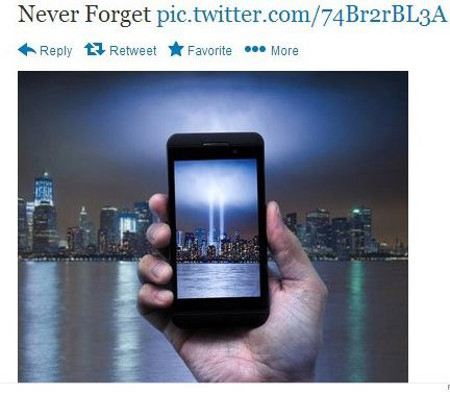
    Image

    It seems that in this situation, AT&T just can’t do anything right. Users of Twitter still were not happy with the apology, admitting that it’s insincerity somehow made the situation worse. Some consumers were so outraged that they threatened to change phone carriers, all because of this ad. In today’s market, finding new customers costs six to seven times more money than it would cost to maintain them. Finding new customers can’t be easy, especially after the bad media attention that AT&T received once the photo was released. If the Twitter comments live up to their words, AT&T could be out a lot of cash by the end of this year.

    AT&T was not the only company to bring the facepalms this past 9/11. Esquire Magazine’s online server accidentally posted an iconic photo next to a headline for another article. Instead of describing it, here’s an example of “a picture is worth a thousand words” :

    Image

    Following the post, Esquire tweeted a half-hearted apology saying, “Relax, everybody. There was a stupid technical glitch on our “Falling Man” story and it was fixed asap. We’re sorry for the confusion.” I imagine that Esquire did not consider their Return on Investments (ROI) when posting this tweet. While such outrage over a glitch may seem silly, taking the time to post a genuine apology would secure their consumers and perhaps draw in more. Because the Huffington Post reported on the incident, consumers from all over the world could unsubscribe from the magazine, causing a bad ROI for Esquire. It seems that a genuine “I’m sorry” tweet from the magazine would be far worth the investment it takes to produce the post. Instead, they received a negative return in response to their unenthusiastic efforts.

    #fail #facepalm

    -Dylan Fowler

  • Consumer’s Point of View

    Although this may seem repetitive of earlier posts, we feel that it is necessary to give another point of view on Corporate Communication to give a full understanding of what it entails.  With that said…

    Professor: “Define ‘Corporate Communication.’”

    Students: [blank stares] “umm. Communicating Corporately?”

    Good guess, but no.

    This was the task presented to our 495 Corporate Communication class. What we found was that defining Corporate Communication was slightly more involved than one might initially think. At the start, we suggested definitions such as “all communication within a business or organization.” Profound, we know. When our teacher pointed out the serious lack of content in our initial definitions, we had to regroup and analyze what Corporate Communication actually meant and create a definition that would encompass the multi-faceted divisions that work together to create Corporate Communication. Our group defined Corporate Communication as:

    “The consistent communicative interaction that builds on organization’s identity and reputation by persuading its internal and external stakeholders to buy into the organizations public narrative.

    Sounds good right? … We think so too.

    So, what does this mean?

    Communication within an organization must be consistent.  Everything within a corporation is constantly moving and changing; therefore, they must have definite communication practices in order to be successful.  These practices help maintain and sustain their relationships with their stakeholders and/ or public. While maintaining their relationships, an organization must build an identity and reputation. They do this through their advertising, marketing, financial charitable contributions, etc. These efforts are to persuade and convince the public and their stakeholders to buy into and partake in the narrative the organization has created.

    You may be thinking at this point, “well that sounds great, but why am I reading this and why is this important?”

    The importance of successful Corporate Communication is that it has a trickle-down affect, which ends with the consumer, aka you! Your satisfaction with an organization is dependent on the success of their Corporate Communication skills. For example, this became very obvious this week to one of our writers while dealing with AT&T. While considering the consequences of the criminal behavior that releasing our frustration on this company would cause, we weighed out the pros and cons and figured the most effective and productive use of our frustration would be to illustrate the effects and consequences of poor Corporate Communication and how it directly impacts you, the consumer.

    Setting up a wireless Internet account and having it installed shouldn’t be an impossible task, right?  Well, apparently it is when you’re dealing with AT&T.  After setting up an installation appointment, mind you it was two weeks after the initial phone calls and account set-up, and having the repairman install it at the wrong address, several calls had to be made to the customer service line.  The calls almost always ended in the same routine:

    Call. Wait. Talk with a representative who takes your number just in case “we get disconnected.” Get disconnected. No call back.

    Finally, I got through to a representative who tells me it will be at least two weeks until I can get another installation date, and wait, she has just checked and the Internet availability in my area is non-existent.  “Wait? What?”, I say.  Couldn’t they have recognized this discrepancy when I set up my account?  After a weeklong process or countless waiting, endless daytime minutes used, and plenty of pent-up frustration, I told them to forget it and cancel my account.

    On the contrary, as a test we called the customer service line to Chase Sapphire credit cards.  They advertise that you get an actual person whenever you place a customer call (what we consider acceptable Corporate Communication, unlike AT&T) and sure enough, NO RECORDING; you actually speak to a real person immediately without any hassle.

    We’ve all experienced some kind of frustration in dealing with recordings and major corporations but have we ever stepped back and thought of what it was saying to us about the corporation?  This is our story, what’s yours?

    Breanna Alexander
    Lauren Dehart
    Lauren Smith
    Kelly Wiley