Tag: Advertising

  • Big Brother is Watching You FaceTime: 30 Years After “1984”

    apple_1984_ad_5

    On January 24thApple Computer will introduce Macintosh. And you’ll see why 1984 won’t be like “1984.”

    On January 22, 1984, what is widely regarded as one of the greatest television advertisements of all time aired during the third quarter of Super Bowl XVIII. The one-minute spot is a postmodern representation of George Orwell’s 1949 dystopian novel, 1984, which depicts a futuristic totalitarian society stripped of all freedom and individualism.

    In 1983, Apple and IBM battled for market share as the two giants in the computer industry selling over one billion dollars of PCs that year. In 1983, at his company’s keynote address, Apple founder and CEO Steve Jobs made clear that IBM is a fierce competitor gunning to dominate the industry.

    “Dealers initially welcoming IBM with open arms now fear an IBM dominated and controlled future…they are increasingly and desperately turning back to Apple as the only force that can ensure their future freedom.”–Steve Jobs, 1983

    During his address, Jobs unveiled the ad to an exclusive audience for the first time, to thundering applause. The ad, created by Chiat/Day, ultimately positions Apple and Mac as empowering, liberating, and individualistic, unlike the IBM view that computers are nothing more than tools. IBM is gray, cold, mechanical. Apple is colorful, creative, independent. This ad separated Mac to start the “Mac versus PC debate” that is still relevant today.

    mac-pc

    Which of these guys do you picture in an office at IBM?

    In 2009, Hunch did a survey to analyze personality traits between Mac and PC users. They found that Mac users are more likely to see the existing world as the same all the time and want to be seen as different and unique. They are more apt to call themselves “verbal”, “conceptual”, and “risk-takers”.  The Mac brand is still as relevant today as it was 30 years ago at its introduction, and its consumer base reflects it.

    The “1984” ad has also found itself injected into American culture. In 2007, Phil de Vellis used the visuals from the Macintosh ad and made it into “Vote Different”. It uses sound bites and images of 2008 Democratic presidential candidate Hillary Clinton to put her in the role of “Big Brother”—the role IBM took in the original ad. The woman with the sledgehammer that represented Mac became equated to Barack Obama. The video went viral and is a great example of using appropriation to communicate a message.

    From “1984” to “Think different.” to “Get a Mac”, Apple’s advertising for Macintosh has continued to embody the individualism Steve Jobs envisioned for the brand. Now, 30 years after it was introduced, what does the Mac brand mean to you?


    Nathan Evers

  • Product Placement: Relatable or Repulsive?

    Product placement is a very powerful tool that has been used by companies since the late 19th century. Believe it or not product placement was first used in novels, one of which was Jules Verne’s “Around the World in 80 Days” where shipping companies paid so that they may be mentioned in the novel. Later we see the use of product placement in film and today product placement can even be seen in video games.

    It seems like product placement in American films has gone from something companies used to raise awareness about their brand, to movie producers’ main way to generate revenue before the motion picture is even released. This is something that has been going on since the early 1900’s, but has reached new levels of ridiculousness in the past twenty years or so. While it began as subtle background mentions and clever references, many believe product placement to just be too aggressive now. A few years ago, “Transformers” set the record of product placements with over 47 different brands getting exposure throughout the film. Seems a bit much, right? Well box office hit “Man of Steel” has broken the record with over 100 different companies paying for product placements and promotional tie ins. He film had grossed around $160 million before it even hit the theatres!

    Here we have a quick and interesting video giving the brief history of product placement in movies. While the video is just a few years outdated, it is very informational and effective in bringing light to this ongoing trend in our media.

    http://thesocietypages.org/socimages/2011/03/22/a-history-of-product-placement/

    One side of the argument would state that this is a great way to keep money rolling through our media channels, and that the more recognizable products we see in our movies or programs, the more realistic and believable those programs are. In a way, the product placement makes the program more relatable for the viewers.

    On the other side, many viewers see this as blatant advertising that may very well disrupt the narrative of the program they are trying to enjoy. The last thing someone wants to see in the middle of an intense or intriguing scene is some unashamed reference to a product or service that has nothing to do with the situation anyways.

    Does product placement make movies seem more realistic and relatable to you, or is the excessive amount of product placement a turn off from what you watch?

    -Austin Johnson, Jade Lester, Jami Rogers, Ty Thomas

  • Students Help Students Travel

    Ready to experience the world with exclusive travel discounts and rewards without breaking your college fund? Well we found just the website to make this process and your travels go much smoother. StudentUniverse is a technology company that offers these incentives and many more through their website. The best part? Membership is free! StudentUniverse is the leading student travel agency with almost one-third of all U.S. college students visiting the site every year. The website and blog offered by this company are operated by college students themselves. This team of students creates and spreads the latest trends so you know the destinations chosen are the “hottest” vacation spots this year.

    This travel agency also coordinates campaigns to engage students with brands and destinations, gaining their attention and swaying purchase decisions. StudentUniverse sells exclusive airfares from over 60 airline partners as well as sale rates on hotels and tours all throughout the world. The company also writes a blog, likewise conducted by students, which discuss the latest and greatest deals. They offer apps that you can download that release discounts on hotels, tours and more. The blog posts also offer information and tips about the youth travel market and how this industry is growing. Airline deals are also displayed in the blog along with the benefits for international students. StudetUniverse also gives away free round trip flights to a maximum number of students and scholarships to study abroad.

    wales

    StudentUniverse recently introduced WeHostels, which is a new application for any smart phone that allows users to book hotels or hostels last-minute all over the world. It also features over 200,000 properties listed within the app. The target audience of this app is for students and young budget-conscious travelers between the ages of 18 and 28. WeHostels is currently  one of the most downloaded apps across the globe. It has been called one of the “100 Brilliant Companies of the Year” by Entrepreneur Magazine.

    One of the main components of WeHostel’s said brilliance is the emotional appeal of its campaign. Their campaign focuses on the destinations that people would like to travel to before death. This idea heavily utilizes pathos and pulls as the heart-strings of the target audience. WeHostels encourages people to deeply think about where they would love to travel most to before they die by using the hashtag “beforeidie” on Twitter. In turn of promoting the app via hashtag usage, WeHostels has made the promise to send a few lucky travelers on their dream bucket list journey. This is a prize that is sure to be coveted by inspired young travelers.

    In addition to promoting #beforeidie on Twitter, WeHostel has also created a video to display their mission of empowering young travelers. The video shows different individuals on the street saying where exactly in the world they would like to go before they die. Once again, pathos is strategically incorporated into this advertisement by providing young dreamers with a sense of empowerment.  In the end of the short video, WeHostels encourages audience members to go to their website to take the next step in making their dreams come true.

    The promotions and ideas that StudentUniverse provide are endless and the information is very beneficial for the average college student. StudentUniverse’s mission states, “It’s about getting the most out of your time in school. We believe in the positive effects that travel experiences can have on a person’s character and that having those experiences early on in life is critical in personal development”. They are a dedicated company who value the experience to travel and attempt to make the process a little easier. The company even offers a 24/7 customer support line for any comments, questions, or concerns at your convenience! Do you think that their use of pathos was effective in the overall advertisement of the app?

    -Briana McWhirter, Hannah Turner, Emily Foulke

  • “Dumb Ways to Die” Campaign—Dumb Enough to Work?

    What do you think of when you hear “Australia”? Accents? Kangaroos? The Great Barrier Reef? Wouldn’t it be nice to be there in lieu of the recent frigid weather? I bet two things no one would ever put together is Australia and train safety, but you probably will after seeing the two awareness commercials Australia has recently released for the Melbourne Metro.

    In 2012 “Dumb Ways to Die” was launched as a train safety PSA. The three-minute animated spot features personified blobs making outrageously stupid decisions –  setting your hair on fire, eating out of date medicine, using the clothes dryer as a hiding place, selling both kidneys on the Internet. With these demonstrations, comes a catchy song that illustrates each scene as it unfolds. At the 2:24 mark, the audience is introduced to train safety in which the dumbest ways to die are: standing on the edge of a train station platform, driving around the barrier at a railroad crossing, and running across the tracks.

    This year, another PSA spot appeared just in time for Valentine’s Day. Titled “Dumb Ways”, the second video – this only ones 30 seconds – features the blob from the original spot who died from selling both his kidneys on the Internet and replicates the format of the first spot with the simplistic design elements, characters, and tune. Even though the new spot has absolutely no correlation with train safety, the advertisement’s copy reads “Be safe around Valentine’s Day*” and in smaller font, “*and trains”.

    With the release of the newest Valentine spot, it is obvious that McCann Melbourne realized the success first 3 minute spot reached with over 71 million YouTube views. However, the Valentine Day advertisement is relying on the presumption that the viewer has already seen previous campaign efforts, which include radio, print and outdoor advertising. The campaign even has some interactive media such as a fully functioning website and a mobile phone game app that offers short mini games where you can save the characters from their “dumb” deaths.

    There is no denying that the whole campaign is undeniably cute and captures attention, but the question is, is this direction effective?

    When asked about the creation and initial vision of the campaign, John Mescall, McCann’s executive director, said this, “The idea for a song started from a very simple premise: What if we disguised a worthy safety message inside something that didn’t feel at all like a safety message? So we thought about what the complete opposite of a serious safety message would be and came to the conclusion it was an insanely happy and cute song.”

    metrotrain_2

    What Mescall is describing is the use of logical fallacy or in our case irrelevant points. Usually the use of fallacies in an argument or message weakens it, but Mescall used it to his advantage, strengthening the impact.

    One logical fallacy, argumentum ad baculum, is an argument that uses threats or forces to cause the acceptance of the conclusion. Example: “Do this! Or ____ will happen!” “If you don’t this, ____ will happen!” The Dumb Ways campaign uses this fallacy’s appeal to fear in the explicit form of death – if you do these activities in the ad you will die – to remind people of the need for train safety.

    In addition, another logical fallacy is also used – red herring. In this type, a fallacy of diversion is created where irrelevant arguments or information is introduced into a discussion in order to divert people’s attention away from the issue under discussion and towards a different conclusion. No one needs to know all the dumb ways to die; almost all of the scenarios are things that are common sense. Except for the last 30 seconds, none of the scenarios are relevant to educating people on train safety.

    Over a year after the original launch of the “Dumb Ways to Die” commercial, the campaign has grabbed the attention of the world, educating all of us on train safety. What do you think of this PSA? Do you think the campaign could have been stronger if the agency had gone in a different direction?

    Savannah Valade, Elizabeth Harrington, Caroline Robinson

  • High Fashion Hits Home: Dolce & Gabbana

    If there is one fashion name that has never been afraid to add a splash of culture to their line of clothing, it is definitely Dolce & Gabbana. They have already made quite the impression during this Spring’s Mercedes Benz Fashion Week, which began on February 6 and is currently going on until tomorrow. During this particular fashion week, D&G made the decision to advertise the entirety of their displayed clothing line as an Italian tourist department. Their goal is to gear their clothing to those who want a taste of the true Italian culture, while serving as an overall advertisement of the country of Italy itself.

     images

    The decision to dedicate their Spring line to the Italian culture came from co-founder, Domenico Dolce’s wishes to include a taste of his hometown of Sicily, Italy. The team of designers wanted to bring archaeology of the Italian island to life, with its many layers of history, drama and religion. The other part of the collection represents the Greek ruins of Sicily, in all of its springtime beauty. Stefano Gabbana refers to this part of the collection as “a dream of Sicily.” The goal was to represent these different angles, and to invite people around the world to purchase a glimpse into this Sicilian lifestyle.

    The Italian theme of Dolce & Gabbana’s recent campaign is clearly depicted in their print advertisements. Each picture plays on stereotypes by humorously portraying the typical Italian culture (all in high fashion clothes, of course). Featured on-location in Italy, the photo-shoot captures the essence of a traditional Italian family, complete with the loud, boisterous women as the life of the party and their large families in tow.

    Dolce-and-Gabbana-Spring-2014-Ad-4-600x399

    Each advertisement exudes liveliness as models forgo their typical high fashion poses, and instead pour energy and Italian charisma into each shot. In the foreground, models can be seen wearing D&G’s new Spring collection, with fabrics and patterns that embody and were inspired by the Mediterranean’s local colors and Greco-Roman temples. The models also engage in stereotypical Italian activities, such as dancing, scorning their children, and buying goods such as fish and bread. Viewers are transported through the lens, across the world to experience traditional Italian culture in Dolce & Gabbana’s new campaign.

    DG PE 12_progetto donna.indd

    There is no doubting that Dolce & Gabbana have, in all their departments, uniquely used their cultural approaches to differentiate themselves in the high fashion world. The embedded concepts of history and culture will attract a vast variety of publics. Through their advertisements and on the runway, D&G have raised the high fashion bar, especially with competing Italian designers (Prada, Gucci, and Georgio Armani). Dolce & Gabbana’s Spring 2014 collection can accommodate any rendezvous a conservative woman may attend. They have taken a sort of “back road” approach which more than likely sells than other high fashion brands. They went for more doable than the over-the-top, un-wearable line that the average woman could not wear to any event.

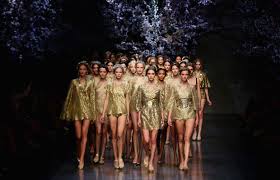
    Gabbana described the collection as “an unconscious dream,” in the sense that the clothes exemplified the blend of the real and the irrational that can only be found in dreams. The line is truly a dream and captivating at that. The Sicilian lifestyle has been opened for all to discover and enjoy through the D&G Spring 2014 line. The genius use of the culture of Sicily has provided limitless ideas of inspiration for Domenico Dolce and Stefano Gabbana, setting themselves apart from the rest of the high fashion domain. For the finale, the gilded army of women that strutted the catwalk offered another vision of female empowerment that has stirred conversations between other designers all week. Dolce and Gabbana have given the fashion world romantic maximalism at its best. The design duo’s cultural orientation without being too common or over the top. Innovative, not so much, but wearable, indeed!ewfew

    D&G have definitely grabbed our attention with their new look. Does adding a splash of culture make their line more desirable? Or do you think the typical “high fashion” is more successful on the runway?

    -Briana McWhirter, Emily Foulke, Hannah Turner

  • #VersaceLovesGaga

    Ever wonder what could happen if two fashion superstars like Donatella Versace and Lady Gaga got together?  They would open up a whole new world of consumers to both of their brands.  Versace is a well-known luxury clothing brand that been around since 1978.  The head lady in charge now is none other than Donatella Versace herself.  Although Donatella is distinguished as a talented designer, it’s her vibrant persona that makes her even more famous.  In recent years Versace usually went with non-famous models in their ad to focus more on the clothing instead of a celebrity name on it.  This spring fashion season Versace is trying a new campaign with Lady Gaga as the focus.

    This change up in the ad routine of Versace is very positive considering the social power these women have.   In leading up to this announcement, the two have been seen together everywhere.  This new well established friendship is great for the Versace brand.  Lady Gaga is a very influential woman not only in music, but in fashion.  When someone thinks of Gaga, their first thought is “I wonder what she’s wearing this time?”  She has a major advantage because of her power to expose this brand as much as possible.   Versace is thought of more as a mature brand, but with Lady G’s influence over a younger generation this can reel in a completely different group of purchasers then before.

    Lady Gaga is quite possibly a twenty-four hour ad campaign for the Versace clothing brand.  She is constantly being photographed in this brand that is then exposed all over the internet and in magazines.  She truly has embraced the product, she is being paid to promote to exact detail including her new Donatella look.

    Not only do these ladies have reach on tabloids, but their social media sites are a huge way to endorse the company as well.  The combined followers on twitter for Versace and Gaga is over forty-two million people.  The two are always promoting one another on various media sites, creating this whole new revolution for Versace. Including a personalized hash-tag for the Versace endorser herself, #VersaceLovesGaga.  This has been trending all over twitter, just proving how much influence she has also in the cyber world. This seems to be an extremely beneficial partnership for both brands and we’ll continue to see growth in Versace and Lady Gaga this fashion season.

    Melissa Shampoe

  • The Half-Naked Truth

    Sex sells products. Despite the moral implications involved, advertisers continue to rely on sex appeal and promiscuous behavior to sell products. Now it’s easy for us to recognize the problems that arise as a result, and you don’t need to be a Mississippi fundamentalist to do so. Sex is so engrained in our media that one cannot watch 15 minutes of television without being shown sex in some form or another. From an advertisers perspective sex is a very powerful tool, simply put, the consumer is human and inherently will become intrigued when viewing material related to sex. This trend is often times seen in fashion advertisements.

    abercrombie-fitch

    Many of us can remember walking into an Abercrombie store at some point in time and being bombarded with gigantic posters of half naked men and women. So long as humans have an inherent need for romance we will continue to gravitate towards depictions of the desired sex, much like a moth to the flame. So of course we must beg the question of ethicality rather than opening up our wallets whilst drooling like a Neanderthal. Well a business insider article did just that when they published an article entitled “13 Brands That Use Sex to Sell Their Products” and sure enough Abercrombie and Fitch was included along companies like American Apparel, Armani, Old Spice, and Axe Body Spray. Funny story I had a friend confide in me once that he was afraid to use Axe body spray as a child because he thought it would turn on his mother and sister. The ethicality of high-powered pheromone mists is next week’s subject matter.

    Recent attempts to woe consumers can be seen in advertisements of the past Superbowl, specifically in regard to David Beckham’s appearance in the H&M commercial. In the commercial viewers are asked to tweet either #covered or #uncovered while watching David Beckham prance around in his underwear. As a heterosexual male even I can tell you that it is very effective.

    Fashion companies have found a prosperous way of communicating their brands to their target audience because they know what message will resonate with the audience. Not only does sex resonate, it helps to bring in a higher average of gross income per year for the more frequently advertised and credible fashion lines. One can’t help but wonder whether the value of popular fashion brands would depreciate if the sex appeal approach was no longer used in advertisements.

    Austin Johnson, Jade Lester