Tag: Advertising

  • The Phenomenon of Dub Hockey

    hockey team pictureUNC Wilmington, a university that many students have characterized as “chill”, gets surprisingly heated when comes to ice hockey. When one thinks of college and ice hockey, they typically imagine it being played competitively in northern states. The same states where devoted hockey fans can be seen sporting the logos of their favorite hockey team on their snow-covered winter jackets. At UNC Wilmington, however, students can spend a Friday afternoon relaxing on the beach, sporting their Dub Hockey t-shirts, then spend the night getting rowdy at the local ice rink.

    Since its creation in 2004, UNC Wilmington’s club ice hockey team has become something of a phenomenon. Not only would it surprise an outsider to find a successful ice hockey team within the warm climate of the Carolina shoreline, but they would be in for an even bigger surprise when they showed up to the Wilmington Ice House. They would find it packed with a sold out crowd, a crowd consisting of excited and enthusiastic supporters loudly cheering on the their beloved team. After reaching the ACHA Division III national tournament in 2014, the unlikely ice hockey team has shown they are a force to be taken seriously.IMG_1338So where does all the energy surrounding the hockey team come from? Largely, it is generated by the team itself. It is hard for UNCW students not to notice the team when they lace up their skates to roll up and down the ever crowded Chancellor’s Walk, in uniform, carrying sirens and horns, while shouting about the upcoming game. The players display an enthusiasm that is, simply put, infectious. They broadcast the same high energy level they hope to receive from the fans. They actively create the brand of Dub Hockey. With the team’s outgoing advertising, as well as their social media presence on Twitter and Facebook, not only do they regularly reach max capacity at games, but those fans who manage to get inside are always full of spirit as they cheer, chant, and pound away at the glass separating them from the ice, demonstrating the level of their support.

    “It’s incredible how rowdy our fans are. We don’t see anything like it at any of the other rinks we go to,” remarked Kevin Mullaney, the team president during the successful 2014 season, in an interview with WRAL.

    The first game of the 2015 season was played last Friday against Elon University. They put on a show as they fought for a 6-4 win against the Phoenixes in front of a max capacity crowd. It would seem that this unlikely group of hockey players will continue to cause UNC Wilmington to lose their chill at the Wilmington Ice house for another season of Dub Hockey.

    Sold out game

    – Austin Moody, Griffin Weidele, Allen Wooten, Scott Uraro, Luci Keefer
  • The Super Bowl will never be the same

    The Super Bowl draws in more than 100 million viewers each year from around the world. Some watch for the game but many of these viewers only watch for the debut commercials. Companies spend upward of 4 million dollars for one 30-second spot during the four-hour broadcast.

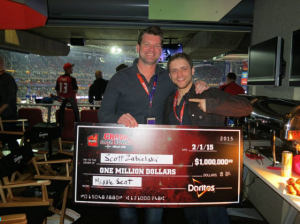
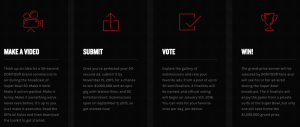
    Although we will still see the classic Budweiser and Coke commercials, Doritos will be ending a 10 year tradition. Since 2006, Doritos has run their “Crash the Super Bowl” campaign, which allows consumers to submit a 30-second ad that could be aired during the Super Bowl. This has generated some of the top Super Bowl commercials of the last decade.

    Screen Shot 2015-09-10 at 2.55.19 PM

    After 9 years, 8 installments, 32,000 entries and 7 million dollars in prizes Doritos is abandoning the project because of risks involved. The company feels the contest would no longer be profitable because of increasing prices for ad space.

    Screen Shot 2015-09-10 at 3.00.28 PM

    On one side, Doritos now has the reins of their Super Bowl ads; however, ending the contest could upset participants and viewers that have followed the campaign. While we still have the 2016 “Crash the Super Bowl” ad, it remains to be seen how Doritos will position themselves for Super Bowl LI.

    Do you think Doritos’ decision to end the campaign will impact them positively or negatively?

    -Nick, Melanie, Mary & Patrick

  • Tailgating Musts or Bust

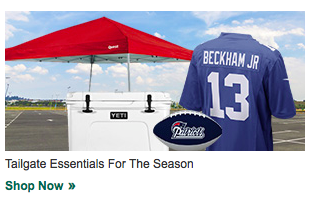
    Football season starting up and so are the advertisements. Target, Dicks Sporting Goods, and Best Buy are some retailers advertising “essentials” for game day and football season in their print ads and online.

    Screen Shot 2015-09-06 at 2.58.57 PM

    http://www.dickssportinggoods.com/home/index.jsp

    By defining particular items as necessities for football season and tailgating, retailers are creating their own definitions of tailgating and narratives of what the tailgating experience should be like for consumers.

    Target’s ad includes food items such as pre-made pizza and Coca-Cola, but also advertises TVs, grills, and fan gear. Dicks Sporting Goods’ ad includes pop-up tents and chairs, fan gear, coolers, and tailgating games such as corn hole. With Best Buy, all of their “necessities” are electronic – including cameras, speakers, televisions, and cell phone cases.

    Screen Shot 2015-09-06 at 3.02.12 PM

    http://weeklyad.target.com/site/#/wilmington-nc-28405/page/Target-150906

    By showing consumers products that are considered “game day essentials,” retailers are building their own narratives about the tailgating experience. Each retailer’s idea of what commodities that experience requires may be different based on the products sold at each business and their target audiences. Those that want the full experience are more likely to buy into a store’s ad and purchase the products retailers suggest.

    It’s not necessarily about what the consumer realistically needs for a tailgate. These ads for “must have” items are more about creating an idea that makes a consumer feel that without those items, they aren’t getting the best game day experience.

    These advertisements are an example of how today’s market is controlled by commodity culture – we define ourselves by the stuff that we buy. Typically, big businesses are able to sell higher ticket items based on a consumer’s need to feel like they fit in. Both the beginning of football season and the end are big opportunities for retailers to convince consumers that these products are what they need for the perfect football celebration. Football fans define themselves by having the best game day items for the season; new TVs, new grills, new gear, new everything. Retailers are ready for football season, and now the fans will be too.

    -Amanda Kluttz, Kendall Catterton, Meleah Lewis, Luke Matheney, and Dan Dawson

  • Taco Bell’s commercial brings more than hexagon-shaped sandwiches

    Taco Bell is known for its unique food the company creates, but it’s recently known for something a little more bizarre: its new advertising campaign, “Routine Republic.” The advertising video depicts a world where the government emphasizes sameness and everyone is eating the same circle breakfast sandwiches.

    However, two people decide to rebel and break out of the controlled world they lived in and head to greater, happier places that have hexagon-shaped breakfast sandwiches.

    The target audience appears to be customers who eat breakfast at other fast-food chains, particularly McDonalds as the familiar clowns are depicted as the dictators who slide down slides and have ball pits. But, did Taco Bell miss the target by featuring propaganda imagery? Although the company is attempting to advertise their newest commodity–breakfast–doing so by reflecting Communism has stirred up controversy.

    According to Marshall McLuhan, the “medium is the message,” and found that audiences are too often distracted by the content of the medium that we miss the overall point. The video advertisement that is centered around a communist-driven theme could deter from Taco Bell effectively targeting its intended audience because viewers are too caught up trying to understand the commercial.

    Commentators on the video responded with more questions about the setting of the commercial than an initial reaction to the new product. People were also bothered by the imagery and scary clowns who run the Routine Republic. This proves McLuhan’s theory that the medium is the message because many viewers are more focused on the overall concept and medium as opposed to the actual content.

    Although, Taco Bell could be trying to target a younger audience–as seen with the young characters–who would not necessarily be offended by the propaganda.
    Do you think Taco Bell’s commercial was effective, or were you too distracted by the content and missed the point?

    -Kaitlyn Russell, Hannah Rodgers, Anna Joy Zima

  • One Country Painted Red

    With the rapid growth of new products, brand extensions and the blurring of traditional and new age advertising, marketing and advertising to target audiences has reached a new level of competitiveness. Brands now must adapt to this changing environment and contest with competitors to stay at the top of their market and target to audiences in creative, attention-grabbing tactics.

    The most iconic brand in the soda market, and throughout the world, is undoubtedly that of Coca-Cola. In the summer of 2011, Coke created an original marketing strategy to run a campaign that would inspire people to connect with the brand both online and offline in order to acclimate to the changing marketing environment. The campaign’s prime objective was to increase consumption of Coke over the summer season and to get people to fall in love with the iconic brand again. Particularly, in Australia, at the time nearly 50% of teens and young adults had never tasted a Coke and this drove the brand to reconnect with the country.

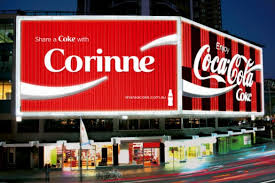
    Established in Australia, the ‘Share a Coke’ campaign immediately received positive media attention and consumer responsiveness. The idea of the ‘Share a Coke’ campaign was to place Australia’s 150 most popular names on the front of millions of Coca-Cola bottles, simple right? This was the first time in 125 years that Coke had made such a paramount transformation to it packaging, and it was revolutionary.

    “We used publicly available data to review the most popular names in Australia and ethnic representation in Australia to ensure the diversity of our multi-cultural nation was represented appropriately.”

    – Coca-Cola Spokesperson.

    The Coca-Cola brand wanted to initiate conversations by putting Australians front and center and inspire them to connect with people and ‘Share a Coke’. The central theme that gave ‘Share a Coke’ its power was the way a brand so universal could replace its logo with individual names by reaching out to consumers and personalizing its brand to individuals.

    “We are using the power of the first name in a playful and social way to remind people of those in their lives they may have lost touch with, or have yet to connect with”

    -Lucie Austin, Marketing Director for Coca-Cola South Pacific.

    The ‘Share a Coke’ campaign strategically exhibited that when personalization in advertising is done the right way, it can be highly appealing and extremely effective. While Coke got personal, media was buzzing with talk over what the brand was implementing behind the personalization. Coke remained silent until Australia’s highest rated media weekend. The campaign was revealed to the public and aired across the biggest weekend in Australian sport, during the AFL (Australian Football League) and NRL (National Rugby League) grand finals which reached over 30% of the population.

    Succeeding the campaign launch, requests for more names were coming in the thousands. Coke was prepared for this boom of requests by setting up kiosks that toured 18 Westfield shopping centers attracting consumers to personalize any name on a Coca-Cola bottle.

    Coke wanted to especially reach out to the 50% of young adults that had never tasted a Coke in Australia, and there was no better way to reach this target market than online. Participation and mass allocation was achieved through Facebook by providing consumers with the resources to connect and ‘Share a Coke’ by creating a personalized virtual Coke bottle to share with a Facebook friend. Consumers were tagging friends in pictures with personalized Coke bottles and sharing stories on social media platforms like Twitter, Facebook and YouTube. Coke consumers also could create their own commercials! With the abundance of requests still pouring in, Coke told consumers to put in a vote of “who do you want to share a Coke with the most?” via Facebook. After 65,000 people voted, Coke bottles with 50 new names were released. “Consumers were invited to SMS a friend’s name, which was projected live onto the iconic ‘Coca-Cola’ sign at Sydney’s King’s Cross. They then received an MMS enabling them to share their friend’s name up in lights, via Facebook and email.”

    untitled

    The multi-platform communications strategy was implemented to ‘Share a Coke’ with someone you know, or want to know and ultimately gave people the resources to find, connect and share. After 3 short months of running the campaign, young adult Coca-Cola consumption increased significantly in Australia by up to 7%, making 2011 Coke’s most fruitful summer season in history. The ‘Share a Coke’ campaign resulted in 76,000 virtual coke cans shared, 378,000 extra coke cans printed at kiosks, and 5% more people were drinking coke. Coca-Cola had successfully won over Australia and became a part of popular culture again.

    -Briana McWhirter

  • See the USA in Your Chevrolet, or See China in Your Buick

    Baseball, hot dogs, apple pie and Chevrolet. That line from this 1970s ad for Chevrolet exhibits the brand’s position as an American icon.

    Fast-forward several decades, and General Motors’ Chevy is still an iconic American brand. Meanwhile, in China, the Chevrolet brand is still young. Chevy is China’s seventh-best selling brand, although two models, the Cruze (sold in North America) and the Sail are strong sellers.

    While Chevy is still catching on in China, another longtime GM brand from the United States holds popular: Buick.

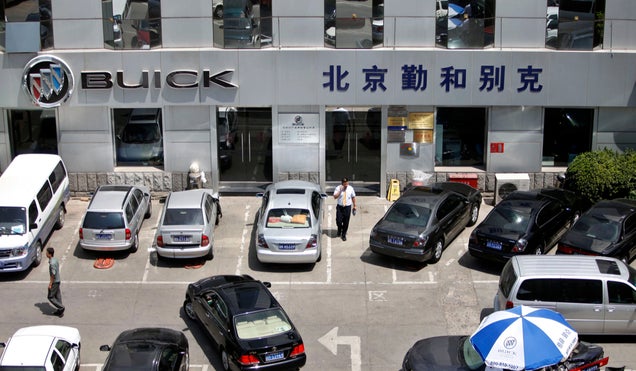
    lugzaoaf2otau1jrolprYou may be asking yourself: Buick? Isn’t that the car for old people? Not so the case in China! In 2013, four times as many Buicks were sold in China than in the U.S.  Nearly 810,000 Buicks were sold in China, compared to over 205,000 stateside.

    What explains Buick’s popularity in China? The answer is rooted in the early 20th century when important Chinese government figures such as president Dr. Sun Yat-sen, premier Zhou Enlai, and emperor Pu Yi either owned, drove, or were driven around in Buicks. This historical background adds to Buick’s image of upper class and prestige. Their advertising uses images of success to propel Buick to a high-end brand, such as in this Buick Excelle ad from the 2000s.

    Establishing global brand coherence has its difficulties. To contrast, in the United States, Buick is having trouble shaking off the “55-to-dead” demographic, and they tackle that problem in this new ad that features the demographic commonly associated with the brand in the U.S. with the desired target demographic in the driver’s seat of the brand-new 2014 Buicks:

    GM isn’t the only American automaker popular with the Chinese. Ford’s sales in China rose 49 percent in 2013, and the Ford Focus was China’s best-selling car that year. NPR interviewed 32-year-old Li Ning, who said he bought a Focus because he likes its muscular American style. In China, Ford is establishing its image as young and trendy.

    chinaford2_wide-852ed1ca329096cde3278d9430a4ed11fd559123-s40-c85

    Auto China 2014, the Beijing International Automotive Exhibition, kicked off on April 20th and runs until April 29th. At Auto China, Ford is introducing a luxury brand familiar to Americans—Lincoln.

    LincolnThumb_1398177154

    Lincoln’s model of selling cars in China is called “The Lincoln Way” and features luxurious showrooms that feel like a five-star hotel. Lincoln plans to focus on building customer relationships by understanding and fulfilling their needs. Lincoln may bring this style of personal selling to the U.S. based on how it works in China.

    Only time will tell if Ford’s effort to introduce the Lincoln brand to China will be a success. Will it become a competitor to Buick, which is already established as a strong luxury brand in China? Are there other ways in which this is an example of globalization?

    Nathan Evers

  • Advertising Bans Beautify the City

    Imagine one of our biggest cities, such as New York, Chicago or LA. If you were to take a walk down one of the major streets, what would you see? Besides getting bumped into constantly for not paying attention well enough, you would see advertisements. They would go as far as the eye could see! To some people, these ads are creative forms of art and entertainment that bring character to the city streets and help amuse and educate the citizens. To others, these ads may be nothing more than corporate America polluting the city with over the top marketing gimmicks and oversized eye sores. But can you imagine if one of these cities banned outdoor advertising all together? Would it bring the metropolis back to its original architectural beauty? … Or would the ban take all of the residents back into some sort of concrete jungle? This in itself is completely subjective, and really depends on one’s attitude towards outdoor advertising.

    Any readers who may want to experience this for themselves are in luck, and have been since 2006. Just head to your nearest airport and hop on the next plane to São Paulo, Brazil! It has been almost 8 years since the Brazilian city had passed the “Clean City Law,” one that outlawed all forms of outdoor advertisements! This included transit advertising, as well as storefront and billboard marketing.  Can you imagine driving into Wilmington and not being able to see the massive billboard letting us know of the 12 McDonalds ready to serve in our location? (Yeah 12 seems a bit Mcmuch huh?)  Either way, the law was passed and is still going strong, regardless of critics. Many feared the law would have devastating consequences on jobs and revenue in the city, and rightfully so. However, São Paulo continues to stand, just as the citizens continue to stand behind the law. A recent survey administered in 2011 found that of the 11 million residents, over 70% were in approval of the ban. It turns out that many of the citizens feel that the removal of all the advertising brought back an architectural magnificence that had long been hidden. We will let you decide though.  Did the city make the right decision in your opinion? And what do you see, a primitive concrete jungle, or a simple but yet beautiful city restored in its original form?

    The_London_Vandal_sao_paulo_brazil_outdoor_advertising_ban_0001 sao-paulo-billboard-ban-26

    Following the advertising ban,  “Critics worried that the advertising ban would entail a revenue loss of $133 million and a net job loss of 20,000.” Although a revenue loss has not been reported, and the majority of the city citizens are in favor of the ban, we all must wonder how businesses are surviving. James B. Twitchell believes that  producers “have to advertise or drown in their own overproduction.” However, it seems as though companies in Brazil are doing just fine without massive advertisements on billboards, buses, or other sources of outdoor advertising. 

    Times_Square_Landmark_New_York

    Many people could argue that advertisements in America are brainwashing citizens, or have various negative effects on people. What about the aesthetics that Brazil has focused? Would NYC be as beautiful and attractive if all of the bright lights and advertisements were stripped away? America thrives on advertisements, so to lose them would probably cause more outrage that being bombarded by advertising through all mediums. According to those who live in Brazil, the “Clean City Law”  was a brilliant change to how the city looks. Bans on billboards exist in other parts of the world, such as Vermont, Alaska, Hawaii, and Maine in the US, as well as some 1,500 towns. Could America ever go beyond banning billboard advertising and deny advertisers of all outdoor ads in general? This shows how different advertising is between various nations.

    Austin Johnson, Jade Johnson-Grant, Jami Rogers, Ty Thomas